
 Deutschland
 France
 Nederland
 Great Britain
 Sverige
 Norge
Norge Danmark
 Suomi
Suomi Italia
 Polska
 España
VS
Mercedes EQT vs VW Transporter Transporter – Which one offers the better deal?
Two cars, one duel: Mercedes EQT meets VW Transporter Transporter.
Which one wins in performance, efficiency and value for money? Find out now!
EQT
@ Mercedes-Benz Group Media
Costs and Efficiency:
Looking at overall running costs, both models reveal some interesting differences in everyday economy.
Mercedes EQT has a clearly perceptible advantage in terms of price – it starts at 27800 £, while the VW Transporter Transporter costs 37500 £. That’s a price difference of around 9741 £.
In terms of energy consumption, the advantage goes to the Mercedes EQT: with 19.50 kWh per 100 km, it’s slightly more efficient than the VW Transporter Transporter with 21.90 kWh. That’s a difference of about 2.40 kWh.
As for range, the VW Transporter Transporter performs somewhat better – achieving up to 331 km, about 53 km more than the Mercedes EQT.
EQT
@ Mercedes-Benz Group Media
Engine and Performance:
Power, torque and acceleration are the classic benchmarks for car enthusiasts – and here, some clear differences start to show.
When it comes to engine power, the VW Transporter Transporter has a clearly edge – offering 286 HP compared to 122 HP. That’s roughly 164 HP more horsepower.
In acceleration from 0 to 100 km/h, the VW Transporter Transporter is decisively quicker – completing the sprint in 7.40 s, while the Mercedes EQT takes 12.60 s. That’s about 5.20 s faster.
In terms of top speed, the VW Transporter Transporter performs to a small extent better – reaching 150 km/h, while the Mercedes EQT tops out at 132 km/h. The difference is around 18 km/h.
There’s also a difference in torque: VW Transporter Transporter pulls significantly stronger with 415 Nm compared to 245 Nm. That’s about 170 Nm difference.
EQT
@ Mercedes-Benz Group Media
Space and Everyday Use:
Beyond pure performance, interior space and usability matter most in daily life. This is where you see which car is more practical and versatile.
Both vehicles offer seating for 5 people.
In curb weight, VW Transporter Transporter is barely noticeable lighter – 1872 kg compared to 1925 kg. The difference is around 53 kg.
When it comes to payload, VW Transporter Transporter significantly takes the win – 1259 kg compared to 531 kg. That’s a difference of about 728 kg.
Who comes out on top?
Overall, the VW Transporter Transporter shows itself to be leaves the rival little chance and secures the title of DriveDuel Champion.
It convinces with the more balanced overall package and proves to be the more versatile choice for everyday use.
from about £37,500

VW Transporter Transporter
Mercedes EQT
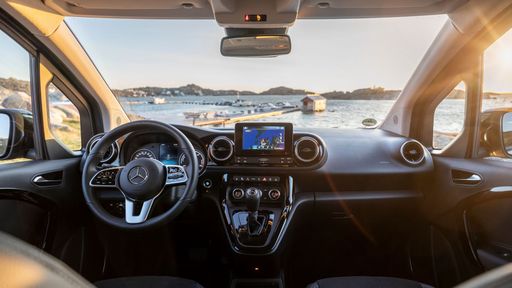
The Mercedes-Benz EQT represents a new chapter in the world of electric vehicles, seamlessly combining elegance with practicality. Its interior offers a sophisticated design, featuring premium materials and advanced technology to ensure a comfortable driving experience. On the road, the EQT impresses with its smooth handling and efficient electric powertrain, making it a strong contender in the growing market of eco-friendly family cars.
details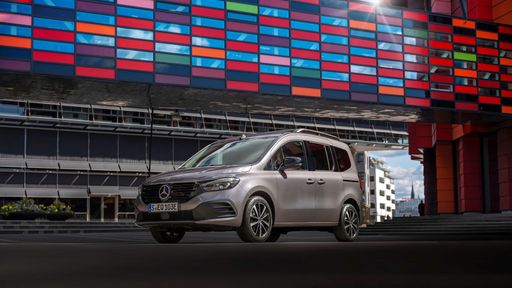 @ Mercedes-Benz Group Media
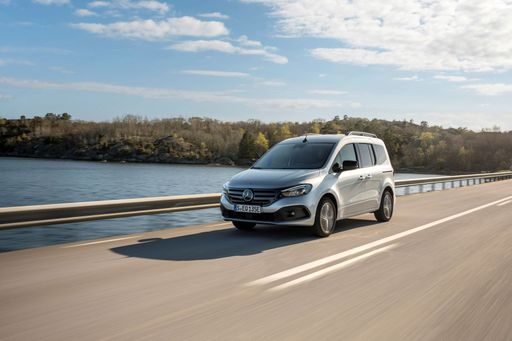 @ Mercedes-Benz Group Media
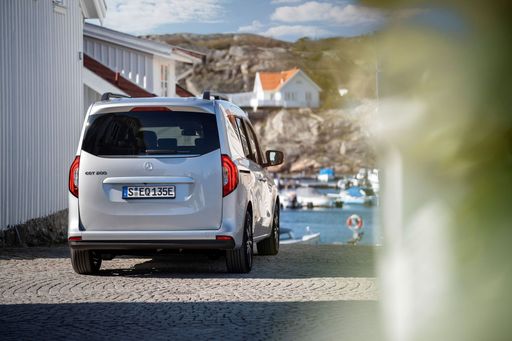 @ Mercedes-Benz Group Media
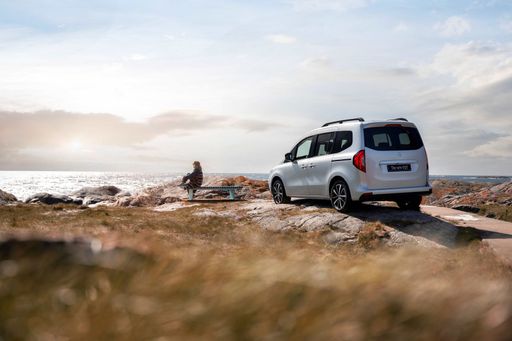 @ Mercedes-Benz Group Media
 @ Mercedes-Benz Group Media
VW Transporter Transporter
The VW Transporter is the workhorse of the modern tradesman, blending practical cleverness with a cabin that's actually pleasant to spend a long day in. It may not steal the style spotlight, but its unshowy durability, clever load solutions and easy-to-live-with character make it a sensible pick for businesses and weekend projects alike.
details
Mercedes EQT
VW Transporter Transporter
|
@ Mercedes-Benz Group Media
|
|
|
|
|
Costs and Consumption |
|
|---|---|
|
Price
27800 - 32100 £
|
Price
37500 - 60800 £
|
|
Consumption L/100km
-
|
Consumption L/100km
7.1 - 8.4 L
|
|
Consumption kWh/100km
19.5 - 20.8 kWh
|
Consumption kWh/100km
21.9 - 24.4 kWh
|
|
Electric Range
265 - 278 km
|
Electric Range
56 - 331 km
|
|
Battery Capacity
45 kWh
|
Battery Capacity
11.8 - 63.8 kWh
|
|
co2
0 g/km
|
co2
0 - 220 g/km
|
|
Fuel tank capacity
-
|
Fuel tank capacity
55 L
|
Dimensions and Body |
|
|---|---|
|
Body Type
High Roof Estate
|
Body Type
Cargo Van
|
|
Seats
5
|
Seats
2 - 5
|
|
Doors
5
|
Doors
4 - 5
|
|
Curb weight
1925 - 2023 kg
|
Curb weight
1872 - 2462 kg
|
|
Trunk capacity
242 - 551 L
|
Trunk capacity
-
|
|
Length
4498 - 4922 mm
|
Length
5050 - 5450 mm
|
|
Width
1859 mm
|
Width
2032 mm
|
|
Height
1819 - 1830 mm
|
Height
1966 - 1985 mm
|
|
Max trunk capacity
1979 L
|
Max trunk capacity
-
|
|
Payload
457 - 531 kg
|
Payload
755 - 1259 kg
|
Engine and Performance |
|
|---|---|
|
Engine Type
Electric
|
Engine Type
Diesel, Plugin Hybrid, Electric
|
|
Transmission
Automatic
|
Transmission
Manuel, Automatic
|
|
Transmission Detail
Reduction Gearbox
|
Transmission Detail
Manual Gearbox, Automatic Gearbox
|
|
Drive Type
Front-Wheel Drive
|
Drive Type
Front-Wheel Drive, All-Wheel Drive, Rear-Wheel Drive
|
|
Power HP
122 HP
|
Power HP
110 - 286 HP
|
|
Acceleration 0-100km/h
12.60 s
|
Acceleration 0-100km/h
7.4 - 16.9 s
|
|
Max Speed
132 km/h
|
Max Speed
112 - 150 km/h
|
|
Torque
245 Nm
|
Torque
310 - 415 Nm
|
|
Number of Cylinders
-
|
Number of Cylinders
4
|
|
Power kW
90 kW
|
Power kW
81 - 210 kW
|
|
Engine capacity
-
|
Engine capacity
1996 - 2488 cm3
|
General |
|
|---|---|
|
Model Year
2023 - 2024
|
Model Year
2025
|
|
CO2 Efficiency Class
A
|
CO2 Efficiency Class
G, A
|
|
Brand
Mercedes-Benz
|
Brand
VW
|
What drivetrain options does the Mercedes EQT have?
Available configurations include Front-Wheel Drive.
The prices and data displayed are estimates based on German list prices and may vary by country. This information is not legally binding.