
 Deutschland
 France
 Nederland
 Great Britain
 Sverige
 Norge
Norge Danmark
 Suomi
Suomi Italia
 Polska
 España
VS
VW Tiguan vs MG HS/EHS – Which car suits you better?
Both models have their strengths – but which one suits you more?
Compare performance, efficiency, price and space directly: VW Tiguan or MG HS/EHS?
Tiguan
@ Volkswagen AG / VW Media
Costs and Efficiency:
Price and efficiency are key factors when choosing a car – and this is often where the real differences emerge.
MG HS/EHS has a noticeable advantage in terms of price – it starts at 24000 £, while the VW Tiguan costs 32800 £. That’s a price difference of around 8794 £.
Fuel consumption also shows a difference: MG HS/EHS manages with 0.50 L and is therefore decisively more efficient than the VW Tiguan with 1.40 L. The difference is about 0.90 L per 100 km.
As for range, the VW Tiguan performs clearly perceptible better – achieving up to 126 km, about 26 km more than the MG HS/EHS.
Tiguan
@ Volkswagen AG / VW Media
Engine and Performance:
Under the bonnet, it becomes clear which model is tuned for sportiness and which one takes the lead when you hit the accelerator.
Both models deliver identical power – 272 HP each.
In acceleration from 0 to 100 km/h, the VW Tiguan is slightly quicker – completing the sprint in 5.90 s, while the MG HS/EHS takes 6.80 s. That’s about 0.90 s faster.
In terms of top speed, the VW Tiguan performs somewhat better – reaching 242 km/h, while the MG HS/EHS tops out at 195 km/h. The difference is around 47 km/h.
There’s also a difference in torque: VW Tiguan pulls somewhat stronger with 400 Nm compared to 350 Nm. That’s about 50 Nm difference.
Tiguan
@ Volkswagen AG / VW Media
Space and Everyday Use:
Beyond pure performance, interior space and usability matter most in daily life. This is where you see which car is more practical and versatile.
Both vehicles offer seating for 5 people.
In curb weight, VW Tiguan is barely noticeable lighter – 1599 kg compared to 1625 kg. The difference is around 26 kg.
In terms of boot space, the VW Tiguan offers clearly perceptible more room – 652 L compared to 507 L. That’s a difference of about 145 L.
In maximum load capacity, the VW Tiguan performs slightly better – up to 1650 L, which is about 166 L more than the MG HS/EHS.
When it comes to payload, VW Tiguan noticeable takes the win – 533 kg compared to 400 kg. That’s a difference of about 133 kg.
Who comes out on top?
Overall, the MG HS/EHS shows itself to be leaves the rival little chance and secures the title of DriveDuel Champion.
It convinces with the more balanced overall package and proves to be the more versatile choice for everyday use.
from about £24,000

MG HS/EHS
VW Tiguan
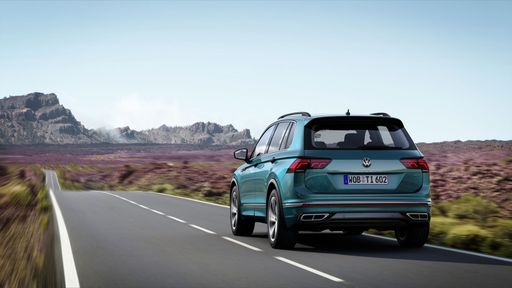
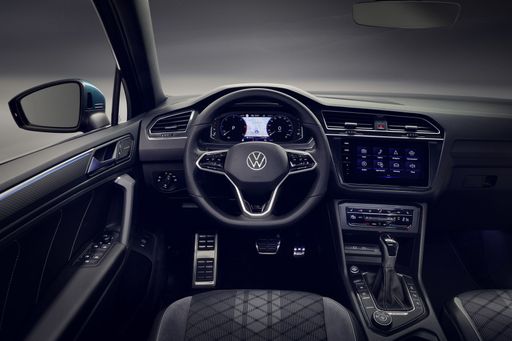
The VW Tiguan blends sensible family practicality with a dash of German polish, delivering a calm, reassuring ride and a cabin that never feels like an afterthought. For buyers who want an SUV that’s easy to live with yet still nicely dressed, the Tiguan is the grown‑up choice that keeps a cheeky wink in reserve.
details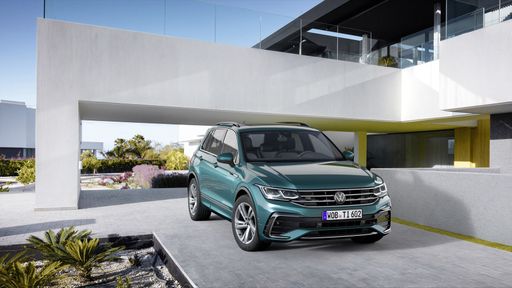 @ Volkswagen AG / VW Media
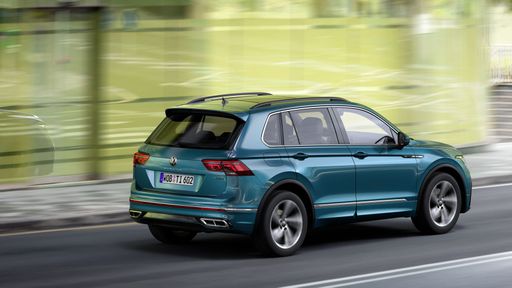 @ Volkswagen AG / VW Media
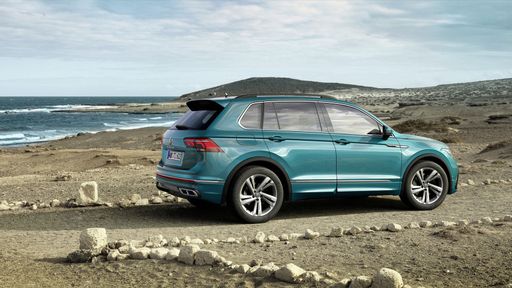 @ Volkswagen AG / VW Media
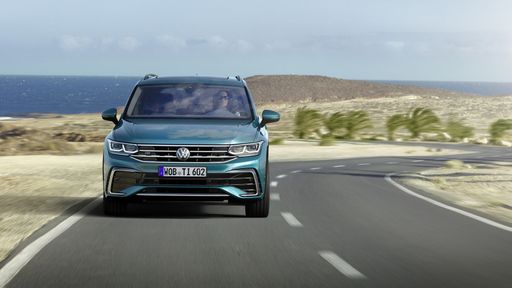 @ Volkswagen AG / VW Media
 @ Volkswagen AG / VW Media
 @ Volkswagen AG / VW Media
MG HS/EHS
The MG HS, also known as the EHS in its hybrid variant, is a midsize SUV that combines modern design with a focus on comfort and technology. Its spacious interior offers a premium feel, enhanced by quality materials and an array of advanced features aimed at ensuring a smooth driving experience. Known for its efficiency, the MG HS/EHS delivers an enjoyable ride whether navigating city streets or taking on longer road trips.
details
VW Tiguan
MG HS/EHS
|
@ Volkswagen AG / VW Media
|
|
|
|
|
Costs and Consumption |
|
|---|---|
|
Price
32800 - 51900 £
|
Price
24000 - 36000 £
|
|
Consumption L/100km
1.4 - 8.4 L
|
Consumption L/100km
0.5 - 7.6 L
|
|
Consumption kWh/100km
-
|
Consumption kWh/100km
-
|
|
Electric Range
118 - 126 km
|
Electric Range
100 km
|
|
Battery Capacity
19.70 kWh
|
Battery Capacity
-
|
|
co2
32 - 190 g/km
|
co2
14 - 173 g/km
|
|
Fuel tank capacity
45 - 58 L
|
Fuel tank capacity
55 L
|
Dimensions and Body |
|
|---|---|
|
Body Type
SUV
|
Body Type
SUV
|
|
Seats
5
|
Seats
5
|
|
Doors
5
|
Doors
5
|
|
Curb weight
1599 - 1890 kg
|
Curb weight
1625 - 1930 kg
|
|
Trunk capacity
490 - 652 L
|
Trunk capacity
441 - 507 L
|
|
Length
4539 mm
|
Length
4655 - 4670 mm
|
|
Width
1842 - 1859 mm
|
Width
1890 mm
|
|
Height
1656 - 1658 mm
|
Height
1663 - 1664 mm
|
|
Max trunk capacity
1486 - 1650 L
|
Max trunk capacity
1291 - 1484 L
|
|
Payload
460 - 533 kg
|
Payload
400 kg
|
Engine and Performance |
|
|---|---|
|
Engine Type
Petrol, Petrol MHEV, Diesel, Plugin Hybrid
|
Engine Type
Petrol, Plugin Hybrid, Full Hybrid
|
|
Transmission
Automatic
|
Transmission
Manuel, Automatic
|
|
Transmission Detail
Dual-Clutch Automatic
|
Transmission Detail
Manual Gearbox, Dual-Clutch Automatic, Automatic Gearbox
|
|
Drive Type
All-Wheel Drive, Front-Wheel Drive
|
Drive Type
Front-Wheel Drive
|
|
Power HP
130 - 272 HP
|
Power HP
170 - 272 HP
|
|
Acceleration 0-100km/h
5.9 - 10.6 s
|
Acceleration 0-100km/h
6.8 - 9.6 s
|
|
Max Speed
198 - 242 km/h
|
Max Speed
190 - 195 km/h
|
|
Torque
220 - 400 Nm
|
Torque
275 - 350 Nm
|
|
Number of Cylinders
4
|
Number of Cylinders
4
|
|
Power kW
96 - 200 kW
|
Power kW
125 - 200 kW
|
|
Engine capacity
1498 - 1984 cm3
|
Engine capacity
1496 cm3
|
General |
|
|---|---|
|
Model Year
2024 - 2025
|
Model Year
2024 - 2025
|
|
CO2 Efficiency Class
G, D, E, F, B
|
CO2 Efficiency Class
F, B, D
|
|
Brand
VW
|
Brand
MG
|
What drivetrain options does the VW Tiguan have?
The VW Tiguan is offered with All-Wheel Drive or Front-Wheel Drive.
The prices and data displayed are estimates based on German list prices and may vary by country. This information is not legally binding.