
 Deutschland
 France
 Nederland
 Great Britain
 Sverige
 Norge
Norge Danmark
 Suomi
Suomi Italia
 Polska
 España
VS
Ferrari 296 Coupe vs Volvo ES90 - Differences and prices compared
Compare performance (830 HP vs 680 HP), boot space and price (242700 £ vs 61700 £ ) at a glance. Find out which car is the better choice for you – Ferrari 296 Coupe or Volvo ES90?
296 Coupe
Costs and Efficiency:
Price and efficiency are often the first things buyers look at. Here it becomes clear which model has the long-term edge – whether at the pump, the plug, or in purchase price.
Volvo ES90 has a clearly advantage in terms of price – it starts at 61700 £ , while the Ferrari 296 Coupe costs 242700 £ . That’s a price difference of around 181025 £.
As for electric range, the Volvo ES90 performs clearly better – achieving up to 700 km, about 675 km more than the Ferrari 296 Coupe.
Engine and Performance:
Power, torque and acceleration say a lot about how a car feels on the road. This is where you see which model delivers more driving dynamics.
When it comes to engine power, the Ferrari 296 Coupe has a slightly edge – offering 830 HP compared to 680 HP. That’s roughly 150 HP more horsepower.
In acceleration from 0 to 100 km/h, the Ferrari 296 Coupe is distinct quicker – completing the sprint in 2.90 s, while the Volvo ES90 takes 4 s. That’s about 1.10 s faster.
In terms of top speed, the Ferrari 296 Coupe performs clearly better – reaching 330 km/h, while the Volvo ES90 tops out at 180 km/h. The difference is around 150 km/h.
There’s also a difference in torque: Volvo ES90 pulls slightly stronger with 870 Nm compared to 740 Nm. That’s about 130 Nm difference.
Ad · Affiliate
As an Amazon Associate, we earn from qualifying purchases.
Space and Everyday Use:
Cabin size, boot volume and payload all play a role in everyday practicality. Here, comfort and flexibility make the difference.
Seats: Volvo ES90 offers significantly more seating capacity – 5 vs 2.
In curb weight, Ferrari 296 Coupe is significantly lighter – 1470 kg compared to 2410 kg. The difference is around 940 kg.
In terms of boot space, the Volvo ES90 offers clearly more room – 424 L compared to 0 L. That’s a difference of about 424 L.
When it comes to payload, Volvo ES90 minimal takes the win – 500 kg compared to 482 kg. That’s a difference of about 18 kg.
Who wins the race?
The Volvo ES90 proves to be leaves the rival little chance and therefore becomes our DriveDuel Champion!
Volvo ES90 is the better all-rounder in this comparison.
from about £61,700

Volvo ES90
Ferrari 296 Coupe
Volvo ES90
Costs and Consumption
View detailed analysis
View detailed analysis
Engine and Performance
View detailed analysis
View detailed analysis
Dimensions and Body
View detailed analysis
View detailed analysis
Ferrari 296 Coupe
Slip behind the wheel of the Ferrari 296 GTB and you get a compact supercar that turns everyday roads into a racetrack with intoxicating urgency and razor-sharp poise. It's the perfect choice for drivers who want headline-grabbing performance and Ferrari drama without the showroom theatrics, all wrapped in stunning Italian design.
details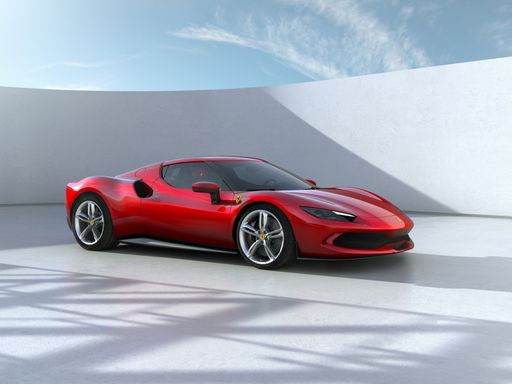
Volvo ES90
3.5 (2 Reviews)
The Volvo ES90 stands out as a luxury sedan, embodying Scandinavian elegance combined with innovative technology. Its sleek design is complemented by a plush interior that emphasizes comfort and safety, aligning with Volvo's renowned reputation. With advanced features and a focus on sustainability, the ES90 is a testament to the brand's commitment to responsible luxury.
details
Ferrari 296 Coupe
Volvo ES90
Costs and Consumption |
|
|---|---|
|
Price
242700 £
|
Price
61700 - 81000 £
|
|
Consumption L/100km
7.40 L
|
Consumption L/100km
-
|
|
Consumption kWh/100km
-
|
Consumption kWh/100km
15.9 - 17.1 kWh
|
|
Electric Range
25 km
|
Electric Range
651 - 700 km
|
|
Battery Capacity
-
|
Battery Capacity
88 - 102 kWh
|
|
co2
169 g/km
|
co2
0 g/km
|
|
Fuel tank capacity
65 L
|
Fuel tank capacity
-
|
Dimensions and Body |
|
|---|---|
|
Body Type
Coupe
|
Body Type
Hatchback
|
|
Seats
2
|
Seats
5
|
|
Doors
2
|
Doors
5
|
|
Curb weight
1470 kg
|
Curb weight
2410 - 2610 kg
|
|
Trunk capacity
0 L
|
Trunk capacity
424 L
|
|
Length
4565 mm
|
Length
5000 mm
|
|
Width
1958 mm
|
Width
1942 mm
|
|
Height
1187 mm
|
Height
1546 mm
|
|
Max trunk capacity
-
|
Max trunk capacity
1427 L
|
|
Payload
482 kg
|
Payload
490 - 500 kg
|
Engine and Performance |
|
|---|---|
|
Engine Type
Plugin Hybrid
|
Engine Type
Electric
|
|
Transmission
Automatic
|
Transmission
Automatic
|
|
Transmission Detail
Dual-Clutch Automatic
|
Transmission Detail
Reduction Gearbox
|
|
Drive Type
Rear-Wheel Drive
|
Drive Type
Rear-Wheel Drive, All-Wheel Drive
|
|
Power HP
830 HP
|
Power HP
333 - 680 HP
|
|
Acceleration 0-100km/h
2.90 s
|
Acceleration 0-100km/h
4 - 6.6 s
|
|
Max Speed
330 km/h
|
Max Speed
180 km/h
|
|
Torque
740 Nm
|
Torque
480 - 870 Nm
|
|
Number of Cylinders
6
|
Number of Cylinders
-
|
|
Power kW
610 kW
|
Power kW
245 - 500 kW
|
|
Engine capacity
2992 cm3
|
Engine capacity
-
|
General |
|
|---|---|
|
Model Year
2022
|
Model Year
2025
|
|
CO2 Efficiency Class
F
|
CO2 Efficiency Class
A
|
|
Brand
Ferrari
|
Brand
Volvo
|
What drive types are available for the Ferrari 296 Coupe?
Available configurations include Rear-Wheel Drive.
The prices shown are estimates based on German list prices, adjusted for local VAT. Local registration taxes (e.g. NoVA, BPM or CO2 malus) are not included. This information is not legally binding.