VS

Hyundai Staria vs Kia PV5 comparison

Compare performance (225 HP vs 163 HP), boot space and price (42400 £ vs 32800 £ ) at a glance. Find out which car is the better choice for you – Hyundai Staria or Kia PV5?

Staria

Two different ideas of the people-mover

Meet the two contenders: the bold, pod-like Hyundai Staria that courts attention with its lounge-like cabin, and the more restrained, work-focused Kia PV5 that pitches practicality with a modern twist. This is less about straight-line bragging and more about two philosophies of moving people and things with style or sensible intent. Think of it as a duel between a living-room-on-wheels and a clever, no-nonsense transporter.
PV5

Style versus substance (but with personality)

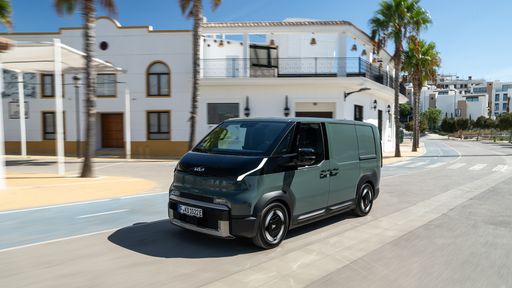
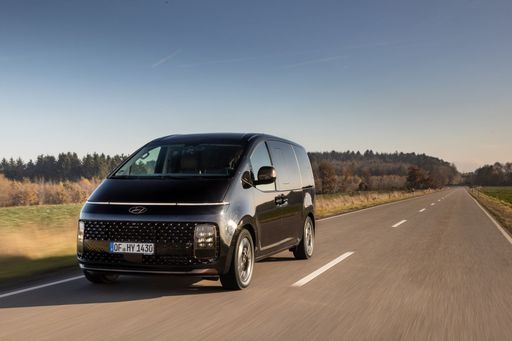
The Staria leans into theatrical presence — its interior feels curated to soothe and impress, while exterior cues demand a double-take at the lights. The PV5 keeps its cards closer to the chest, projecting efficiency and tidy usefulness rather than spectacle. It’s a classic contrast: expressive, relaxed luxury versus modest, purpose-driven design with a modern edge.

Staria

Daily life: errands, carpools and road trips

In everyday use the Staria feels like a mobile retreat for people-first duties — long runs, multi-kid shuttles and anyone who values a calm, cushioned ride at the end of a hectic day. The PV5 rewards rhythm and routine: easier maneuvering, straightforward loading and a cabin that puts practicality ahead of theatricality. Both make life easier in different ways — one prioritises passenger comfort and presence, the other prioritises efficiency and usable space when the week gets real.

PV5

What you tell your friends you bought

Choosing the Staria signals you care about presence, comfort and a slightly luxurious daily experience — you’re buying atmosphere as much as transport. Picking the PV5 says you prefer tidy thinking: sensible choices, clever packaging and a vehicle that earns its keep without shouting. Neither choice is apologetic; each broadcasts a deliberate lifestyle decision.

Staria

Who should consider the Staria

The Staria suits drivers who prioritise calm arrivals and long-haul quiet — families wanting a civilised cabin and commuters who enjoy a softer, more composed ride. It also appeals to anyone who values a distinctive look and a car that makes practical days feel a bit more special. If your checklist leans toward comfort and presence, the Staria comfortably earns a place on it.

PV5

Who should consider the PV5

The PV5 is geared toward pragmatic buyers who prize everyday usefulness, easy loading and a tidy footprint for city life — those who like their transport to be sensible and smart rather than showy, often in contrast to the Staria’s more lounge-like ambition. It’s for people who map purchases to purpose: commuters, hobbyists who need cargo flexibility, and those who want modern tech without fuss. Read on — the hard numbers and fine print are next to help you see which package matches your reality.

Hyundai Staria vs Kia PV5: Key differences

Hyundai Staria

  • clearly perceptible more power
  • hardly perceptible quicker from 0–100 km/h

Kia PV5

  • noticeable cheaper
  • noticeable lighter
  • evident more trunk space

Here’s where it gets real: The technical differences in detail

Staria

Costs and Efficiency:

Looking at overall running costs, both models reveal some interesting differences in everyday economy.

Kia PV5 has a noticeable advantage in terms of price – it starts at 32800 £ , while the Hyundai Staria costs 42400 £ . That’s a price difference of around 9608 £.

PV5

Engine and Performance:

Power, torque and acceleration say a lot about how a car feels on the road. This is where you see which model delivers more driving dynamics.

When it comes to engine power, the Hyundai Staria has a clearly perceptible edge – offering 225 HP compared to 163 HP. That’s roughly 62 HP more horsepower.

In acceleration from 0 to 100 km/h, the Hyundai Staria is hardly perceptible quicker – completing the sprint in 10.20 s, while the Kia PV5 takes 10.60 s. That’s about 0.40 s faster.

There’s also a difference in torque: Hyundai Staria pulls clearly perceptible stronger with 367 Nm compared to 250 Nm. That’s about 117 Nm difference.

Staria

Space and Everyday Use:

Whether family car or daily driver – which one offers more room, flexibility and comfort?

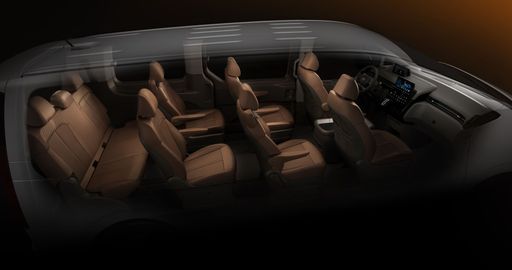
Seats: Hyundai Staria offers convincingly more seating capacity – 9 vs 5.

In curb weight, Kia PV5 is noticeable lighter – 1860 kg compared to 2275 kg. The difference is around 415 kg.

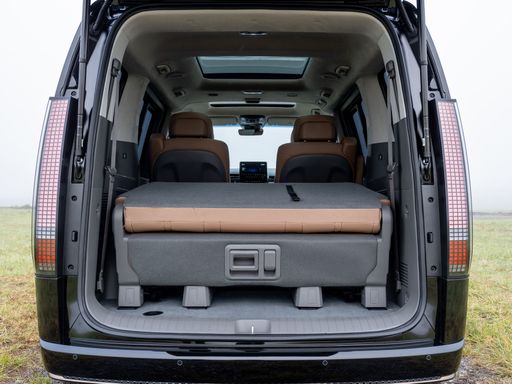
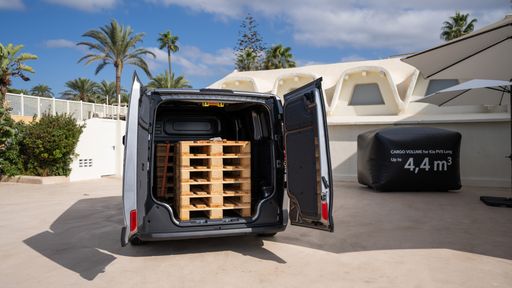
In terms of boot space, the Kia PV5 offers evident more room – 1330 L compared to 831 L. That’s a difference of about 499 L.

When it comes to payload, Kia PV5 minimal takes the win – 790 kg compared to 775 kg. That’s a difference of about 15 kg.

Who wins the race in the data check?

The Kia PV5 comes out ahead with a more balanced overall result in the objective data comparison.
This result only shows which model scores more points on paper – not which of the two cars feels right for you.

Hyundai Staria
Kia PV5

Costs and Consumption

View detailed analysis

Engine and Performance

View detailed analysis

Dimensions and Body

View detailed analysis
from about £32,800
PV5

Kia PV5

  • Engine Type : Electric
  • Transmission : Automatic
  • Drive Type : Front-Wheel Drive
  • Power HP : 121 - 163 HP
  • Consumption kWh/100km : 19 - 19.3 kWh
  • Electric Range : 295 - 416 km

Hyundai Staria

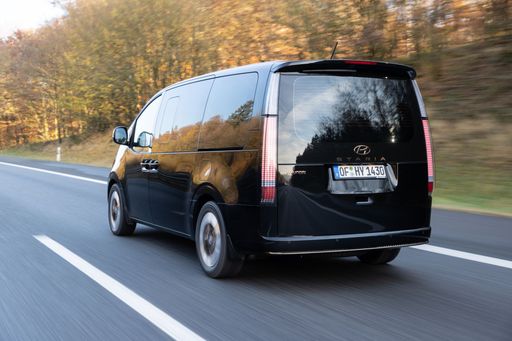
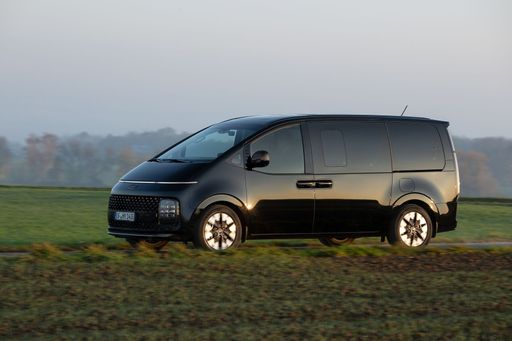
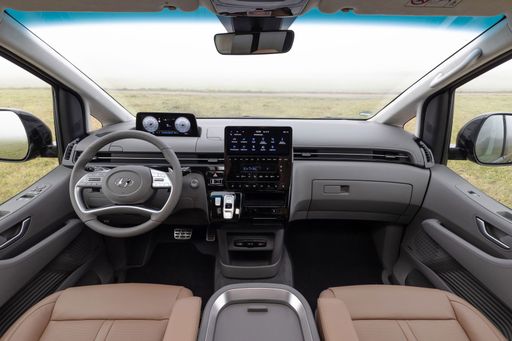
Hyundai Staria looks like a friendly spaceship, its sweeping glass and soft edges turning a people‑mover into a design statement that actually gets noticed. Inside it's airy and practical — perfect for families or anyone who likes travelling in comfort and style, with enough flexibility to swallow luggage and weekend plans without drama.

details

Kia PV5

The Kia EV5 is an exciting new entrant in the landscape of electric SUVs, promising a blend of style and innovation that captures attention. It boasts a sleek and modern design that aligns with Kia's evolving aesthetic identity, blending practicality with eye-catching details. With its foray into the electric vehicle segment, the EV5 is set to offer a highly competitive option for those looking to embrace sustainable mobility without compromising on comfort or tech features.

details
Hyundai Staria
Kia PV5

Costs and Consumption

Price
42400 - 50500 £
Price
32800 - 38900 £
Consumption L/100km
7.60 L
Consumption L/100km
-
Consumption kWh/100km
-
Consumption kWh/100km
19 - 19.3 kWh
Electric Range
-
Electric Range
295 - 416 km
Battery Capacity
-
Battery Capacity
-
co2
172 g/km
co2
0 g/km
Fuel tank capacity
-
Fuel tank capacity
-

Dimensions and Body

Body Type
Bus
Body Type
Cargo Van, Bus
Seats
7 - 9
Seats
2 - 5
Doors
-
Doors
-
Curb weight
2275 - 2345 kg
Curb weight
1860 - 2145 kg
Trunk capacity
117 - 831 L
Trunk capacity
1330 L
Length
-
Length
-
Width
1997 mm
Width
1895 mm
Height
-
Height
-
Max trunk capacity
-
Max trunk capacity
-
Payload
605 - 775 kg
Payload
455 - 790 kg

Engine and Performance

Engine Type
Full Hybrid
Engine Type
Electric
Transmission
Automatic
Transmission
Automatic
Transmission Detail
Automatic Gearbox
Transmission Detail
Reduction Gearbox
Drive Type
Front-Wheel Drive
Drive Type
Front-Wheel Drive
Power HP
225 HP
Power HP
121 - 163 HP
Acceleration 0-100km/h
10.20 s
Acceleration 0-100km/h
10.6 - 16.2 s
Max Speed
-
Max Speed
-
Torque
367 Nm
Torque
250 Nm
Number of Cylinders
4
Number of Cylinders
-
Power kW
165 kW
Power kW
89 - 120 kW
Engine capacity
1598 cm3
Engine capacity
-

General

Model Year
2024
Model Year
2025
CO2 Efficiency Class
F
CO2 Efficiency Class
A
Brand
Hyundai
Brand
Kia
What drive types are available for the Hyundai Staria?

The Hyundai Staria is available as Front-Wheel Drive.

The prices shown are estimates based on German list prices, adjusted for local VAT. Local registration taxes (e.g. NoVA, BPM or CO2 malus) are not included. This information is not legally binding.