@ Jaguar Land Rover Media
VS

Jaguar F-Pace vs Land Rover Range Rover – Which model is better for everyday use?

Both models have their strengths – but which one suits you more?
Compare performance, efficiency, price and space directly: Jaguar F-Pace or Land Rover Range Rover?

Jaguar F-Pace

Land Rover Range Rover

F-Pace @ Jaguar Land Rover Media

Performance and Power: Under the Hood

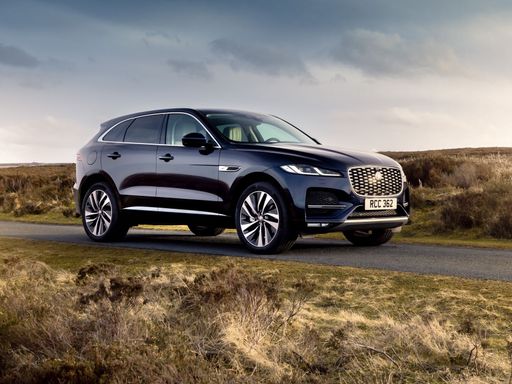
When it comes to power and performance, the Jaguar F-Pace offers a diverse range of engine options. With engines ranging from a modest 163 HP Diesel MHEV to the supercharged 575 HP petrol variant, driving enthusiasts will find a fitting choice. This broad spectrum is complemented by MHEV and plugin hybrid technology, offering both traditional power and modern efficiency balance. The F-Pace achieves consistent acceleration capabilities, reaching 0-100 km/h in as little as 4 seconds.

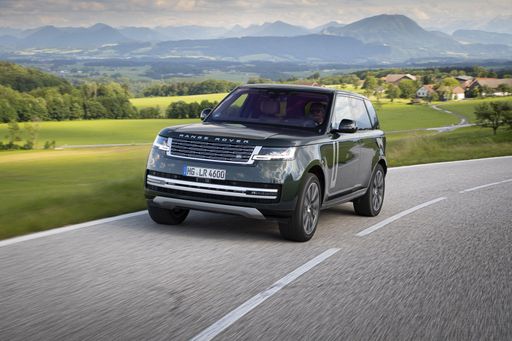
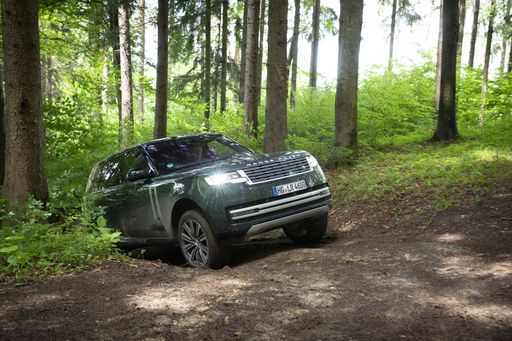
In comparison, the Range Rover is no slouch, providing similar versatility in its power department. With options such as a 615 HP petrol MHEV engine, this SUV takes performance seriously. Despite its off-roader roots, it holds its ground well against the F-Pace, reaching 0-100 km/h in a competitive 4.6 seconds. The Range Rover's focus leans slightly more towards an environmentally friendly disposition with two plugin hybrid models that excel in electric range, extending up to 110 km thanks to its 31.8 kWh battery capacity.
Range Rover @ Jaguar Land Rover Media

Design and Dimensions: Aesthetics and Practicality

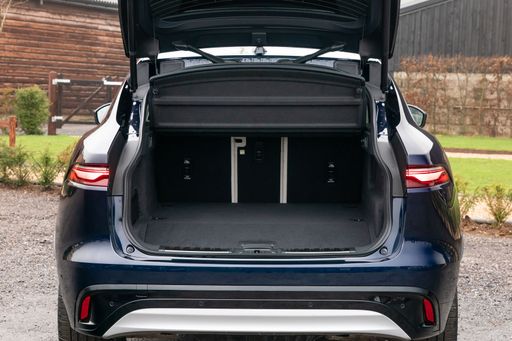
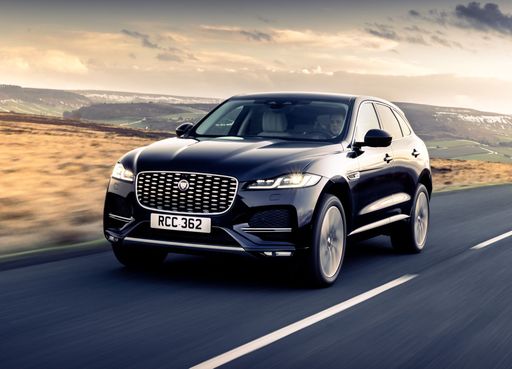
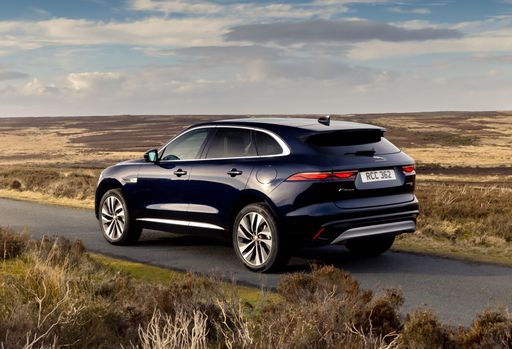
The Jaguar F-Pace boasts a sleek, sporty design traditionally found in high-performance models. Its length of 4747 mm and width of 1936 mm ensure a moderate, sensible size for urban driving while retaining ample internal space, with a trunk capacity of up to 470 liters.

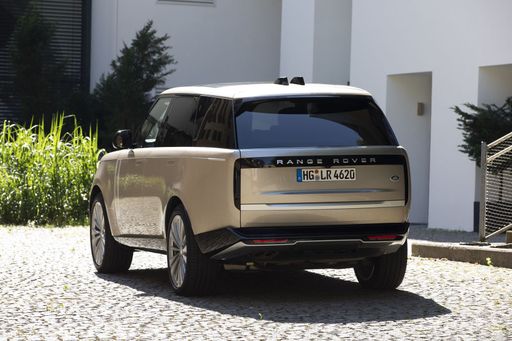
The Range Rover, on the other hand, embodies a more robust and commanding presence with its off-roader styling. Its substantial dimensions—standing 1870 mm tall and stretching over 5052 mm in length—enhance both roominess and road presence. Accommodating up to seven passengers, its interior space is a definitive advantage, paired with a sizable 818-liter trunk capacity for all practical storage needs.

F-Pace @ Jaguar Land Rover Media

Innovations and Technology: Modern In-Car Experience

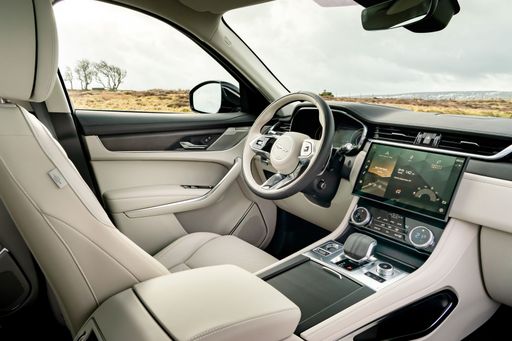
Modern technology is at the heart of both vehicles. The Jaguar F-Pace employs a sophisticated infotainment system paired with digital support, focusing heavily on driver engagement and providing seamless connectivity within its luxury interior.

Similarly, the Range Rover stands out with cutting-edge technological features. The emphasis on luxury mingled with technology offers a seamless interface, no less sophisticated than that of the Jaguar, which is expected for a Range Rover product. Its intuitive controls, high-quality displays, and superior audio systems suit those seeking an enhanced driving experience.

Range Rover @ Jaguar Land Rover Media

Fuel Efficiency and Range: Balancing Power with Economy

Fuel efficiency is crucial when comparing these two formidable contenders. The F-Pace holds its own with hybrid versions, achieving weighted consumption values as low as 1.8 L/100km, reflecting excellent fuel economy that rivals traditional models. The plugin hybrid option provides a 64 km electric range, appealing to urban commuters.

The Range Rover goes a step further in plugin hybrid mode, consuming just 0.8 L/100km, matching its impressive electric range with a 110 km span on a single charge. These figures highlight the Range Rover's commitment to efficiency without compromising on luxury or performance.

F-Pace @ Jaguar Land Rover Media

Conclusion: Choosing Your Champion

Ultimately, your choice between the Jaguar F-Pace and the Range Rover will depend on your priority. Whether it's the sporty agility and diverse engine choices of the F-Pace or the luxurious, larger-than-life presence of the Range Rover—these models balance power, efficiency, and cutting-edge technology, ensuring a driving experience worthy of their prestigious brands.

Here’s where it gets real: The technical differences in detail

Range Rover @ Jaguar Land Rover Media

Costs and Efficiency:

Price and efficiency are key factors when choosing a car – and this is often where the real differences emerge.

Jaguar F-Pace has a decisively advantage in terms of price – it starts at 56400 £, while the Land Rover Range Rover costs 122700 £. That’s a price difference of around 66342 £.

Fuel consumption also shows a difference: Jaguar F-Pace manages with 1.80 L and is therefore significantly more efficient than the Land Rover Range Rover with 2.70 L. The difference is about 0.90 L per 100 km.

As for range, the Land Rover Range Rover performs significantly better – achieving up to 117 km, about 53 km more than the Jaguar F-Pace.

F-Pace @ Jaguar Land Rover Media

Engine and Performance:

Power, torque and acceleration are the classic benchmarks for car enthusiasts – and here, some clear differences start to show.

When it comes to engine power, the Land Rover Range Rover has a hardly perceptible edge – offering 615 HP compared to 575 HP. That’s roughly 40 HP more horsepower.

In acceleration from 0 to 100 km/h, the Jaguar F-Pace is somewhat quicker – completing the sprint in 4 s, while the Land Rover Range Rover takes 4.50 s. That’s about 0.50 s faster.

In terms of top speed, the Jaguar F-Pace performs hardly perceptible better – reaching 286 km/h, while the Land Rover Range Rover tops out at 261 km/h. The difference is around 25 km/h.

There’s also a difference in torque: Land Rover Range Rover pulls slightly stronger with 800 Nm compared to 700 Nm. That’s about 100 Nm difference.

Range Rover @ Jaguar Land Rover Media

Space and Everyday Use:

Cabin size, boot volume and payload all play a role in everyday practicality. Here, comfort and flexibility make the difference.

Seats: Land Rover Range Rover offers clearly perceptible more seating capacity – 7 vs 5.

In curb weight, Jaguar F-Pace is distinct lighter – 1951 kg compared to 2504 kg. The difference is around 553 kg.

In terms of boot space, the Land Rover Range Rover offers significantly more room – 818 L compared to 470 L. That’s a difference of about 348 L.

In maximum load capacity, the Land Rover Range Rover performs noticeable better – up to 2176 L, which is about 748 L more than the Jaguar F-Pace.

When it comes to payload, Land Rover Range Rover distinct takes the win – 846 kg compared to 589 kg. That’s a difference of about 257 kg.

Who comes out on top?

Overall, the Jaguar F-Pace shows itself to be won narrowly and secures the title of DriveDuel Champion.
It convinces with the more balanced overall package and proves to be the more versatile choice for everyday use.

Jaguar F-Pace
Land Rover Range Rover

Costs and Consumption

View detailed analysis

Engine and Performance

View detailed analysis

Dimensions and Body

View detailed analysis
from about £56,400
F-Pace @ Jaguar Land Rover Media

Jaguar F-Pace

  • Engine Type : Diesel MHEV, Petrol MHEV, Plugin Hybrid, Petrol
  • Transmission : Automatic
  • Drive Type : All-Wheel Drive
  • Power HP : 163 - 575 HP
  • Consumption L/100km : 1.8 - 12 L
  • Electric Range : 64 km

Jaguar F-Pace

Jaguar F-Pace blends the prowling presence of a sports car with the practicality of an SUV, looking elegant while rewarding drivers with lively handling. If you crave something that feels special every time you climb in and prefer style and driving flair over blending into the parking lot, the F-Pace is a classy, slightly cheeky alternative to the usual German suspects.

details

Land Rover Range Rover

The Range Rover wraps unabashed luxury and genuine off-road capability into a silhouette that still manages to look effortlessly elegant whether parked outside a city hotel or splashing through a muddy trail. Inside, it’s a cocoon of soft leathers, refined materials and serene ride quality that makes long journeys feel like private-jet comfort — ideal for buyers who want a plush cruiser that can also go where lesser SUVs won’t.

details
Jaguar F-Pace
Land Rover Range Rover
F-Pace @ Jaguar Land Rover Media
Range Rover @ Jaguar Land Rover Media

Costs and Consumption

Price
56400 - 100800 £
Price
122700 - 244700 £
Consumption L/100km
1.8 - 12 L
Consumption L/100km
2.7 - 11.7 L
Consumption kWh/100km
-
Consumption kWh/100km
-
Electric Range
64 km
Electric Range
116 - 117 km
Battery Capacity
15.40 kWh
Battery Capacity
31.80 kWh
co2
41 - 274 g/km
co2
62 - 265 g/km
Fuel tank capacity
62 - 83 L
Fuel tank capacity
71 - 90 L

Dimensions and Body

Body Type
SUV
Body Type
Off-Roader
Seats
5
Seats
5 - 7
Doors
5
Doors
5
Curb weight
1951 - 2230 kg
Curb weight
2504 - 2810 kg
Trunk capacity
354 - 470 L
Trunk capacity
212 - 818 L
Length
4747 - 4762 mm
Length
5052 - 5258 mm
Width
1936 mm
Width
2047 mm
Height
1664 - 1670 mm
Height
1870 mm
Max trunk capacity
1299 - 1428 L
Max trunk capacity
1841 - 2176 L
Payload
457 - 589 kg
Payload
589 - 846 kg

Engine and Performance

Engine Type
Diesel MHEV, Petrol MHEV, Plugin Hybrid, Petrol
Engine Type
Plugin Hybrid, Petrol MHEV, Diesel MHEV
Transmission
Automatic
Transmission
Automatic
Transmission Detail
Automatic Gearbox
Transmission Detail
Automatic Gearbox
Drive Type
All-Wheel Drive
Drive Type
All-Wheel Drive
Power HP
163 - 575 HP
Power HP
300 - 615 HP
Acceleration 0-100km/h
4 - 10.1 s
Acceleration 0-100km/h
4.5 - 6.6 s
Max Speed
195 - 286 km/h
Max Speed
218 - 261 km/h
Torque
380 - 700 Nm
Torque
650 - 800 Nm
Number of Cylinders
4 - 8
Number of Cylinders
6 - 8
Power kW
120 - 423 kW
Power kW
221 - 452 kW
Engine capacity
1997 - 5000 cm3
Engine capacity
2997 - 4395 cm3

General

Model Year
2024
Model Year
2025
CO2 Efficiency Class
G, B
CO2 Efficiency Class
B, G
Brand
Jaguar
Brand
Land Rover
What drive types are available for the Jaguar F-Pace?

Available configurations include All-Wheel Drive.

The prices and data displayed are estimates based on German list prices and may vary by country. This information is not legally binding.

do not click