VS

Mercedes T Class vs Vauxhall Combo Cargo comparison

Compare performance (131 HP vs 136 HP), boot space and price (23,000 £ vs 27,100 £ ) at a glance. Find out which car is the better choice for you – Mercedes T Class or Vauxhall Combo Cargo?

Mercedes T Class vs Vauxhall Combo Cargo: Key differences

Mercedes T Class

4 (1 Reviews)
rate
  • a bit cheaper
  • very slightly more efficient
details

Vauxhall Combo Cargo

  • marginally more power
  • only slightly quicker 0–100 km/h
  • somewhat lighter
details

All details on performance, efficiency, range and trunk space can be found in the technical comparison below – including user reviews for both models.

By Achim Sedelmaier

T Class

Dynamic Duo: Comparing the Mercedes T-Klasse and Vauxhall Combo Cargo

In the competitive world of midsize vehicles, the Mercedes T-Klasse and Vauxhall Combo Cargo represent two distinct yet compelling options. Each excels in different areas, whether you are prioritizing luxury and comfort or versatile utility. As we dive into the technical aspects and innovations of these models, it becomes clear how they cater to various consumer needs.

Combo Cargo

Design and Body Type

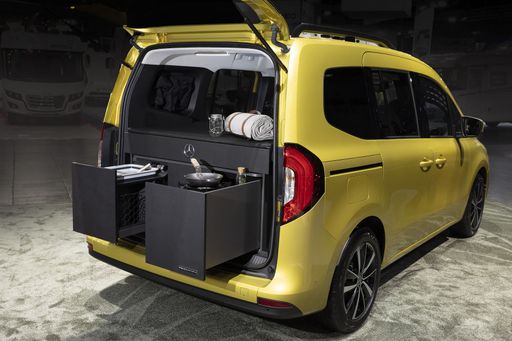
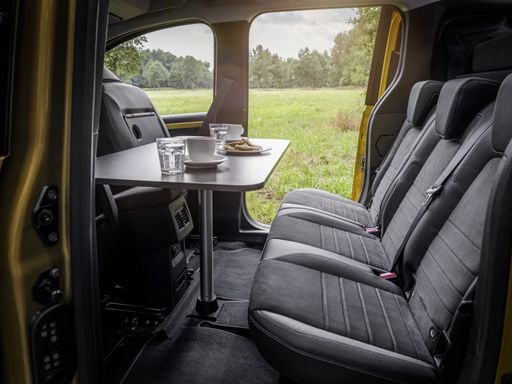
The Mercedes T-Klasse is a high-roof wagon, designed with both family and leisure activities in mind. It boasts a mix of elegance and practicality, characterized by its spacious interior and a substantial trunk capacity of 520 liters. Its dimensions showcase a length of up to 4922 mm, width of 1859 mm, and height of 1811 mm, making it ideal for accommodating larger families or groups.

In contrast, the Vauxhall Combo Cargo fits the mold of a classic cargo van. Available in lengths up to 4753 mm and a height of 1825 mm, it emphasizes utility with flexible seating arrangements and payload capabilities. Its body type is tailored for businesses or anyone needing robust cargo options, so the choice for users depends significantly on their intended use.

T Class

Performance and Engine Options

Under the hood, the Mercedes T-Klasse offers a range of engine options including diesel and petrol, with power output spanning from 95 to 131 HP. The versatility extends to its transmission system, available in both manual and dual-clutch automatic, ensuring a driving experience that can be tailored from smooth cruises to more dynamic drives. The T-Klasse reaches a top speed between 164 and 184 km/h, supported by a combination of engine capacities up to 1461 cm3 and a well-balanced torque distribution.

The Vauxhall Combo Cargo introduces additional versatility with diesel, petrol, and even electric engine options. Its power range is slightly expansive, reaching up to 136 HP. Electric motors provide an impressive eco-friendly alternative, with an electric range up to 336 km. Depending on the choice of engine, the Combo Cargo can achieve speeds up to 182 km/h featuring torque figures that top out at 300 Nm, making it a strong candidate for sustainability-focused buyers.


Fuel Efficiency and Environmental Ratings

Fuel consumption remains a critical measurement in any car comparison. The Mercedes T-Klasse averages between 5.1 to 7.1 L/100 km depending on engine selection, with CO2 emissions ranging from 134 to 161 g/km, making it a contender primarily in efficiency Class D to F.

The Vauxhall Combo Cargo offers diverse CO2 efficiency ranging from class A to E, achieving lower emissions particularly in its fully electric model, which naturally emits zero g/km. Its fuel consumption sits at a slightly higher range from 5.4 to 6.7 L/100 km for diesel and petrol engines. These variances highlight the Combo Cargo’s broader spectrum of eco-friendly choices, particularly for environmentally conscious consumers.

Practicality and Innovation

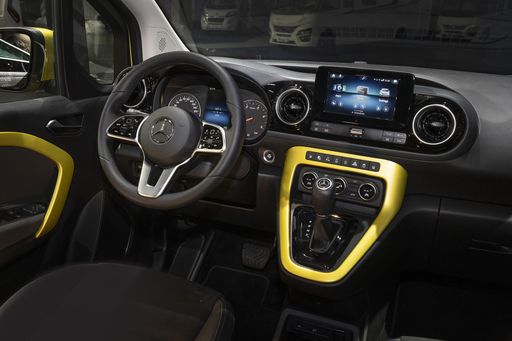
Both the T-Klasse and Combo Cargo exhibit distinctive innovations that bolster their functionality. The T-Klasse incorporates advanced driving assistance systems synonymous with the Mercedes brand, elevating its safety and comfort standards. Features such as adaptive cruise control, lane-keeping assistance, and a thorough infotainment setup form part of the experience.

The Combo Cargo leans heavily into practicality with its adaptable interior configurations and generous payload capacity up to 916 kg. It includes innovative storage solutions and smart technology, such as a reduction gearbox option for its electric variant, making it attractive for logistics and delivery services.

Conclusion

Choosing between the Mercedes T-Klasse and Vauxhall Combo Cargo hinges largely on personal priority. If luxury, comprehensive safety features, and family orientation are your focus, the T-Klasse emerges as a strong candidate. Conversely, for those seeking a versatile, functional van that doesn't skimp on eco-friendly options, the Combo Cargo presents an equally impressive deal. In the end, both models deliver a balanced mix of performance, innovation, and practicality, demonstrating the evolving landscape of midsize vehicles.

Here’s where it gets real: The technical differences in detail

T Class

Costs and Efficiency:

When it comes to price and running costs, the biggest differences usually appear. This is often where you see which car fits your budget better in the long run.

Mercedes T Class is a bit cheaper – starting at 23,000 £ , while the Vauxhall Combo Cargo costs 27,100 £ . That’s a price difference of around 4,165 £.

Fuel consumption also shows a difference: the Mercedes T Class uses 5.1 L/100km and is very slightly more efficient than the Vauxhall Combo Cargo with 5.2 L/100km. The difference is about 0.1 L/100km.

Combo Cargo

Engine and Performance:

Power, torque and acceleration are the classic benchmarks for car enthusiasts – and here, some clear differences start to show.

When it comes to engine power, the Vauxhall Combo Cargo offers marginally more power – delivering 136 HP compared to 131 HP. That’s roughly 5 HP more horsepower.

When accelerating from 0 to 100 km/h, the Vauxhall Combo Cargo is only slightly quicker – completing the sprint in 11.2 s, while the Mercedes T Class takes 11.6 s. That’s about 0.4 s quicker.

There’s also a difference in torque: the Vauxhall Combo Cargo delivers only slightly more torque with 300 Nm compared to 270 Nm. That’s about 30 Nm more.

T Class

Space and Everyday Use:

Cabin size, boot volume and payload all play a role in everyday practicality. Here, comfort and flexibility make the difference.

Seats: Mercedes T Class offers more seats – 5 vs 2.

In terms of curb weight, Vauxhall Combo Cargo is somewhat lighter – 1,371 kg compared to 1,556 kg. The difference is around 185 kg.

When it comes to payload, the Vauxhall Combo Cargo carries a bit more – 781 kg compared to 630 kg. That’s a difference of about 151 kg.

Who wins the race in the data check?

The Vauxhall Combo Cargo is decisively ahead in the objective data comparison.
This result only shows which model scores more points on paper – not which of the two cars feels right for you.

from £27,100
Combo Cargo

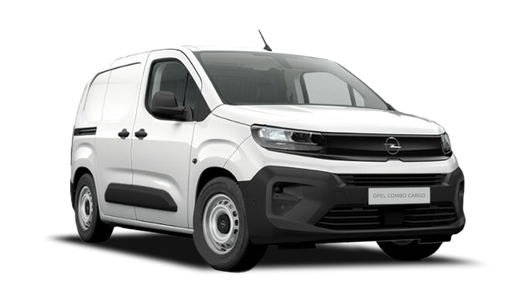
Vauxhall Combo Cargo

  • Engine Type Diesel, Electric
  • Transmission Manuel, Automatic
  • Drive Type Front-Wheel Drive
  • Power HP 102 - 136 HP
  • Consumption L/100km 5.2 - 5.4 L/100km
  • Consumption kWh/100km 17.4 kWh/100km
  • Electric Range 354 km
Mercedes T Class
Vauxhall Combo Cargo

Costs and Consumption

View detailed analysis

Engine and Performance

View detailed analysis

Dimensions and Body

View detailed analysis

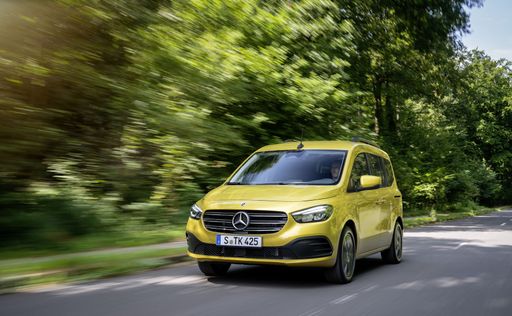
Mercedes T Class

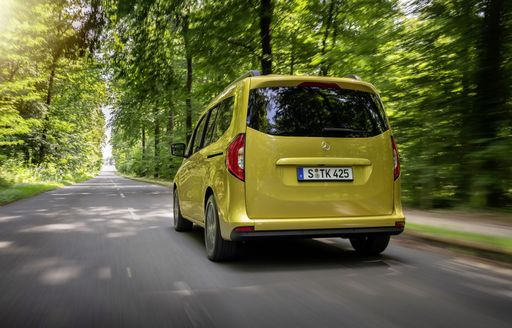
The Mercedes T-Class dresses everyday practicality in a premium suit, blending the sensible utility of a small van with the refinement you expect from the three-pointed star. Its flexible interior and clever details make it a brilliantly pragmatic choice for families and active owners who want comfort and usefulness without the fuss.

details

Vauxhall Combo Cargo

The Opel Combo Cargo is a pragmatic workhorse that pairs sensible practicality with surprisingly car-like manners, making it a smart choice for small businesses and weekend DIYers. With clever storage, easy access and a calm cabin that keeps the focus on the job, it turns daily deliveries and errands into something almost enjoyable.

details
Mercedes T Class
Vauxhall Combo Cargo

Costs and Consumption

Price
23,000 - 30,500 £
Price
27,100 - 34,800 £
Consumption L/100km
5.1 - 7.4 L/100km
Consumption L/100km
5.2 - 5.4 L/100km
Consumption kWh/100km
-
Consumption kWh/100km
17.4 kWh/100km
Electric Range
-
Electric Range
354 km
Battery Capacity
-
Battery Capacity
-
co2
135 - 167 g/km
co2
0 - 143 g/km
Fuel tank capacity
-
Fuel tank capacity
-

Dimensions and Body

Body Type
High Roof Estate
Body Type
Cargo Van
Seats
5
Seats
2
Doors
-
Doors
-
Curb weight
1,556 - 1,678 kg
Curb weight
1,371 - 1,674 kg
Trunk capacity
-
Trunk capacity
-
Length
-
Length
-
Width
1,859 mm
Width
1,848 mm
Height
-
Height
-
Max trunk capacity
-
Max trunk capacity
-
Payload
521 - 630 kg
Payload
645 - 781 kg

Engine and Performance

Engine Type
Petrol, Diesel
Engine Type
Diesel, Electric
Transmission
Manuel, Automatic
Transmission
Manuel, Automatic
Transmission Detail
Manual Gearbox, Dual-Clutch Automatic
Transmission Detail
Manual Gearbox, Automatic Gearbox, Reduction Gearbox
Drive Type
Front-Wheel Drive
Drive Type
Front-Wheel Drive
Power HP
95 - 131 HP
Power HP
102 - 136 HP
Acceleration 0-100km/h
11.6 - 15.1 s
Acceleration 0-100km/h
11.2 s
Max Speed
-
Max Speed
-
Torque
200 - 270 Nm
Torque
250 - 300 Nm
Number of Cylinders
4
Number of Cylinders
4
Power kW
70 - 96 kW
Power kW
75 - 100 kW
Engine capacity
1,332 - 1,461 cm3
Engine capacity
1,499 cm3

General

Model Year
2025
Model Year
2026
CO2 Efficiency Class
F, D, E
CO2 Efficiency Class
E, A
Brand
Mercedes-Benz
Brand
Vauxhall
DriveDuel uses data analysis and artificial intelligence to evaluate vehicle data and create content. Content is regularly reviewed and improved. The displayed prices are estimates based on German list prices, adjusted to the respective country’s VAT. Country-specific registration taxes are not included. This information is not legally binding.