
VS

VW Crafter vs Mercedes Sprinter Bus comparison

Compare performance (177 HP vs 190 HP), boot space and price (47,100 £ vs 41,400 £ ) at a glance. Find out which car is the better choice for you – VW Crafter or Mercedes Sprinter Bus?

VW Crafter vs Mercedes Sprinter Bus: Key differences

VW Crafter

  • a bit more efficient
  • slightly lighter
details

Mercedes Sprinter Bus

  • slightly cheaper
  • marginally more power
details

By Achim Sedelmaier

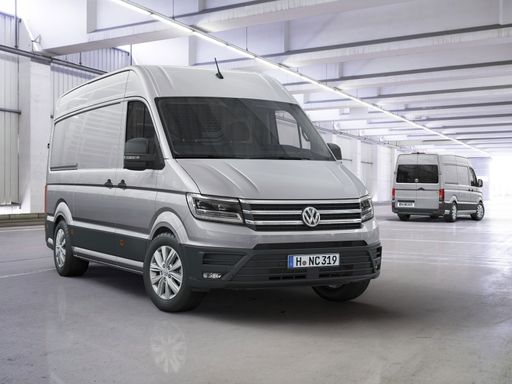
Crafter

Head-to-Head: Mercedes-Benz Sprinter Bus vs. VW Crafter

As the demand for versatile, reliable buses becomes increasingly prevalent, automotive manufacturers like Mercedes-Benz and VW rise to the challenge. The Mercedes-Benz Sprinter Bus and the VW Crafter have long been favorites in the van segment, offering robust performance, advanced technology, and impressive functionality. In this article, we delve into a detailed comparison between these two models, analyzing their technical specifications and innovations to help you make an informed choice.
Sprinter Bus

Powertrain and Performance

The Mercedes-Benz Sprinter Bus offers a range of diesel engines with a power output of 114 HP to 190 HP. With torque figures stretching from 300 Nm to 450 Nm, the Sprinter ensures a smooth yet powerful driving experience. The drive types available are rear-wheel drive and all-wheel drive, catering to different driving conditions and preferences. With a maximum speed ranging between 150 and 160 km/h, the Sprinter merges power with control.

On the other hand, the VW Crafter provides power options from 140 HP to 177 HP supported by a maximum torque of 410 Nm. With its innovative drive offerings, including rear-wheel, front-wheel, and all-wheel drive, the Crafter caters flexibly to diverse needs. Its speed capabilities range up to 165 km/h, aligning closely with the Sprinter's performance metrics.

Fuel Efficiency and Environmental Impact

Fuel efficiency is a critical factor for businesses and individual users alike. The Mercedes-Benz Sprinter offers consumption ranging from 9.3 L/100km to 12.3 L/100km. However, the VW Crafter shows a more variable consumption range, from a low 8.4 L/100km to 13.1 L/100km, indicative of its range of engine options. Both models fall into CO2 Efficiency Class G, though the Crafter tends to have a slightly higher CO2 emission level.

Dimensions and Capacity

The Sprinter Bus ranges from 5,932 mm to 6,967 mm in length, whereas the Crafter's length options span from 5,986 mm to 7,391 mm, offering a more extended configuration. In terms of dimensions, the Crafter provides a slight edge with a maximum width of 2,069 mm and a height up to 2,830 mm, compared to the Sprinter's width of 1,993 mm and height options up to 2,659 mm.

Payload and Seating

Both vehicles seat two occupants comfortably, supporting their principal use as cargo-focused options. The Mercedes Sprinter features a payload capacity ranging typically from 974 kg to 1,249 kg, whereas the Crafter exhibits a substantial payload capability reaching up to 2,994 kg, demonstrating its strength as a robust transporter.

Innovations and Technological Features

Mercedes-Benz and VW have equipped their vans with a host of innovative technologies. The Sprinter boasts a myriad of cutting-edge features, focusing on safety, connectivity, and driver assistance systems. Meanwhile, VW presents the Crafter with a similar suite of modern features, including accessible digital cockpit interfaces, advanced driver-assistance programs, and seamless connectivity options.

The Verdict

Choosing between the Mercedes-Benz Sprinter Bus and the VW Crafter largely depends on specific needs and priorities. For those seeking a wide range of power and transmission options, coupled with the reliability of German engineering, the Sprinter is a worthy contender. Conversely, the Crafter impresses with its high payload capacity, extended dimensional options, and versatile driving configurations. Both models offer substantial advancements in technology, ensuring any choice caters well to modern transport requirements.

Here’s where it gets real: The technical differences in detail

Crafter

Costs and Efficiency:

When it comes to price and running costs, the biggest differences usually appear. This is often where you see which car fits your budget better in the long run.

Mercedes Sprinter Bus is slightly cheaper – starting at 41,400 £ , while the VW Crafter costs 47,100 £ . That’s a price difference of around 5,741 £.

Fuel consumption also shows a difference: the VW Crafter uses 8.4 L/100km and is a bit more efficient than the Mercedes Sprinter Bus with 9.3 L/100km. The difference is about 0.9 L/100km.

Sprinter Bus

Engine and Performance:

Power, torque and acceleration are the classic benchmarks for car enthusiasts – and here, some clear differences start to show.

When it comes to engine power, the Mercedes Sprinter Bus offers marginally more power – delivering 190 HP compared to 177 HP. That’s roughly 13 HP more horsepower.

Looking at top speed, the VW Crafter is barely faster – reaching 165 km/h, while the Mercedes Sprinter Bus tops out at 159 km/h. The difference is around 6 km/h.

There’s also a difference in torque: the Mercedes Sprinter Bus delivers only slightly more torque with 450 Nm compared to 410 Nm. That’s about 40 Nm more.

Space and Everyday Use:

Beyond pure performance, interior space and usability matter most in daily life. This is where you see which car is more practical and versatile.

Both vehicles offer seating for 2 people.

In terms of curb weight, VW Crafter is slightly lighter – 2,072 kg compared to 2,356 kg. The difference is around 284 kg.

When it comes to payload, the VW Crafter carries substantially more – 2,994 kg compared to 1,144 kg. That’s a difference of about 1,850 kg.

Who wins the race in the data check?

The VW Crafter stands well ahead of its rival in the objective data comparison.
This result only shows which model scores more points on paper – not which of the two cars feels right for you.

from £47,100
Crafter

VW Crafter

  • Engine Type : Diesel
  • Transmission : Manuel, Automatic
  • Drive Type : Rear-Wheel Drive, Front-Wheel Drive, All-Wheel Drive
  • Power HP : 140 - 177 HP
  • Consumption L/100km : 8.4 - 13.1 L/100km
VW Crafter
Mercedes Sprinter Bus

Costs and Consumption

View detailed analysis

Engine and Performance

View detailed analysis

Dimensions and Body

View detailed analysis

VW Crafter

The VW Crafter is a no-nonsense workhorse that makes hauling and running a mobile business feel almost civilized, with a cabin built for long days and smart storage where you need it. It may not turn heads for glamour, but its sturdy build, straightforward tech and reliable manners mean fewer headaches for owners — a van that prefers to earn your trust rather than demand attention.

details

Mercedes Sprinter Bus

The Mercedes Sprinter is the go-to people-mover for operators and families who want robust practicality wrapped in a premium feel, with a flexible interior that can be tailored from shuttle to mobile office without breaking a sweat. Sporting the three-pointed star and the driving manners of a tall estate, the Sprinter Bus is comfortable, dependable and refreshingly easy to live with day after day.

details
VW Crafter
Mercedes Sprinter Bus

Costs and Consumption

Price
47,100 - 68,800 £
Price
41,400 - 55,900 £
Consumption L/100km
8.4 - 13.1 L/100km
Consumption L/100km
9.3 - 12.3 L/100km
Consumption kWh/100km
-
Consumption kWh/100km
-
Electric Range
-
Electric Range
-
Battery Capacity
-
Battery Capacity
-
co2
220 - 342 g/km
co2
244 - 322 g/km
Fuel tank capacity
75 L
Fuel tank capacity
71 L

Dimensions and Body

Body Type
Cargo Van
Body Type
Bus
Seats
2
Seats
2
Doors
4
Doors
4
Curb weight
2,072 - 2,810 kg
Curb weight
2,356 - 2,559 kg
Trunk capacity
-
Trunk capacity
-
Length
5,986 - 7,391 mm
Length
5,932 - 6,967 mm
Width
2,040 - 2,069 mm
Width
1,993 mm
Height
2,355 - 2,830 mm
Height
2,633 - 2,659 mm
Max trunk capacity
9,300 - 18,400 L
Max trunk capacity
-
Payload
1,037 - 2,994 kg
Payload
814 - 1,144 kg

Engine and Performance

Engine Type
Diesel
Engine Type
Diesel
Transmission
Manuel, Automatic
Transmission
Manuel, Automatic
Transmission Detail
Manual Gearbox, Automatic Gearbox
Transmission Detail
Manual Gearbox, Automatic Gearbox
Drive Type
Rear-Wheel Drive, Front-Wheel Drive, All-Wheel Drive
Drive Type
Rear-Wheel Drive, All-Wheel Drive
Power HP
140 - 177 HP
Power HP
114 - 190 HP
Acceleration 0-100km/h
-
Acceleration 0-100km/h
-
Max Speed
90 - 165 km/h
Max Speed
150 - 159 km/h
Torque
360 - 410 Nm
Torque
300 - 450 Nm
Number of Cylinders
4
Number of Cylinders
4
Power kW
103 - 130 kW
Power kW
84 - 140 kW
Engine capacity
1,968 cm3
Engine capacity
1,950 cm3

General

Model Year
2,017 - 2,023
Model Year
2,024 - 2,025
CO2 Efficiency Class
G
CO2 Efficiency Class
G
Brand
VW
Brand
Mercedes-Benz
DriveDuel uses data analysis and artificial intelligence to evaluate vehicle data and create content. Content is regularly reviewed and improved. The displayed prices are estimates based on German list prices, adjusted to the respective country’s VAT. Country-specific registration taxes are not included. This information is not legally binding.








