@ Ford Motor Company / Ford Media Center
@ Toyota Motor Corporation
VS

Ford Transit Custom Bus vs Toyota Proace City – Which car suits you better?

Compare performance, boot capacity, efficiency and price at a glance.
Find out which car is the better choice for you – Ford Transit Custom Bus or Toyota Proace City?

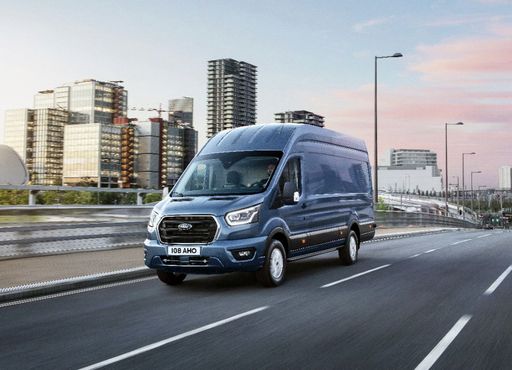
Transit Custom Bus @ Ford Motor Company / Ford Media Center

Ford Transit Custom Bus vs. Toyota Proace City: A Head-to-Head Comparison

For businesses and families looking for a versatile and economical vehicle, the choice often boils down to a van or a high-roof wagon. In this comparison, we dive into the features and innovations of the Ford Transit Custom Bus and the Toyota Proace City. Each model offers unique strengths catered to different needs, from commercial logistics to family transport solutions. Let's examine the technical aspects and innovations these vehicles bring to the table.

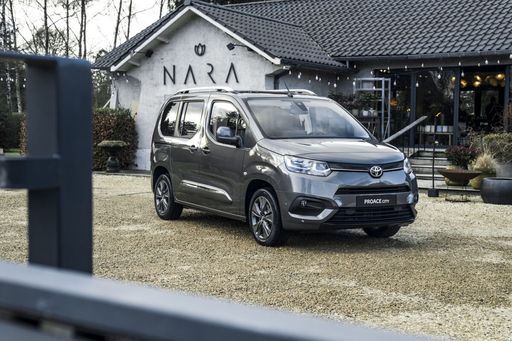
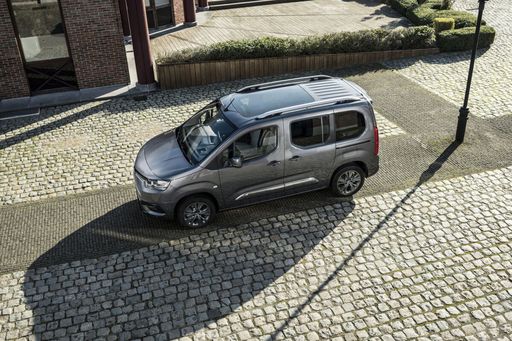
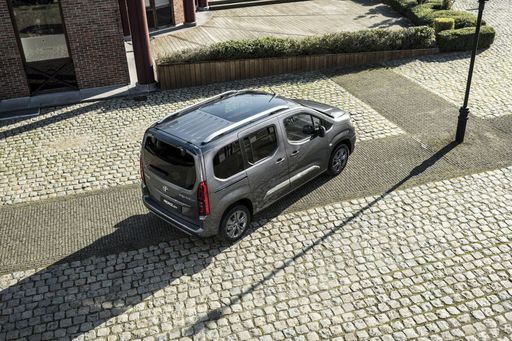
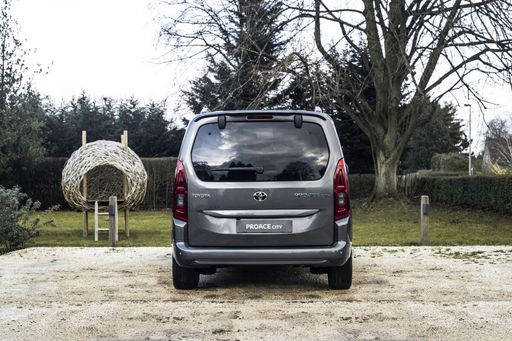
Proace City @ Toyota Motor Corporation

Power and Performance

The Ford Transit Custom Bus, available in models from 2023 and 2024, offers a diversified engine lineup, including electric, diesel, and plug-in hybrid options. Its power spectrum ranges from 110 HP to a robust 233 HP, with torque levels reaching up to 415 Nm. This range allows for various driving preferences and practical demands, making it versatile for both urban and rural environments. Depending on the engine choice, the Transit Custom Bus showcases remarkable flexibility in its drive types, ranging from rear-wheel drive to all-wheel drive.

In contrast, the Toyota Proace City, available in 2024 and 2025 models, presents a balanced power lineup with petrol, diesel, and electric engines offering between 102 HP and 136 HP. While it doesn’t offer the same high-power options as the Transit, it stresses efficiency and sustainability with its electric variant achieving an impressive range of 343 km. The Proace City conforms to front-wheel drive exclusively, streamlining its design for urban agility and efficiency.

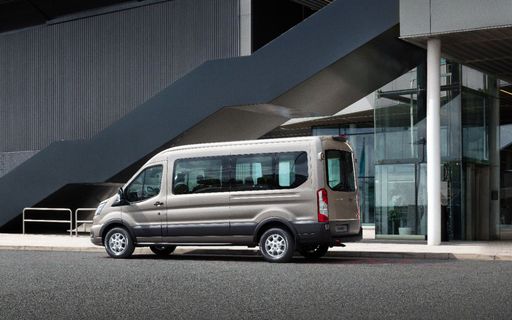
Transit Custom Bus @ Ford Motor Company / Ford Media Center

Fuel Efficiency and Environmental Impact

Addressing economic and environmental concerns, the Ford Transit Custom Bus features diverse fuel consumptions ranging from 7.2 L/100km on diesel engines to 22.6 kWh/100km for electric models. The plug-in hybrid edition boasts a remarkably low 1.6 L/100km consumption. With CO2 emissions spanning zero to 235 g/km, the Transit embraces varied efficiency classes from A to G.

The Toyota Proace City shines in efficiency with its electric models consuming merely 18.1 kWh/100km. Conventional engines exhibit commendable economy, with diesel options averaging 5.3 L/100km. CO2 emissions for its non-electric versions range from 139 to 146 g/km, earning efficiency class ratings up to A, making it an environmentally conscientious choice.

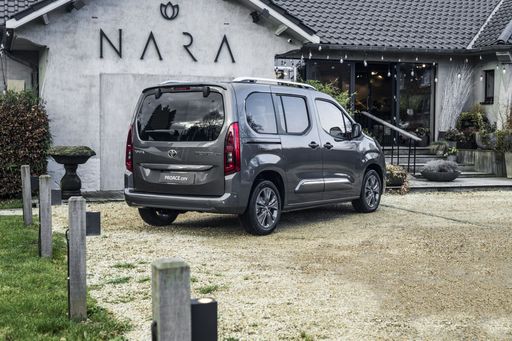
Proace City @ Toyota Motor Corporation

Capacity and Dimensions

Both vehicles offer considerable seating arrangements, with the Ford accommodating up to nine passengers, ideal for larger groups or team transport. Despite its substantial capacity, the Transit does not compromise on agility, demonstrating a length of up to 5450 mm and a height of 1959 mm.

The Toyota Proace City complements smaller groups comfortably, seating five to seven passengers depending on the configuration. When it comes to storage, it provides a spacious trunk capacity reaching up to 912 liters, making it a reliable option for carrying extensive cargo or luggage. Its more compact length of 4751 mm and width of 1848 mm allow for enhanced manoeuvrability in tight urban spaces.

Transit Custom Bus @ Ford Motor Company / Ford Media Center

Technological Innovations

The Ford Transit Custom Bus integrates advanced hybrid technology and a choice of gearboxes, including the modern reduction gearbox suitable for electric applications. These newer transmissions aim to enhance driving comfort and adaptability in varied conditions.

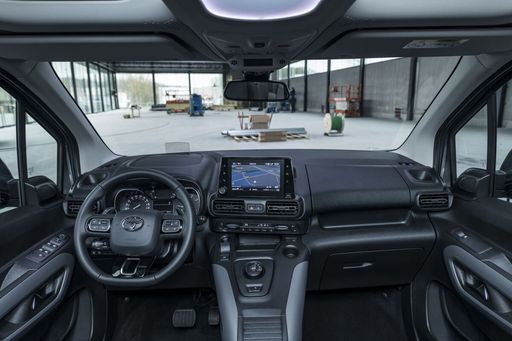
Meanwhile, the Toyota Proace City remains competitive with its emphasis on simplicity and efficiency. Its electric variant uses advanced battery management systems, promoting longevity and performance stability, a necessary feature for modern fleets aiming to reduce their environmental footprint.

Proace City @ Toyota Motor Corporation

Conclusion

Both the Ford Transit Custom Bus and the Toyota Proace City cater to different segments with their distinct advantages. The Transit shines with its powerful engine options and broader driving capabilities, tailored for versatility and capacity. The Proace City, on the other hand, capitalizes on efficiency, agility, and eco-friendliness, making it a solid choice for urban commuters and environmentally conscious buyers.

Here’s where it gets real: The technical differences in detail

Costs and Efficiency:

When it comes to price and running costs, the biggest differences usually appear. This is often where you see which car fits your budget better in the long run.

Toyota Proace City has a significantly advantage in terms of price – it starts at 20800 £, while the Ford Transit Custom Bus costs 41900 £. That’s a price difference of around 21073 £.

Fuel consumption also shows a difference: Ford Transit Custom Bus manages with 3.90 L and is therefore distinct more efficient than the Toyota Proace City with 5.30 L. The difference is about 1.40 L per 100 km.

In terms of energy consumption, the advantage goes to the Toyota Proace City: with 18.10 kWh per 100 km, it’s evident more efficient than the Ford Transit Custom Bus with 22.40 kWh. That’s a difference of about 4.30 kWh.

As for range, the Toyota Proace City performs minimal better – achieving up to 343 km, about 19 km more than the Ford Transit Custom Bus.

Engine and Performance:

Power, torque and acceleration say a lot about how a car feels on the road. This is where you see which model delivers more driving dynamics.

When it comes to engine power, the Ford Transit Custom Bus has a convincingly edge – offering 233 HP compared to 136 HP. That’s roughly 97 HP more horsepower.

In terms of top speed, the Toyota Proace City performs somewhat better – reaching 186 km/h, while the Ford Transit Custom Bus tops out at 150 km/h. The difference is around 36 km/h.

There’s also a difference in torque: Ford Transit Custom Bus pulls noticeable stronger with 415 Nm compared to 300 Nm. That’s about 115 Nm difference.

Space and Everyday Use:

Cabin size, boot volume and payload all play a role in everyday practicality. Here, comfort and flexibility make the difference.

Seats: Ford Transit Custom Bus offers distinct more seating capacity – 9 vs 7.

In terms of boot space, the Toyota Proace City offers clearly more room – 912 L compared to 0 L. That’s a difference of about 912 L.

Who wins the race?

The Toyota Proace City proves to be wins by a narrow margin and therefore becomes our DriveDuel Champion!
Toyota Proace City is the better all-rounder in this comparison.

from about £20,800
Proace City @ Toyota Motor Corporation

Toyota Proace City

  • Engine Type : Petrol, Diesel, Electric
  • Transmission : Manuel, Automatic
  • Drive Type : Front-Wheel Drive
  • Power HP : 102 - 136 HP
  • Consumption L/100km : 5.3 - 6.3 L
  • Consumption kWh/100km : 18.10 kWh
  • Electric Range : 343 km

Ford Transit Custom Bus

The Ford Transit Custom Bus offers a versatile solution for those in need of a spacious and practical vehicle, combining comfort with durability. Its stylish exterior is matched by a well-designed interior that provides ample space for passengers, making it an ideal choice for group travel. The driving experience is enhanced by a smooth ride and responsive handling, ensuring both driver and passengers enjoy the journey.

details

Toyota Proace City

The Toyota Proace City High Roof Combi is designed to seamlessly blend practicality with comfort, making it an ideal choice for families and businesses alike. Its versatile interior allows for flexible seating and cargo arrangements, catering to a variety of transport needs. Equipped with modern technology and advanced safety features, this vehicle ensures a reliable and secure driving experience.

details
Ford Transit Custom Bus
Toyota Proace City
Transit Custom Bus @ Ford Motor Company / Ford Media Center
Proace City @ Toyota Motor Corporation

Costs and Consumption

Price
41900 - 55600 £
Price
20800 - 44100 £
Consumption L/100km
3.9 - 8.5 L
Consumption L/100km
5.3 - 6.3 L
Consumption kWh/100km
22.4 - 24.3 kWh
Consumption kWh/100km
18.10 kWh
Electric Range
52 - 324 km
Electric Range
343 km
Battery Capacity
11.8 - 64 kWh
Battery Capacity
-
co2
0 - 222 g/km
co2
0 - 146 g/km
Fuel tank capacity
55 - 63 L
Fuel tank capacity
50 - 61 L

Dimensions and Body

Body Type
Bus
Body Type
High Roof Estate
Seats
9
Seats
5 - 7
Doors
4
Doors
4 - 5
Curb weight
-
Curb weight
1366 - 1664 kg
Trunk capacity
0 L
Trunk capacity
322 - 912 L
Length
5050 - 5450 mm
Length
4401 - 4751 mm
Width
2032 mm
Width
1848 mm
Height
1958 - 1959 mm
Height
1812 - 1818 mm
Max trunk capacity
-
Max trunk capacity
2126 - 2693 L
Payload
-
Payload
525 - 869 kg

Engine and Performance

Engine Type
Electric, Diesel, Plugin Hybrid
Engine Type
Petrol, Diesel, Electric
Transmission
Automatic, Manuel
Transmission
Manuel, Automatic
Transmission Detail
Reduction Gearbox, Manual Gearbox, Automatic Gearbox, CVT
Transmission Detail
Manual Gearbox, Reduction Gearbox, Automatic Gearbox
Drive Type
Rear-Wheel Drive, Front-Wheel Drive, All-Wheel Drive
Drive Type
Front-Wheel Drive
Power HP
110 - 233 HP
Power HP
102 - 136 HP
Acceleration 0-100km/h
-
Acceleration 0-100km/h
11.5 - 13.2 s
Max Speed
110 - 150 km/h
Max Speed
135 - 186 km/h
Torque
310 - 415 Nm
Torque
205 - 300 Nm
Number of Cylinders
4
Number of Cylinders
3 - 4
Power kW
81 - 171 kW
Power kW
75 - 100 kW
Engine capacity
1996 - 2488 cm3
Engine capacity
1199 - 1499 cm3

General

Model Year
2023 - 2024
Model Year
2024 - 2025
CO2 Efficiency Class
A, G, B
CO2 Efficiency Class
E, A
Brand
Ford
Brand
Toyota
What drivetrain options does the Ford Transit Custom Bus have?

The Ford Transit Custom Bus is offered with Rear-Wheel Drive, Front-Wheel Drive or All-Wheel Drive.

The prices and data displayed are estimates based on German list prices and may vary by country. This information is not legally binding.