VS

Kia EV9 vs Hyundai Santa Fe comparison

Compare performance (508 HP vs 288 HP), boot space and price (54,200 £ vs 51,700 £ ) at a glance. Find out which car is the better choice for you – Kia EV9 or Hyundai Santa Fe?

Kia EV9 vs Hyundai Santa Fe: Key differences

Kia EV9

5 (1 Reviews)
rate
  • clearly more power
  • clearly more electric range
  • substantially quicker 0–100 km/h

Hyundai Santa Fe

4.7 (1 Reviews)
rate
  • marginally cheaper
  • clearly lighter
  • considerably more trunk space
EV9

Head-to-Head: Hyundai Santa Fe vs. Kia EV9

In the bustling SUV market, Hyundai and Kia have carved notable niches with their popular models, the Hyundai Santa Fe and the Kia EV9, respectively. Offering a mix of innovation, power, and driveability, these vehicles cater to a wide spectrum of driving needs and preferences. Let's delve into the details and compare these two remarkable cars.
Santa Fe

Performance and Powertrain

The Hyundai Santa Fe enters the arena with two hybrid options: full hybrid and plug-in hybrid. It offers a power output of either 215 or 253 HP, delivered through an automatic gearbox. The Santa Fe is available with both front-wheel and all-wheel drive, reaching a top speed of 180 km/h. Notably, it provides an electric range of 54 km in its plug-in hybrid variant.

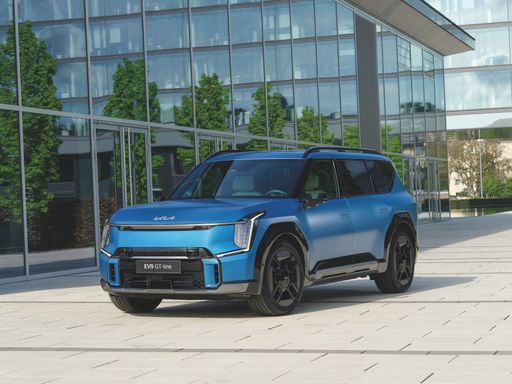
In contrast, the Kia EV9 is an all-electric behemoth. With a range of power outputs between 204 and 385 HP depending on the variant, this SUV highlights Kia’s commitment to electric mobility. It offers a maximum speed that can reach up to 200 km/h. The EV9's electric range is impressive, stretching between 443 and 563 km, showcasing its potential for long-range travel without frequent recharges.

EV9

Efficiency and Sustainability

Fuel and energy consumption highlight the efficiency spectrum of these two vehicles. The Hyundai Santa Fe presents a moderate consumption rate at 1.7 to 6.9 L/100km and produces CO2 emissions ranging from 38 to 167 g/km, reflecting its hybrid credentials.

With a zero-emission score, the Kia EV9 leapfrogs toward sustainability. Its energy consumption sits between 19.5 and 22.8 kWh/100km, classifying it in the top CO2 efficiency class. This car is a significant stride forward in the electric SUV category.

Santa Fe

Interior and Capacity

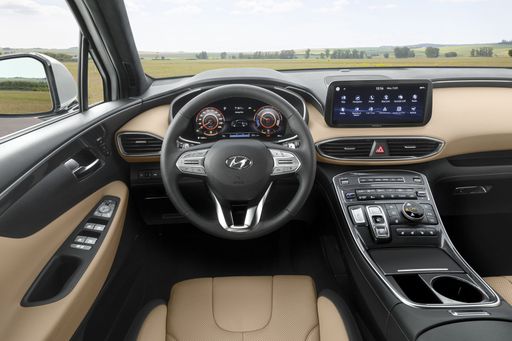
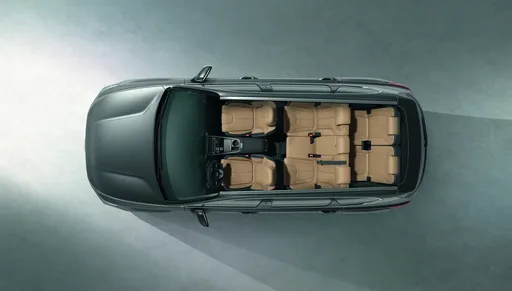
When it comes to interior space, the Santa Fe provides versatility with options for 5, 6, or 7 seats, catering to families and larger groups. It boasts a trunk capacity ranging from 621 to 711 liters, which suits both daily and extensive travel needs.

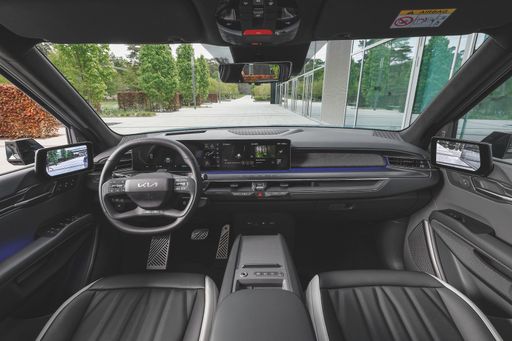
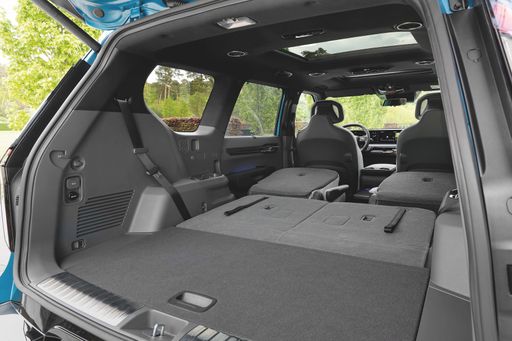
The EV9 offers room for 6 to 7 passengers, focusing on spacious comfort for its occupants. However, it comes with a more compact trunk capacity totaling 333 liters. Yet, the EV9 compensates through its electric-focused design, suited for environmentally conscious drivers.

EV9

Dimensions and Design

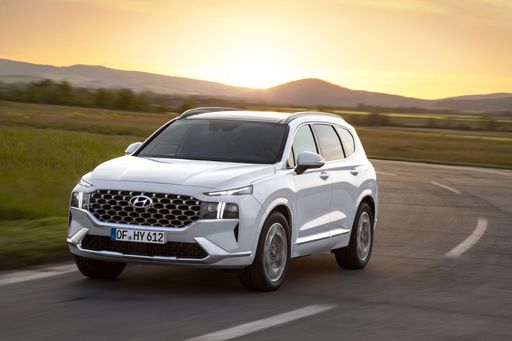
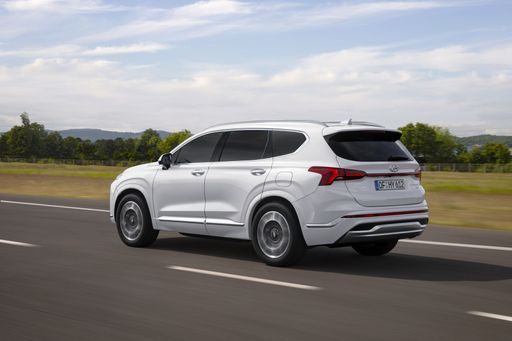
Aesthetically, the Santa Fe is shaped with dimensions of 4830 mm in length, 1900 mm in width, and 1720 mm in height, offering a roomy yet streamlined silhouette. Its curb weight ranges from 1920 to 2165 kg, depending on the variant.

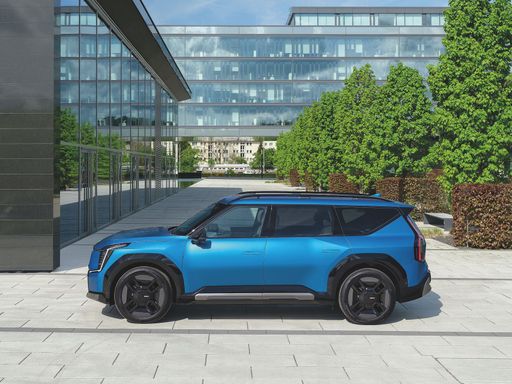
Meanwhile, the Kia EV9 stands slightly larger, measuring up to 5015 mm in length, 1980 mm in width, and up to 1780 mm in height. It carries a heftier curb weight touching 2664 kg at its maximum, which reflects its robust electric battery system.

Santa Fe

The Verdict

Deciding between the Hyundai Santa Fe and the Kia EV9 brings us to a critical juncture of hybrid versus electric preferences. The Santa Fe appeals to those looking for a traditional hybrid while still embracing some electrification benefits. On the other hand, the EV9 is a pioneer for those ready to plunge fully into the electric vehicle revolution, promising innovation and a cleaner drive.

Ultimately, the choice boils down to your personal requirements and environmental considerations — whether you're inclined towards the traditional hybrid landscape or stepping into the future with all-electric efficiency.

Here’s where it gets real: The technical differences in detail

EV9

Costs and Efficiency:

When it comes to price and running costs, the biggest differences usually appear. This is often where you see which car fits your budget better in the long run.

Hyundai Santa Fe is marginally cheaper – starting at 51,700 £ , while the Kia EV9 costs 54,200 £ . That’s a price difference of around 2,434 £.

As for electric range, the Kia EV9 offers clearly more range – reaching up to 563 km, about 509 km more than the Hyundai Santa Fe.

Santa Fe

Engine and Performance:

Power, torque and acceleration say a lot about how a car feels on the road. This is where you see which model delivers more driving dynamics.

When it comes to engine power, the Kia EV9 offers clearly more power – delivering 508 HP compared to 288 HP. That’s roughly 220 HP more horsepower.

When accelerating from 0 to 100 km/h, the Kia EV9 is substantially quicker – completing the sprint in 4.6 s, while the Hyundai Santa Fe takes 8 s. That’s about 3.4 s quicker.

There’s also a difference in torque: the Kia EV9 delivers substantially more torque with 740 Nm compared to 380 Nm. That’s about 360 Nm more.

EV9

Space and Everyday Use:

Beyond pure performance, interior space and usability matter most in daily life. This is where you see which car is more practical and versatile.

Both vehicles offer seating for 7 people.

In terms of curb weight, Hyundai Santa Fe is clearly lighter – 1,920 kg compared to 2,392 kg. The difference is around 472 kg.

Looking at boot space, the Hyundai Santa Fe offers considerably more boot space – 704 L compared to 333 L. That’s a difference of about 371 L.

When it comes to payload, the Hyundai Santa Fe carries barely more – 665 kg compared to 615 kg. That’s a difference of about 50 kg.

Who wins the race in the data check?

The Kia EV9 stands well ahead of its rival in the objective data comparison.
This result only shows which model scores more points on paper – not which of the two cars feels right for you.

from £54,200
EV9

Kia EV9

  • Engine Type : Electric
  • Transmission : Automatic
  • Drive Type : All-Wheel Drive, Rear-Wheel Drive
  • Power HP : 204 - 508 HP
  • Consumption kWh/100km : 19.5 - 22.8 kWh/100km
  • Electric Range : 443 - 563 km
Kia EV9
Hyundai Santa Fe

Costs and Consumption

View detailed analysis

Engine and Performance

View detailed analysis

Dimensions and Body

View detailed analysis

Kia EV9

The Kia EV9 is a bold, boxy electric SUV that looks like it could swallow your luggage and the in‑laws, with an interior that feels more lounge than cockpit and a presence that makes smaller rivals suddenly feel shy. On the road it delivers calm long‑distance composure with enough shove to keep overtakes effortless, and its tech and practicality make it an easy, sensible choice for buyers who want electric without compromise.

details

Hyundai Santa Fe

The Hyundai Santa Fe blends practical family friendliness with a hint of premium style, offering roomy, sensible packaging wrapped in modern, confident design. Inside it serves up comfortable seats, straightforward tech and a calm, composed ride that makes daily drives feel a little more grown up — a solid all‑rounder that doesn’t try to be flashy.

details
Kia EV9
Hyundai Santa Fe

Costs and Consumption

Price
54,200 - 78,000 £
Price
51,700 - 58,600 £
Consumption L/100km
-
Consumption L/100km
3.8 - 7.2 L/100km
Consumption kWh/100km
19.5 - 22.8 kWh/100km
Consumption kWh/100km
-
Electric Range
443 - 563 km
Electric Range
54 km
Battery Capacity
99.8 kWh
Battery Capacity
-
co2
0 g/km
co2
90 - 162 g/km
Fuel tank capacity
-
Fuel tank capacity
-

Dimensions and Body

Body Type
SUV
Body Type
SUV
Seats
6 - 7
Seats
5 - 7
Doors
5
Doors
-
Curb weight
2,392 - 2,664 kg
Curb weight
1,920 - 2,165 kg
Trunk capacity
333 L
Trunk capacity
621 - 704 L
Length
5,015 mm
Length
-
Width
1,980 mm
Width
1,900 mm
Height
1,780 mm
Height
-
Max trunk capacity
2,318 - 2,393 L
Max trunk capacity
-
Payload
542 - 615 kg
Payload
560 - 665 kg

Engine and Performance

Engine Type
Electric
Engine Type
Full Hybrid, Plugin Hybrid
Transmission
Automatic
Transmission
Automatic
Transmission Detail
Reduction Gearbox
Transmission Detail
Automatic Gearbox
Drive Type
All-Wheel Drive, Rear-Wheel Drive
Drive Type
Front-Wheel Drive, All-Wheel Drive
Power HP
204 - 508 HP
Power HP
239 - 288 HP
Acceleration 0-100km/h
4.6 - 9.4 s
Acceleration 0-100km/h
8 - 9.2 s
Max Speed
200 km/h
Max Speed
-
Torque
350 - 740 Nm
Torque
380 Nm
Number of Cylinders
-
Number of Cylinders
4
Power kW
150 - 374 kW
Power kW
176 - 212 kW
Engine capacity
-
Engine capacity
1,598 cm3

General

Model Year
2,023 - 2,025
Model Year
2,025
CO2 Efficiency Class
A
CO2 Efficiency Class
E, F, B
Brand
Kia
Brand
Hyundai
DriveDuel uses data analysis and artificial intelligence to evaluate vehicle data and create content. Content is regularly reviewed and improved. The displayed prices are estimates based on German list prices, adjusted to the respective country’s VAT. Country-specific registration taxes are not included. This information is not legally binding.