VS

Kia PV5 vs VW Transporter Transporter comparison

Compare performance (163 HP vs 286 HP), boot space and price (32,800 £ vs 37,500 £ ) at a glance. Find out which car is the better choice for you – Kia PV5 or VW Transporter Transporter?

Kia PV5 vs VW Transporter Transporter: Key differences

Kia PV5

  • slightly cheaper
  • moderately more efficient
  • visibly more electric range
  • very slightly lighter
details

VW Transporter Transporter

  • substantially more power
  • considerably quicker 0–100 km/h
details

By Achim Sedelmaier

PV5

VW Transporter Transporter VS Kia PV5 — which suits your real life?

VW Transporter Transporter VS Kia PV5 sit on the same broad stage but play very different roles: the Transporter arrives as a utility‑first van with a wide palette of body types and tow/load focus, while the Kia PV5 pitches itself as a quiet, space‑maximising electric family and fleet MPV with punchy value. The Transporter feels like a professional tool — robust, configurable and built around carrying and towing loads — whereas the PV5 is engineered around low running costs, interior calm and everyday accessibility. This comparison looks less at headline specs and more at how each behaves when you load tools, kids or kit and drive through real towns and motorways. Read on if you want to understand which one fits your day‑to‑day priorities rather than which one wins on paper.
Transporter Transporter

Character and usability: workhorse versus modern electric MPV

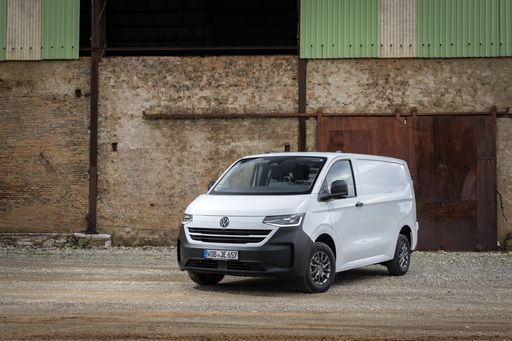
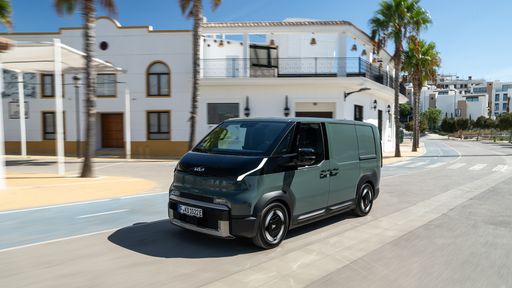
The VW Transporter Transporter makes its case with sheer utility: wider space between the wheelarches, higher payload potential and greater towing mindset that turns it into a true work van or shuttle. The Kia PV5 answers with a different kind of practicality — an electric architecture that gives a usable, cavernous cabin and a low boot lip that makes daily loading easier, plus EV features that help on urban routes. That contrast matters: if your week includes trailers, heavy toolboxes or repeated full‑load runs the Transporter’s character rewards you; if you’re mostly ferrying people, bikes or weekend kit and want lower running fuss the PV5 fits better. Neither is an all‑rounder in the other’s strongest field, so the choice comes down to payload/towing needs versus EV efficiency and everyday ergonomics.

PV5

Cabin feel and perceived quality: functional versus quietly modern

Step into the Volkswagen and you feel a cabin designed for practical use — lots of stowage, an upright driving position and controls laid out for workdays, but with materials that lean toward durable rather than plush. The Kia PV5’s interior trades a touch of premium sheen for smarter tech integration: a Google‑based infotainment system, OTA updates and thoughtful EV utilities give a modern, streamlined feel, even if some plastics are on the simple side. In everyday terms the Transporter’s cockpit feels more utilitarian and familiar to tradespeople, while the PV5 feels more like a contemporary MPV where tech and silence are part of the comfort package. Both can feel well sorted; they just signal different priorities — utility and durability in the Transporter, tech and quiet refinement in the PV5.

Comfort and long‑distance behavior: quiet EV cruising vs. stable towing presence

On long drives the Kia PV5 impresses with low cabin noise and a supple ride that makes motorway miles less tiring, although its efficiency and range are more sensitive to sustained high speeds. The VW Transporter Transporter offers a steadier, more planted feel when loaded and while towing, and its drivetrain choices give flexibility for heavy duty runs, but certain powertrains can be louder and mirror noise is more noticeable at higher speeds. So if your regular driving is long, relaxed trips without heavy loads the PV5’s serenity will win hearts, while if you haul, tow or carry heavy loads frequently the Transporter’s composed behaviour under stress is the practical pick. Each delivers comfort, but they arrive there for different reasons: the PV5 via electric refinement, the Transporter via drivetrain strength and chassis purposefulness.

City friendliness and everyday usability: tight turns and easy loading

In town the Kia PV5 feels particularly at home — nimble steering, a small turning circle and electric torque make short trips and parking painless, while sliding doors and a low load floor speed up loading children or cargo. The VW Transporter Transporter surprises with clever ergonomics for urban work too: wide sliding doors, a low sill on some versions and an unexpectedly small turning radius for its size, though large mirrors and a boxier silhouette demand more spatial awareness. For fleet drivers and families operating in congested areas the PV5’s compact EV manners are slightly kinder day‑to‑day, but the Transporter still holds the edge where quick loading, trailer hookup or carrying odd‑shaped goods are routine. In short, PV5 simplifies city life; Transporter simplifies the job — pick which daily friction you want to eliminate.

Buyer fit: who should choose the Transporter and who the PV5?

Choose the VW Transporter Transporter if your priority is maximum utility: regular heavy loads, towing, upfit flexibility and a commercial feel that’s built around work cycles and reliability under stress. Opt for the Kia PV5 if you want a modern electric van for families or light commercial use — a quieter cabin, strong value, generous warranty and easy urban usability make it a compelling everyday companion. If both descriptions appeal, weigh whether you need payload and towing capacity more than lower running costs and electric comfort, because that trade‑off defines the two models more than any single specification. Below you’ll find a technical comparison that maps these real‑world differences onto drivetrains, range, charging and payload so you can align use case with numbers.

Here’s where it gets real: The technical differences in detail

PV5

Costs and Efficiency:

Price and efficiency are often the first things buyers look at. Here it becomes clear which model has the long-term edge – whether at the pump, the plug, or in purchase price.

Kia PV5 is slightly cheaper – starting at 32,800 £ , while the VW Transporter Transporter costs 37,500 £ . That’s a price difference of around 4,695 £.

In terms of energy consumption, the Kia PV5 is moderately more efficient: consuming 19 kWh/100km compared to 21.9 kWh/100km for the VW Transporter Transporter. That’s a difference of about 2.9 kWh/100km.

As for electric range, the Kia PV5 offers visibly more range – reaching up to 416 km, about 85 km more than the VW Transporter Transporter.

Transporter Transporter

Engine and Performance:

Power, torque and acceleration are the classic benchmarks for car enthusiasts – and here, some clear differences start to show.

When it comes to engine power, the VW Transporter Transporter offers substantially more power – delivering 286 HP compared to 163 HP. That’s roughly 123 HP more horsepower.

When accelerating from 0 to 100 km/h, the VW Transporter Transporter is considerably quicker – completing the sprint in 7.4 s, while the Kia PV5 takes 10.6 s. That’s about 3.2 s quicker.

There’s also a difference in torque: the VW Transporter Transporter delivers visibly more torque with 415 Nm compared to 250 Nm. That’s about 165 Nm more.

PV5

Space and Everyday Use:

Cabin size, boot volume and payload all play a role in everyday practicality. Here, comfort and flexibility make the difference.

Both vehicles offer seating for 5 people.

In terms of curb weight, Kia PV5 is very slightly lighter – 1,860 kg compared to 1,872 kg. The difference is around 12 kg.

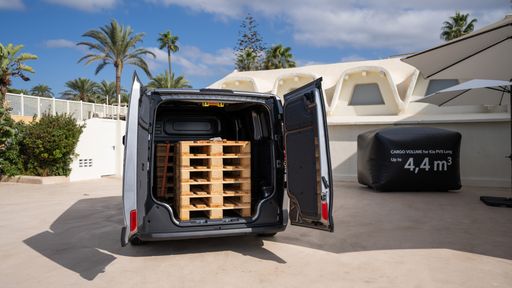
When it comes to payload, the VW Transporter Transporter carries clearly more – 1,259 kg compared to 790 kg. That’s a difference of about 469 kg.

Who wins the race in the data check?

The VW Transporter Transporter is far ahead overall in the objective data comparison.
This result only shows which model scores more points on paper – not which of the two cars feels right for you.

from £37,500
Transporter Transporter

VW Transporter Transporter

  • Engine Type Diesel, Plugin Hybrid, Electric
  • Transmission Manuel, Automatic
  • Drive Type Front-Wheel Drive, All-Wheel Drive, Rear-Wheel Drive
  • Power HP 110 - 286 HP
  • Consumption L/100km 7.1 - 8.4 L/100km
  • Consumption kWh/100km 21.9 - 24.4 kWh/100km
  • Electric Range 56 - 331 km
Kia PV5
VW Transporter Transporter

Costs and Consumption

View detailed analysis

Engine and Performance

View detailed analysis

Dimensions and Body

View detailed analysis

Kia PV5

The Kia EV5 is an exciting new entrant in the landscape of electric SUVs, promising a blend of style and innovation that captures attention. It boasts a sleek and modern design that aligns with Kia's evolving aesthetic identity, blending practicality with eye-catching details. With its foray into the electric vehicle segment, the EV5 is set to offer a highly competitive option for those looking to embrace sustainable mobility without compromising on comfort or tech features.

details

VW Transporter Transporter

The VW Transporter is the workhorse of the modern tradesman, blending practical cleverness with a cabin that's actually pleasant to spend a long day in. It may not steal the style spotlight, but its unshowy durability, clever load solutions and easy-to-live-with character make it a sensible pick for businesses and weekend projects alike.

details
Kia PV5
VW Transporter Transporter

Costs and Consumption

Price
32,800 - 38,900 £
Price
37,500 - 60,800 £
Consumption L/100km
-
Consumption L/100km
7.1 - 8.4 L/100km
Consumption kWh/100km
19 - 19.3 kWh/100km
Consumption kWh/100km
21.9 - 24.4 kWh/100km
Electric Range
295 - 416 km
Electric Range
56 - 331 km
Battery Capacity
-
Battery Capacity
11.8 - 63.8 kWh
co2
0 g/km
co2
0 - 220 g/km
Fuel tank capacity
-
Fuel tank capacity
55 L

Dimensions and Body

Body Type
Cargo Van, Bus
Body Type
Cargo Van
Seats
2 - 5
Seats
2 - 5
Doors
-
Doors
4 - 5
Curb weight
1,860 - 2,145 kg
Curb weight
1,872 - 2,462 kg
Trunk capacity
1,330 L
Trunk capacity
-
Length
-
Length
5,050 - 5,450 mm
Width
1,895 mm
Width
2,032 mm
Height
-
Height
1,966 - 1,985 mm
Max trunk capacity
-
Max trunk capacity
-
Payload
455 - 790 kg
Payload
755 - 1,259 kg

Engine and Performance

Engine Type
Electric
Engine Type
Diesel, Plugin Hybrid, Electric
Transmission
Automatic
Transmission
Manuel, Automatic
Transmission Detail
Reduction Gearbox
Transmission Detail
Manual Gearbox, Automatic Gearbox
Drive Type
Front-Wheel Drive
Drive Type
Front-Wheel Drive, All-Wheel Drive, Rear-Wheel Drive
Power HP
121 - 163 HP
Power HP
110 - 286 HP
Acceleration 0-100km/h
10.6 - 16.2 s
Acceleration 0-100km/h
7.4 - 16.9 s
Max Speed
-
Max Speed
112 - 150 km/h
Torque
250 Nm
Torque
310 - 415 Nm
Number of Cylinders
-
Number of Cylinders
4
Power kW
89 - 120 kW
Power kW
81 - 210 kW
Engine capacity
-
Engine capacity
1,996 - 2,488 cm3

General

Model Year
2025
Model Year
2025
CO2 Efficiency Class
A
CO2 Efficiency Class
G, A
Brand
Kia
Brand
VW
DriveDuel uses data analysis and artificial intelligence to evaluate vehicle data and create content. Content is regularly reviewed and improved. The displayed prices are estimates based on German list prices, adjusted to the respective country’s VAT. Country-specific registration taxes are not included. This information is not legally binding.