VS

Mazda CX-5 vs Jaguar F-Pace comparison

Compare performance (141 HP vs 575 HP), boot space and price (30,000 £ vs 56,400 £ ) at a glance. Find out which car is the better choice for you – Mazda CX-5 or Jaguar F-Pace?

Mazda CX-5 vs Jaguar F-Pace: Key differences

Mazda CX-5

4.7 (11 Reviews)
rate
  • substantially cheaper
  • somewhat lighter
details

Jaguar F-Pace

5 (1 Reviews)
rate
  • clearly more power
  • clearly more efficient
  • substantially quicker 0–100 km/h
  • barely more trunk space
details

All details on performance, efficiency, range and trunk space can be found in the technical comparison below – including user reviews for both models.

By Achim Sedelmaier

CX-5

Quick take: Jaguar F-Pace and Mazda CX-5 face off

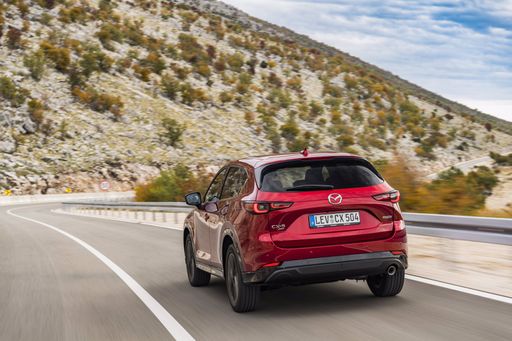
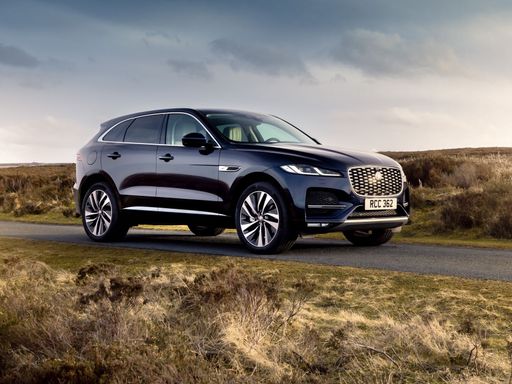
The Jaguar F-Pace and the Mazda CX-5 arrive with very different priorities, so this is less about who is objectively "better" and more about which trade-offs you’re willing to live with. In short, the Jaguar F-Pace VS Mazda CX-5 comparison pits a premium, driver‑focused SUV against a roomier, value‑oriented family car. The F-Pace leans into sharper handling, a quiet highway presence and a noticeably upmarket cabin, while the CX-5 prioritizes space, easy loading and straightforward day‑to‑day usability. Read on to see which character fits your routine: spirited mile‑eating or pragmatic family duty, and why the technical section that follows will matter differently for each buyer.
F-Pace

Character and driving feel

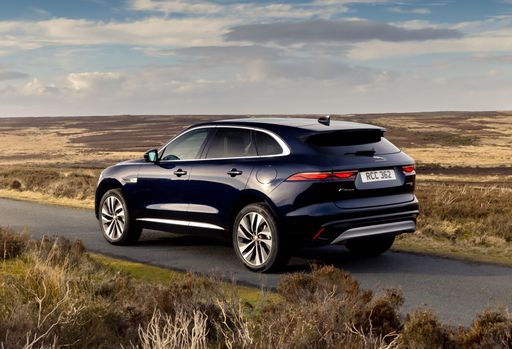
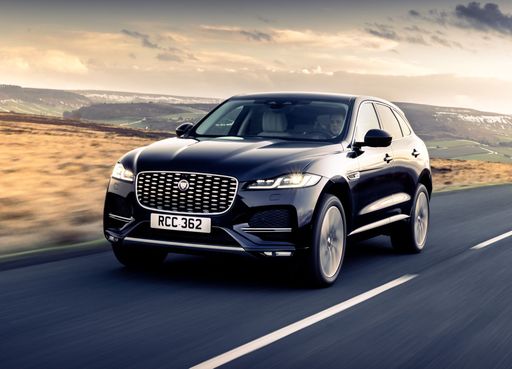
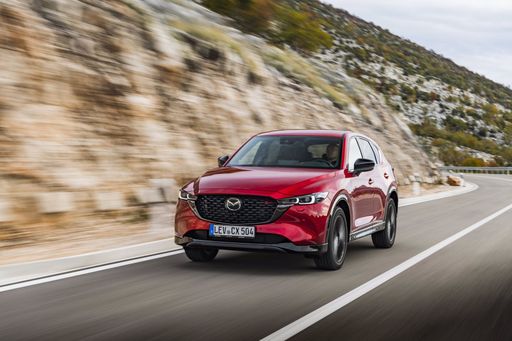
The Jaguar F-Pace feels like a European sporting SUV — direct steering, taut body control and a sense that it wants to be driven with purpose. By contrast, the Mazda CX-5 is tuned toward calm, predictable responses: it rewards smooth inputs and punishes aggressive expectations with a softer, less eager powertrain. That difference makes the F-Pace more engaging on country roads and the CX-5 more forgiving in everyday traffic. If you enjoy cornering and a connected steering feel, the Jaguar will satisfy; if you prefer relaxed, confidence‑oriented manners, the Mazda is the sensible choice.

CX-5

Comfort and long‑distance behavior

On the motorway the Jaguar F-Pace impresses with low cabin noise and supportive seats that make long hours behind the wheel less tiring, though its suspension can feel firmer when fitted with larger wheels. The Mazda CX-5 trades a touch of that refinement for a cushioned ride and a more relaxed posture in the cabin, which many will prefer for family road trips. However, the CX-5’s engine becomes more audible under load, so overtaking and steep climbs draw attention to its limitations. For regular long‑distance commuting pick the F-Pace for serenity and driver comfort; for comfortable family cruising the CX-5 is an easier, less demanding companion.

F-Pace

Practicality and family usability

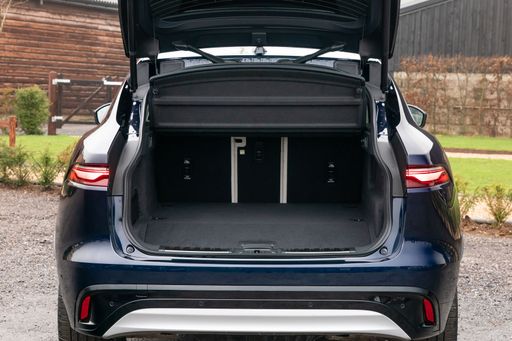
The Mazda CX-5 makes everyday life easier: wider rear doors, more usable rear legroom and a very flat, low‑loading boot that simplifies strollers and luggage. The Jaguar F-Pace isn’t clueless — it has a sensible split rear seat and a usable load area — but certain variants reduce luggage practicality and complicate loading, which a family will notice. The CX-5’s layout and door architecture make child seats and regular cargo routines faster and less fiddly. If your priority is straightforward family logistics and maximum usable space, the Mazda is the pragmatist’s pick; if you value style and a sportier driving package more than absolute cargo convenience, the F-Pace will still serve adequately.

CX-5

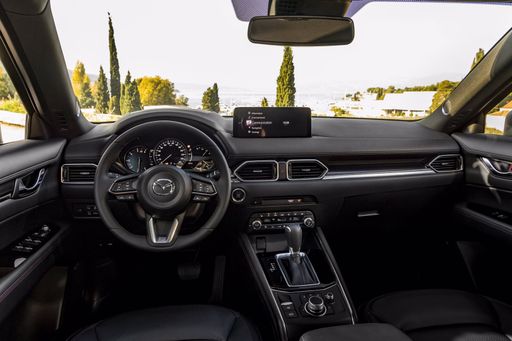
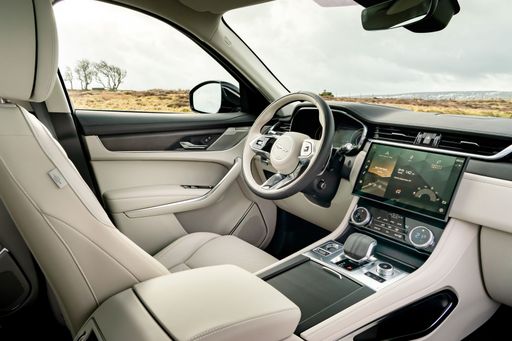
Cabin feel, tech and perceived quality

The F-Pace benefits from a recent interior uplift: richer materials, stronger attention to detail and an ambience that reads more premium the moment you sit down. Mazda’s CX-5 scores with clean, modern interfaces and deep Google integration that brings smart features and over‑the‑air updates, but some touch‑centric controls and harder plastics keep it a step behind in tactile luxury. Jaguar’s infotainment is feature‑rich and polished but can feel more complex, while Mazda’s system is simpler yet sometimes slow and touch‑dependent. If perceived luxury and material quality matter, the Jaguar edges ahead; if intuitive cloud services and software convenience top your list, the Mazda packs the smarter gadget set for daily life.

F-Pace

City friendliness, running costs and buyer fit

In town the Mazda CX-5 is easier to live with: lighter steering, better visibility in manoeuvres and a layout that reduces everyday friction — plus a lower entry cost that makes ownership simpler for budget‑minded buyers. The Jaguar F-Pace works in urban settings too, but its firmer setup, wider stance and higher option bills reward drivers who spend serious time on fast roads or who want a premium presence. Running costs and the real benefit of electrified options depend on how you use them; regular charging and longer motorway stints amplify the Jaguar’s strengths, while conservative ownership and family practicality tilt the scales toward the Mazda. Choose the F-Pace if you want a more emotional, refined driving experience; choose the CX-5 if you need space, simplicity and everyday value — and let the technical comparison that follows clarify the mechanics behind those choices.

Here’s where it gets real: The technical differences in detail

CX-5

Costs and Efficiency:

Looking at overall running costs, both models reveal some interesting differences in everyday economy.

Mazda CX-5 is substantially cheaper – starting at 30,000 £ , while the Jaguar F-Pace costs 56,400 £ . That’s a price difference of around 26,409 £.

Fuel consumption also shows a difference: the Jaguar F-Pace uses 1.8 L/100km and is clearly more efficient than the Mazda CX-5 with 7 L/100km. The difference is about 5.2 L/100km.

F-Pace

Engine and Performance:

Power, torque and acceleration are the classic benchmarks for car enthusiasts – and here, some clear differences start to show.

When it comes to engine power, the Jaguar F-Pace offers clearly more power – delivering 575 HP compared to 141 HP. That’s roughly 434 HP more horsepower.

When accelerating from 0 to 100 km/h, the Jaguar F-Pace is substantially quicker – completing the sprint in 4 s, while the Mazda CX-5 takes 10.5 s. That’s about 6.5 s quicker.

There’s also a difference in torque: the Jaguar F-Pace delivers significantly more torque with 700 Nm compared to 238 Nm. That’s about 462 Nm more.

CX-5

Space and Everyday Use:

Whether family car or daily driver – which one offers more room, flexibility and comfort?

Both vehicles offer seating for 5 people.

In terms of curb weight, Mazda CX-5 is somewhat lighter – 1,629 kg compared to 1,951 kg. The difference is around 322 kg.

Looking at boot space, the Jaguar F-Pace offers barely more boot space – 470 L compared to 466 L. That’s a difference of about 4 L.

When it comes to payload, the Mazda CX-5 carries barely more – 601 kg compared to 589 kg. That’s a difference of about 12 kg.

Who wins the race in the data check?

The Jaguar F-Pace is clearly superior overall in the objective data comparison.
This result only shows which model scores more points on paper – not which of the two cars feels right for you.

from £56,400
F-Pace

Jaguar F-Pace

  • Engine Type Diesel MHEV, Petrol MHEV, Plugin Hybrid, Petrol
  • Transmission Automatic
  • Drive Type All-Wheel Drive
  • Power HP 163 - 575 HP
  • Consumption L/100km 1.8 - 12 L/100km
  • Electric Range 64 km
Mazda CX-5
Jaguar F-Pace

Costs and Consumption

View detailed analysis

Engine and Performance

View detailed analysis

Dimensions and Body

View detailed analysis

Mazda CX-5

The Mazda CX-5 blends sporty handling with a refined, premium interior, making everyday driving feel engaging and comfortable. It pairs stylish design and thoughtful cabin materials with user-friendly tech to deliver a well-rounded compact SUV that suits drivers who want more driver involvement without sacrificing practicality.

details

Jaguar F-Pace

Jaguar F-Pace blends the prowling presence of a sports car with the practicality of an SUV, looking elegant while rewarding drivers with lively handling. If you crave something that feels special every time you climb in and prefer style and driving flair over blending into the parking lot, the F-Pace is a classy, slightly cheeky alternative to the usual German suspects.

details
Mazda CX-5
Jaguar F-Pace

Costs and Consumption

Price
30,000 - 39,500 £
Price
56,400 - 100,800 £
Consumption L/100km
7 - 7.5 L/100km
Consumption L/100km
1.8 - 12 L/100km
Consumption kWh/100km
-
Consumption kWh/100km
-
Electric Range
-
Electric Range
64 km
Battery Capacity
-
Battery Capacity
15.4 kWh
co2
157 - 169 g/km
co2
41 - 274 g/km
Fuel tank capacity
-
Fuel tank capacity
62 - 83 L

Dimensions and Body

Body Type
SUV
Body Type
SUV
Seats
5
Seats
5
Doors
-
Doors
5
Curb weight
1,629 - 1,671 kg
Curb weight
1,951 - 2,230 kg
Trunk capacity
466 L
Trunk capacity
354 - 470 L
Length
-
Length
4,747 - 4,762 mm
Width
1,860 mm
Width
1,936 mm
Height
-
Height
1,664 - 1,670 mm
Max trunk capacity
-
Max trunk capacity
1,299 - 1,428 L
Payload
566 - 601 kg
Payload
457 - 589 kg

Engine and Performance

Engine Type
Petrol MHEV
Engine Type
Diesel MHEV, Petrol MHEV, Plugin Hybrid, Petrol
Transmission
Automatic
Transmission
Automatic
Transmission Detail
Automatic Gearbox
Transmission Detail
Automatic Gearbox
Drive Type
Front-Wheel Drive, All-Wheel Drive
Drive Type
All-Wheel Drive
Power HP
141 HP
Power HP
163 - 575 HP
Acceleration 0-100km/h
10.5 - 10.9 s
Acceleration 0-100km/h
4 - 10.1 s
Max Speed
-
Max Speed
195 - 286 km/h
Torque
238 Nm
Torque
380 - 700 Nm
Number of Cylinders
4
Number of Cylinders
4 - 8
Power kW
104 kW
Power kW
120 - 423 kW
Engine capacity
2,488 cm3
Engine capacity
1,997 - 5,000 cm3

General

Model Year
2025
Model Year
2024
CO2 Efficiency Class
F
CO2 Efficiency Class
G, B
Brand
Mazda
Brand
Jaguar
DriveDuel uses data analysis and artificial intelligence to evaluate vehicle data and create content. Content is regularly reviewed and improved. The displayed prices are estimates based on German list prices, adjusted to the respective country’s VAT. Country-specific registration taxes are not included. This information is not legally binding.