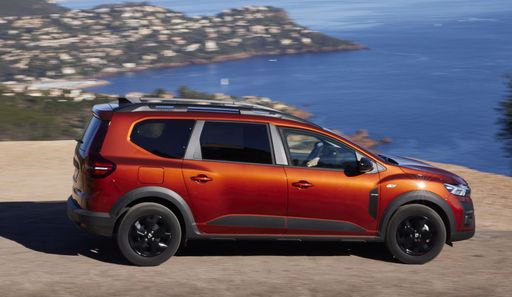
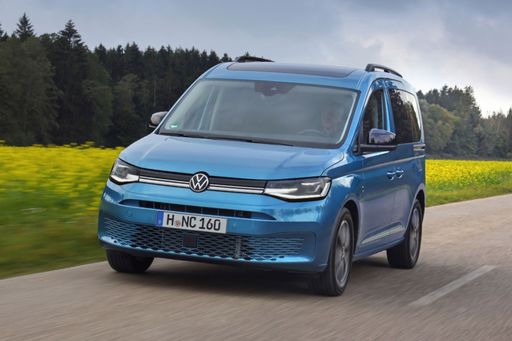
VS

VW Caddy vs Dacia Jogger comparison

Compare performance (150 HP vs 158 HP), boot space and price (27,800 £ vs 15,400 £ ) at a glance. Find out which car is the better choice for you – VW Caddy or Dacia Jogger?

VW Caddy vs Dacia Jogger: Key differences

VW Caddy

5 (1 Reviews)
rate
  • clearly more efficient
details

Dacia Jogger

4.3 (3 Reviews)
rate
  • considerably cheaper
  • barely more power
  • clearly quicker 0–100 km/h
  • markedly lighter
details

All details on performance, efficiency, range and trunk space can be found in the technical comparison below – including user reviews for both models.

By Achim Sedelmaier

Caddy

Quick head-to-head: Dacia Jogger and VW Caddy

Dacia Jogger and VW Caddy answer a familiar buyer question: how much space and practicality do you need, and what are you willing to pay for it? This Dacia Jogger VS VW Caddy comparison focuses on character, comfort and everyday usability rather than raw specs. The Jogger pitches itself as the honest, low-cost seven-seater that maximises usable space with few frills, while the Caddy presents a more polished, van‑based alternative with greater modularity and higher asking price. Expect the Jogger to feel like a pragmatic family tool and the Caddy to feel like a higher‑budget workhorse that behaves more like a car. Choices here come down to which compromises—noise, refinement, or extra practicality—you can live with day to day.
Jogger

Character and driving behavior

The Dacia Jogger drives with a simple, comfort‑oriented personality: light steering, composed but unexciting handling and a powertrain tuned for efficiency rather than punch. The VW Caddy, by contrast, feels firmer and more precise, thanks to a more car-like chassis layout that rewards cruising and heavier loads with stability and predictable responses. The Jogger’s hybrid variants are pleasant around town and mask low‑speed NVH, whereas the Jogger’s petrol under strain reveals its limits on steep gradients and high-speed runs. The Caddy trades a bit of cabin quiet for a stronger torque feel and steadier behaviour on motorways and when loaded. In short, the Jogger comforts with ease and economy while the Caddy steers confidence under stress and weight.

Caddy

Comfort, cabin feel and perceived quality

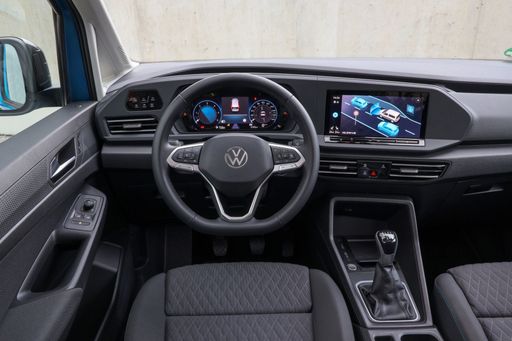
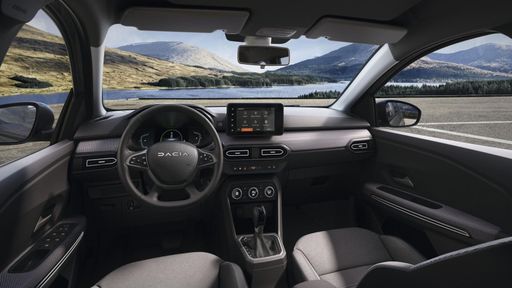
Inside, the Dacia Jogger is deliberately utilitarian: durable plastics, straightforward switches and bright sightlines that make parking and loading easier but lack premium polish. The VW Caddy raises the perceived quality with firmer seats, tighter panel fits and a layout that reads more purposeful than basic, although its touch‑slider controls can feel fussy compared with physical knobs. Noise insulation is a telling difference — the Jogger can sound more lively at motorway speeds, whereas the Caddy, while not silent, generally communicates a heavier, more controlled tone. Both cabins are built for family life rather than luxury, but the Caddy aims for a near‑car feel while the Jogger embraces robustness and easy maintenance. Buyers who value tactile refinement will prefer the Caddy; those prioritising cleanliness and resilience will like the Jogger’s pragmatic surfaces.

Jogger

Usability and practicality in everyday life

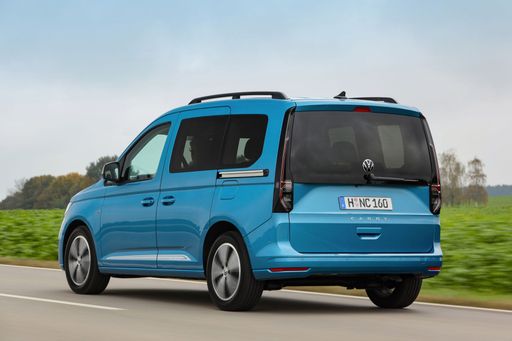
Practicality is where these two show their strongest contrasts: the Dacia Jogger delivers genuine seven‑seat flexibility with a surprisingly low loading sill and seats that can be removed to create cargo space quickly. The VW Caddy doubles down on utility with sliding doors, multiple wheelbase choices and a cavernous load bay that makes awkward items and daily family logistics straightforward. The Jogger’s third row is best for kids and occasional use and can be fiddly to access, while the Caddy’s layout—especially in the longer Maxi—caters better to full‑time seven‑seat families or anyone hauling bulky gear regularly. Neither car prioritises trunk glamour: the Jogger keeps things simple with fewer tie‑down points and basic lighting, and the Caddy’s large tailgate can be cumbersome in tight parking. If you need effortless loading and rear access in tight spaces, the Caddy’s doors and space layout win; if you need the cheapest route to seven seats and easy boot lip, the Jogger is the practical bargain.

Caddy

City friendliness and long‑distance behavior

The Dacia Jogger is notably city‑friendly: compact enough for urban streets, excellent outward visibility and hybrid options that let you cruise silently at low speeds. The VW Caddy also works well in town, where sliding doors and a tight turning circle in the short wheelbase make school runs and kerbside access easier, but its higher profile and larger doors demand a bit more parking planning. On longer trips the balance shifts—the Jogger’s simpler insulation and noisier profile make long motorway miles feel more tiring, especially under load, while the Caddy’s chassis and drivetrain choices deliver steadier high‑speed behaviour and more reassuring cruise comfort. In other words, choose the Jogger for mostly urban, cost‑conscious life; choose the Caddy if your week includes regular motorway stretches or heavier cargo and you want a calmer long‑haul experience.

Jogger

Buyer fit and trade‑offs — who should test drive which

If your priority is the lowest cost to a workable seven‑seat family car with easy-to-clean materials and simple engineering, the Dacia Jogger will match that brief and stretch a tight budget further. If you need modular load space, sliding doors, stronger motorway composure and a cabin that feels closer to a mainstream family car, the VW Caddy will suit buyers willing to trade a higher purchase price for everyday versatility and refinement. Families that rarely use the third row and mainly drive in town will find the Jogger pragmatic and economical, while users who regularly carry bulky gear, tow attention away from tight parking or require Maxi‑level space should lean toward the Caddy. Decide whether price and straightforward utility or modular capability and feel‑good robustness matter more, and then move on to the technical comparison to see how engines, payload and equipment translate into real‑world numbers for your needs.

Here’s where it gets real: The technical differences in detail

Caddy

Costs and Efficiency:

When it comes to price and running costs, the biggest differences usually appear. This is often where you see which car fits your budget better in the long run.

Dacia Jogger is considerably cheaper – starting at 15,400 £ , while the VW Caddy costs 27,800 £ . That’s a price difference of around 12,339 £.

Fuel consumption also shows a difference: the VW Caddy uses 0.5 L/100km and is clearly more efficient than the Dacia Jogger with 4.5 L/100km. The difference is about 4 L/100km.

Jogger

Engine and Performance:

Power, torque and acceleration are the classic benchmarks for car enthusiasts – and here, some clear differences start to show.

When it comes to engine power, the Dacia Jogger offers barely more power – delivering 158 HP compared to 150 HP. That’s roughly 8 HP more horsepower.

When accelerating from 0 to 100 km/h, the Dacia Jogger is clearly quicker – completing the sprint in 8.9 s, while the VW Caddy takes 11.4 s. That’s about 2.5 s quicker.

There’s also a difference in torque: the VW Caddy delivers clearly more torque with 320 Nm compared to 200 Nm. That’s about 120 Nm more.

Caddy

Space and Everyday Use:

Whether family car or daily driver – which one offers more room, flexibility and comfort?

Both vehicles offer seating for 7 people.

In terms of curb weight, Dacia Jogger is markedly lighter – 1,268 kg compared to 1,575 kg. The difference is around 307 kg.

When it comes to payload, the VW Caddy carries clearly more – 710 kg compared to 559 kg. That’s a difference of about 151 kg.

Who wins the race in the data check?

The VW Caddy is far ahead overall in the objective data comparison.
This result only shows which model scores more points on paper – not which of the two cars feels right for you.

from £27,800
Caddy

VW Caddy

  • Engine Type Petrol, Diesel, Plugin Hybrid
  • Transmission Manuel, Automatic
  • Drive Type Front-Wheel Drive, All-Wheel Drive
  • Power HP 102 - 150 HP
  • Consumption L/100km 0.5 - 6.9 L/100km
  • Electric Range 116 - 121 km
VW Caddy
Dacia Jogger

Costs and Consumption

View detailed analysis

Engine and Performance

View detailed analysis

Dimensions and Body

View detailed analysis

VW Caddy

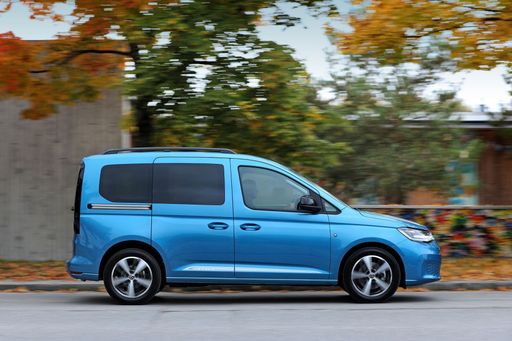
The VW Caddy is the Swiss-army knife of compact vans — practical, surprisingly refined, and ready to swap a weekend adventure for a grocery run without breaking a sweat. It’s user-friendly, comfortable enough for daily driving, and sensible for buyers who want utility with a dash of style and no drama.

details

Dacia Jogger

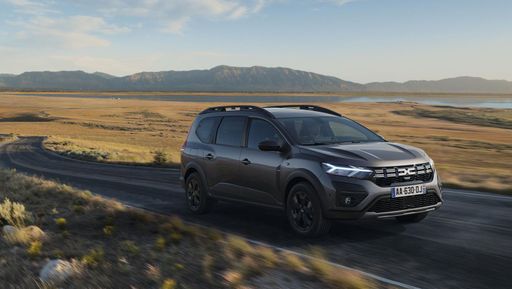
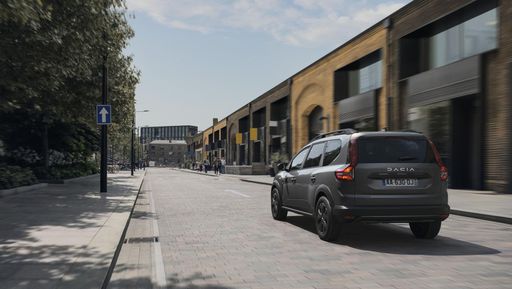
The Dacia Jogger is a no-nonsense family mover that stretches the idea of value with cavernous practicality and flexible space, perfect for buyers who need a sensible, everyday Swiss Army knife on wheels. It doesn’t try to be glamorous — instead it wins hearts with cheerful thrift, durable materials and honest engineering, giving you useful transport without the pretence.

details
VW Caddy
Dacia Jogger

Costs and Consumption

Price
27,800 - 45,900 £
Price
15,400 - 23,500 £
Consumption L/100km
0.5 - 6.9 L/100km
Consumption L/100km
4.5 - 7.6 L/100km
Consumption kWh/100km
-
Consumption kWh/100km
-
Electric Range
116 - 121 km
Electric Range
-
Battery Capacity
19.7 kWh
Battery Capacity
-
co2
10 - 165 g/km
co2
103 - 138 g/km
Fuel tank capacity
50 L
Fuel tank capacity
-

Dimensions and Body

Body Type
High Roof Estate
Body Type
MPV
Seats
5 - 7
Seats
5 - 7
Doors
5
Doors
-
Curb weight
1,575 - 1,998 kg
Curb weight
1,268 - 1,463 kg
Trunk capacity
-
Trunk capacity
160 - 607 L
Length
4,500 - 4,853 mm
Length
-
Width
1,855 mm
Width
1,784 mm
Height
1,819 - 1,860 mm
Height
-
Max trunk capacity
2,556 - 3,700 L
Max trunk capacity
-
Payload
501 - 710 kg
Payload
384 - 559 kg

Engine and Performance

Engine Type
Petrol, Diesel, Plugin Hybrid
Engine Type
Petrol, Full Hybrid, LPG
Transmission
Manuel, Automatic
Transmission
Manuel, Automatic
Transmission Detail
Manual Gearbox, Dual-Clutch Automatic
Transmission Detail
Manual Gearbox, Automatic Gearbox, Dual-Clutch Automatic
Drive Type
Front-Wheel Drive, All-Wheel Drive
Drive Type
Front-Wheel Drive
Power HP
102 - 150 HP
Power HP
110 - 158 HP
Acceleration 0-100km/h
11.4 - 14 s
Acceleration 0-100km/h
8.9 - 12 s
Max Speed
173 - 186 km/h
Max Speed
-
Torque
220 - 320 Nm
Torque
190 - 200 Nm
Number of Cylinders
4
Number of Cylinders
3 - 4
Power kW
75 - 110 kW
Power kW
81 - 116 kW
Engine capacity
1,498 - 1,968 cm3
Engine capacity
999 - 1,789 cm3

General

Model Year
2024
Model Year
2025
CO2 Efficiency Class
E, F, B
CO2 Efficiency Class
D, E, C
Brand
VW
Brand
Dacia
DriveDuel uses data analysis and artificial intelligence to evaluate vehicle data and create content. Content is regularly reviewed and improved. The displayed prices are estimates based on German list prices, adjusted to the respective country’s VAT. Country-specific registration taxes are not included. This information is not legally binding.