VS

VW Tayron vs Mazda CX-5 comparison

Compare performance (272 HP vs 141 HP), boot space and price (39,600 £ vs 30,000 £ ) at a glance. Find out which car is the better choice for you – VW Tayron or Mazda CX-5?

VW Tayron vs Mazda CX-5: Key differences

VW Tayron

4.8 (2 Reviews)
rate
  • significantly more power
  • significantly more efficient
  • substantially quicker 0–100 km/h
  • markedly more trunk space
details

Mazda CX-5

4.7 (8 Reviews)
rate
  • clearly cheaper
  • very slightly lighter
details

All details on performance, efficiency, range and trunk space can be found in the technical comparison below – including user reviews for both models.

By Achim Sedelmaier

Tayron

Mazda CX-5 vs. VW Tayron: A Battle of Innovation and Performance

The compact SUV sector is fiercely competitive, and when it comes to the Mazda CX-5 and VW Tayron, both models offer enticing attributes for buyers. Striking a balance between performance, innovation, and practicality, these vehicles cater to the diverse needs of car enthusiasts.

CX-5

Engine Options & Performance

The Mazda CX-5 offers a range of petrol mild hybrid (MHEV) and diesel engines, providing power outputs from 150 to 194 horsepower. With options for manual or automatic transmissions, and both front-wheel and all-wheel-drive configurations, the CX-5 is designed to cater to a variety of driving experiences. The quickest acceleration from 0-100 km/h is achieved in just 9.2 seconds, setting a respectable benchmark for its class.

Meanwhile, the VW Tayron steps into the ring with an equally robust lineup, including options for petrol, diesel, and a plugin hybrid engine. Horsepower ranges from 150 to a powerful 272, with a dual-clutch automatic transmission standard across the range. The Tayron shines with its hybrid models, offering an electric range that can reach up to 126 km, making it an environmentally friendly option. The Tayron's best 0-100 km/h time stands at an astoundingly quick 6.1 seconds, reflecting its sporty credentials.

Tayron

Fuel Efficiency and CO2 Emissions

Fuel consumption for the Mazda CX-5 varies between 5.6 to 7.6 L/100km, depending on the powertrain. CO2 emissions fall within 146 to 173 g/km, placing it in efficiency classes E and F.

The VW Tayron offers a broad spectrum of consumption rates, from a remarkable 0.4 L/100km for the plugin hybrid to a more conventional 7.8 L/100km for petrol variants. Emission ratings for the Tayron range between 9 to 177 g/km, demonstrating its potential leverage in CO2-efficient driving, particularly significant for environmentally conscious consumers.

CX-5

Dimensions and Practicality

With a length of 4575 mm, width of 1845 mm, and height of 1680 mm, the Mazda CX-5 provides a trunk capacity of 522 liters, making it a versatile companion for both urban commuting and family adventures. Its curb weight varies from 1567 to 1800 kg, ensuring agile handling and a smooth driving experience.

The VW Tayron, on the other hand, measures slightly larger with a length of 4792 mm and width stretching up to 1866 mm, optimizing interior space significantly with a trunk capacity reaching up to 885 liters. Despite its larger size, the Tayron's advanced aerodynamics and lightweight design, ranging from 1682 to 1948 kg, promise stability and control on diverse terrains.

Tayron

Conclusion

Choosing between the Mazda CX-5 and VW Tayron ultimately hinges on the buyer's priorities. The CX-5 offers a delightful mix of power and economy with simplicity in design and versatility, appealing to those who value a straightforward yet dynamic SUV. Conversely, the VW Tayron stands out with its innovative hybrid technology and class-leading performance metrics, ideal for those who prioritize cutting-edge features and eco-conscious driving.

Both SUVs remain shining examples of modern automotive engineering, demonstrating how advanced features can coexist with performance and practicality. Whether opting for the traditional charm of Mazda or the futuristic edge of VW, buyers are certain to appreciate the excellence both models bring to the table.

Here’s where it gets real: The technical differences in detail

Tayron

Costs and Efficiency:

Price and efficiency are key factors when choosing a car – and this is often where the real differences emerge.

Mazda CX-5 is clearly cheaper – starting at 30,000 £ , while the VW Tayron costs 39,600 £ . That’s a price difference of around 9,621 £.

Fuel consumption also shows a difference: the VW Tayron uses 1.5 L/100km and is significantly more efficient than the Mazda CX-5 with 7 L/100km. The difference is about 5.5 L/100km.

CX-5

Engine and Performance:

Power, torque and acceleration say a lot about how a car feels on the road. This is where you see which model delivers more driving dynamics.

When it comes to engine power, the VW Tayron offers significantly more power – delivering 272 HP compared to 141 HP. That’s roughly 131 HP more horsepower.

When accelerating from 0 to 100 km/h, the VW Tayron is substantially quicker – completing the sprint in 6.1 s, while the Mazda CX-5 takes 10.5 s. That’s about 4.4 s quicker.

Looking at top speed, the VW Tayron is a bit faster – reaching 221 km/h, while the Mazda CX-5 tops out at 195 km/h. The difference is around 26 km/h.

There’s also a difference in torque: the VW Tayron delivers clearly more torque with 400 Nm compared to 238 Nm. That’s about 162 Nm more.

Tayron

Space and Everyday Use:

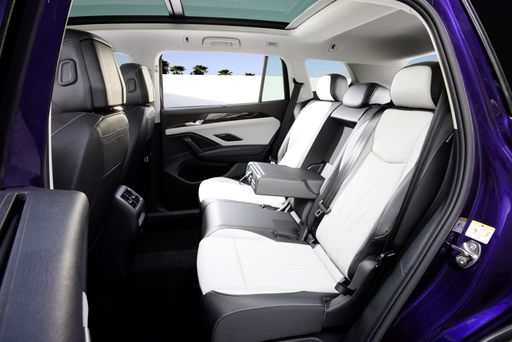
Beyond pure performance, interior space and usability matter most in daily life. This is where you see which car is more practical and versatile.

Both vehicles offer seating for 5 people.

In terms of curb weight, Mazda CX-5 is very slightly lighter – 1,629 kg compared to 1,682 kg. The difference is around 53 kg.

Looking at boot space, the VW Tayron offers markedly more boot space – 885 L compared to 583 L. That’s a difference of about 302 L.

For maximum load capacity, the VW Tayron offers marginally more capacity – up to 2,090 L, about 71 L more than the Mazda CX-5.

When it comes to payload, the Mazda CX-5 carries barely more – 601 kg compared to 566 kg. That’s a difference of about 35 kg.

Who wins the race in the data check?

The VW Tayron stands well ahead of its rival in the objective data comparison.
This result only shows which model scores more points on paper – not which of the two cars feels right for you.

from £39,600
Tayron

VW Tayron

  • Engine Type : Petrol MHEV, Diesel, Petrol, Plugin Hybrid
  • Transmission : Automatic
  • Drive Type : Front-Wheel Drive, All-Wheel Drive
  • Power HP : 150 - 272 HP
  • Consumption L/100km : 1.5 - 8.5 L/100km
  • Electric Range : 116 - 123 km
VW Tayron
Mazda CX-5

Costs and Consumption

View detailed analysis

Engine and Performance

View detailed analysis

Dimensions and Body

View detailed analysis

VW Tayron

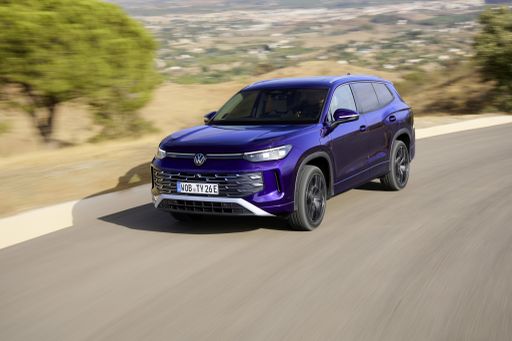
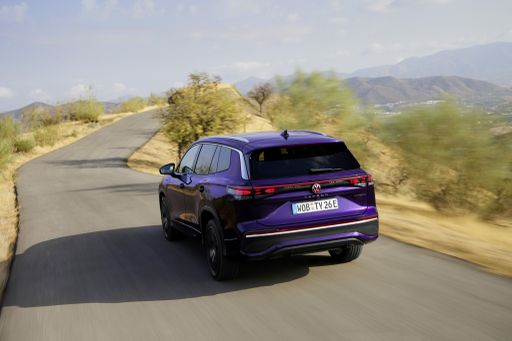
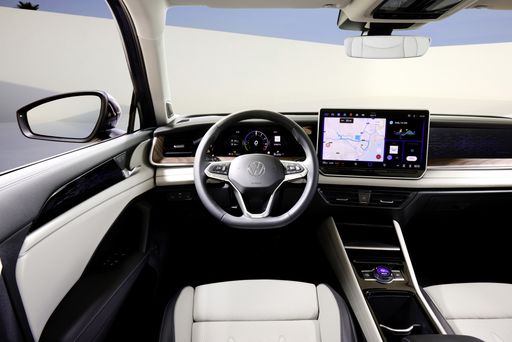
The VW Tayron is Volkswagen's roomy, no-nonsense SUV that pairs clean, familiar styling with a practical cabin built for families and everyday use. It rides comfortably, packs sensible tech and creature comforts, and feels like the sensible sweater of SUVs for buyers who prefer steady value over headline-grabbing drama.

details

Mazda CX-5

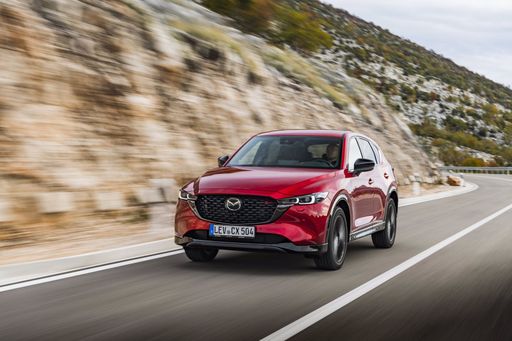
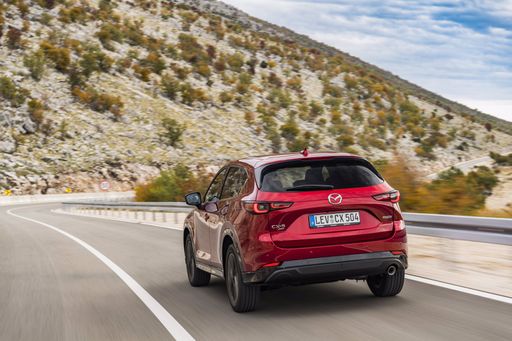
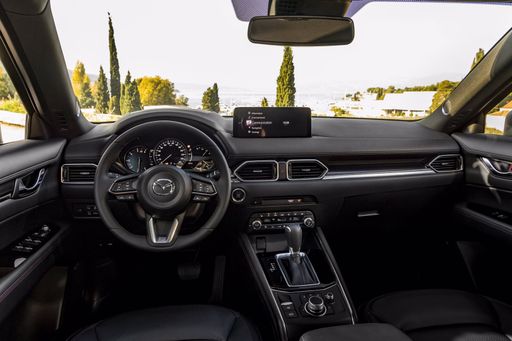
The Mazda CX-5 blends elegant, athletic styling with a surprisingly engaging driving character, turning routine trips into small, satisfying adventures. Inside it feels thoughtfully built and comfortable, offering sensible practicality and a premium feel that punches above its price.

details
VW Tayron
Mazda CX-5

Costs and Consumption

Price
39,600 - 56,000 £
Price
30,000 - 39,500 £
Consumption L/100km
1.5 - 8.5 L/100km
Consumption L/100km
7 - 7.4 L/100km
Consumption kWh/100km
-
Consumption kWh/100km
-
Electric Range
116 - 123 km
Electric Range
-
Battery Capacity
19.7 kWh
Battery Capacity
-
co2
33 - 192 g/km
co2
157 - 168 g/km
Fuel tank capacity
45 - 58 L
Fuel tank capacity
56 - 58 L

Dimensions and Body

Body Type
SUV
Body Type
SUV
Seats
5
Seats
5
Doors
5
Doors
5
Curb weight
1,682 - 1,948 kg
Curb weight
1,629 - 1,671 kg
Trunk capacity
705 - 885 L
Trunk capacity
466 - 583 L
Length
4,792 mm
Length
4,690 mm
Width
1,853 - 1,866 mm
Width
1,860 mm
Height
1,666 - 1,668 mm
Height
1,695 mm
Max trunk capacity
1,915 - 2,090 L
Max trunk capacity
2,019 L
Payload
489 - 566 kg
Payload
601 kg

Engine and Performance

Engine Type
Petrol MHEV, Diesel, Petrol, Plugin Hybrid
Engine Type
Petrol MHEV
Transmission
Automatic
Transmission
Automatic
Transmission Detail
Dual-Clutch Automatic
Transmission Detail
Automatic Gearbox
Drive Type
Front-Wheel Drive, All-Wheel Drive
Drive Type
Front-Wheel Drive, All-Wheel Drive
Power HP
150 - 272 HP
Power HP
141 HP
Acceleration 0-100km/h
6.1 - 9.7 s
Acceleration 0-100km/h
10.5 - 10.9 s
Max Speed
204 - 221 km/h
Max Speed
195 km/h
Torque
250 - 400 Nm
Torque
238 Nm
Number of Cylinders
4
Number of Cylinders
4
Power kW
110 - 200 kW
Power kW
104 kW
Engine capacity
1,498 - 1,984 cm3
Engine capacity
2,488 cm3

General

Model Year
2,025 - 2,026
Model Year
2025
CO2 Efficiency Class
E, F, G, B
CO2 Efficiency Class
F
Brand
VW
Brand
Mazda
DriveDuel uses data analysis and artificial intelligence to evaluate vehicle data and create content. Content is regularly reviewed and improved. The displayed prices are estimates based on German list prices, adjusted to the respective country’s VAT. Country-specific registration taxes are not included. This information is not legally binding.