VS

BMW i5 Touring vs Volvo V90 comparison

Compare performance (601 HP vs 455 HP), boot space and price (62,500 £ vs 62,300 £ ) at a glance. Find out which car is the better choice for you – BMW i5 Touring or Volvo V90?

BMW i5 Touring vs Volvo V90: Key differences

BMW i5 Touring

4.4 (1 Reviews)
rate
  • noticeably more power
  • clearly more electric range
  • visibly quicker 0–100 km/h
  • a bit more trunk space
details

Volvo V90

4 (1 Reviews)
rate
  • marginally cheaper
  • very slightly lighter
details

All details on performance, efficiency, range and trunk space can be found in the technical comparison below – including user reviews for both models.

By Achim Sedelmaier

i5 Touring

When it comes to luxury wagons, the 2024 BMW i5 Touring and the Volvo V90 stand out as two of the most compelling options on the market. Both vehicles boast sophisticated designs, robust performance, and advanced technology. In this comparison, we will delve into the technical specifications and innovations that differentiate these two automotive heavyweights.

V90

Performance and Powertrain

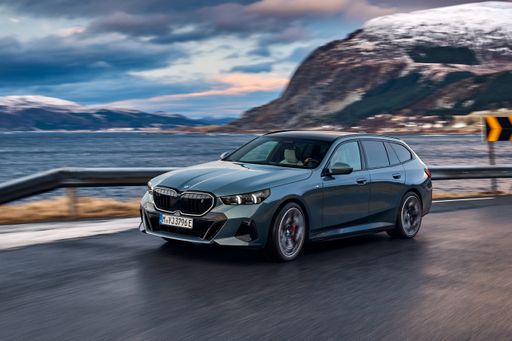
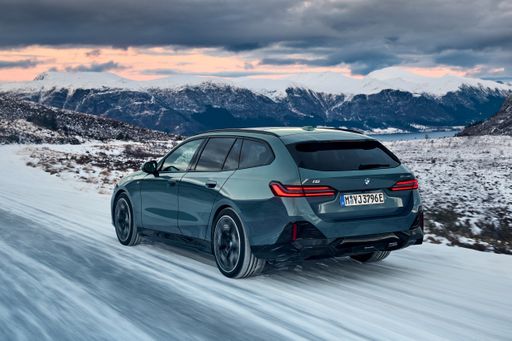
The BMW i5 Touring showcases cutting-edge electric innovation with a powerful dual-motor setup that delivers an impressive 601 horsepower. With an acceleration time of just 3.9 seconds from 0 to 100 km/h, the i5 Touring offers a sprightly performance, making it one of the quickest wagons available. Its electric powertrain is paired with an 81.2 kWh battery, providing a remarkable electric range of up to 560 kilometers.

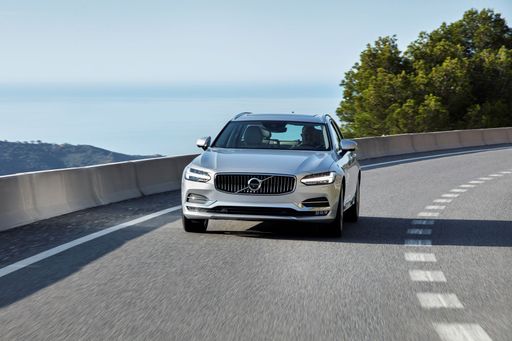
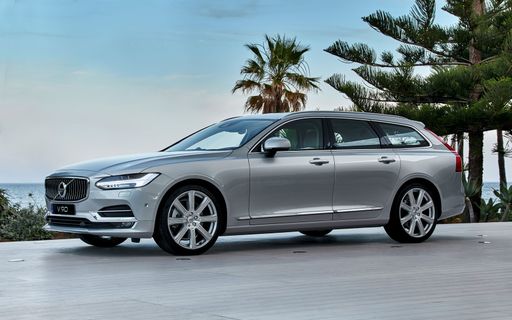
In contrast, the Volvo V90 offers a range of powertrains, including petrol MHEV, diesel MHEV, and plug-in hybrid configurations, with power outputs ranging from 197 to 455 horsepower. The most potent variant, the T8 plug-in hybrid, can accelerate from 0 to 100 km/h in just 4.8 seconds, showcasing competitive performance. However, with a maximum speed limited to 180 km/h, the V90 is not as fast as the i5 Touring.


i5 Touring

Efficiency and Sustainability

In terms of sustainability, the BMW i5 Touring hits the mark with zero tailpipe emissions, boasting a CO2 efficiency class of “A.” Its energy consumption stands at around 18.5 kWh per 100 km, further emphasizing its green credentials. Conversely, the Volvo V90, while offering hybrid options, emits between 160 to 18 g/km of CO2 depending on the variant, indicating that it is less environmentally friendly than the purely electric i5 Touring.

V90

Interior and Comfort

Both vehicles offer upscale interiors designed for maximum comfort and utility. The BMW i5 Touring features a spacious cabin that seats five with a trunk capacity of 570 liters, providing ample storage for family outings or road trips. Additionally, high-tech features such as large infotainment displays and extensive customization options enhance the driving experience.

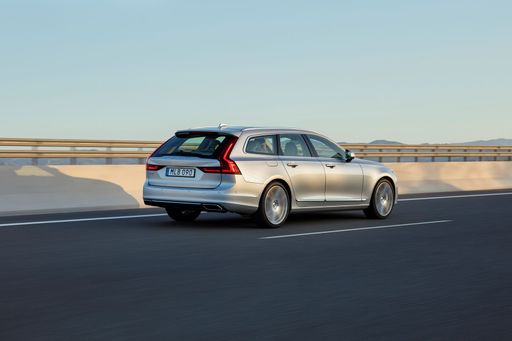
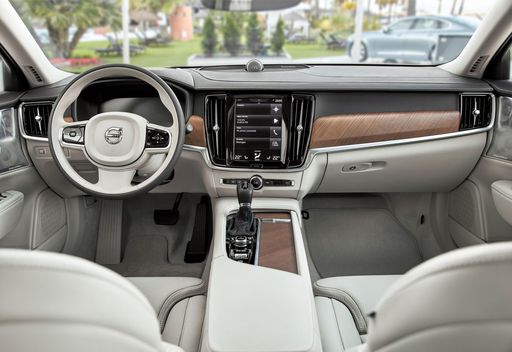
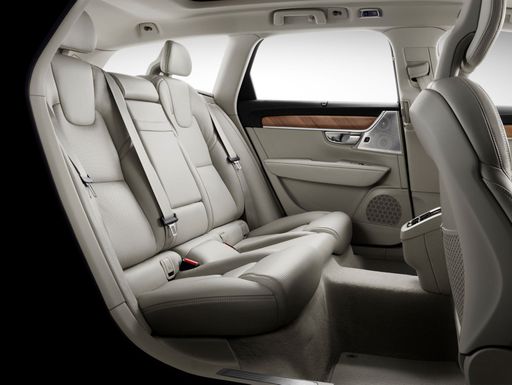
The Volvo V90, while slightly smaller in trunk space at 507 liters, compensates with its Scandinavian design aesthetics that emphasize natural materials and minimalism. Its ergonomic seating and high-quality finishes provide a luxurious environment, making it perfect for long journeys.

Handling and Driving Dynamics

The driving experience in the BMW i5 Touring is electrifying, thanks to its all-wheel-drive configuration and precise steering. The vehicle responds with agility, whether on city roads or winding highways, giving drivers confidence in its capabilities.

The Volvo V90 offers a different experience characterized by comfort over sportiness. It features a well-tuned suspension system that absorbs road imperfections, creating a serene driving environment. Its front-wheel or all-wheel drive options cater to various driving needs, although it may not feel as sporty as the i5 Touring.

Technology and Innovations

Innovation plays a critical role in both models. The BMW i5 Touring is equipped with the latest iDrive system, incorporating advanced connectivity features, voice commands, and a plethora of driver-assistance technologies. Its user interface is designed for intuitive control, ensuring that tech-savvy drivers will feel right at home.

On the other hand, the Volvo V90 harnesses the power of its Pilot Assist system, which provides semi-autonomous driving features for highway navigation. Additionally, the Sensus infotainment system integrates with smartphone platforms seamlessly, keeping drivers connected while on the move.

Conclusion

In summary, the BMW i5 Touring and the Volvo V90 cater to distinct audiences in the luxury wagon segment. The i5 Touring, with its electric innovation, aggressive performance, and zero-emission status, appeals to environmentally conscious enthusiasts seeking a thrilling driving experience. Meanwhile, the Volvo V90 offers a more traditional, comfort-oriented approach with a variety of powertrains, ensuring that it remains a solid choice for those who prioritize luxury and style. Ultimately, your choice will depend on your personal preferences, driving style, and lifestyle needs.

Here’s where it gets real: The technical differences in detail

i5 Touring

Costs and Efficiency:

Looking at overall running costs, both models reveal some interesting differences in everyday economy.

Volvo V90 is marginally cheaper – starting at 62,300 £ , while the BMW i5 Touring costs 62,500 £ . That’s a price difference of around 180 £.

As for electric range, the BMW i5 Touring offers clearly more range – reaching up to 602 km, about 514 km more than the Volvo V90.

V90

Engine and Performance:

Power, torque and acceleration are the classic benchmarks for car enthusiasts – and here, some clear differences start to show.

When it comes to engine power, the BMW i5 Touring offers noticeably more power – delivering 601 HP compared to 455 HP. That’s roughly 146 HP more horsepower.

When accelerating from 0 to 100 km/h, the BMW i5 Touring is visibly quicker – completing the sprint in 3.9 s, while the Volvo V90 takes 4.8 s. That’s about 0.9 s quicker.

There’s also a difference in torque: the BMW i5 Touring delivers moderately more torque with 820 Nm compared to 709 Nm. That’s about 111 Nm more.

i5 Touring

Space and Everyday Use:

Beyond pure performance, interior space and usability matter most in daily life. This is where you see which car is more practical and versatile.

Both vehicles offer seating for 5 people.

In terms of curb weight, Volvo V90 is very slightly lighter – 2,075 kg compared to 2,255 kg. The difference is around 180 kg.

Looking at boot space, the BMW i5 Touring offers a bit more boot space – 570 L compared to 488 L. That’s a difference of about 82 L.

When it comes to payload, the BMW i5 Touring carries only slightly more – 560 kg compared to 515 kg. That’s a difference of about 45 kg.

Who wins the race in the data check?

The BMW i5 Touring stands well ahead of its rival in the objective data comparison.
This result only shows which model scores more points on paper – not which of the two cars feels right for you.

from £62,500
i5 Touring

BMW i5 Touring

  • Engine Type Electric
  • Transmission Automatic
  • Drive Type All-Wheel Drive, Rear-Wheel Drive
  • Power HP 340 - 601 HP
  • Consumption kWh/100km 15.4 - 17.7 kWh/100km
  • Electric Range 522 - 602 km
BMW i5 Touring
Volvo V90

Costs and Consumption

View detailed analysis

Engine and Performance

View detailed analysis

Dimensions and Body

View detailed analysis

BMW i5 Touring

The BMW i5 Touring marries the everyday usefulness of a roomy estate with the hushed, premium feel of a modern electric BMW. It’s an appealing choice for buyers who want confident, relaxed driving and executive poise without sacrificing weekend practicality — and it even makes loading skis feel slightly glamorous.

details

Volvo V90

The Volvo V90 blends Scandinavian elegance with estate practicality, delivering a composed ride and an interior that's both luxurious and perfectly sensible. Packed with clever storage and top-flight safety kit, it's the choice for buyers who want to look classy while hauling life's chaos — without making a fuss about it.

details
BMW i5 Touring
Volvo V90

Costs and Consumption

Price
62,500 - 87,600 £
Price
62,300 - 71,700 £
Consumption L/100km
-
Consumption L/100km
0.8 L/100km
Consumption kWh/100km
15.4 - 17.7 kWh/100km
Consumption kWh/100km
-
Electric Range
522 - 602 km
Electric Range
88 km
Battery Capacity
-
Battery Capacity
14.7 kWh
co2
0 g/km
co2
18 g/km
Fuel tank capacity
-
Fuel tank capacity
60 L

Dimensions and Body

Body Type
Estate
Body Type
Estate
Seats
5
Seats
5
Doors
-
Doors
5
Curb weight
2,255 - 2,425 kg
Curb weight
2,075 kg
Trunk capacity
570 L
Trunk capacity
488 L
Length
-
Length
4,945 mm
Width
1,900 mm
Width
1,879 mm
Height
-
Height
1,472 mm
Max trunk capacity
-
Max trunk capacity
1,454 L
Payload
535 - 560 kg
Payload
515 kg

Engine and Performance

Engine Type
Electric
Engine Type
Plugin Hybrid
Transmission
Automatic
Transmission
Automatic
Transmission Detail
Reduction Gearbox
Transmission Detail
Automatic Gearbox
Drive Type
All-Wheel Drive, Rear-Wheel Drive
Drive Type
All-Wheel Drive
Power HP
340 - 601 HP
Power HP
398 - 455 HP
Acceleration 0-100km/h
3.9 - 6.1 s
Acceleration 0-100km/h
4.8 - 5.5 s
Max Speed
-
Max Speed
180 km/h
Torque
430 - 820 Nm
Torque
659 - 709 Nm
Number of Cylinders
-
Number of Cylinders
4
Power kW
250 - 442 kW
Power kW
293 - 335 kW
Engine capacity
-
Engine capacity
1,969 cm3

General

Model Year
2024
Model Year
2024
CO2 Efficiency Class
A
CO2 Efficiency Class
B
Brand
BMW
Brand
Volvo
DriveDuel uses data analysis and artificial intelligence to evaluate vehicle data and create content. Content is regularly reviewed and improved. The displayed prices are estimates based on German list prices, adjusted to the respective country’s VAT. Country-specific registration taxes are not included. This information is not legally binding.