VS

Ford Kuga vs Vauxhall Grandland comparison

Compare performance (243 HP vs 325 HP), boot space and price (34,200 £ vs 32,600 £ ) at a glance. Find out which car is the better choice for you – Ford Kuga or Vauxhall Grandland?

Ford Kuga vs Vauxhall Grandland: Key differences

Ford Kuga

4.2 (6 Reviews)
rate
  • only slightly lighter

Vauxhall Grandland

5 (1 Reviews)
rate
  • very slightly cheaper
  • clearly more power
  • only slightly more efficient
  • significantly more electric range
  • slightly quicker 0–100 km/h

All details on performance, efficiency, range and trunk space can be found in the technical comparison below – including user reviews for both models.

By Achim Sedelmaier

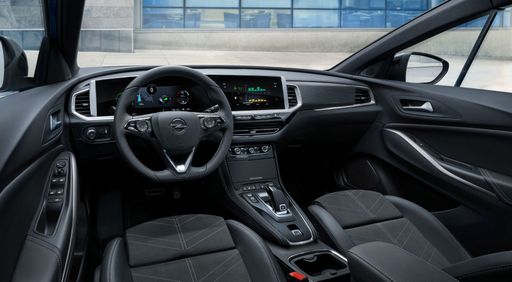
Kuga

The ever-evolving automotive landscape presents a constant challenge for manufacturers to innovate and excel. Among the popular players in the SUV market today are the Ford Kuga and the Opel Grandland. Both models boast impressive features, performance capabilities, and advancements in technology, making them contenders for attention from consumers. Let’s delve into the details, comparing these two esteemed vehicles across various technical aspects and innovations.
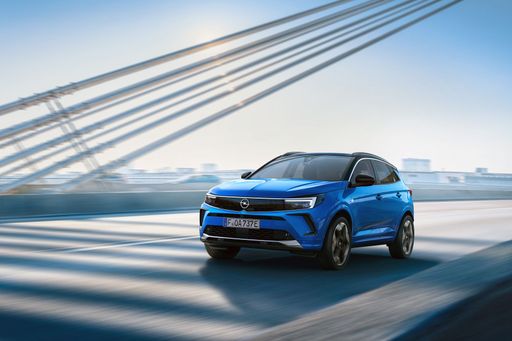
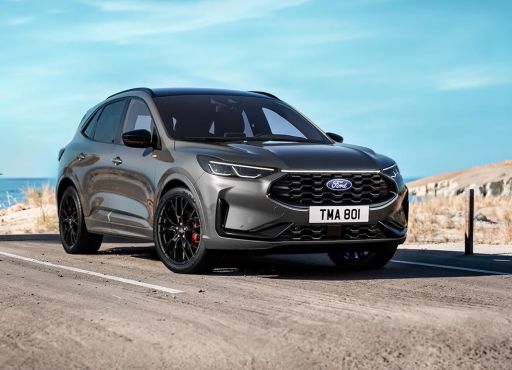
Grandland

Engine Options and Performance

The Ford Kuga offers a range of powertrains that cater to different driving preferences and environmental considerations. From a petrol engine, full hybrids to plug-in hybrids, customers have options that include power outputs ranging from 150 to 243 HP. The Kuga's acceleration from 0-100 km/h spans from a robust 7.3 seconds to a more leisurely 9.5 seconds, depending on the selected engine.

Conversely, the Opel Grandland provides a slightly more streamlined powertrain selection, featuring petrol mild hybrid engines, electric options, and plug-in hybrids. The Grandland’s performance is competitive, with power figures reaching up to 213 HP, and an impressive acceleration capability of 7.8 seconds in its most potent form. On paper, the Grandland has marginally higher maximum speeds, topping out at 220 km/h, compared to the Kuga's peak of 200 km/h.

Kuga

Efficiency and Consumption

Fuel efficiency remains a critical consideration for potential buyers. The Kuga exhibits commendable consumption figures, with conventional petrol variants showing around 6.4 - 5.3 L/100km, while its plug-in hybrid variant offers an astonishing 0.9 L/100km and an electric range of 69 km. It also features a battery capacity of 14.4 kWh, enhancing its eco-friendliness.

In contrast, the Opel Grandland excels in electric driving range, boasting impressive figures of up to 585 km on a full charge. Its efficiency also shines through, with plug-in hybrids showcasing a consumption as low as 0.8 L/100km, and electric consumption figures around 16.9 - 17.7 kWh/100km. Thus, while both models provide significant fuel-economy benefits, the Grandland has a clearer edge in electric range.

Grandland

Interior Comfort and Cargo Capacity

The interior space and comfort are essential components of any SUV. Both the Ford Kuga and Opel Grandland comfortably seat five passengers; however, the Grandland edges ahead with a trunk capacity of 550 liters compared to the Kuga's 412 liters. This means that the Grandland is more suited for families or those requiring additional space for luggage and other items.

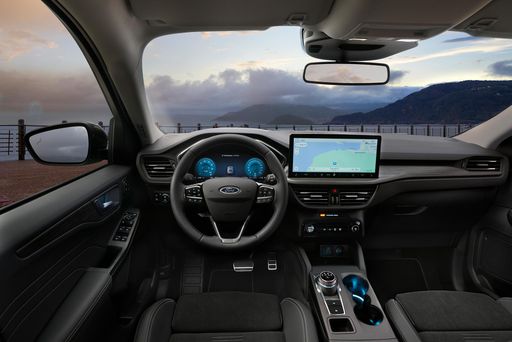
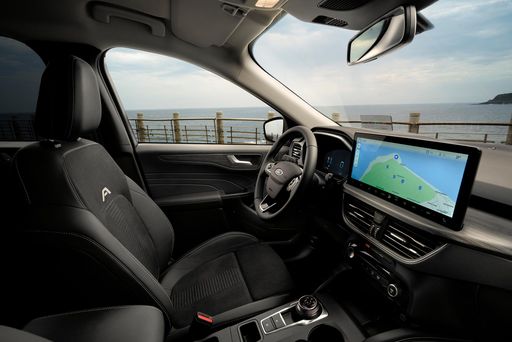
Moreover, both vehicles feature modern infotainment systems equipped with Apple CarPlay and Android Auto. However, the Kuga offers a more intuitive interface and can be upgraded with Ford’s latest driver-assist technologies, including adaptive cruise control and lane-keeping assistance, setting a formidable standard for the market.

Kuga

Technology and Safety Features

Both the Ford Kuga and Opel Grandland come loaded with state-of-the-art technology designed for safety and convenience. The Kuga includes Ford’s Co-Pilot360 suite, which introduces features such as automatic emergency braking, blind-spot monitoring, and a 360-degree camera system. These advancements ensure a secure driving experience for both driver and passengers.

The Grandland also offers a suite of safety features, including advanced driver assistance and collision avoidance technologies. Notably, its IntelliLux LED matrix headlights adjust automatically to surrounding traffic, enhancing visibility while minimizing glare for other road users. While both SUVs prioritize safety, the Kuga’s wider array of cutting-edge technologies may appeal to tech-savvy buyers.

Grandland

Conclusion: Which SUV Reigns Supreme?

In summary, both the Ford Kuga and Opel Grandland present compelling arguments for themselves in an increasingly crowded SUV marketplace. The Kuga shines with its variety of engine options, technological innovations, and engaging driving experience. On the other hand, the Grandland impresses with its electric range, spacious cargo capacity, and comprehensive safety features. Ultimately, the choice between these two vehicles will depend on individual preferences, including desired performance characteristics, fuel efficiency priorities, and the importance of interior space. Each model undoubtedly has its strengths, and discerning buyers will appreciate what both the Ford Kuga and Opel Grandland bring to the table in today's modern automotive landscape.

Here’s where it gets real: The technical differences in detail

Kuga

Costs and Efficiency:

Price and efficiency are key factors when choosing a car – and this is often where the real differences emerge.

Vauxhall Grandland is very slightly cheaper – starting at 32,600 £ , while the Ford Kuga costs 34,200 £ . That’s a price difference of around 1,680 £.

Fuel consumption also shows a difference: the Vauxhall Grandland uses 2.6 L/100km and is only slightly more efficient than the Ford Kuga with 2.8 L/100km. The difference is about 0.2 L/100km.

As for electric range, the Vauxhall Grandland offers significantly more range – reaching up to 694 km, about 626 km more than the Ford Kuga.

Grandland

Engine and Performance:

Under the bonnet, it becomes clear which model is tuned for sportiness and which one takes the lead when you hit the accelerator.

When it comes to engine power, the Vauxhall Grandland offers clearly more power – delivering 325 HP compared to 243 HP. That’s roughly 82 HP more horsepower.

When accelerating from 0 to 100 km/h, the Vauxhall Grandland is slightly quicker – completing the sprint in 6.1 s, while the Ford Kuga takes 7.3 s. That’s about 1.2 s quicker.

There’s also a difference in torque: the Vauxhall Grandland delivers significantly more torque with 509 Nm compared to 240 Nm. That’s about 269 Nm more.

Kuga

Space and Everyday Use:

Beyond pure performance, interior space and usability matter most in daily life. This is where you see which car is more practical and versatile.

Both vehicles offer seating for 5 people.

In terms of curb weight, Ford Kuga is only slightly lighter – 1,526 kg compared to 1,675 kg. The difference is around 149 kg.

When it comes to payload, the Ford Kuga carries marginally more – 550 kg compared to 495 kg. That’s a difference of about 55 kg.

Who wins the race in the data check?

The Vauxhall Grandland is clearly superior overall in the objective data comparison.
This result only shows which model scores more points on paper – not which of the two cars feels right for you.

from £32,600
Grandland

Vauxhall Grandland

  • Engine Type : Electric, Petrol MHEV, Plugin Hybrid
  • Transmission : Automatic
  • Drive Type : Front-Wheel Drive, All-Wheel Drive
  • Power HP : 145 - 325 HP
  • Consumption L/100km : 2.6 - 5.6 L/100km
  • Consumption kWh/100km : 17.8 - 18.6 kWh/100km
  • Electric Range : 82 - 694 km
Ford Kuga
Vauxhall Grandland

Costs and Consumption

View detailed analysis

Engine and Performance

View detailed analysis

Dimensions and Body

View detailed analysis

Ford Kuga

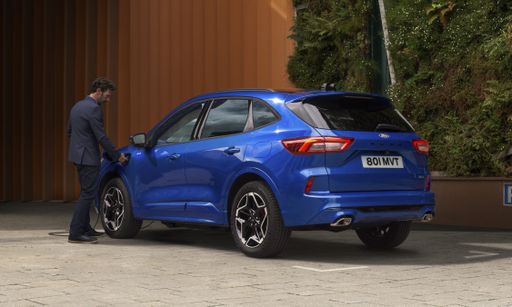
The Kuga is Ford’s adaptable family SUV that blends usable space with a surprisingly lively driving character, making daily commutes and weekend escapes equally enjoyable. With smart interior packaging, an easy-to-use infotainment setup and composed road manners, it’s a sensible choice for buyers who want a bit of fun without the fuss.

details

Vauxhall Grandland

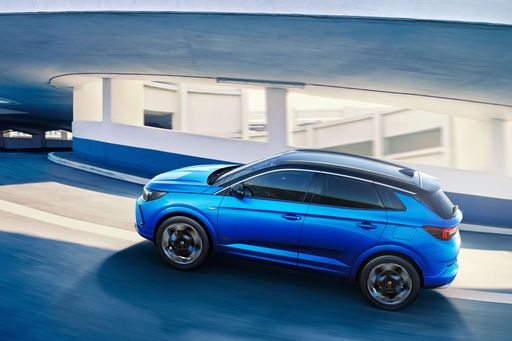
The Opel Grandland feels like a sensible, well-rounded SUV — neat styling, a spacious cabin and a composed ride that turns daily driving into a quietly pleasant experience. It’s a smart choice for buyers who want modern tech, good economy and a dash of German practicality without shouting for attention.

details
Ford Kuga
Vauxhall Grandland

Costs and Consumption

Price
34,200 - 46,300 £
Price
32,600 - 51,400 £
Consumption L/100km
2.8 - 6.8 L/100km
Consumption L/100km
2.6 - 5.6 L/100km
Consumption kWh/100km
-
Consumption kWh/100km
17.8 - 18.6 kWh/100km
Electric Range
68 km
Electric Range
82 - 694 km
Battery Capacity
-
Battery Capacity
-
co2
55 - 154 g/km
co2
0 - 126 g/km
Fuel tank capacity
-
Fuel tank capacity
55 L

Dimensions and Body

Body Type
SUV
Body Type
SUV
Seats
5
Seats
5
Doors
-
Doors
5
Curb weight
1,526 - 1,859 kg
Curb weight
1,675 - 2,325 kg
Trunk capacity
-
Trunk capacity
485 - 550 L
Length
-
Length
4,650 mm
Width
1,882 mm
Width
1,905 mm
Height
-
Height
1,665 mm
Max trunk capacity
-
Max trunk capacity
1,580 - 1,645 L
Payload
541 - 550 kg
Payload
425 - 495 kg

Engine and Performance

Engine Type
Petrol, Full Hybrid, Plugin Hybrid
Engine Type
Electric, Petrol MHEV, Plugin Hybrid
Transmission
Manuel, Automatic
Transmission
Automatic
Transmission Detail
Manual Gearbox, CVT, Automatic Gearbox
Transmission Detail
Reduction Gearbox, Dual-Clutch Automatic
Drive Type
Front-Wheel Drive, All-Wheel Drive
Drive Type
Front-Wheel Drive, All-Wheel Drive
Power HP
150 - 243 HP
Power HP
145 - 325 HP
Acceleration 0-100km/h
7.3 - 9.9 s
Acceleration 0-100km/h
6.1 - 10.2 s
Max Speed
-
Max Speed
170 - 202 km/h
Torque
240 Nm
Torque
230 - 509 Nm
Number of Cylinders
3 - 4
Number of Cylinders
3 - 4
Power kW
111 - 178 kW
Power kW
107 - 239 kW
Engine capacity
1,496 - 2,488 cm3
Engine capacity
1,199 - 1,598 cm3

General

Model Year
2,025
Model Year
2,024 - 2,025
CO2 Efficiency Class
E, D, B
CO2 Efficiency Class
A, D, B
Brand
Ford
Brand
Vauxhall
DriveDuel uses data analysis and artificial intelligence to evaluate vehicle data and create content. Content is regularly reviewed and improved. The displayed prices are estimates based on German list prices, adjusted to the respective country’s VAT. Country-specific registration taxes are not included. This information is not legally binding.