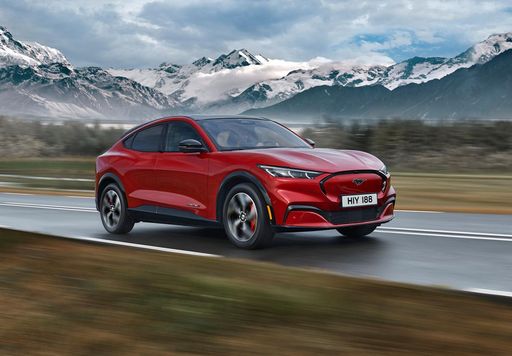
@ Ford Motor Company / Ford Media Center
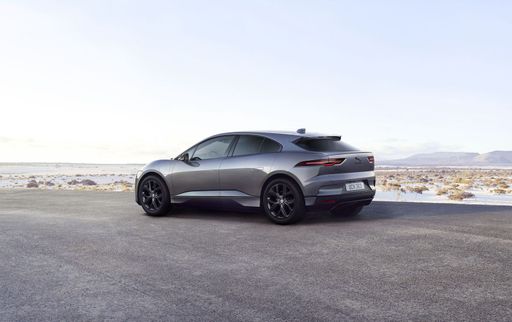
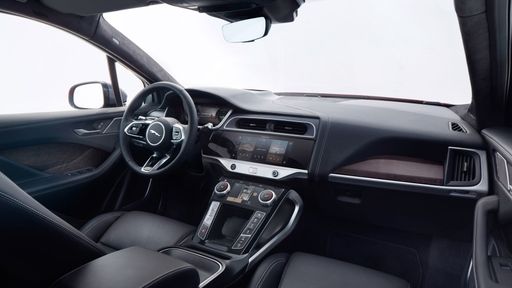
@ Jaguar Land Rover Media
VS

Ford Mustang Mach-E vs Jaguar I-Pace – Which car suits you better?

Compare performance, boot capacity, efficiency and price at a glance.
Find out which car is the better choice for you – Ford Mustang Mach-E or Jaguar I-Pace?

Mustang Mach-E @ Ford Motor Company / Ford Media Center

Electrifying Showdown: Ford Mustang Mach-E vs. Jaguar I-Pace

The electric vehicle market is heating up, and the Ford Mustang Mach-E and Jaguar I-Pace are two stellar examples leading the charge. Both cars offer a blend of performance, luxury, and innovation, making them formidable contenders in the electric SUV segment. But how do they stack up against each other? Let's dive into the technical aspects and innovations of these electrified pace-setters.
I-Pace @ Jaguar Land Rover Media

Power and Performance

The Ford Mustang Mach-E comes with a range of power levels. Starting with the baseline model, it offers 269 horsepower in the rear-wheel-drive configuration and scales up to an impressive 487 horsepower in the high-performance models. Acceleration from 0 to 100 km/h ranges from 7.3 seconds for the modest configurations to a neck-snapping 3.5 seconds for top-spec models. The Mustang Mach-E boasts a maximum speed of 200 km/h.

Meanwhile, the Jaguar I-Pace delivers a consistent 400 horsepower with all-wheel drive, ensuring solid performance across the board. It accelerates from 0 to 100 km/h in 4.8 seconds, which makes it a thrilling ride. The I-Pace matches the Mach-E with a top speed of 200 km/h.

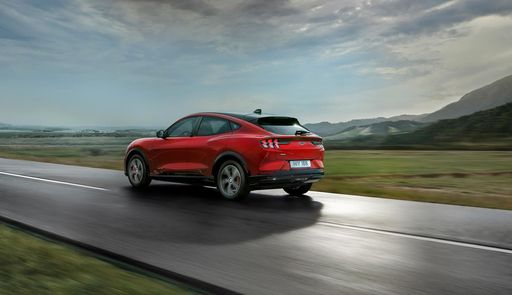
Mustang Mach-E @ Ford Motor Company / Ford Media Center

Efficiency and Range

When it comes to battery capacity, the Mustang Mach-E offers options with capacities of up to 91 kWh, facilitating a substantial electric range of up to 600 km, depending on the configuration. Ford has managed to provide competitive efficiency, with consumption figures ranging from 17.3 to 21.3 kWh per 100 km.

The Jaguar I-Pace features a slightly smaller battery at 84.7 kWh, providing an electric range of 469 km. The I-Pace has a consumption rate of 25.2 kWh per 100 km, making it less efficient than the Mach-E. Both vehicles uphold impeccable CO2 efficiency classes, contributing zero emissions.

I-Pace @ Jaguar Land Rover Media

Design and Dimensions

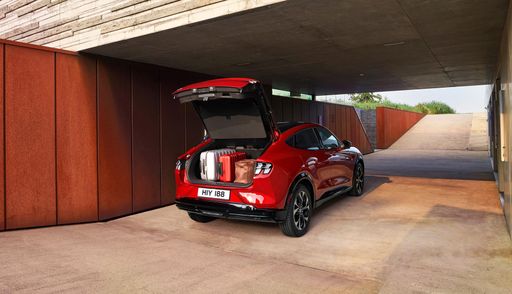
In terms of dimensions, the Mach-E has a length ranging up to 4750 mm, a width of 1882 mm, and a height of up to 1648 mm, offering a substantial road presence. It provides a trunk capacity of 402 liters, which, while adequate, falls short of its competitor.

The I-Pace, on the other hand, is slightly more compact with a length of 4682 mm; however, it is wider at 2011 mm and lower in height at 1566 mm. Its design provides a generous trunk space of 638 liters, which is notably larger than the Mach-E, making it more practical for transporting cargo or luggage.

Mustang Mach-E @ Ford Motor Company / Ford Media Center

Conclusion: Choosing Your Ride

Both the Ford Mustang Mach-E and Jaguar I-Pace bring compelling arguments to the table. The Mach-E offers more range options, versatility in power and drivetrain configurations, and a broader electric range, appealing to those seeking flexibility and long-distance capability. Meanwhile, the Jaguar I-Pace offers a more consistent performance output and a spacious interior, emphasizing luxury and daily practicality.

Ultimately, the choice between these two electrifying SUVs boils down to individual priorities—whether it’s range, performance flexibility, or luxury that takes the front seat. Both vehicles are a testament to the impressive advancements in electric vehicle technology, paving the road for an exciting automotive future.

Here’s where it gets real: The technical differences in detail

I-Pace @ Jaguar Land Rover Media

Costs and Efficiency:

Looking at overall running costs, both models reveal some interesting differences in everyday economy.

Ford Mustang Mach-E has a convincingly advantage in terms of price – it starts at 48400 £, while the Jaguar I-Pace costs 79200 £. That’s a price difference of around 30772 £.

In terms of energy consumption, the advantage goes to the Ford Mustang Mach-E: with 17.70 kWh per 100 km, it’s clearly more efficient than the Jaguar I-Pace with 25.20 kWh. That’s a difference of about 7.50 kWh.

As for range, the Ford Mustang Mach-E performs distinct better – achieving up to 600 km, about 131 km more than the Jaguar I-Pace.

Mustang Mach-E @ Ford Motor Company / Ford Media Center

Engine and Performance:

Power, torque and acceleration are the classic benchmarks for car enthusiasts – and here, some clear differences start to show.

When it comes to engine power, the Ford Mustang Mach-E has a to a small extent edge – offering 487 HP compared to 400 HP. That’s roughly 87 HP more horsepower.

In acceleration from 0 to 100 km/h, the Ford Mustang Mach-E is clearly perceptible quicker – completing the sprint in 3.80 s, while the Jaguar I-Pace takes 4.80 s. That’s about 1 s faster.

There’s no difference in top speed – both reach 200 km/h.

There’s also a difference in torque: Ford Mustang Mach-E pulls distinct stronger with 950 Nm compared to 696 Nm. That’s about 254 Nm difference.

Space and Everyday Use:

Cabin size, boot volume and payload all play a role in everyday practicality. Here, comfort and flexibility make the difference.

Both vehicles offer seating for 5 people.

In curb weight, Ford Mustang Mach-E is barely noticeable lighter – 2161 kg compared to 2226 kg. The difference is around 65 kg.

In terms of boot space, the Jaguar I-Pace offers to a small extent more room – 638 L compared to 519 L. That’s a difference of about 119 L.

In maximum load capacity, the Jaguar I-Pace performs slight better – up to 1453 L, which is about 33 L more than the Ford Mustang Mach-E.

When it comes to payload, Ford Mustang Mach-E slight takes the win – 450 kg compared to 444 kg. That’s a difference of about 6 kg.

Who wins the race?

The Ford Mustang Mach-E proves to be dominates this comparison and therefore becomes our DriveDuel Champion!
Ford Mustang Mach-E is the better all-rounder in this comparison.

from about £48,400
Mustang Mach-E @ Ford Motor Company / Ford Media Center

Ford Mustang Mach-E

  • Engine Type : Electric
  • Transmission : Automatic
  • Drive Type : Rear-Wheel Drive, All-Wheel Drive
  • Power HP : 268 - 487 HP
  • Consumption kWh/100km : 17.7 - 21 kWh
  • Electric Range : 470 - 600 km

Ford Mustang Mach-E

5 (1)
rate

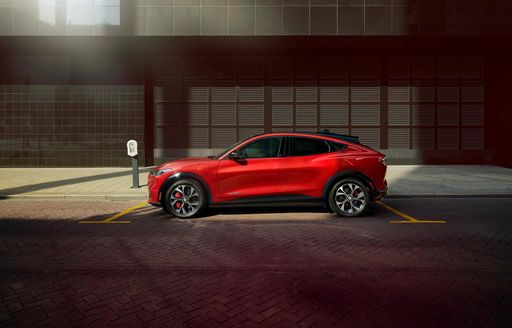
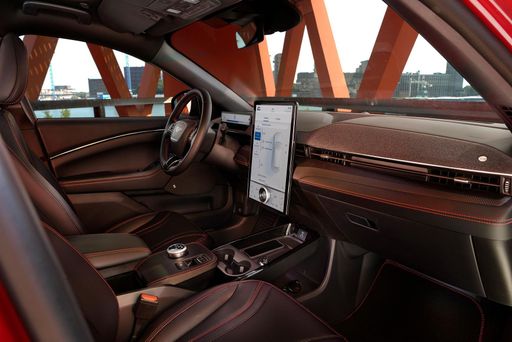
The Ford Mustang Mach-E marks a new chapter in the legacy of the iconic American brand, combining classic muscle car aesthetics with modern electric vehicle technology. Its sleek design captures the spirit of innovation while offering a spacious and tech-savvy interior for enhanced driving comfort. The Mach-E promises an exhilarating driving experience, packed with cutting-edge features that set a new standard for electric SUVs.

details

Jaguar I-Pace

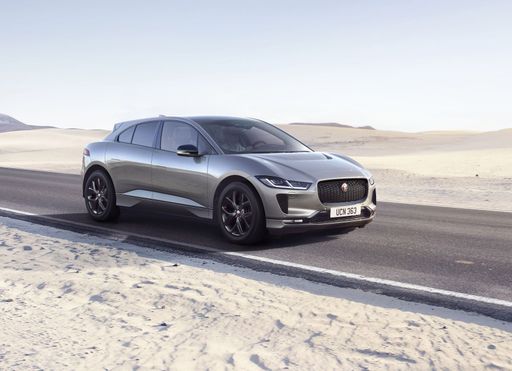
The Jaguar I-Pace represents a remarkable fusion of cutting-edge electric performance and iconic British luxury. With its sleek design and spacious interior, this model redefines what one can expect from an electric vehicle in terms of style and comfort. Its impressive driving dynamics and advanced technology make it a standout choice for those looking to make a statement on the road.

details
Ford Mustang Mach-E
Jaguar I-Pace
Mustang Mach-E @ Ford Motor Company / Ford Media Center
I-Pace @ Jaguar Land Rover Media

Costs and Consumption

Price
48400 - 66900 £
Price
79200 - 85500 £
Consumption L/100km
-
Consumption L/100km
-
Consumption kWh/100km
17.7 - 21 kWh
Consumption kWh/100km
25.20 kWh
Electric Range
470 - 600 km
Electric Range
469 km
Battery Capacity
73 - 91 kWh
Battery Capacity
84.70 kWh
co2
0 g/km
co2
0 g/km
Fuel tank capacity
-
Fuel tank capacity
-

Dimensions and Body

Body Type
SUV
Body Type
SUV
Seats
5
Seats
5
Doors
5
Doors
5
Curb weight
2161 - 2351 kg
Curb weight
2226 kg
Trunk capacity
519 L
Trunk capacity
638 L
Length
4713 - 4743 mm
Length
4682 mm
Width
1881 mm
Width
2011 mm
Height
1613 - 1624 mm
Height
1566 mm
Max trunk capacity
1345 - 1420 L
Max trunk capacity
1453 L
Payload
368 - 450 kg
Payload
444 kg

Engine and Performance

Engine Type
Electric
Engine Type
Electric
Transmission
Automatic
Transmission
Automatic
Transmission Detail
Reduction Gearbox
Transmission Detail
Reduction Gearbox
Drive Type
Rear-Wheel Drive, All-Wheel Drive
Drive Type
All-Wheel Drive
Power HP
268 - 487 HP
Power HP
400 HP
Acceleration 0-100km/h
3.8 - 6.2 s
Acceleration 0-100km/h
4.80 s
Max Speed
180 - 200 km/h
Max Speed
200 km/h
Torque
525 - 950 Nm
Torque
696 Nm
Number of Cylinders
-
Number of Cylinders
-
Power kW
197 - 358 kW
Power kW
294 kW
Engine capacity
-
Engine capacity
-

General

Model Year
2025
Model Year
2023
CO2 Efficiency Class
A
CO2 Efficiency Class
A
Brand
Ford
Brand
Jaguar
What drive types are available for the Ford Mustang Mach-E?

The Ford Mustang Mach-E is offered with Rear-Wheel Drive or All-Wheel Drive.

The prices and data displayed are estimates based on German list prices and may vary by country. This information is not legally binding.