VS

Mazda 3 Sedan vs Hyundai i30 comparison

Compare performance (186 HP vs 150 HP), boot space and price (25,400 £ vs 24,600 £ ) at a glance. Find out which car is the better choice for you – Mazda 3 Sedan or Hyundai i30?

Mazda 3 Sedan vs Hyundai i30: Key differences

Mazda 3 Sedan

4.7 (1 Reviews)
rate
  • slightly more power
  • marginally more efficient
  • barely quicker 0–100 km/h
  • slightly more trunk space
details

Hyundai i30

4.3 (2 Reviews)
rate
  • very slightly cheaper
  • very slightly lighter
details

By Achim Sedelmaier

3 Sedan

The Battle of Compacts: Hyundai i30 vs. Mazda 3 Sedan

In the ever-evolving landscape of compact cars, two strong contenders are staking their claim: the Hyundai i30 and the Mazda 3 Sedan. Both geared for the discerning driver, these models bring a host of innovative features and robust technical specs that promise a thrilling experience on the road. Let’s delve into the specifics and see how they compare.
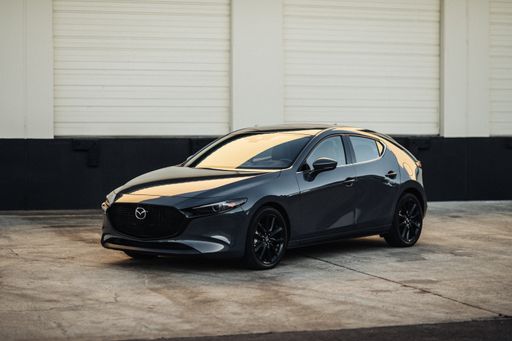
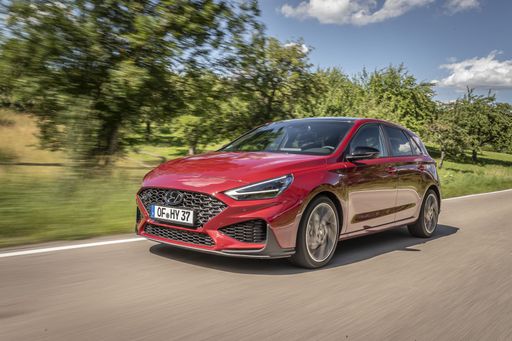
i30

Engine Performance and Efficiency

The Hyundai i30 offers a choice between petrol and petrol mild-hybrid electric vehicle (MHEV) engine types, providing flexibility for buyers focusing on power and efficiency. The 1.0-liter three-cylinder engine delivers a modest 100 HP, while the more potent 1.5-liter four-cylinder boosts output up to 140 HP. Both variants keep fuel consumption low, ranging from 5.6 to 5.9 L/100 km.

On the other hand, the Mazda 3 Sedan packs a punch with its 2.0-liter and 2.5-liter petrol MHEV engines, churning out between 140 and an impressive 186 HP. Despite the higher power output, the Mazda maintains fuel efficiency with consumption between 5.5 and 5.9 L/100 km, thanks to its advanced Skyactiv technology.

Transmission and Driving Dynamics

Both the i30 and Mazda 3 offer manual and automatic transmission options, emphasizing the importance of a personalized driving experience. Hyundai's dual-clutch automatic gearbox ensures a smooth shift, enhancing the driving pleasure of the i30.

The Mazda 3 handles transmission duties with a keen focus on driving dynamics, thanks to its fine-tuned automatic and manual gearboxes that deliver a responsive and engaging ride. Front-wheel drive configurations in both vehicles ensure optimal power distribution and fuel economy.

Design and Dimensions

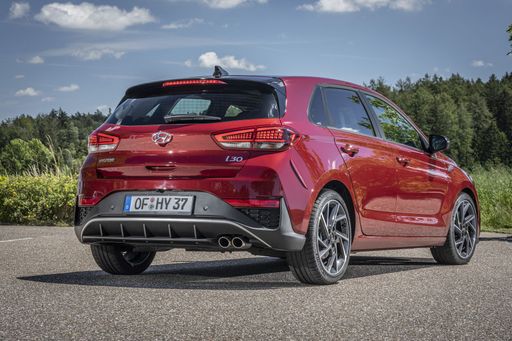
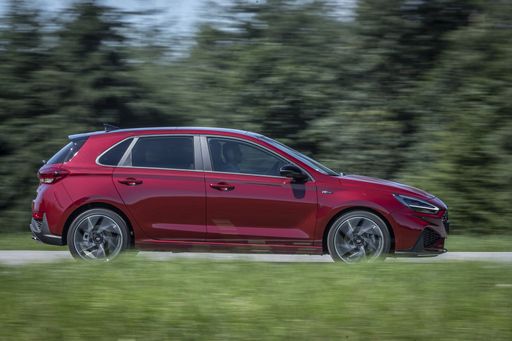
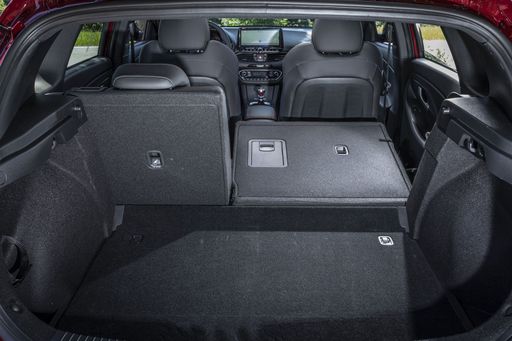
When it comes to aesthetics, the Hyundai i30, with its hatchback design, offers a compact form that is perfect for urban environments. It measures 4,340 mm in length, 1,795 mm in width, and 1,455 mm in height, providing a well-balanced appearance and a functional 395-liter trunk capacity.

The Mazda 3 showcases a sleek sedan profile, stretching 4,660 mm in length with the same width of 1,795 mm, albeit slightly lower in height at 1,440 mm. It offers a more spacious trunk capacity of 450 liters, making it a practical choice for longer journeys.

Interior Space and Features

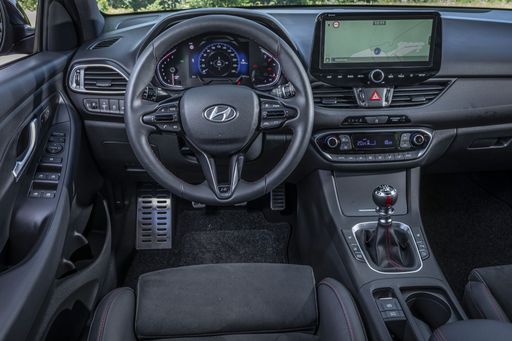
Both cars comfortably seat five occupants, paying close attention to interior ergonomics and comfort. The Hyundai i30’s cabin is space-efficient and modern, with intuitive controls and ample room for front and rear passengers. It weighs between 1,291 to 1,407 kg, contributing to its agile handling.

The Mazda 3's interior is a step up with premium materials and a driver-centric design. It boasts a slightly higher curb weight ranging from 1,420 to 1,492 kg, which adds to its substantial on-road presence and comfort in driving.

Safety and Technology

When it comes to safety, both models come equipped with a robust suite of driver-assistance technologies. The Hyundai SmartSense system offers adaptive cruise control, lane-keeping assist, and emergency braking, among others.

The Mazda 3 is not far behind, boasting the i-Activsense safety suite which includes features like rear cross-traffic alert, lane departure warning, and adaptive cruise control. Both cars sit in the CO2 efficiency class D, with the i30 emitting between 126-133 g/km of CO2, while the Mazda 3 ranges from 123-135 g/km.

Conclusion

Choosing between the Hyundai i30 and the Mazda 3 Sedan requires careful consideration of one's priorities. For drivers prioritizing agility, urban maneuverability, and a variety of engine options, the i30 stands out. Conversely, the Mazda 3 appeals to those seeking enhanced power, a more luxurious interior, and superior trunk space.

Ultimately, both cars offer compelling packages with advanced technological features and admirable performance characteristics, making either choice a testament to modern automotive engineering.

Here’s where it gets real: The technical differences in detail

3 Sedan

Costs and Efficiency:

Price and efficiency are key factors when choosing a car – and this is often where the real differences emerge.

Hyundai i30 is very slightly cheaper – starting at 24,600 £ , while the Mazda 3 Sedan costs 25,400 £ . That’s a price difference of around 891 £.

Fuel consumption also shows a difference: the Mazda 3 Sedan uses 5.5 L/100km and is marginally more efficient than the Hyundai i30 with 5.9 L/100km. The difference is about 0.4 L/100km.

i30

Engine and Performance:

Power, torque and acceleration say a lot about how a car feels on the road. This is where you see which model delivers more driving dynamics.

When it comes to engine power, the Mazda 3 Sedan offers slightly more power – delivering 186 HP compared to 150 HP. That’s roughly 36 HP more horsepower.

When accelerating from 0 to 100 km/h, the Mazda 3 Sedan is barely quicker – completing the sprint in 8.1 s, while the Hyundai i30 takes 8.9 s. That’s about 0.8 s quicker.

There’s also a difference in torque: the Hyundai i30 delivers very slightly more torque with 250 Nm compared to 240 Nm. That’s about 10 Nm more.

Space and Everyday Use:

Cabin size, boot volume and payload all play a role in everyday practicality. Here, comfort and flexibility make the difference.

Both vehicles offer seating for 5 people.

In terms of curb weight, Hyundai i30 is very slightly lighter – 1,315 kg compared to 1,417 kg. The difference is around 102 kg.

Looking at boot space, the Mazda 3 Sedan offers slightly more boot space – 450 L compared to 395 L. That’s a difference of about 55 L.

When it comes to payload, the Mazda 3 Sedan carries barely more – 501 kg compared to 485 kg. That’s a difference of about 16 kg.

Who wins the race in the data check?

The Mazda 3 Sedan stands well ahead of its rival in the objective data comparison.
This result only shows which model scores more points on paper – not which of the two cars feels right for you.

from £25,400
3 Sedan

Mazda 3 Sedan

  • Engine Type Petrol MHEV
  • Transmission Manuel, Automatic
  • Drive Type Front-Wheel Drive
  • Power HP 140 - 186 HP
  • Consumption L/100km 5.5 - 6 L/100km
Mazda 3 Sedan
Hyundai i30

Costs and Consumption

View detailed analysis

Engine and Performance

View detailed analysis

Dimensions and Body

View detailed analysis

Mazda 3 Sedan

The Mazda 3 Sedan dresses like a compact premium car, with sculpted lines and an interior that punches well above its class. It rewards drivers with eager handling and a composed, comfortable ride that turns routine runs into something a bit more enjoyable — proof that style and substance can share the same key.

details

Hyundai i30

The Hyundai i30 proves that sensible can also be stylish, offering a confident driving character wrapped in neat, modern design. It serves up a roomy, well-equipped cabin and composed ride that make everyday motoring feel like a clever purchase rather than a compromise.

details
Mazda 3 Sedan
Hyundai i30

Costs and Consumption

Price
25,400 - 34,700 £
Price
24,600 - 31,400 £
Consumption L/100km
5.5 - 6 L/100km
Consumption L/100km
5.9 - 6.3 L/100km
Consumption kWh/100km
-
Consumption kWh/100km
-
Electric Range
-
Electric Range
-
Battery Capacity
-
Battery Capacity
-
co2
123 - 137 g/km
co2
134 - 142 g/km
Fuel tank capacity
-
Fuel tank capacity
-

Dimensions and Body

Body Type
Sedan
Body Type
Hatchback
Seats
5
Seats
5
Doors
-
Doors
-
Curb weight
1,417 - 1,468 kg
Curb weight
1,315 - 1,435 kg
Trunk capacity
450 L
Trunk capacity
395 L
Length
-
Length
-
Width
1,795 mm
Width
1,795 mm
Height
-
Height
-
Max trunk capacity
-
Max trunk capacity
-
Payload
482 - 501 kg
Payload
445 - 485 kg

Engine and Performance

Engine Type
Petrol MHEV
Engine Type
Petrol
Transmission
Manuel, Automatic
Transmission
Manuel, Automatic
Transmission Detail
Manual Gearbox, Automatic Gearbox
Transmission Detail
Manual Gearbox, Dual-Clutch Automatic
Drive Type
Front-Wheel Drive
Drive Type
Front-Wheel Drive
Power HP
140 - 186 HP
Power HP
115 - 150 HP
Acceleration 0-100km/h
8.1 - 9.8 s
Acceleration 0-100km/h
8.9 - 11.7 s
Max Speed
-
Max Speed
-
Torque
238 - 240 Nm
Torque
172 - 250 Nm
Number of Cylinders
4
Number of Cylinders
3 - 4
Power kW
103 - 137 kW
Power kW
85 - 110 kW
Engine capacity
1,998 - 2,488 cm3
Engine capacity
998 - 1,598 cm3

General

Model Year
2026
Model Year
2026
CO2 Efficiency Class
D, E
CO2 Efficiency Class
D, E
Brand
Mazda
Brand
Hyundai
DriveDuel uses data analysis and artificial intelligence to evaluate vehicle data and create content. Content is regularly reviewed and improved. The displayed prices are estimates based on German list prices, adjusted to the respective country’s VAT. Country-specific registration taxes are not included. This information is not legally binding.