VS

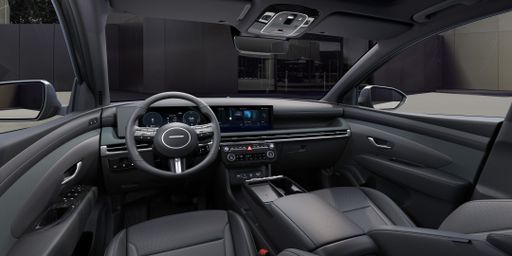
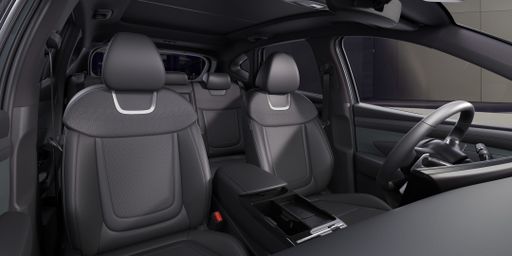
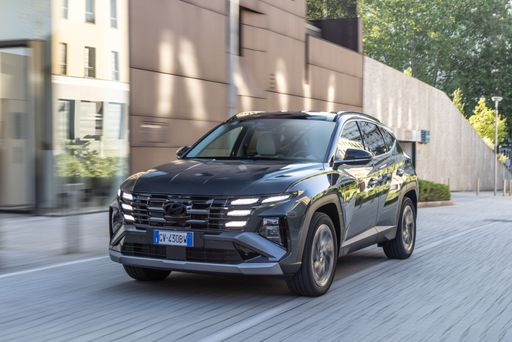
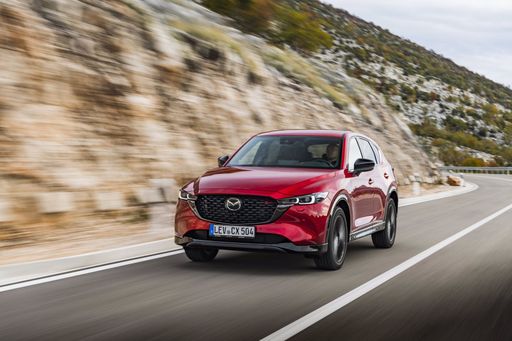
Mazda CX-5 vs Hyundai Tucson comparison

Compare performance (141 HP vs 288 HP), boot space and price (30,000 £ vs 20,900 £ ) at a glance. Find out which car is the better choice for you – Mazda CX-5 or Hyundai Tucson?

Mazda CX-5 vs Hyundai Tucson: Key differences

Mazda CX-5

4.6 (7 Reviews)
rate

Hyundai Tucson

4.6 (4 Reviews)
rate
  • considerably cheaper
  • substantially more power
  • substantially more efficient
  • noticeably quicker 0–100 km/h
  • marginally lighter
  • very slightly more trunk space

All details on performance, efficiency, range and trunk space can be found in the technical comparison below – including user reviews for both models.

CX-5

Head-to-Head: Hyundai Tucson vs. Mazda CX-5

In the ever-competitive segment of compact SUVs, two contenders consistently vying for attention are the Hyundai Tucson and the Mazda CX-5. Both vehicles bring unique strengths and innovations to the table, appealing to a broad range of car enthusiasts and casual drivers alike. Let's dive into a comprehensive comparison of these two popular models, focusing on their latest versions equipped with cutting-edge technology.
Tucson

Technical Specifications

The Hyundai Tucson 2024 comes with a diverse engine lineup including options like Diesel Mild Hybrid Electric Vehicle (MHEV), Petrol MHEV, Petrol, Full Hybrid, and Plugin Hybrid. This variety caters to different driving preferences and environmental considerations. On the other hand, the Mazda CX-5 offers Petrol MHEV and Diesel engines, giving drivers a blend of efficiency and power.

Both models offer modern transmission options. The Tucson provides dual-clutch automatic, manual, and standard automatic gearboxes, while the CX-5 offers manual and automatic transmissions. The drive type for both vehicles includes front-wheel drive and all-wheel drive options, providing adaptability for various terrains and driving needs.

CX-5

Power and Performance

When it comes to power, the Hyundai Tucson offers a range topping at 252 HP, while the Mazda CX-5 isn't far behind with its maximum output at 194 HP. The Tucson’s acceleration from 0-100km/h varies from 7.9 to 11.6 seconds, showing agility in multiple engine variants. Conversely, the CX-5 boasts acceleration figures between 9.2 and 11.1 seconds, making it a robust performer on the road.

In terms of maximum speed, the CX-5 shows a slight edge with top speeds reaching up to 208 km/h compared to Tucson’s 194 km/h. This advantage might appeal to those looking for a bit more thrill and speed on highways.

Tucson

Fuel Efficiency and Emissions

The fuel consumption of Hyundai Tucson varies, with the plugin hybrid variant showing impressive efficiency at just 1.2 L/100km. The Mazda CX-5, while slightly less efficient, offers reasonable consumption starting from 5.6 L/100km. Tucson's CO2 emissions begin at 22 g/km for hybrid models, presenting a cleaner option than the CX-5, whose emissions start from 146 g/km.

CX-5

Design and Capacity

Inside, both SUVs provide a spacious environment with seating for five. The trunk capacity is a crucial consideration for those who require extra space. The Tucson excels with a capacity that can go up to 620 liters, whereas the CX-5 offers up to 522 liters. This difference might sway buyers who prioritize cargo space.

Tucson

Dimensions and Practicality

Size-wise, the Tucson measures at 4510-4520mm in length, 1865mm in width, and 1650mm in height. The Mazda CX-5 is slightly longer and taller, measuring 4575mm in length, 1845mm in width, and 1680mm in height. These dimensions suggest that the CX-5 could offer more headroom, although the Tucson might benefit from a broader stance for stability.

Conclusion: A Close Call

Both the Hyundai Tucson and Mazda CX-5 are equipped with impressive features and technology that cater to different tastes and needs. The Tucson shines in terms of engine variety and CO2 efficiency, while the CX-5 boasts performance speed and classic Mazda styling. Ultimately, the choice between these two might come down to personal preference and specific priorities such as efficiency, speed, or space.

Here’s where it gets real: The technical differences in detail

CX-5

Costs and Efficiency:

Price and efficiency are key factors when choosing a car – and this is often where the real differences emerge.

Hyundai Tucson is considerably cheaper – starting at 20,900 £ , while the Mazda CX-5 costs 30,000 £ . That’s a price difference of around 9,094 £.

Fuel consumption also shows a difference: the Hyundai Tucson uses 2.7 L/100km and is substantially more efficient than the Mazda CX-5 with 7 L/100km. The difference is about 4.3 L/100km.

Tucson

Engine and Performance:

Power, torque and acceleration say a lot about how a car feels on the road. This is where you see which model delivers more driving dynamics.

When it comes to engine power, the Hyundai Tucson offers substantially more power – delivering 288 HP compared to 141 HP. That’s roughly 147 HP more horsepower.

When accelerating from 0 to 100 km/h, the Hyundai Tucson is noticeably quicker – completing the sprint in 7.5 s, while the Mazda CX-5 takes 10.5 s. That’s about 3 s quicker.

Looking at top speed, the Hyundai Tucson is marginally faster – reaching 204 km/h, while the Mazda CX-5 tops out at 195 km/h. The difference is around 9 km/h.

There’s also a difference in torque: the Hyundai Tucson delivers markedly more torque with 379 Nm compared to 238 Nm. That’s about 141 Nm more.

CX-5

Space and Everyday Use:

Whether family car or daily driver – which one offers more room, flexibility and comfort?

Both vehicles offer seating for 5 people.

In terms of curb weight, Hyundai Tucson is marginally lighter – 1,542 kg compared to 1,629 kg. The difference is around 87 kg.

Looking at boot space, the Hyundai Tucson offers very slightly more boot space – 620 L compared to 583 L. That’s a difference of about 37 L.

For maximum load capacity, the Mazda CX-5 offers moderately more capacity – up to 2,019 L, about 220 L more than the Hyundai Tucson.

When it comes to payload, the Mazda CX-5 carries marginally more – 601 kg compared to 545 kg. That’s a difference of about 56 kg.

Who wins the race in the data check?

The Hyundai Tucson is far ahead overall in the objective data comparison.
This result only shows which model scores more points on paper – not which of the two cars feels right for you.

from £20,900
Tucson

Hyundai Tucson

  • Engine Type : Petrol, Full Hybrid, Plugin Hybrid, Diesel MHEV
  • Transmission : Manuel, Automatic
  • Drive Type : Front-Wheel Drive, All-Wheel Drive
  • Power HP : 136 - 288 HP
  • Consumption L/100km : 2.7 - 7.6 L/100km
  • Electric Range : 63 - 70 km
Mazda CX-5
Hyundai Tucson

Costs and Consumption

View detailed analysis

Engine and Performance

View detailed analysis

Dimensions and Body

View detailed analysis

Mazda CX-5

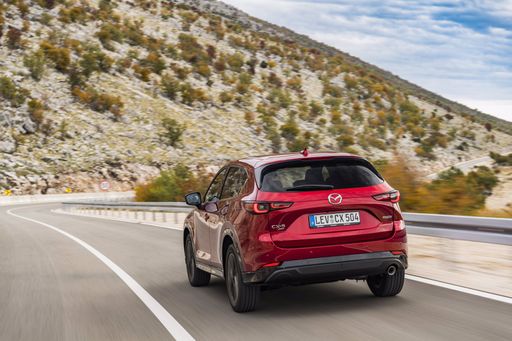
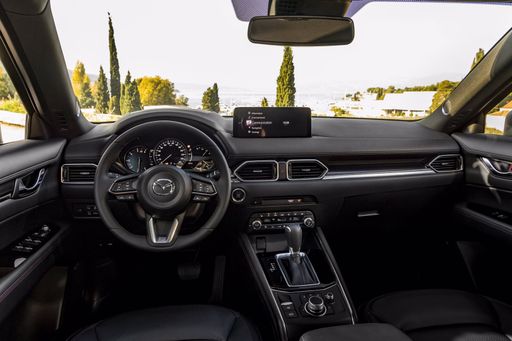
The Mazda CX-5 blends elegant, athletic styling with a surprisingly engaging driving character, turning routine trips into small, satisfying adventures. Inside it feels thoughtfully built and comfortable, offering sensible practicality and a premium feel that punches above its price.

details

Hyundai Tucson

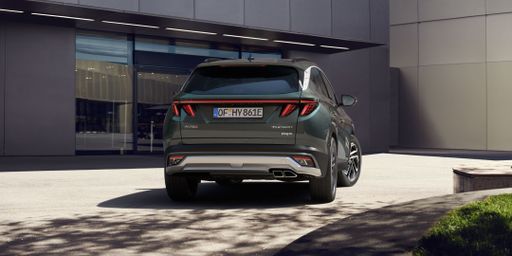
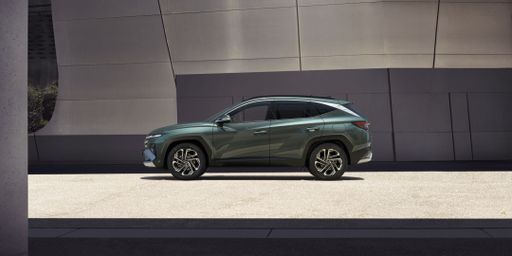
Hyundai Tucson marries bold, sculpted looks with a clever, roomy cabin that feels smarter than its price tag suggests. It's composed on the road, easy to live with day-to-day, and a sensible choice for buyers who want SUV style without the showroom theatrics.

details
Mazda CX-5
Hyundai Tucson

Costs and Consumption

Price
30,000 - 39,500 £
Price
20,900 - 47,900 £
Consumption L/100km
7 - 7.4 L/100km
Consumption L/100km
2.7 - 7.6 L/100km
Consumption kWh/100km
-
Consumption kWh/100km
-
Electric Range
-
Electric Range
63 - 70 km
Battery Capacity
-
Battery Capacity
-
co2
157 - 168 g/km
co2
62 - 172 g/km
Fuel tank capacity
56 - 58 L
Fuel tank capacity
52 - 54 L

Dimensions and Body

Body Type
SUV
Body Type
SUV
Seats
5
Seats
5
Doors
5
Doors
5
Curb weight
1,629 - 1,671 kg
Curb weight
1,542 - 1,893 kg
Trunk capacity
466 - 583 L
Trunk capacity
546 - 620 L
Length
4,690 mm
Length
4,525 - 4,535 mm
Width
1,860 mm
Width
1,865 mm
Height
1,695 mm
Height
1,650 mm
Max trunk capacity
2,019 L
Max trunk capacity
1,795 - 1,799 L
Payload
601 kg
Payload
518 - 545 kg

Engine and Performance

Engine Type
Petrol MHEV
Engine Type
Petrol, Full Hybrid, Plugin Hybrid, Diesel MHEV
Transmission
Automatic
Transmission
Manuel, Automatic
Transmission Detail
Automatic Gearbox
Transmission Detail
Manual Gearbox, Dual-Clutch Automatic, Automatic Gearbox
Drive Type
Front-Wheel Drive, All-Wheel Drive
Drive Type
Front-Wheel Drive, All-Wheel Drive
Power HP
141 HP
Power HP
136 - 288 HP
Acceleration 0-100km/h
10.5 - 10.9 s
Acceleration 0-100km/h
7.5 - 11.6 s
Max Speed
195 km/h
Max Speed
196 - 204 km/h
Torque
238 Nm
Torque
250 - 379 Nm
Number of Cylinders
4
Number of Cylinders
4
Power kW
104 kW
Power kW
100 - 212 kW
Engine capacity
2,488 cm3
Engine capacity
1,598 cm3

General

Model Year
2,025
Model Year
2,025
CO2 Efficiency Class
F
CO2 Efficiency Class
F, D, E, B
Brand
Mazda
Brand
Hyundai
DriveDuel uses data analysis and artificial intelligence to evaluate vehicle data and create content. Content is regularly reviewed and improved. The displayed prices are estimates based on German list prices, adjusted to the respective country’s VAT. Country-specific registration taxes are not included. This information is not legally binding.