VS

Mercedes GLA vs Volvo XC40 comparison

Compare performance (421 HP vs 197 HP), boot space and price (38,800 £ vs 36,800 £ ) at a glance. Find out which car is the better choice for you – Mercedes GLA or Volvo XC40?

Mercedes GLA vs Volvo XC40: Key differences

Mercedes GLA

4.6 (3 Reviews)
rate
  • considerably more power
  • considerably more efficient
  • substantially quicker 0–100 km/h
  • very slightly lighter

Volvo XC40

5 (4 Reviews)
rate
  • marginally cheaper
  • only slightly more trunk space

All details on performance, efficiency, range and trunk space can be found in the technical comparison below – including user reviews for both models.

GLA

The Battle of Premium Compact SUVs: Mercedes GLA vs Volvo XC40

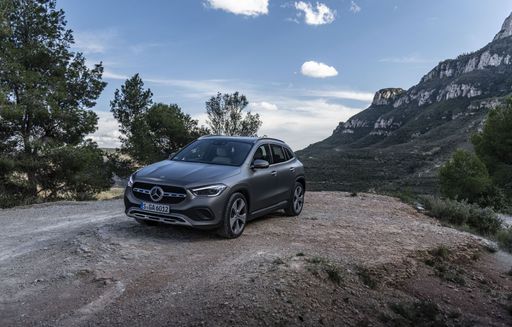
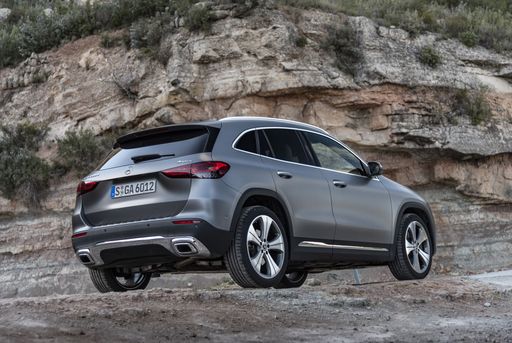
In the world of premium compact SUVs, the competition is fierce, and two contenders that often dominate discussions are the Mercedes-Benz GLA and the Volvo XC40. Both German engineering and Swedish innovation come to life in these models, each with its unique strengths and features. In this head-to-head comparison, we dissect their technical aspects and innovations to see how they stack up against one another.
XC40

Engine and Performance

The Mercedes GLA offers a diverse range of engine types, including Petrol Mild Hybrid Electric Vehicles (MHEV), diesel, plug-in hybrid, and conventional petrol engines. This diversity allows Mercedes to cater to a broader audience with varying power preferences, boasting power outputs from 116 HP up to a whopping 421 HP, depending on the model variant. The GLA reaches a top speed of up to 270 km/h.

On the other side, the Volvo XC40 is equipped with practical Petrol MHEV engines available in 163 HP and 197 HP variants. While slightly less powerful than its German rival, the XC40 emphasizes efficiency and smooth acceleration, achieving 0-100 km/h in as little as 7.6 seconds, and it has a top speed of 180 km/h due to Volvo’s commitment to safety.

GLA

Fuel Efficiency and Environmental Impact

Both vehicles recognize the growing importance of sustainability. The Mercedes GLA stands out with an excellent plug-in hybrid option featuring a consumption rate as low as 1.1 L/100km and an electric range of up to 74 km, thanks to its 12.9 kWh battery. The traditional combustion engines exhibit varied fuel consumption rates, capped at a reasonable 9.5 L/100km for the high-performance models.

The Volvo XC40, with its MHEV setup, offers a consistent fuel efficiency of around 6.5 L/100km. CO2 emissions range between 147 and 148 g/km, positioning it within the 'E' efficiency class. While it may not have an electric range, its overall efficiency remains competitive.

XC40

Dimensions and Practicality

Both the GLA and XC40 feature the practicality inherent to small SUVs. The Mercedes measures up to 4443 mm in length, 1849 mm in width, and 1616 mm in height, offering a trunk capacity of up to 435 liters. Volvo's XC40, although slightly more compact with a length of 4425 mm, provides more width and height at 1863 mm and 1652 mm respectively, and exceeds in trunk space with 452 liters.

GLA

Driving Dynamics and Comfort

Mercedes prides itself on offering both front-wheel and all-wheel-drive configurations for the GLA, tailored through a dual-clutch automatic transmission for a dynamic drive. The vehicle is designed for those who appreciate precision and luxury in their journeys.

Volvo offers a straightforward front-wheel-drive with their XC40 model, focusing on a refined and smooth driving experience. Both SUVs come with a well-tuned suspension to ensure comfort, making them ideal for both city drives and long-distance travel.

XC40

Conclusion: Premium Choice Depends on Personal Preferences

Ultimately, the choice between the Mercedes GLA and Volvo XC40 boils down to individual preferences. If diversity in engine options and raw power is your goal, the Mercedes GLA shines with its broad spectrum of configurations. On the other hand, if you prioritize efficiency, Scandinavian design, and a slightly more eco-friendly footprint, the Volvo XC40 emerges as a compelling alternative.

Both the Mercedes GLA and Volvo XC40 continue to set benchmarks in the compact SUV segment with their innovative features and meticulous craftsmanship, leaving buyers with the luxurious yet challenging decision of choosing which path aligns with their lifestyle.

Here’s where it gets real: The technical differences in detail

GLA

Costs and Efficiency:

Looking at overall running costs, both models reveal some interesting differences in everyday economy.

Volvo XC40 is marginally cheaper – starting at 36,800 £ , while the Mercedes GLA costs 38,800 £ . That’s a price difference of around 2,074 £.

Fuel consumption also shows a difference: the Mercedes GLA uses 2.9 L/100km and is considerably more efficient than the Volvo XC40 with 6.5 L/100km. The difference is about 3.6 L/100km.

XC40

Engine and Performance:

Under the bonnet, it becomes clear which model is tuned for sportiness and which one takes the lead when you hit the accelerator.

When it comes to engine power, the Mercedes GLA offers considerably more power – delivering 421 HP compared to 197 HP. That’s roughly 224 HP more horsepower.

When accelerating from 0 to 100 km/h, the Mercedes GLA is substantially quicker – completing the sprint in 4.3 s, while the Volvo XC40 takes 7.6 s. That’s about 3.3 s quicker.

Looking at top speed, the Mercedes GLA is a bit faster – reaching 210 km/h, while the Volvo XC40 tops out at 180 km/h. The difference is around 30 km/h.

There’s also a difference in torque: the Mercedes GLA delivers markedly more torque with 500 Nm compared to 300 Nm. That’s about 200 Nm more.

GLA

Space and Everyday Use:

Whether family car or daily driver – which one offers more room, flexibility and comfort?

Both vehicles offer seating for 5 people.

In terms of curb weight, Mercedes GLA is very slightly lighter – 1,570 kg compared to 1,688 kg. The difference is around 118 kg.

Looking at boot space, the Volvo XC40 offers only slightly more boot space – 452 L compared to 435 L. That’s a difference of about 17 L.

For maximum load capacity, the Mercedes GLA offers barely more capacity – up to 1,385 L, about 57 L more than the Volvo XC40.

When it comes to payload, the Volvo XC40 carries barely more – 532 kg compared to 500 kg. That’s a difference of about 32 kg.

Who wins the race in the data check?

The Mercedes GLA is clearly superior overall in the objective data comparison.
This result only shows which model scores more points on paper – not which of the two cars feels right for you.

from £38,800
GLA

Mercedes GLA

  • Engine Type : Plugin Hybrid, Petrol MHEV, Diesel, Petrol
  • Transmission : Automatic
  • Drive Type : Front-Wheel Drive, All-Wheel Drive
  • Power HP : 116 - 421 HP
  • Consumption L/100km : 2.9 - 9.5 L/100km
  • Electric Range : 74 km
Mercedes GLA
Volvo XC40

Costs and Consumption

View detailed analysis

Engine and Performance

View detailed analysis

Dimensions and Body

View detailed analysis

Mercedes GLA

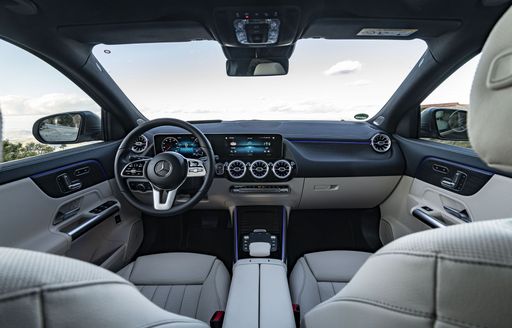
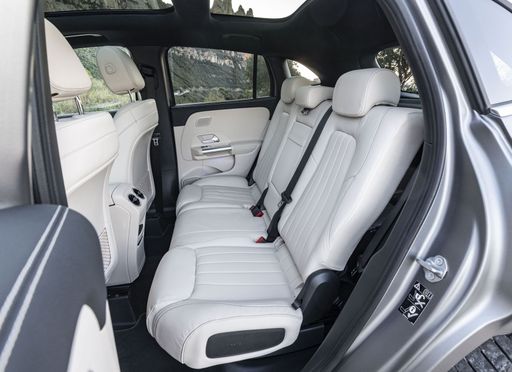
The Mercedes GLA blends Mercedes style with compact crossover practicality, looking sharper than its size suggests while still feeling purposeful around town. Inside it serves up premium materials and tech-forward ergonomics, and the composed ride makes it an appealing pick for buyers who want luxury wrapped in a city-friendly package with a wink of adventurous spirit.

details

Volvo XC40

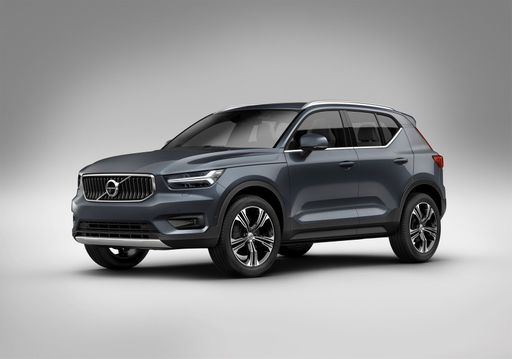
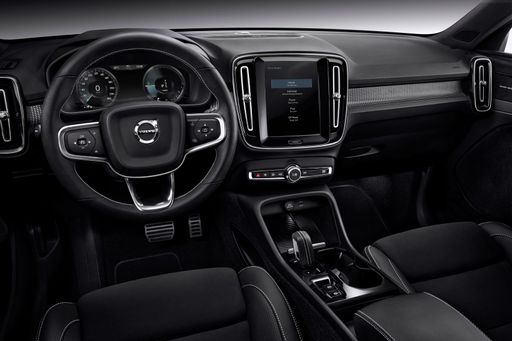
The Volvo XC40 wraps Scandinavian minimalism into a compact, city-ready SUV with a premium cabin that feels both practical and grown-up. It will suit buyers who prize safety, clever storage and a composed ride, proving that small dimensions don't mean small personality.

details
Mercedes GLA
Volvo XC40

Costs and Consumption

Price
38,800 - 75,300 £
Price
36,800 - 47,200 £
Consumption L/100km
2.9 - 9.5 L/100km
Consumption L/100km
6.5 L/100km
Consumption kWh/100km
-
Consumption kWh/100km
-
Electric Range
74 km
Electric Range
-
Battery Capacity
12.9 kWh
Battery Capacity
-
co2
66 - 216 g/km
co2
147 - 148 g/km
Fuel tank capacity
35 L
Fuel tank capacity
54 L

Dimensions and Body

Body Type
SUV
Body Type
SUV
Seats
5
Seats
5
Doors
5
Doors
5
Curb weight
1,570 - 1,810 kg
Curb weight
1,688 kg
Trunk capacity
385 - 435 L
Trunk capacity
452 L
Length
4,412 mm
Length
4,425 mm
Width
1,834 - 1,849 mm
Width
1,863 mm
Height
1,616 mm
Height
1,652 mm
Max trunk capacity
1,385 L
Max trunk capacity
1,328 L
Payload
480 - 500 kg
Payload
532 kg

Engine and Performance

Engine Type
Plugin Hybrid, Petrol MHEV, Diesel, Petrol
Engine Type
Petrol MHEV
Transmission
Automatic
Transmission
Automatic
Transmission Detail
Dual-Clutch Automatic
Transmission Detail
Dual-Clutch Automatic
Drive Type
Front-Wheel Drive, All-Wheel Drive
Drive Type
Front-Wheel Drive
Power HP
116 - 421 HP
Power HP
163 - 197 HP
Acceleration 0-100km/h
4.3 - 11 s
Acceleration 0-100km/h
7.6 - 8.6 s
Max Speed
210 km/h
Max Speed
180 km/h
Torque
230 - 500 Nm
Torque
265 - 300 Nm
Number of Cylinders
4
Number of Cylinders
4
Power kW
85 - 310 kW
Power kW
120 - 145 kW
Engine capacity
1,332 - 1,991 cm3
Engine capacity
1,969 cm3

General

Model Year
2,024 - 2,025
Model Year
2,024
CO2 Efficiency Class
B, E, F, G
CO2 Efficiency Class
E
Brand
Mercedes-Benz
Brand
Volvo
DriveDuel uses data analysis and artificial intelligence to evaluate vehicle data and create content. Content is regularly reviewed and improved. The displayed prices are estimates based on German list prices, adjusted to the respective country’s VAT. Country-specific registration taxes are not included. This information is not legally binding.