
 Deutschland
 France
 Nederland
 Great Britain
 Sverige
 Norge
Norge Danmark
 Suomi
Suomi Italia
 Polska
 España
VS
MINI Countryman vs Nissan Leaf – Performance, range & efficiency compared
Two cars, one duel: MINI Countryman meets Nissan Leaf.
Which one wins in performance, efficiency and value for money? Find out now!
Countryman
@ MINI / BMW Group Press
Costs and Efficiency:
When it comes to price and running costs, the biggest differences usually appear. This is often where you see which car fits your budget better in the long run.
Nissan Leaf has a slight advantage in terms of price – it starts at 30800 £, while the MINI Countryman costs 31500 £. That’s a price difference of around 771 £.
In terms of energy consumption, the advantage goes to the MINI Countryman: with 15.70 kWh per 100 km, it’s barely noticeable more efficient than the Nissan Leaf with 16.70 kWh. That’s a difference of about 1 kWh.
As for range, the MINI Countryman performs slightly better – achieving up to 462 km, about 77 km more than the Nissan Leaf.
Leaf
@ Nissan Motor Corporation
Engine and Performance:
Under the bonnet, it becomes clear which model is tuned for sportiness and which one takes the lead when you hit the accelerator.
When it comes to engine power, the MINI Countryman has a evident edge – offering 313 HP compared to 217 HP. That’s roughly 96 HP more horsepower.
In acceleration from 0 to 100 km/h, the MINI Countryman is clearly perceptible quicker – completing the sprint in 5.40 s, while the Nissan Leaf takes 6.90 s. That’s about 1.50 s faster.
In terms of top speed, the MINI Countryman performs noticeable better – reaching 250 km/h, while the Nissan Leaf tops out at 157 km/h. The difference is around 93 km/h.
There’s also a difference in torque: MINI Countryman pulls distinct stronger with 494 Nm compared to 340 Nm. That’s about 154 Nm difference.
Countryman
@ MINI / BMW Group Press
Space and Everyday Use:
Cabin size, boot volume and payload all play a role in everyday practicality. Here, comfort and flexibility make the difference.
Both vehicles offer seating for 5 people.
In curb weight, Nissan Leaf is barely noticeable lighter – 1580 kg compared to 1620 kg. The difference is around 40 kg.
In terms of boot space, the MINI Countryman offers noticeable more room – 505 L compared to 394 L. That’s a difference of about 111 L.
In maximum load capacity, the MINI Countryman performs convincingly better – up to 1530 L, which is about 740 L more than the Nissan Leaf.
When it comes to payload, MINI Countryman somewhat takes the win – 500 kg compared to 415 kg. That’s a difference of about 85 kg.
Who comes out on top?
Overall, the MINI Countryman shows itself to be outperforms in nearly all aspects and secures the title of DriveDuel Champion.
It convinces with the more balanced overall package and proves to be the more versatile choice for everyday use.
from about £31,500
 @ MINI / BMW Group Press
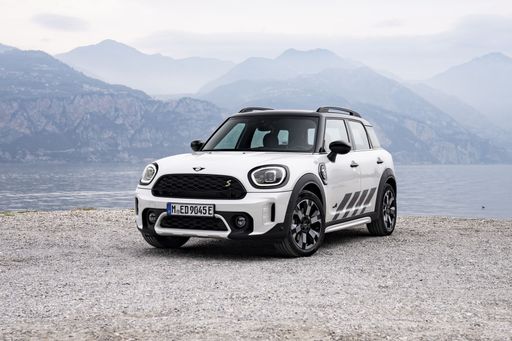
MINI Countryman
MINI Countryman
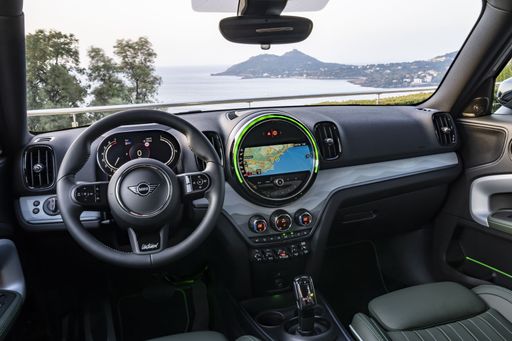
The MINI Countryman turns the cheeky charm of a classic MINI into a proper all-rounder, blending playful styling with surprisingly usable space for everyday life. It still grins at city lights but will happily tackle muddy lanes, perfect for buyers who want character without sacrificing practicality.
details
@ MINI / BMW Group Press
 @ MINI / BMW Group Press
 @ MINI / BMW Group Press
 @ MINI / BMW Group Press
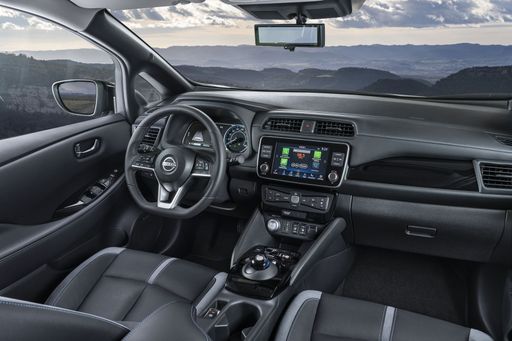
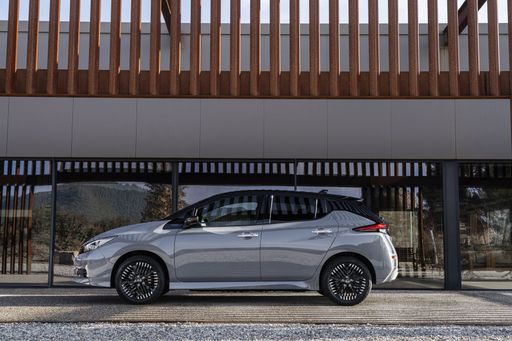
Nissan Leaf
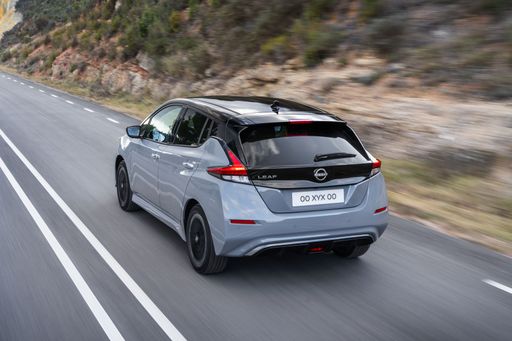
The Nissan Leaf stands out as a pioneering model in the realm of electric vehicles, known for its impressive blend of practicality and eco-friendliness. It offers a smooth and quiet driving experience, making it an ideal choice for city commuting and longer journeys alike. The interior design is both comfortable and intuitive, providing drivers with a sense of modernity and ease of use.
details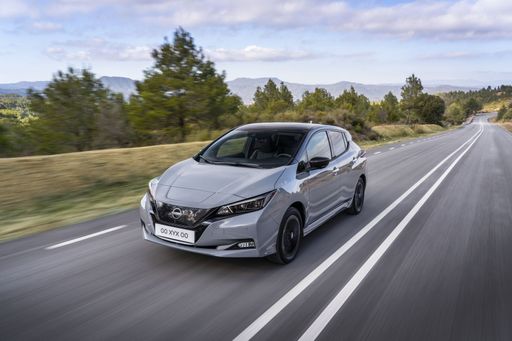 @ Nissan Motor Corporation
 @ Nissan Motor Corporation
 @ Nissan Motor Corporation
 @ Nissan Motor Corporation
MINI Countryman
Nissan Leaf
|
@ MINI / BMW Group Press
|
@ Nissan Motor Corporation
|
|
|
|
Costs and Consumption |
|
|---|---|
|
Price
31500 - 45300 £
|
Price
30800 - 37200 £
|
|
Consumption L/100km
4.6 - 7.8 L
|
Consumption L/100km
-
|
|
Consumption kWh/100km
15.7 - 16.8 kWh
|
Consumption kWh/100km
16.7 - 17.8 kWh
|
|
Electric Range
432 - 462 km
|
Electric Range
270 - 385 km
|
|
Battery Capacity
64.60 kWh
|
Battery Capacity
39 - 59 kWh
|
|
co2
0 - 177 g/km
|
co2
0 g/km
|
|
Fuel tank capacity
45 - 54 L
|
Fuel tank capacity
-
|
Dimensions and Body |
|
|---|---|
|
Body Type
SUV
|
Body Type
Hatchback
|
|
Seats
5
|
Seats
5
|
|
Doors
5
|
Doors
5
|
|
Curb weight
1620 - 2075 kg
|
Curb weight
1580 - 1756 kg
|
|
Trunk capacity
450 - 505 L
|
Trunk capacity
385 - 394 L
|
|
Length
4444 - 4447 mm
|
Length
4490 mm
|
|
Width
1843 mm
|
Width
1788 mm
|
|
Height
1635 - 1661 mm
|
Height
1540 - 1545 mm
|
|
Max trunk capacity
1450 - 1530 L
|
Max trunk capacity
790 L
|
|
Payload
460 - 500 kg
|
Payload
384 - 415 kg
|
Engine and Performance |
|
|---|---|
|
Engine Type
Petrol MHEV, Diesel MHEV, Electric, Petrol
|
Engine Type
Electric
|
|
Transmission
Automatic
|
Transmission
Automatic
|
|
Transmission Detail
Dual-Clutch Automatic, Automatic Gearbox, Reduction Gearbox
|
Transmission Detail
Reduction Gearbox
|
|
Drive Type
Front-Wheel Drive, All-Wheel Drive
|
Drive Type
Front-Wheel Drive
|
|
Power HP
163 - 313 HP
|
Power HP
150 - 217 HP
|
|
Acceleration 0-100km/h
5.4 - 8.6 s
|
Acceleration 0-100km/h
6.9 - 7.9 s
|
|
Max Speed
170 - 250 km/h
|
Max Speed
144 - 157 km/h
|
|
Torque
250 - 494 Nm
|
Torque
320 - 340 Nm
|
|
Number of Cylinders
3 - 4
|
Number of Cylinders
-
|
|
Power kW
120 - 230 kW
|
Power kW
110 - 160 kW
|
|
Engine capacity
1499 - 1998 cm3
|
Engine capacity
-
|
General |
|
|---|---|
|
Model Year
2024
|
Model Year
2019
|
|
CO2 Efficiency Class
D, E, A, G
|
CO2 Efficiency Class
A
|
|
Brand
MINI
|
Brand
Nissan
|
What drive types are available for the MINI Countryman?
The MINI Countryman is available as Front-Wheel Drive or All-Wheel Drive.
The prices and data displayed are estimates based on German list prices and may vary by country. This information is not legally binding.