VS

Nissan Juke vs VW Taigo comparison

Compare performance (143 HP vs 150 HP), boot space and price (21,400 £ vs 19,900 £ ) at a glance. Find out which car is the better choice for you – Nissan Juke or VW Taigo?

Nissan Juke vs VW Taigo: Key differences

Nissan Juke

5 (1 Reviews)
rate
  • slightly more efficient
details

VW Taigo

4.6 (5 Reviews)
rate
  • only slightly cheaper
  • barely more power
  • clearly quicker 0–100 km/h
  • only slightly lighter
  • barely more trunk space
details

All details on performance, efficiency, range and trunk space can be found in the technical comparison below – including user reviews for both models.

Juke

Quick head-to-head: Nissan Juke VS VW Taigo

Nissan Juke VS VW Taigo opens the door on two compact crossovers that look similar on paper but behave differently in daily life. The Nissan Juke leans into personality — quirky styling, a cockpit that flatters the driver and a city-biased powertrain — while the VW Taigo trades flash for measured practicality and long‑distance poise. Buyers who care about presence and a driver‑centric cabin will gravitate toward the Juke, whereas those after easy usability, a big boot and calmer cruising will prefer the Taigo. Below we unpack how those character differences translate to comfort, cargo, cabin feel and the types of buyers each car suits best. This is about real-world trade‑offs, not spec sheets, and the technical comparison that follows will show why each choice behaves the way it does.
Taigo

Character and driving personality

The Nissan Juke feels like a city-focussed performer: light steering, quick turn‑in and a sense of cheeky agility that makes urban lanes fun to own. The VW Taigo is more restrained, with a neutral, confidence‑inspiring setup that soothes rather than excites and rewards relaxed region‑to‑motorway driving. That means the Juke is more engaging for short, twisty trips and urban manoeuvres, while the Taigo is kinder on longer drives when you want the car to quietly get on with the job. Both are competent, but the Juke asks for a more active driver and the Taigo asks for patience in exchange for stability. If you want personality over placid progress, Juke; if you want predictable, low‑stress transport, Taigo.

Juke

Comfort and long-distance behavior

On comfort the VW Taigo clearly tilts toward long‑distance calm: softer suspension tuning and a quieter demeanor make it the better companion for motorway miles and weekend trips. The Nissan Juke is firmer and more prone to road and wind noise, especially on larger wheels, so long trips feel livelier but also more tiring at speed. Seats in both are comfortable for daily use, but the Taigo’s overall serenity and smoother ride reduce fatigue over extended runs more effectively. If most of your miles are suburb-to-city with occasional motorway stints, the Juke’s sharper setup can be invigorating; if you regularly do long commutes or motorway journeys, the Taigo will feel more relaxed day after day. Wheel choice and trim can narrow these gaps, so a motorway-focused test drive matters for both.

Taigo

Practicality, space and family usability

The VW Taigo is the practical winner when it comes to luggage and everyday loading: a wider, more usable boot and lower, easier access make shopping trips and strollers less of a chore. The Nissan Juke sacrifices some everyday practicality for style: a taller loading lip and, in hybrid form, reduced boot space make loading bulkier items fiddlier. Rear seating tells a similar story — the Juke’s rear is tighter and feels more claustrophobic for adult passengers, while the Taigo’s cabin gives more usable legroom even if headroom can be pinched by the coupe‑style roof. For parents fitting ISOFIX seats and regular school‑run duties, the Taigo’s cargo and access advantages are tangible; for singles or couples who prioritise personality and drive, the Juke’s compromises are easier to accept. Think about what you haul daily: boxes and buggies point to Taigo, city errands and style to Juke.

Juke

Cabin feel, infotainment and perceived quality

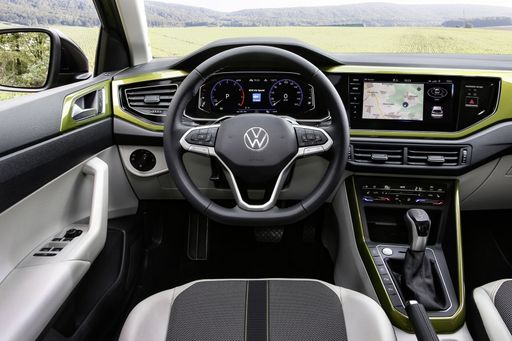
The Nissan Juke’s refreshed interior aims to please the driver with a tilted 12.3‑inch screen, intuitive physical climate controls and a cockpit that feels modern and slightly more premium at first glance. The VW Taigo takes a familiar, functional approach — ergonomically tidy and solid, but with more obvious hard plastics and an infotainment system that can feel sluggish or fussy, especially when sliders replace simple knobs. That results in two different everyday impressions: the Juke feels more characterful and driver‑centred, while the Taigo feels conservative and workmanlike, which some buyers will interpret as dependable rather than dull. Both have their annoyances — delayed touchscreen reactions in the Taigo, and occasional DCT or hybrid gearbox quirks in the Juke — but the net effect is Juke feels lively inside, Taigo feels sensible. If interface fluidity and tactile controls matter, the Juke’s cockpit will please you more; if you want straightforward ergonomics and a no‑nonsense layout, the Taigo delivers.

Taigo

Buyer fit: who should choose which car next

Pick the Nissan Juke if you’re a city‑centric buyer who values style, a driver‑angled cabin and a car that feels smaller and quicker in traffic; it rewards short runs, urban parking and a lively personality more than maximum practicality. Choose the VW Taigo if your priority is everyday usability: larger, easier‑loading boot, calmer motorway behavior and a cabin that favours straightforward ergonomics for family life and longer trips. Price and running‑cost differences tend to favour the Taigo, while the Juke’s hybrid option pays off mainly in stop‑start urban use — both practical facts that should steer the choice depending on your mileage profile. If you’re undecided, the technical comparison that follows will break down why those real‑world impressions exist and which drivetrain, weight and packaging choices produce them. Use those details to match the car’s strengths to how you actually drive and live with a car day to day.

Here’s where it gets real: The technical differences in detail

Juke

Costs and Efficiency:

Looking at overall running costs, both models reveal some interesting differences in everyday economy.

VW Taigo is only slightly cheaper – starting at 19,900 £ , while the Nissan Juke costs 21,400 £ . That’s a price difference of around 1,465 £.

Fuel consumption also shows a difference: the Nissan Juke uses 4.7 L/100km and is slightly more efficient than the VW Taigo with 5.3 L/100km. The difference is about 0.6 L/100km.

Taigo

Engine and Performance:

Power, torque and acceleration are the classic benchmarks for car enthusiasts – and here, some clear differences start to show.

When it comes to engine power, the VW Taigo offers barely more power – delivering 150 HP compared to 143 HP. That’s roughly 7 HP more horsepower.

When accelerating from 0 to 100 km/h, the VW Taigo is clearly quicker – completing the sprint in 8.2 s, while the Nissan Juke takes 10.1 s. That’s about 1.9 s quicker.

There’s also a difference in torque: the VW Taigo delivers moderately more torque with 250 Nm compared to 200 Nm. That’s about 50 Nm more.

Juke

Space and Everyday Use:

Cabin size, boot volume and payload all play a role in everyday practicality. Here, comfort and flexibility make the difference.

Both vehicles offer seating for 5 people.

In terms of curb weight, VW Taigo is only slightly lighter – 1,229 kg compared to 1,274 kg. The difference is around 45 kg.

Looking at boot space, the VW Taigo offers barely more boot space – 440 L compared to 422 L. That’s a difference of about 18 L.

When it comes to payload, the VW Taigo carries very slightly more – 457 kg compared to 427 kg. That’s a difference of about 30 kg.

Who wins the race in the data check?

The VW Taigo holds a solid overall lead in the objective data comparison.
This result only shows which model scores more points on paper – not which of the two cars feels right for you.

from £19,900
Taigo

VW Taigo

  • Engine Type Petrol
  • Transmission Manual, Automatic
  • Drive Type Front-Wheel Drive
  • Power HP 95 - 150 HP
  • Consumption L/100km 5.3 - 5.8 L/100km
Nissan Juke
VW Taigo

Costs and Consumption

View detailed analysis

Engine and Performance

View detailed analysis

Dimensions and Body

View detailed analysis

Nissan Juke

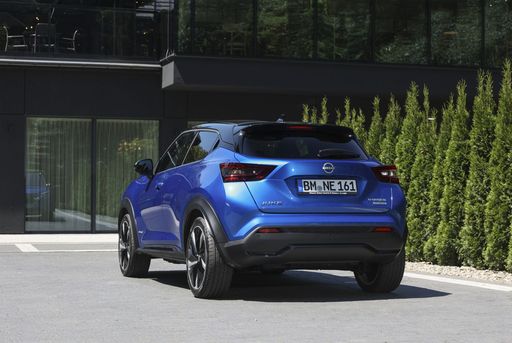
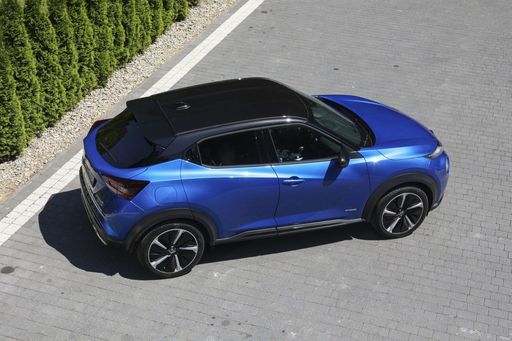
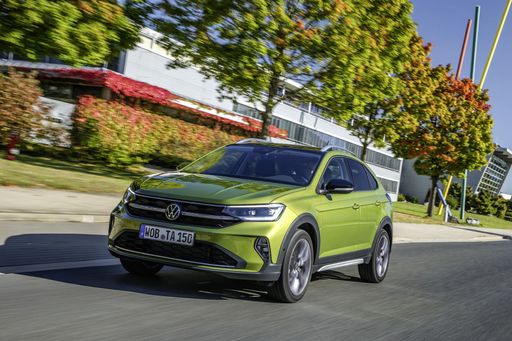
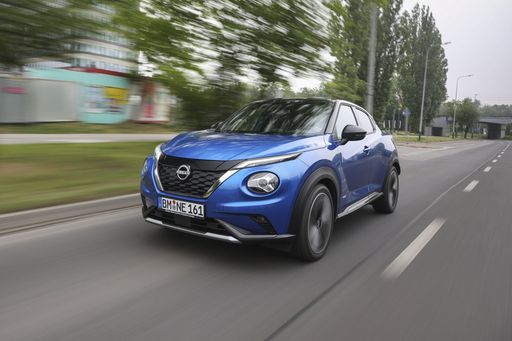
The Nissan Juke is a pocket-sized crossover that refuses to blend in, with quirky styling and a cheeky stance that turns heads at every traffic light. It’s ideal for shoppers who value personality and nimble urban driving over maximum practicality, delivering surprising pep and a well-equipped feel for everyday fun.

details

VW Taigo

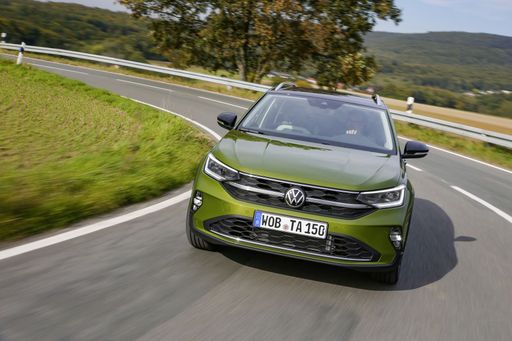
The VW Taigo blends a coupe-like roofline with crossover practicality, giving it a stylish presence on the road while remaining easy to live with for everyday driving. It delivers a comfortable ride, intuitive tech and smart use of space, making it a good choice if you want SUV looks without the bulk of a larger vehicle.

details
Nissan Juke
VW Taigo

Costs and Consumption

Price
21,400 - 30,100 £
Price
19,900 - 31,800 £
Consumption L/100km
4.7 - 6 L/100km
Consumption L/100km
5.3 - 5.8 L/100km
Consumption kWh/100km
-
Consumption kWh/100km
-
Electric Range
-
Electric Range
-
Battery Capacity
-
Battery Capacity
-
co2
105 - 136 g/km
co2
120 - 132 g/km
Fuel tank capacity
-
Fuel tank capacity
-

Dimensions and Body

Body Type
SUV
Body Type
SUV
Seats
5
Seats
5
Doors
-
Doors
-
Curb weight
1,274 - 1,405 kg
Curb weight
1,229 - 1,302 kg
Trunk capacity
354 - 422 L
Trunk capacity
440 L
Length
-
Length
-
Width
1,800 mm
Width
1,757 mm
Height
-
Height
-
Max trunk capacity
-
Max trunk capacity
-
Payload
405 - 427 kg
Payload
448 - 457 kg

Engine and Performance

Engine Type
Petrol, Full Hybrid
Engine Type
Petrol
Transmission
Manual, Automatic
Transmission
Manual, Automatic
Transmission Detail
Manual Gearbox, Dual-Clutch Automatic, Automatic Gearbox
Transmission Detail
Manual Gearbox, Dual-Clutch Automatic
Drive Type
Front-Wheel Drive
Drive Type
Front-Wheel Drive
Power HP
114 - 143 HP
Power HP
95 - 150 HP
Acceleration 0-100km/h
10.1 - 11.8 s
Acceleration 0-100km/h
8.2 - 11.1 s
Max Speed
-
Max Speed
-
Torque
200 Nm
Torque
175 - 250 Nm
Number of Cylinders
3 - 4
Number of Cylinders
3 - 4
Power kW
84 - 105 kW
Power kW
70 - 110 kW
Engine capacity
999 - 1,598 cm3
Engine capacity
999 - 1,498 cm3

General

Model Year
2025
Model Year
2,024 - 2,025
CO2 Efficiency Class
D, E, C
CO2 Efficiency Class
D
Brand
Nissan
Brand
VW
DriveDuel uses data analysis and artificial intelligence to evaluate vehicle data and create content. Content is regularly reviewed and improved. The displayed prices are estimates based on German list prices, adjusted to the respective country’s VAT. Country-specific registration taxes are not included. This information is not legally binding.