VS

VW Caddy vs Peugeot 5008 comparison

Compare performance (150 HP vs 325 HP), boot space and price (27,800 £ vs 39,300 £ ) at a glance. Find out which car is the better choice for you – VW Caddy or Peugeot 5008?

VW Caddy vs Peugeot 5008: Key differences

VW Caddy

5 (1 Reviews)
rate
  • clearly cheaper
  • clearly more efficient
  • barely lighter
details

Peugeot 5008

4.7 (1 Reviews)
rate
  • significantly more power
  • significantly more electric range
  • clearly quicker 0–100 km/h
details

All details on performance, efficiency, range and trunk space can be found in the technical comparison below – including user reviews for both models.

By Achim Sedelmaier

Caddy

Quick take: Peugeot 5008 VS VW Caddy

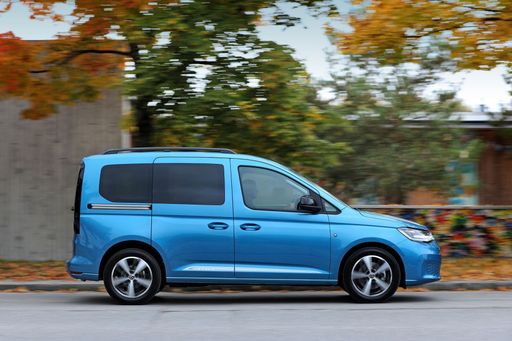
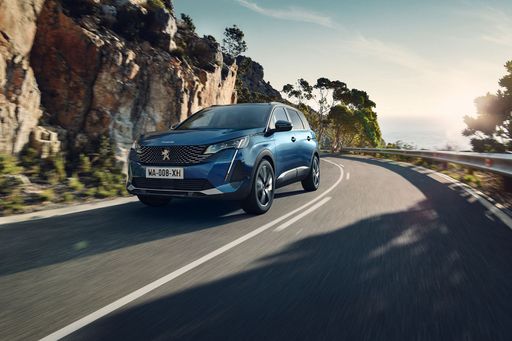
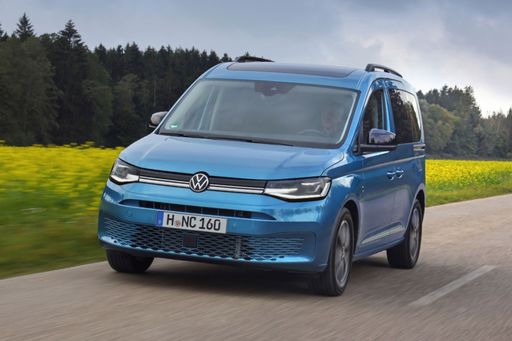
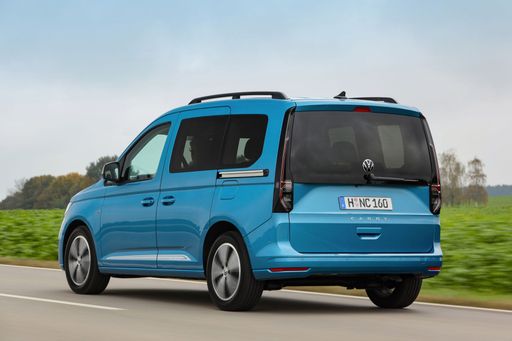
Peugeot 5008 VS VW Caddy pits a design‑forward, comfort‑biased seven‑seat SUV against a brutally practical, van‑style people‑carrier. The Peugeot 5008 feels like a family saloon stretched into seven seats, prioritising quiet, refined travel and a polished interior. The VW Caddy answers with maximum usability: sliding doors, huge openings and cargo flexibility that a traditional SUV can’t match. Choosing between them is a choice between passenger comfort and day‑to‑day practicality rather than a fight over headline specs. Read on to see which one maps better to your real driving life and family routines.
5008

Character and driving personality

The Peugeot 5008 behaves like a composed, lounge‑like SUV: calm steering, measured responses and a focus on refined progress rather than sporty thrills. The VW Caddy, by contrast, drives with purposeful pragmatism — more upright, more utilitarian, and noticeably more “van” in feel but surprisingly car‑like on the road. If you want a relaxed, slightly upscale cruise the 5008 communicates that intent; if you need a workhorse that doubles as a family shuttle the Caddy’s honest, functional character wins. Both are stable and confident, but the emotional tone is different: French polish versus German practicality.

Caddy

Comfort and long‑distance behavior

On long runs the Peugeot 5008 shows its strengths: low interior noise, comfy seats and a chassis tuned for steady, fatigue‑free cruising make it the better companion for motorway miles. The VW Caddy will carry the same load with competence and durability, yet you’ll notice more wind and road noise and a firmer, van‑typical ride at higher speeds. For extended touring with passengers and luggage the 5008 feels more cultured; for heavy loads and repeated point‑to‑point hauling the Caddy will feel more purpose‑built and efficient, especially in diesel form. If you’re considering an electric or hybrid 5008, factor in shorter fast‑charging windows and efficiency trade‑offs on sustained high‑speed runs.

5008

Everyday usability and practicality

This is where the VW Caddy makes its case loudest: sliding rear doors, enormous cargo openings and a modular layout mean school runs, strollers and bulky weekend kit are easier to manage than in the Peugeot 5008. The Peugeot 5008 still offers a clever 5+2 seating layout and a well thought‑through, flat load floor, but the third row is genuinely best for children and occasional use rather than daily adult transport. If you regularly need to load awkward items, wrestle a pram into tight spaces or park in narrow bays the Caddy’s packaging wins. For families after a more polished passenger experience with flexible but neater interior packaging, the 5008 is the nicer houseguest.

Caddy

Cabin feel, controls and perceived quality

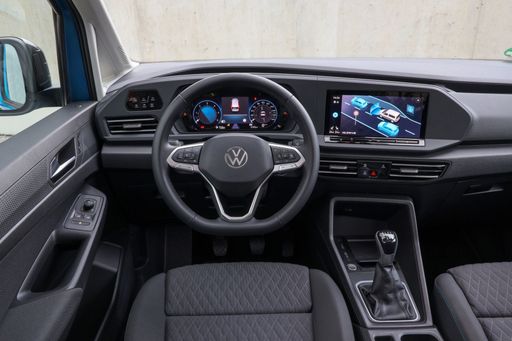
The Peugeot 5008’s cabin aims for a premium impression: softer materials, mood lighting and a modern cockpit that feels designed to be looked at and lived in. The VW Caddy prioritises robustness and logic over glamour — durable plastics and straightforward switchgear that take knocks but don’t try to impress. Both have infotainment compromises: the 5008’s system can be slick but fiddly in operation, while the Caddy’s touch‑first approach removes easy physical control in favour of a minimalist look. In short, pick the 5008 if cabin ambience and perceived quality matter, pick the Caddy if you value simple, damage‑resistant practicality.

5008

Buyer fit and the practical decision ahead

If your priority is serene family travel, refined materials and a genuinely quieter long‑distance experience, the Peugeot 5008 fits that brief better and will please buyers who favour comfort and style. If your life revolves around utility — regular bulky loads, tight urban parking, easy child‑access via sliding doors and a robust, efficient workhorse — the VW Caddy is the clearer match. Both models have real trade‑offs in efficiency, power delivery and equipment, so your next step is to match the specific engines, seating and trim choices to your daily routes and cargo needs. The technical comparison that follows will help translate those practical preferences into which engines, ranges and variants make sense for your use case.

Here’s where it gets real: The technical differences in detail

Caddy

Costs and Efficiency:

Price and efficiency are key factors when choosing a car – and this is often where the real differences emerge.

VW Caddy is clearly cheaper – starting at 27,800 £ , while the Peugeot 5008 costs 39,300 £ . That’s a price difference of around 11,549 £.

Fuel consumption also shows a difference: the VW Caddy uses 0.5 L/100km and is clearly more efficient than the Peugeot 5008 with 2.7 L/100km. The difference is about 2.2 L/100km.

As for electric range, the Peugeot 5008 offers significantly more range – reaching up to 669 km, about 548 km more than the VW Caddy.

5008

Engine and Performance:

Under the bonnet, it becomes clear which model is tuned for sportiness and which one takes the lead when you hit the accelerator.

When it comes to engine power, the Peugeot 5008 offers significantly more power – delivering 325 HP compared to 150 HP. That’s roughly 175 HP more horsepower.

When accelerating from 0 to 100 km/h, the Peugeot 5008 is clearly quicker – completing the sprint in 6.5 s, while the VW Caddy takes 11.4 s. That’s about 4.9 s quicker.

There’s also a difference in torque: the Peugeot 5008 delivers markedly more torque with 511 Nm compared to 320 Nm. That’s about 191 Nm more.

Caddy

Space and Everyday Use:

Beyond pure performance, interior space and usability matter most in daily life. This is where you see which car is more practical and versatile.

Both vehicles offer seating for 7 people.

In terms of curb weight, VW Caddy is barely lighter – 1,575 kg compared to 1,700 kg. The difference is around 125 kg.

When it comes to payload, the VW Caddy carries barely more – 710 kg compared to 640 kg. That’s a difference of about 70 kg.

Who wins the race in the data check?

The VW Caddy is clearly superior overall in the objective data comparison.
This result only shows which model scores more points on paper – not which of the two cars feels right for you.

from £27,800
Caddy

VW Caddy

  • Engine Type Petrol, Diesel, Plugin Hybrid
  • Transmission Manuel, Automatic
  • Drive Type Front-Wheel Drive, All-Wheel Drive
  • Power HP 102 - 150 HP
  • Consumption L/100km 0.5 - 6.9 L/100km
  • Electric Range 116 - 121 km
VW Caddy
Peugeot 5008

Costs and Consumption

View detailed analysis

Engine and Performance

View detailed analysis

Dimensions and Body

View detailed analysis

VW Caddy

The VW Caddy is the Swiss-army knife of compact vans — practical, surprisingly refined, and ready to swap a weekend adventure for a grocery run without breaking a sweat. It’s user-friendly, comfortable enough for daily driving, and sensible for buyers who want utility with a dash of style and no drama.

details

Peugeot 5008

The Peugeot 5008 blends Peugeot's sharp design with the space and versatility families actually need, wrapping clever packaging and a premium-feeling cabin in a crisp, SUV-like silhouette. It drives with more poise than you'd expect from a people carrier, serves up practical touches and flexible seating for everyday chaos, and still looks good when parked outside the school gates.

details
VW Caddy
Peugeot 5008

Costs and Consumption

Price
27,800 - 45,900 £
Price
39,300 - 54,300 £
Consumption L/100km
0.5 - 6.9 L/100km
Consumption L/100km
2.7 - 5.6 L/100km
Consumption kWh/100km
-
Consumption kWh/100km
17.8 - 18.1 kWh/100km
Electric Range
116 - 121 km
Electric Range
78 - 669 km
Battery Capacity
19.7 kWh
Battery Capacity
-
co2
10 - 165 g/km
co2
0 - 127 g/km
Fuel tank capacity
50 L
Fuel tank capacity
-

Dimensions and Body

Body Type
High Roof Estate
Body Type
SUV
Seats
5 - 7
Seats
7
Doors
5
Doors
-
Curb weight
1,575 - 1,998 kg
Curb weight
1,700 - 2,344 kg
Trunk capacity
-
Trunk capacity
294 - 348 L
Length
4,500 - 4,853 mm
Length
-
Width
1,855 mm
Width
1,895 mm
Height
1,819 - 1,860 mm
Height
-
Max trunk capacity
2,556 - 3,700 L
Max trunk capacity
-
Payload
501 - 710 kg
Payload
596 - 640 kg

Engine and Performance

Engine Type
Petrol, Diesel, Plugin Hybrid
Engine Type
Electric, Petrol MHEV, Plugin Hybrid
Transmission
Manuel, Automatic
Transmission
Automatic
Transmission Detail
Manual Gearbox, Dual-Clutch Automatic
Transmission Detail
Reduction Gearbox, Dual-Clutch Automatic
Drive Type
Front-Wheel Drive, All-Wheel Drive
Drive Type
Front-Wheel Drive, All-Wheel Drive
Power HP
102 - 150 HP
Power HP
145 - 325 HP
Acceleration 0-100km/h
11.4 - 14 s
Acceleration 0-100km/h
6.5 - 10.2 s
Max Speed
173 - 186 km/h
Max Speed
-
Torque
220 - 320 Nm
Torque
230 - 511 Nm
Number of Cylinders
4
Number of Cylinders
3 - 4
Power kW
75 - 110 kW
Power kW
107 - 239 kW
Engine capacity
1,498 - 1,968 cm3
Engine capacity
1,199 - 1,598 cm3

General

Model Year
2024
Model Year
2,024 - 2,026
CO2 Efficiency Class
E, F, B
CO2 Efficiency Class
A, D, B
Brand
VW
Brand
Peugeot
DriveDuel uses data analysis and artificial intelligence to evaluate vehicle data and create content. Content is regularly reviewed and improved. The displayed prices are estimates based on German list prices, adjusted to the respective country’s VAT. Country-specific registration taxes are not included. This information is not legally binding.