VS

Ford Tourneo Custom vs VW Transporter Bus comparison

Compare performance (286 HP vs 286 HP), boot space and price (52,900 £ vs 41,500 £ ) at a glance. Find out which car is the better choice for you – Ford Tourneo Custom or VW Transporter Bus?

Ford Tourneo Custom vs VW Transporter Bus: Key differences

Ford Tourneo Custom

3.9 (1 Reviews)
rate
  • marginally more electric range
  • marginally more trunk space
details

VW Transporter Bus

  • visibly cheaper
  • marginally more efficient
  • markedly lighter
details

All details on performance, efficiency, range and trunk space can be found in the technical comparison below – including user reviews for both models.

By Achim Sedelmaier

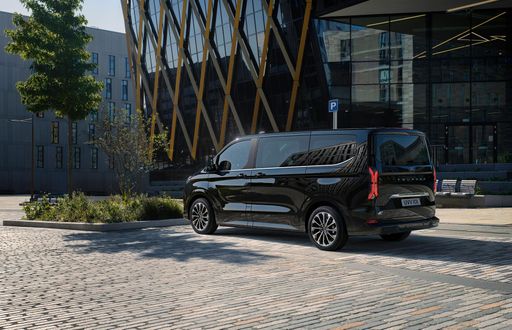
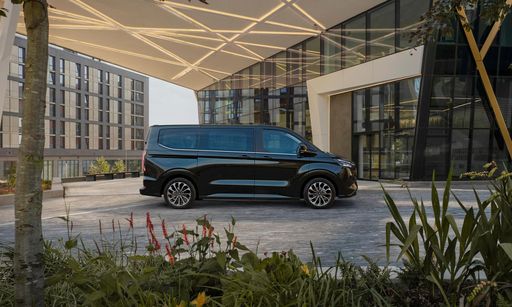
Tourneo Custom

Head-to-Head: Ford Tourneo Custom vs. VW Transporter Bus

In the world of versatile multi-purpose vehicles, two titans stand out: the Ford Tourneo Custom and the VW Transporter Bus. Both are renowned for their capacity, comfort, and advanced technology. We compare these two models to see which offers the most for those looking to transport families or groups in style and efficiency.
Transporter Bus

Engine Options and Performance

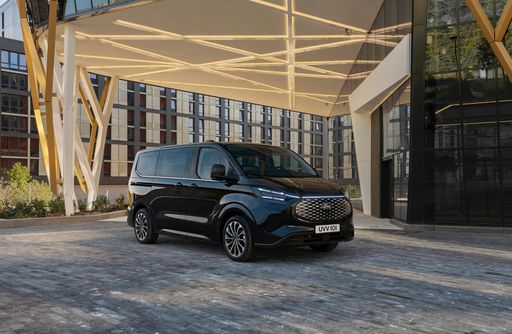
The Ford Tourneo Custom offers a diverse engine lineup, including diesel, plug-in hybrid, and fully electric options, delivering power ratings between 136 HP and 286 HP. The flexibility in drivetrain configurations is also notable, with front-wheel drive, all-wheel drive, and rear-wheel drive options.

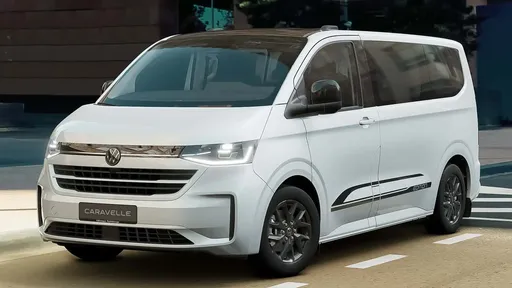
By contrast, the VW Transporter Bus provides a slightly more comprehensive array of engines with diesel, petrol, plug-in hybrid, and electric variations, pushing power outputs ranging from 110 HP to 286 HP. It also includes options for front-wheel drive, all-wheel drive, and rear-wheel drive. Notably, the Transporter Bus offers a high top speed potential, reaching up to 200 km/h.

Tourneo Custom

Fuel Efficiency and Range

For fuel-conscious drivers, the Ford Tourneo Custom's consumption figures are commendable, with averages from 1.7 L/100km for its hybrid configurations to 8.6 L/100km for diesel. Electric variants achieve up to 306 km of range on a single charge, supported by battery capacities up to 64 kWh.

VW's Transporter Bus rivals closely with petrol consumption as low as 6.3 L/100km and its most efficient hybrid sipping just 0.8 L/100km. Its electric models boast superior range capability, offering up to 324 km fully charged owing to a 63.8 kWh battery capacity.

Interior and Comfort

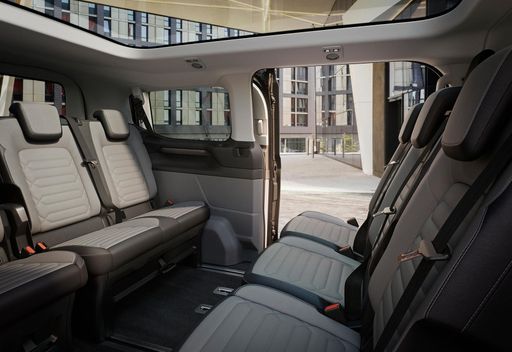
Both vehicles seat eight comfortably, making them ideal for families or small groups. The Ford Tourneo Custom features a trunk capacity of up to 819 liters, practical for luggage or gear, while the VW Transporter Bus offers a maximum of 763 liters, slightly less but still ample for most needs.

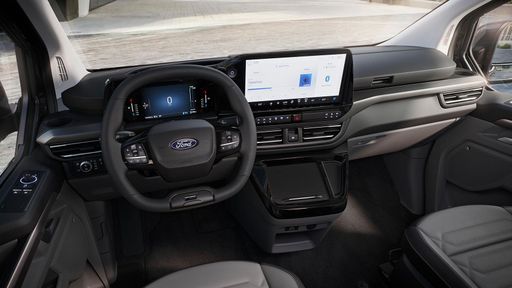
The interior design in both models prioritizes comfort and functionality. Ford's sophisticated layout includes an intuitive dashboard and high-res infotainment system, while VW emphasizes durable materials and a user-friendly interface, with an emphasis on modern technological integration.

Dimensions and Payload

On dimensions, the Ford Tourneo Custom stretches from 5050 mm to 5450 mm in length and maintains a width of 2032 mm, with a consistent height of about 1958 mm. Its payload capacity reaches up to 928 kg, significant for heavy-duty transportation needs.

VW’s Transporter Bus offers slightly more diverse dimension ranges in length from 4973 mm to 5450 mm and is somewhat narrower in width at 1941 mm. Its height options vary considerably, up to 1997 mm. The Transporter's payload ceiling is slightly higher at 939 kg, accommodating larger cargo demands.

Conclusion: Choosing Between Giants

The Ford Tourneo Custom and VW Transporter Bus are both robust choices for anyone in the market for a versatile bus. They both deliver extensive options for customization, power, and fuel efficiency. The choice ultimately depends on your specific needs: whether you prioritize cutting-edge electric range and efficient hybrids of the VW or the expansive engine adaptability and payload of the Ford, rest assured that both serve excellently as leaders in their class of transport solutions.

Here’s where it gets real: The technical differences in detail

Tourneo Custom

Costs and Efficiency:

Price and efficiency are often the first things buyers look at. Here it becomes clear which model has the long-term edge – whether at the pump, the plug, or in purchase price.

VW Transporter Bus is visibly cheaper – starting at 41,500 £ , while the Ford Tourneo Custom costs 52,900 £ . That’s a price difference of around 11,409 £.

In terms of energy consumption, the VW Transporter Bus is marginally more efficient: consuming 22.4 kWh/100km compared to 24.1 kWh/100km for the Ford Tourneo Custom. That’s a difference of about 1.7 kWh/100km.

As for electric range, the Ford Tourneo Custom offers marginally more range – reaching up to 339 km, about 15 km more than the VW Transporter Bus.

Transporter Bus

Engine and Performance:

Under the bonnet, it becomes clear which model is tuned for sportiness and which one takes the lead when you hit the accelerator.

Both models deliver identical power – 286 HP each.

There’s also a difference in torque: the Ford Tourneo Custom delivers markedly more torque with 630 Nm compared to 415 Nm. That’s about 215 Nm more.

Tourneo Custom

Space and Everyday Use:

Cabin size, boot volume and payload all play a role in everyday practicality. Here, comfort and flexibility make the difference.

Both vehicles offer seating for 8 people.

In terms of curb weight, VW Transporter Bus is markedly lighter – 1,998 kg compared to 2,660 kg. The difference is around 662 kg.

Looking at boot space, the Ford Tourneo Custom offers marginally more boot space – 819 L compared to 763 L. That’s a difference of about 56 L.

When it comes to payload, the VW Transporter Bus carries clearly more – 1,143 kg compared to 690 kg. That’s a difference of about 453 kg.

Who wins the race in the data check?

The VW Transporter Bus is clearly superior overall in the objective data comparison.
This result only shows which model scores more points on paper – not which of the two cars feels right for you.

from £41,500
Transporter Bus

VW Transporter Bus

  • Engine Type : Diesel, Petrol, Plugin Hybrid, Electric
  • Transmission : Manuel, Automatic
  • Drive Type : Front-Wheel Drive, All-Wheel Drive, Rear-Wheel Drive
  • Power HP : 110 - 286 HP
  • Consumption L/100km : 0.8 - 9.2 L/100km
  • Consumption kWh/100km : 22.4 - 24.9 kWh/100km
  • Electric Range : 87 - 324 km
Ford Tourneo Custom
VW Transporter Bus

Costs and Consumption

View detailed analysis

Engine and Performance

View detailed analysis

Dimensions and Body

View detailed analysis

Ford Tourneo Custom

The Ford Tourneo Custom is a practical and polished people‑carrier that turns hauling crew and weekend kit into something surprisingly pleasant, with a composed ride and a cabin built for real life rather than showroom gloss. With clever storage, flexible seating and tech that keeps everyone happy on the road, it’s the sensible choice for families or businesses that want function without sacrificing a bit of style — the van that learnt how to be nice to live with.

details

VW Transporter Bus

The VW Transporter is the Swiss Army knife of vans — rugged, practical and surprisingly civilized on the road, whether you’re hauling kit for a job or converting it into a weekend camper. It isn’t trying to be glamorous, but its blend of durability, clever packaging and familiar VW charm makes it a sensible choice for buyers who need space without sacrificing driveability.

details
Ford Tourneo Custom
VW Transporter Bus

Costs and Consumption

Price
52,900 - 69,700 £
Price
41,500 - 85,100 £
Consumption L/100km
-
Consumption L/100km
0.8 - 9.2 L/100km
Consumption kWh/100km
24.1 - 26.6 kWh/100km
Consumption kWh/100km
22.4 - 24.9 kWh/100km
Electric Range
310 - 339 km
Electric Range
87 - 324 km
Battery Capacity
-
Battery Capacity
11.8 - 63.8 kWh
co2
0 g/km
co2
0 - 229 g/km
Fuel tank capacity
-
Fuel tank capacity
45 - 60 L

Dimensions and Body

Body Type
Bus
Body Type
Bus
Seats
8
Seats
4 - 8
Doors
-
Doors
4 - 5
Curb weight
2,660 - 2,707 kg
Curb weight
1,998 - 2,620 kg
Trunk capacity
672 - 819 L
Trunk capacity
0 - 763 L
Length
-
Length
4,973 - 5,450 mm
Width
2,032 mm
Width
1,941 - 2,032 mm
Height
-
Height
1,907 - 1,997 mm
Max trunk capacity
-
Max trunk capacity
3,672 - 4,005 L
Payload
620 - 690 kg
Payload
330 - 1,143 kg

Engine and Performance

Engine Type
Electric
Engine Type
Diesel, Petrol, Plugin Hybrid, Electric
Transmission
Automatic
Transmission
Manuel, Automatic
Transmission Detail
Reduction Gearbox
Transmission Detail
Manual Gearbox, Automatic Gearbox, Dual-Clutch Automatic
Drive Type
Rear-Wheel Drive, All-Wheel Drive
Drive Type
Front-Wheel Drive, All-Wheel Drive, Rear-Wheel Drive
Power HP
218 - 286 HP
Power HP
110 - 286 HP
Acceleration 0-100km/h
-
Acceleration 0-100km/h
7.4 - 16.9 s
Max Speed
-
Max Speed
112 - 200 km/h
Torque
415 - 630 Nm
Torque
310 - 415 Nm
Number of Cylinders
-
Number of Cylinders
4
Power kW
160 - 210 kW
Power kW
81 - 210 kW
Engine capacity
-
Engine capacity
1,498 - 2,488 cm3

General

Model Year
2025
Model Year
2,024 - 2,025
CO2 Efficiency Class
A
CO2 Efficiency Class
G, F, B, A
Brand
Ford
Brand
VW
DriveDuel uses data analysis and artificial intelligence to evaluate vehicle data and create content. Content is regularly reviewed and improved. The displayed prices are estimates based on German list prices, adjusted to the respective country’s VAT. Country-specific registration taxes are not included. This information is not legally binding.