VS

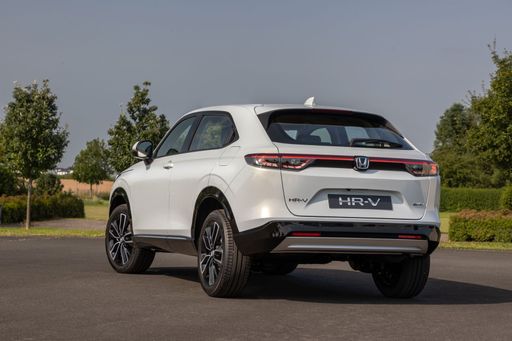
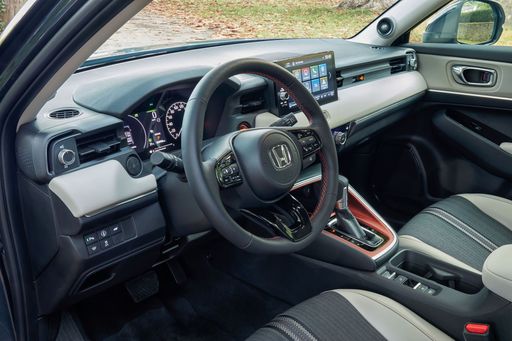
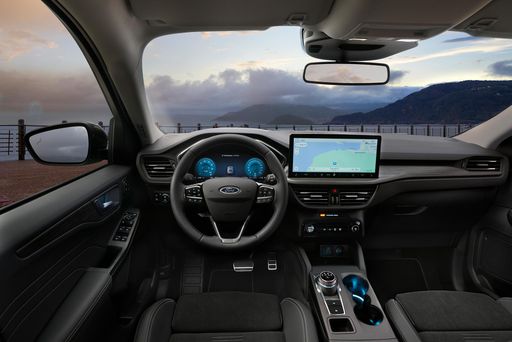
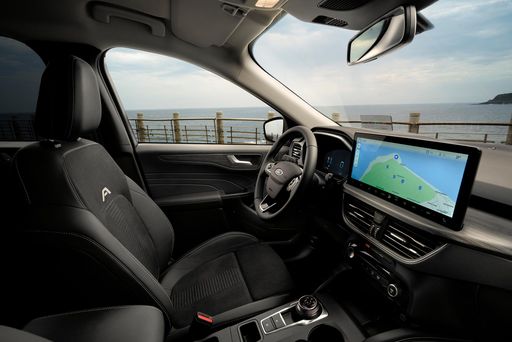
Honda HR-V vs Ford Kuga comparison

Compare performance (131 HP vs 243 HP), boot space and price (29,100 £ vs 34,200 £ ) at a glance. Find out which car is the better choice for you – Honda HR-V or Ford Kuga?

Honda HR-V vs Ford Kuga: Key differences

Honda HR-V

4.3 (15 Reviews)
rate
  • moderately cheaper
  • barely lighter
details

Ford Kuga

4.2 (6 Reviews)
rate
  • considerably more power
  • significantly more efficient
  • considerably quicker 0–100 km/h
details

All details on performance, efficiency, range and trunk space can be found in the technical comparison below – including user reviews for both models.

By Achim Sedelmaier

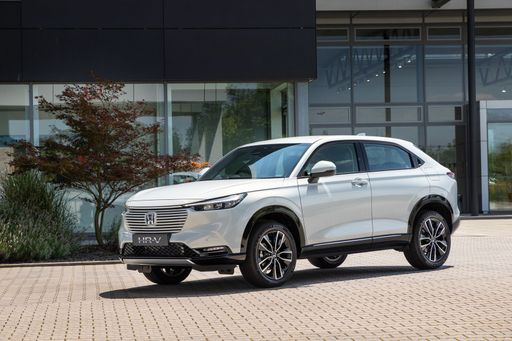
HR-V

The Ultimate Showdown: Ford Kuga vs. Honda HR-V

In the ever-evolving landscape of the SUV market, two contenders have emerged that cater to a diverse range of drivers— the Ford Kuga and the Honda HR-V. Both models have their unique strengths and innovations, making a thorough comparison essential for potential buyers. Let’s delve into the numbers and features that set these two SUVs apart.
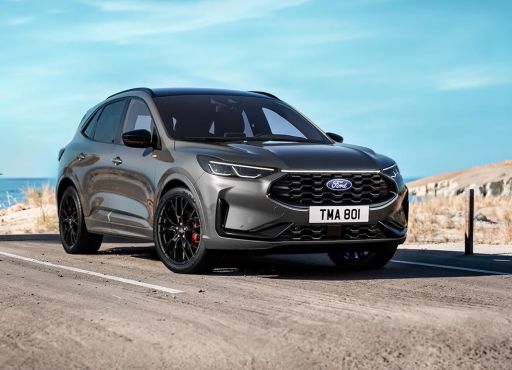
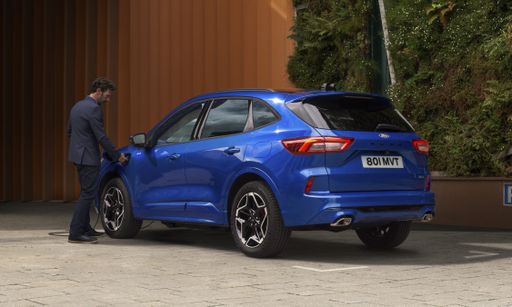
Kuga

Performance and Powertrain

The Ford Kuga boasts a versatile range of powertrains, offering options that include petrol, full hybrid, and plug-in hybrid engines. This model delivers a power output ranging from 150 HP to an impressive 243 HP, giving it the edge in terms of potential performance. With acceleration figures as low as 7.3 seconds from 0 to 100 km/h, the Kuga provides a thrilling driving experience.

In contrast, the Honda HR-V is a solely hybrid offering with a maximum power output of 130 HP. While its acceleration of 10.6 seconds seems modest compared to the Kuga, the HR-V shines in its fuel efficiency, boasting a consumption figure of just 5.4 L/100km. The HR-V's engine capacity stands at 1498 cm³, making it slightly more pedestrian in terms of raw power but more economical for everyday driving.

HR-V

Transmission and Handling

The Kuga provides versatility in its transmission with options for manual and automatic gearboxes, including a CVT. This flexibility caters to a broad audience, ensuring both driving enthusiasts and casual drivers find their preferred setup. The Kuga is available in both front-wheel drive and all-wheel drive configurations, making it suitable for various driving conditions.

On the other hand, the Honda HR-V features a CVT automatic transmission, which enhances the driving experience with smooth and efficient power delivery. However, it exclusively offers front-wheel drive. While this limits its off-road capabilities, it does contribute to a relaxed driving experience in urban environments.

Kuga

Dimensions and Comfort

When it comes to size, the Ford Kuga is larger, measuring between 4604 mm and 4645 mm in length, compared to the HR-V, which is 4340 mm long. The Kuga also provides generous trunk space with a capacity of 412 liters, ideal for families and adventures. The HR-V, while offering a respectable trunk space of up to 335 liters, falls short in this department.

In terms of height, the Kuga stands 1675 mm to 1681 mm tall, providing a commanding driving position, whereas the HR-V is shorter at 1582 mm, which may appeal to those looking for a sportier silhouette. Both SUVs comfortably seat five passengers, ensuring ample interior space for all.

HR-V

Technological Innovations

The Ford Kuga is equipped with cutting-edge technology, including an innovative infotainment system featuring Ford's SYNC and advanced driver assistance systems that add to both convenience and safety. Features such as adaptive cruise control and lane-keeping assist elevate the Kuga’s driving experience.

Similarly, the Honda HR-V includes a suite of modern technological amenities focused on connectivity and safety. Its infotainment system integrates seamlessly with smartphones, keeping drivers hands-free while navigating. However, the Kuga’s tech offerings are generally regarded as more advanced and customizable.

Kuga

Environmental Considerations

Both models prioritize eco-friendliness, but the approaches differ. The Kuga’s hybrid offerings, especially the plug-in variant, have an electric range of up to 69 km and exceptional fuel consumption figures. This makes it a great choice for those looking to minimize their carbon footprint.

The Honda HR-V, with its full hybrid setup, operates efficiently with a CO2 emission rate of 122 g/km, which is commendable but does not quite match the Kuga's eco-options. The HR-V's efficient design makes it a strong candidate for environmentally conscious drivers, albeit with fewer options for powered driving experiences.

HR-V

Conclusion: Which SUV Reigns Supreme?

Ultimately, the decision between the Ford Kuga and Honda HR-V hinges on individual preferences and driving needs. For those seeking a powerful, versatile SUV with multiple engine options and premium technology, the Ford Kuga stands out as a compelling choice. Meanwhile, the Honda HR-V appeals to drivers looking for efficiency and modern conveniences in a more compact package. Both SUVs deliver quality, comfort, and style, making them worthy contenders in today's market.

Here’s where it gets real: The technical differences in detail

HR-V

Costs and Efficiency:

Looking at overall running costs, both models reveal some interesting differences in everyday economy.

Honda HR-V is moderately cheaper – starting at 29,100 £ , while the Ford Kuga costs 34,200 £ . That’s a price difference of around 5,185 £.

Fuel consumption also shows a difference: the Ford Kuga uses 2.8 L/100km and is significantly more efficient than the Honda HR-V with 5.4 L/100km. The difference is about 2.6 L/100km.

Kuga

Engine and Performance:

Power, torque and acceleration are the classic benchmarks for car enthusiasts – and here, some clear differences start to show.

When it comes to engine power, the Ford Kuga offers considerably more power – delivering 243 HP compared to 131 HP. That’s roughly 112 HP more horsepower.

When accelerating from 0 to 100 km/h, the Ford Kuga is considerably quicker – completing the sprint in 7.3 s, while the Honda HR-V takes 10.6 s. That’s about 3.3 s quicker.

There’s also a difference in torque: the Honda HR-V delivers marginally more torque with 253 Nm compared to 240 Nm. That’s about 13 Nm more.

HR-V

Space and Everyday Use:

Whether family car or daily driver – which one offers more room, flexibility and comfort?

Both vehicles offer seating for 5 people.

In terms of curb weight, Honda HR-V is barely lighter – 1,452 kg compared to 1,526 kg. The difference is around 74 kg.

When it comes to payload, the Ford Kuga carries clearly more – 550 kg compared to 418 kg. That’s a difference of about 132 kg.

Who wins the race in the data check?

The Ford Kuga holds a decisive overall lead in the objective data comparison.
This result only shows which model scores more points on paper – not which of the two cars feels right for you.

from £34,200
Kuga

Ford Kuga

  • Engine Type Petrol, Full Hybrid, Plugin Hybrid
  • Transmission Manuel, Automatic
  • Drive Type Front-Wheel Drive, All-Wheel Drive
  • Power HP 150 - 243 HP
  • Consumption L/100km 2.8 - 6.8 L/100km
  • Electric Range 68 km
Honda HR-V
Ford Kuga

Costs and Consumption

View detailed analysis

Engine and Performance

View detailed analysis

Dimensions and Body

View detailed analysis

Honda HR-V

The Honda HR-V is a compact crossover that blends practical versatility with a comfortable, refined cabin, making it a strong choice for daily driving and weekend trips. Its clever packaging and easy-to-use features give owners flexible cargo space and a confidence-inspiring driving experience without feeling fussy.

details

Ford Kuga

The Ford Kuga is a practical and comfortable compact SUV that balances everyday usability with a composed ride and adaptable interior. It offers sensible tech and safety features, making it a solid choice for families or anyone seeking a versatile, easy-to-live-with crossover.

details
Honda HR-V
Ford Kuga

Costs and Consumption

Price
29,100 - 34,700 £
Price
34,200 - 46,300 £
Consumption L/100km
5.4 L/100km
Consumption L/100km
2.8 - 6.8 L/100km
Consumption kWh/100km
-
Consumption kWh/100km
-
Electric Range
-
Electric Range
68 km
Battery Capacity
-
Battery Capacity
-
co2
122 g/km
co2
55 - 154 g/km
Fuel tank capacity
-
Fuel tank capacity
-

Dimensions and Body

Body Type
SUV
Body Type
SUV
Seats
5
Seats
5
Doors
-
Doors
-
Curb weight
1,452 kg
Curb weight
1,526 - 1,859 kg
Trunk capacity
319 L
Trunk capacity
-
Length
-
Length
-
Width
1,866 mm
Width
1,882 mm
Height
-
Height
-
Max trunk capacity
-
Max trunk capacity
-
Payload
418 kg
Payload
541 - 550 kg

Engine and Performance

Engine Type
Full Hybrid
Engine Type
Petrol, Full Hybrid, Plugin Hybrid
Transmission
Automatic
Transmission
Manuel, Automatic
Transmission Detail
Automatic Gearbox
Transmission Detail
Manual Gearbox, CVT, Automatic Gearbox
Drive Type
Front-Wheel Drive
Drive Type
Front-Wheel Drive, All-Wheel Drive
Power HP
131 HP
Power HP
150 - 243 HP
Acceleration 0-100km/h
10.6 - 10.8 s
Acceleration 0-100km/h
7.3 - 9.9 s
Max Speed
-
Max Speed
-
Torque
253 Nm
Torque
240 Nm
Number of Cylinders
4
Number of Cylinders
3 - 4
Power kW
96 kW
Power kW
111 - 178 kW
Engine capacity
1,498 cm3
Engine capacity
1,496 - 2,488 cm3

General

Model Year
2025
Model Year
2025
CO2 Efficiency Class
D
CO2 Efficiency Class
E, D, B
Brand
Honda
Brand
Ford
DriveDuel uses data analysis and artificial intelligence to evaluate vehicle data and create content. Content is regularly reviewed and improved. The displayed prices are estimates based on German list prices, adjusted to the respective country’s VAT. Country-specific registration taxes are not included. This information is not legally binding.