
 Deutschland
 France
 Nederland
 Great Britain
 Sverige
 Norge
Norge Danmark
 Suomi
Suomi Italia
 Polska
 España
VS
Hyundai i10 vs VW Taigo - Differences and prices compared
i10
@ Hyundai Motor Company
Costs and Efficiency:
Price and efficiency are key factors when choosing a car – and this is often where the real differences emerge.
Hyundai i10 has a noticeable advantage in terms of price – it starts at 14600 £, while the VW Taigo costs 19600 £. That’s a price difference of around 5062 £.
Fuel consumption also shows a difference: Hyundai i10 manages with 4.90 L and is therefore hardly perceptible more efficient than the VW Taigo with 5.30 L. The difference is about 0.40 L per 100 km.
Taigo
@ Volkswagen AG / VW Media
Engine and Performance:
Power, torque and acceleration say a lot about how a car feels on the road. This is where you see which model delivers more driving dynamics.
When it comes to engine power, the VW Taigo has a evident edge – offering 150 HP compared to 90 HP. That’s roughly 60 HP more horsepower.
In acceleration from 0 to 100 km/h, the VW Taigo is noticeable quicker – completing the sprint in 8.20 s, while the Hyundai i10 takes 11.40 s. That’s about 3.20 s faster.
In terms of top speed, the VW Taigo performs to a small extent better – reaching 212 km/h, while the Hyundai i10 tops out at 175 km/h. The difference is around 37 km/h.
There’s also a difference in torque: VW Taigo pulls distinct stronger with 250 Nm compared to 172 Nm. That’s about 78 Nm difference.
i10
@ Hyundai Motor Company
Space and Everyday Use:
Cabin size, boot volume and payload all play a role in everyday practicality. Here, comfort and flexibility make the difference.
Seats: offers more seating capacity – vs .
In curb weight, Hyundai i10 is clearly perceptible lighter – 996 kg compared to 1229 kg. The difference is around 233 kg.
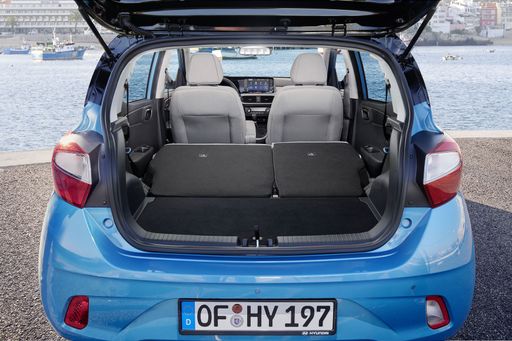
In terms of boot space, the VW Taigo offers significantly more room – 440 L compared to 252 L. That’s a difference of about 188 L.
In maximum load capacity, the VW Taigo performs slightly better – up to 1222 L, which is about 172 L more than the Hyundai i10.
When it comes to payload, VW Taigo hardly perceptible takes the win – 457 kg compared to 423 kg. That’s a difference of about 34 kg.
Who wins the race?
The VW Taigo proves to be outperforms in nearly all aspects and therefore becomes our DriveDuel Champion!
VW Taigo is the better all-rounder in this comparison.
from about £19,600
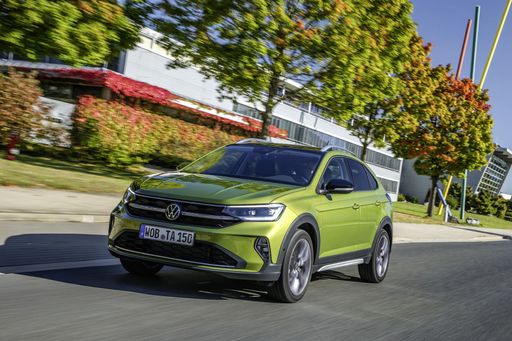 @ Volkswagen AG / VW Media
VW Taigo
Hyundai i10
VW Taigo
Costs and Consumption
View detailed analysis
View detailed analysis
Engine and Performance
View detailed analysis
View detailed analysis
Dimensions and Body
View detailed analysis
View detailed analysis
Hyundai i10
5 (1 Reviews)
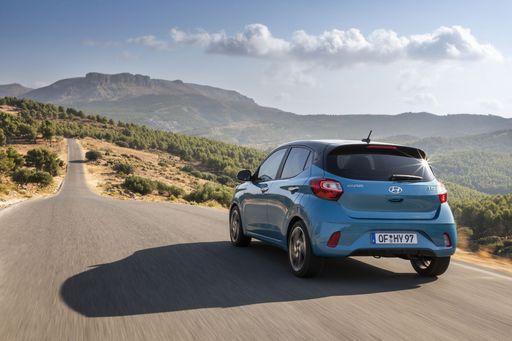
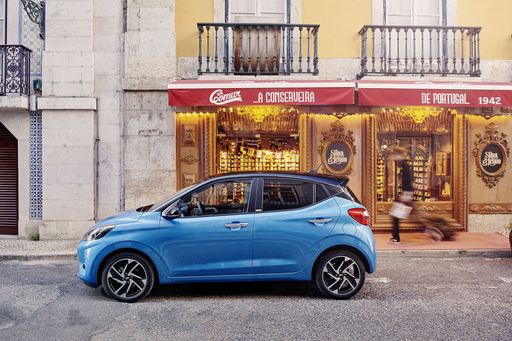
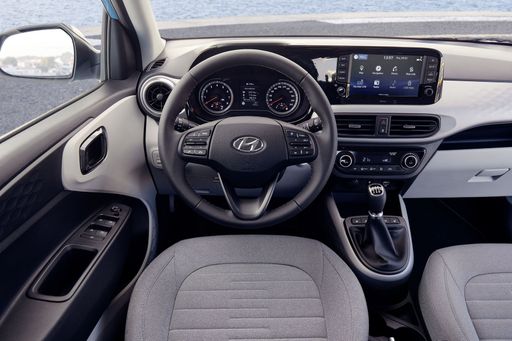
The Hyundai i10 is a cheeky city car that squeezes big-car confidence into a pocket-friendly package, carving through tight streets with surprising composure and sensible practicality. For buyers after low fuss, sensible equipment and wallet-friendly running costs, it's a smart, no-nonsense pick that makes sense whether you're a first-time driver or need a reliable second car.
details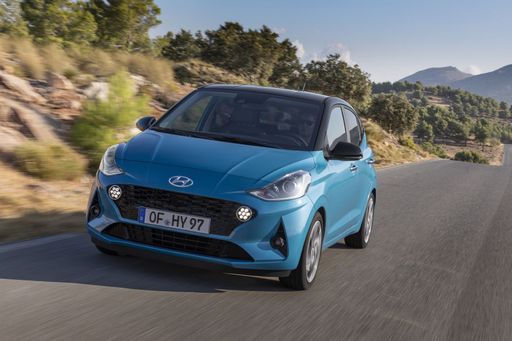 @ Hyundai Motor Company
 @ Hyundai Motor Company
 @ Hyundai Motor Company
 @ Hyundai Motor Company
 @ Hyundai Motor Company
VW Taigo
5 (2 Reviews)
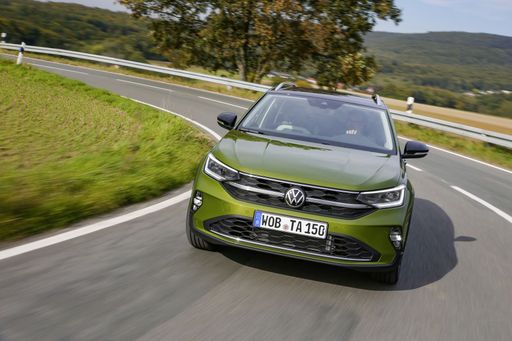
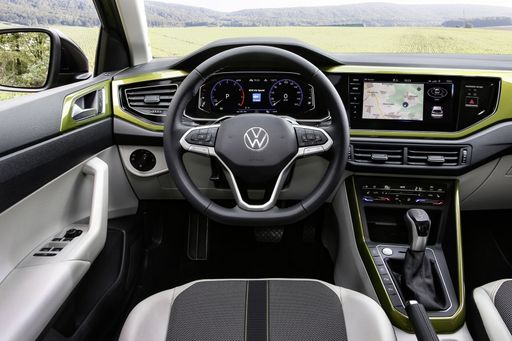
The VW Taigo brings coupe-like flair to the compact crossover scene with sharp styling and an interior that punches above its price, feeling smarter than you’d expect. It’s an easygoing daily companion that balances comfort and practicality with a playful wink, perfect for city drivers who want something livelier than a regular hatchback.
details
@ Volkswagen AG / VW Media
 @ Volkswagen AG / VW Media
 @ Volkswagen AG / VW Media
 @ Volkswagen AG / VW Media
 @ Volkswagen AG / VW Media
Hyundai i10
VW Taigo
|
@ Hyundai Motor Company
|
@ Volkswagen AG / VW Media
|
|
|
|
Costs and Consumption |
|
|---|---|
|
Price
14600 - 19000 £
|
Price
19600 - 31300 £
|
|
Consumption L/100km
4.9 - 5.5 L
|
Consumption L/100km
5.3 - 5.8 L
|
|
Consumption kWh/100km
-
|
Consumption kWh/100km
-
|
|
Electric Range
-
|
Electric Range
-
|
|
Battery Capacity
-
|
Battery Capacity
-
|
|
co2
110 - 124 g/km
|
co2
120 - 132 g/km
|
|
Fuel tank capacity
36 L
|
Fuel tank capacity
40 L
|
Dimensions and Body |
|
|---|---|
|
Body Type
Hatchback
|
Body Type
SUV
|
|
Seats
4 - 5
|
Seats
5
|
|
Doors
5
|
Doors
5
|
|
Curb weight
996 - 1099 kg
|
Curb weight
1229 - 1302 kg
|
|
Trunk capacity
252 L
|
Trunk capacity
440 L
|
|
Length
3670 - 3675 mm
|
Length
4266 mm
|
|
Width
1680 mm
|
Width
1757 mm
|
|
Height
1480 - 1483 mm
|
Height
1518 mm
|
|
Max trunk capacity
1050 L
|
Max trunk capacity
1222 L
|
|
Payload
344 - 423 kg
|
Payload
448 - 457 kg
|
Engine and Performance |
|
|---|---|
|
Engine Type
Petrol
|
Engine Type
Petrol
|
|
Transmission
Manuel, Automatic
|
Transmission
Manuel, Automatic
|
|
Transmission Detail
Manual Gearbox, Automated Manual
|
Transmission Detail
Manual Gearbox, Dual-Clutch Automatic
|
|
Drive Type
Front-Wheel Drive
|
Drive Type
Front-Wheel Drive
|
|
Power HP
63 - 90 HP
|
Power HP
95 - 150 HP
|
|
Acceleration 0-100km/h
11.4 - 18.4 s
|
Acceleration 0-100km/h
8.2 - 11.1 s
|
|
Max Speed
143 - 175 km/h
|
Max Speed
184 - 212 km/h
|
|
Torque
93 - 172 Nm
|
Torque
175 - 250 Nm
|
|
Number of Cylinders
3 - 4
|
Number of Cylinders
3 - 4
|
|
Power kW
46 - 66 kW
|
Power kW
70 - 110 kW
|
|
Engine capacity
998 - 1197 cm3
|
Engine capacity
999 - 1498 cm3
|
General |
|
|---|---|
|
Model Year
2024
|
Model Year
2024 - 2025
|
|
CO2 Efficiency Class
C, D
|
CO2 Efficiency Class
D
|
|
Brand
Hyundai
|
Brand
VW
|
Is the Hyundai i10 offered with different drivetrains?
The Hyundai i10 is offered with Front-Wheel Drive.
The prices and data displayed are estimates based on German list prices and may vary by country. This information is not legally binding.