VS

Jaguar E-Pace vs Peugeot 5008 comparison

Compare performance (269 HP vs 325 HP), boot space and price (32,400 £ vs 39,300 £ ) at a glance. Find out which car is the better choice for you – Jaguar E-Pace or Peugeot 5008?

Jaguar E-Pace vs Peugeot 5008: Key differences

Jaguar E-Pace

  • clearly cheaper
  • substantially more efficient
  • visibly more trunk space
details

Peugeot 5008

4.7 (1 Reviews)
rate
  • somewhat more power
  • substantially more electric range
  • a bit quicker 0–100 km/h
  • only slightly lighter
details

All details on performance, efficiency, range and trunk space can be found in the technical comparison below – including user reviews for both models.

By Achim Sedelmaier

E-Pace

Jaguar E-Pace vs Peugeot 5008: The Ultimate SUV Showdown

In the ever-evolving world of SUVs, the Jaguar E-Pace and the Peugeot 5008 are two standout choices for 2024. Both vehicles have distinct qualities and innovations that cater to different driver needs. Let's delve deeper into what these SUVs have to offer.
5008

Performance and Powertrain

The Jaguar E-Pace showcases a versatile powertrain portfolio, including a plug-in hybrid, diesel MHEV, and petrol MHEV options. With a power output ranging from 160 to 269 HP, drivers can experience an engaging drive, whether they opt for the front-wheel or all-wheel drive models. Impressively, the plug-in hybrid achieves 0 to 100 km/h in just 7.3 seconds, owing to its powerful 11.5 kWh battery and a combined torque of up to 540 Nm.

On the other hand, the Peugeot 5008 offers a choice of petrol MHEV, plug-in hybrid, and electric powertrains. The fully electric variant takes the spotlight with a remarkable power delivery of 231 HP and a range of up to 664 km. Even in its hybrid form, the 5008 maintains impressive efficiency with a mere 1 L/100km fuel consumption. The dual-clutch automatic transmission ensures a smooth ride, with the plug-in hybrid achieving 0 to 100 km/h in 8.8 seconds.

E-Pace

Design and Dimensions

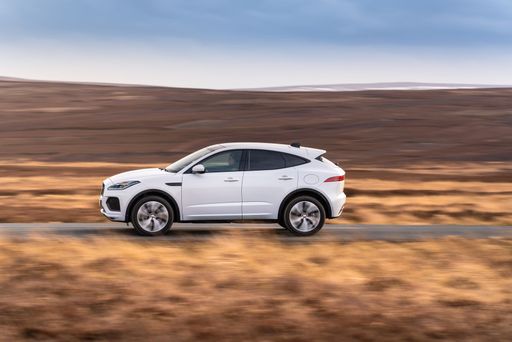
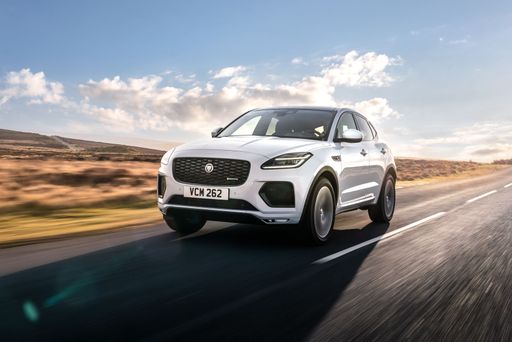
Measuring 4395 mm in length, the Jaguar E-Pace sports a compact yet dynamic SUV profile, ensuring flexibility in city environments. With a width of 1984 mm and height of 1648 mm, it offers a balanced stance with a premium feel, making it an attractive choice for urban adventurers.

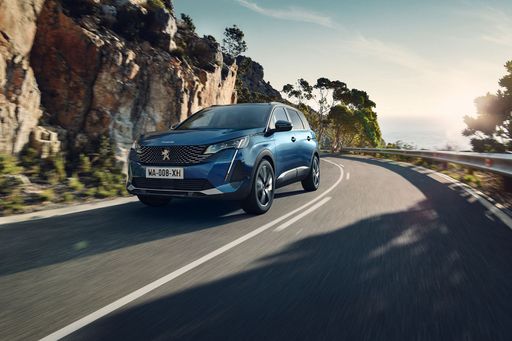
The Peugeot 5008, however, commands a larger presence. At 4791 mm in length and 1694 mm in height, the 5008 boasts a more spacious interior, capable of accommodating up to seven passengers. Its wide stance of 1895 mm enhances road stability, catering to families looking for comfort and space.

5008

Interior and Cargo Space

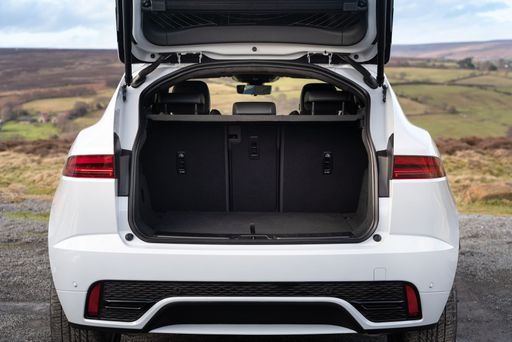
With seating for five, the Jaguar E-Pace provides a refined interior ambiance and a trunk capacity of 494 liters. It's designed for drivers prioritizing luxury and style without compromising practicality.

Conversely, the Peugeot 5008 offers seating for seven, appealing to larger families or those needing more flexibility. The generous trunk capacity of 748 liters makes it an ideal companion for family trips and daily commutes alike.

E-Pace

Efficiency and Environmental Impact

Jaguar has pushed the envelope with the E-Pace's plug-in hybrid model, delivering a CO2 efficiency class of B and CO2 emissions as low as 33 g/km. This reflects their commitment to eco-friendly mobility.

The Peugeot 5008 stands out with its electric variant, achieving zero emissions and class A efficiency. The plug-in hybrid balances performance and efficiency, with CO2 emissions at a mere 23 g/km, underscoring its commitment to sustainability.

5008

Conclusion

In summary, both the Jaguar E-Pace and Peugeot 5008 bring unique strengths to the table. The E-Pace is a match for drivers seeking sporty elegance and agile performance in compact dimensions. Meanwhile, the 5008 lives up to the needs of larger families who prioritize space, versatility, and exceptional energy efficiency. Your choice ultimately hinges on your lifestyle needs and driving preferences. Either way, both are worthy contenders in the realm of modern SUVs.

Here’s where it gets real: The technical differences in detail

E-Pace

Costs and Efficiency:

Price and efficiency are key factors when choosing a car – and this is often where the real differences emerge.

Jaguar E-Pace is clearly cheaper – starting at 32,400 £ , while the Peugeot 5008 costs 39,300 £ . That’s a price difference of around 6,908 £.

Fuel consumption also shows a difference: the Jaguar E-Pace uses 1.4 L/100km and is substantially more efficient than the Peugeot 5008 with 2.7 L/100km. The difference is about 1.3 L/100km.

As for electric range, the Peugeot 5008 offers substantially more range – reaching up to 669 km, about 600 km more than the Jaguar E-Pace.

5008

Engine and Performance:

Power, torque and acceleration say a lot about how a car feels on the road. This is where you see which model delivers more driving dynamics.

When it comes to engine power, the Peugeot 5008 offers somewhat more power – delivering 325 HP compared to 269 HP. That’s roughly 56 HP more horsepower.

When accelerating from 0 to 100 km/h, the Peugeot 5008 is a bit quicker – completing the sprint in 6.5 s, while the Jaguar E-Pace takes 7.3 s. That’s about 0.8 s quicker.

There’s also a difference in torque: the Jaguar E-Pace delivers barely more torque with 540 Nm compared to 511 Nm. That’s about 29 Nm more.

E-Pace

Space and Everyday Use:

Cabin size, boot volume and payload all play a role in everyday practicality. Here, comfort and flexibility make the difference.

Seats: Peugeot 5008 offers more seats – 7 vs 5.

In terms of curb weight, Peugeot 5008 is only slightly lighter – 1,700 kg compared to 1,783 kg. The difference is around 83 kg.

Looking at boot space, the Jaguar E-Pace offers visibly more boot space – 494 L compared to 348 L. That’s a difference of about 146 L.

When it comes to payload, the Peugeot 5008 carries moderately more – 640 kg compared to 554 kg. That’s a difference of about 86 kg.

Who wins the race in the data check?

The Peugeot 5008 is decisively ahead in the objective data comparison.
This result only shows which model scores more points on paper – not which of the two cars feels right for you.

from £39,300
5008

Peugeot 5008

  • Engine Type Electric, Petrol MHEV, Plugin Hybrid
  • Transmission Automatic
  • Drive Type Front-Wheel Drive, All-Wheel Drive
  • Power HP 145 - 325 HP
  • Consumption L/100km 2.7 - 5.6 L/100km
  • Consumption kWh/100km 17.8 - 18.1 kWh/100km
  • Electric Range 78 - 669 km
Jaguar E-Pace
Peugeot 5008

Costs and Consumption

View detailed analysis

Engine and Performance

View detailed analysis

Dimensions and Body

View detailed analysis

Jaguar E-Pace

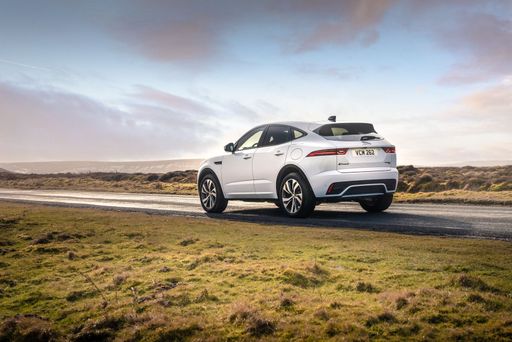
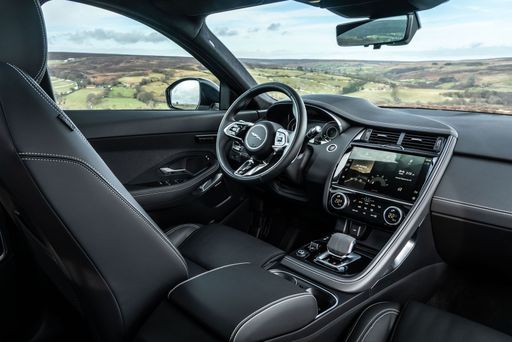
The Jaguar E-Pace brings compact SUV practicality together with taut, sporty design and unmistakable British charm, helping it stand out in a crowded class. Inside, the cabin feels premium and the driving manners are engaging enough to keep a grin on your face, making it a tempting choice for buyers who want Jaguar style without the bulk.

details

Peugeot 5008

The Peugeot 5008 blends Peugeot's sharp design with the space and versatility families actually need, wrapping clever packaging and a premium-feeling cabin in a crisp, SUV-like silhouette. It drives with more poise than you'd expect from a people carrier, serves up practical touches and flexible seating for everyday chaos, and still looks good when parked outside the school gates.

details
Jaguar E-Pace
Peugeot 5008

Costs and Consumption

Price
32,400 - 56,100 £
Price
39,300 - 54,300 £
Consumption L/100km
1.4 - 8.2 L/100km
Consumption L/100km
2.7 - 5.6 L/100km
Consumption kWh/100km
-
Consumption kWh/100km
17.8 - 18.1 kWh/100km
Electric Range
69 km
Electric Range
78 - 669 km
Battery Capacity
11.5 kWh
Battery Capacity
-
co2
33 - 185 g/km
co2
0 - 127 g/km
Fuel tank capacity
56 - 67 L
Fuel tank capacity
-

Dimensions and Body

Body Type
SUV
Body Type
SUV
Seats
5
Seats
7
Doors
5
Doors
-
Curb weight
1,783 - 2,173 kg
Curb weight
1,700 - 2,344 kg
Trunk capacity
494 L
Trunk capacity
294 - 348 L
Length
4,395 mm
Length
-
Width
1,984 mm
Width
1,895 mm
Height
1,648 mm
Height
-
Max trunk capacity
1,170 L
Max trunk capacity
-
Payload
497 - 554 kg
Payload
596 - 640 kg

Engine and Performance

Engine Type
Plugin Hybrid, Diesel MHEV, Petrol MHEV
Engine Type
Electric, Petrol MHEV, Plugin Hybrid
Transmission
Automatic
Transmission
Automatic
Transmission Detail
Automatic Gearbox
Transmission Detail
Reduction Gearbox, Dual-Clutch Automatic
Drive Type
All-Wheel Drive, Front-Wheel Drive
Drive Type
Front-Wheel Drive, All-Wheel Drive
Power HP
160 - 269 HP
Power HP
145 - 325 HP
Acceleration 0-100km/h
7.3 - 10.5 s
Acceleration 0-100km/h
6.5 - 10.2 s
Max Speed
190 - 211 km/h
Max Speed
-
Torque
260 - 540 Nm
Torque
230 - 511 Nm
Number of Cylinders
3 - 4
Number of Cylinders
3 - 4
Power kW
118 - 198 kW
Power kW
107 - 239 kW
Engine capacity
1,498 - 1,998 cm3
Engine capacity
1,199 - 1,598 cm3

General

Model Year
2024
Model Year
2,024 - 2,026
CO2 Efficiency Class
B, G
CO2 Efficiency Class
A, D, B
Brand
Jaguar
Brand
Peugeot
DriveDuel uses data analysis and artificial intelligence to evaluate vehicle data and create content. Content is regularly reviewed and improved. The displayed prices are estimates based on German list prices, adjusted to the respective country’s VAT. Country-specific registration taxes are not included. This information is not legally binding.