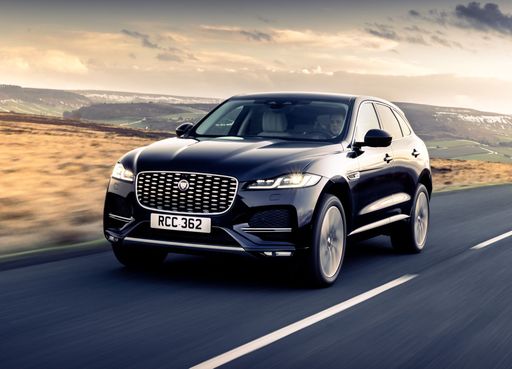
@ Jaguar Land Rover Media
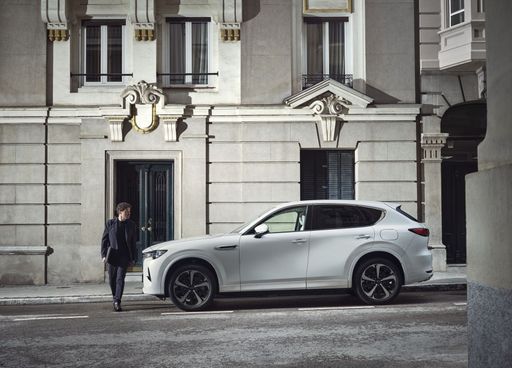
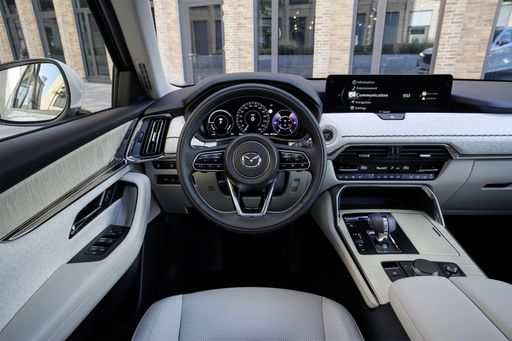
@ Mazda Motor Corporation
VS

Jaguar F-Pace vs Mazda CX-60 – Which model is better for everyday use?

Everyday use, family trips or long-distance drives – here’s where the differences show.
Discover whether Jaguar F-Pace or Mazda CX-60 fits your lifestyle better.

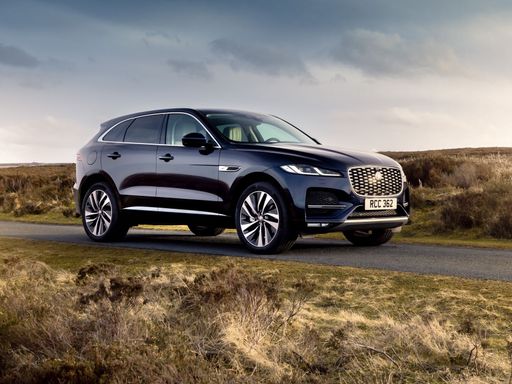
F-Pace @ Jaguar Land Rover Media

The Stylish Duel: Jaguar F-Pace vs. Mazda CX-60

In the world of luxury SUVs, few can rival the charm and substance provided by the Jaguar F-Pace and the Mazda CX-60. Both vehicles offer a taste of opulence and practicality but with distinctively different philosophies and engineering underpinnings. Let's delve into what makes each unique and how they stand against each other in style, performance, and innovation.
CX-60 @ Mazda Motor Corporation

Elegance in Design

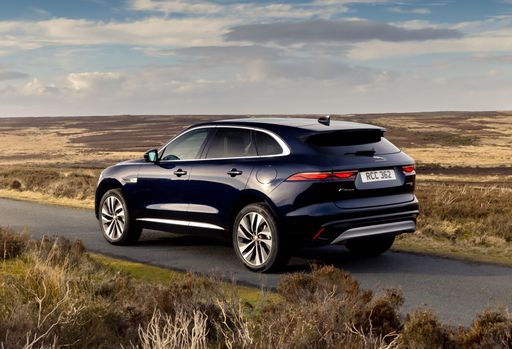
The design of the Jaguar F-Pace reflects the brand's historic love for luxury and dynamic aesthetics. Measuring approximately 4,747 mm in length and 1,936 mm in width, the F-Pace cuts a striking silhouette. Its bold lines and sophisticated exterior capture the eyes of even the most discerning automotive enthusiasts.

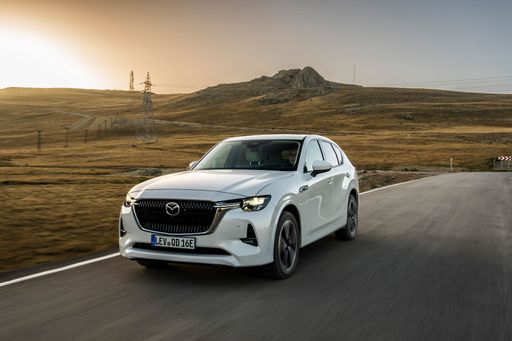
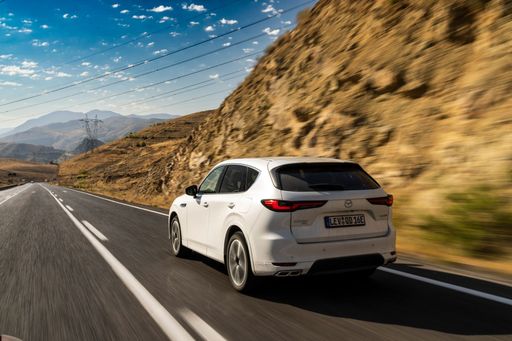
In comparison, the Mazda CX-60 maintains a refined yet bold appearance with its KODO design philosophy. Slightly shorter in length at 4,745 mm, it offers a sophisticated look with purposeful lines that convey motion even when stationary. The 1,890 mm width provides a more compact form factor, ideal for urban settings without compromising interior space.

F-Pace @ Jaguar Land Rover Media

Power and Performance

The Jaguar F-Pace is available with an array of engines, including diesel and petrol MHEV (Mild Hybrid Electric Vehicle), plugin hybrids, and pure petrol options. It boasts power outputs ranging from 163 HP to a thrilling 575 HP in its top-tier configurations. The impressive 0-100 km/h acceleration time can reach as low as 4 seconds, making it an SUV with sports-car-like performance.

In contrast, the Mazda CX-60 offers a more balanced powertrain selection. With engines that include a plugin hybrid capable of delivering 327 HP, the CX-60 achieves a respectable 0-100 km/h time of 5.8 seconds. The diesel MHEV options provide excellent fuel economy, with an impressive consumption of 5 L/100km combined with an electric range of 64 km in hybrid mode.

CX-60 @ Mazda Motor Corporation

Interior and Comfort

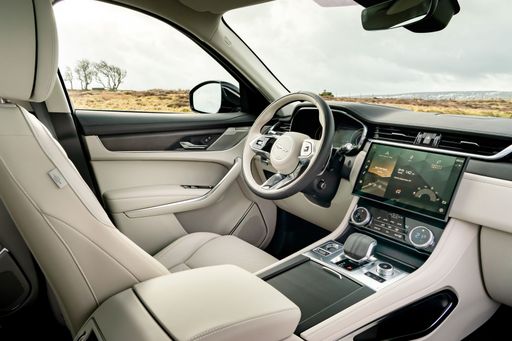
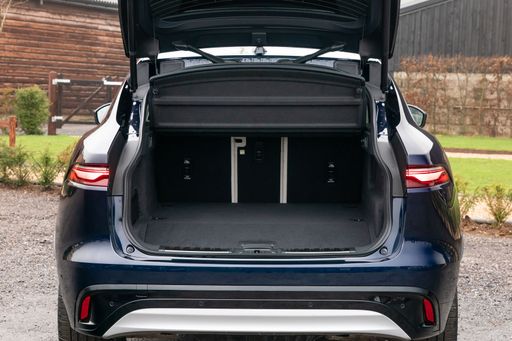
Both vehicles offer luxury and comfort for up to five passengers. The Jaguar F-Pace's interior is crafted with premium materials reflecting its luxury roots, ensuring a plush ride enhanced by state-of-the-art infotainment systems. Trunk space, however, is a bit limited with a capacity of 470 to 354 liters, depending on the model configuration.

The Mazda CX-60, known for its spaciousness, provides a cavernous trunk capacity of 570 liters. Its interior remains a serene sanctuary, featuring Mazda's human-centric design philosophy, allowing intuitive control and a seamless driving experience. The balance between practicality and luxury is evident in the layout and material selection throughout the cabin.

F-Pace @ Jaguar Land Rover Media

Technological Innovations

In innovation, Jaguar and Mazda both shine in 2024. The F-Pace, fitted with an advanced automatic transmission and all-wheel-drive system, trustfully manages its abundant power across various terrains. The utilization of both Mild Hybrid and Plugin Hybrid technologies showcases Jaguar's push towards more sustainable driving solutions.

Mazda’s CX-60, however, brings the rear-wheel-drive dynamics to the table, a nuanced touch for driving purists. The Adoption of the i-Active AWD system ensures grip and stability in a variety of conditions, while the plugin hybrid's minimal CO2 emissions (as low as 31 g/km) affirm its eco-friendly credentials.

CX-60 @ Mazda Motor Corporation

Conclusion

Choosing between the Jaguar F-Pace and the Mazda CX-60 depends on your priorities. If you seek high-performance sports SUV flair with a breadth of engine choices, the Jaguar F-Pace is an enticing option. However, if you prioritize eco-friendliness, interior space, and the craftsmanship of design, the Mazda CX-60 stands out as an excellent candidate.

Ultimately, both vehicles embody technological advancement and luxury, each offering a distinct taste of what modern SUVs can offer in style, performance, and innovation.
Here’s where it gets real: The technical differences in detail

F-Pace @ Jaguar Land Rover Media

Costs and Efficiency:

Price and efficiency are key factors when choosing a car – and this is often where the real differences emerge.

Mazda CX-60 has a noticeable advantage in terms of price – it starts at 41900 £, while the Jaguar F-Pace costs 56400 £. That’s a price difference of around 14495 £.

Fuel consumption also shows a difference: Mazda CX-60 manages with 1.40 L and is therefore evident more efficient than the Jaguar F-Pace with 1.80 L. The difference is about 0.40 L per 100 km.

Range is almost identical – both manage about 64 km on a single charge.

CX-60 @ Mazda Motor Corporation

Engine and Performance:

Under the bonnet, it becomes clear which model is tuned for sportiness and which one takes the lead when you hit the accelerator.

When it comes to engine power, the Jaguar F-Pace has a decisively edge – offering 575 HP compared to 327 HP. That’s roughly 248 HP more horsepower.

In acceleration from 0 to 100 km/h, the Jaguar F-Pace is decisively quicker – completing the sprint in 4 s, while the Mazda CX-60 takes 5.80 s. That’s about 1.80 s faster.

In terms of top speed, the Jaguar F-Pace performs noticeable better – reaching 286 km/h, while the Mazda CX-60 tops out at 219 km/h. The difference is around 67 km/h.

There’s also a difference in torque: Jaguar F-Pace pulls clearly perceptible stronger with 700 Nm compared to 550 Nm. That’s about 150 Nm difference.

F-Pace @ Jaguar Land Rover Media

Space and Everyday Use:

Beyond pure performance, interior space and usability matter most in daily life. This is where you see which car is more practical and versatile.

Both vehicles offer seating for 5 people.

In curb weight, Mazda CX-60 is slight lighter – 1890 kg compared to 1951 kg. The difference is around 61 kg.

In terms of boot space, the Mazda CX-60 offers somewhat more room – 570 L compared to 470 L. That’s a difference of about 100 L.

In maximum load capacity, the Mazda CX-60 performs slightly better – up to 1726 L, which is about 298 L more than the Jaguar F-Pace.

When it comes to payload, Mazda CX-60 barely noticeable takes the win – 612 kg compared to 589 kg. That’s a difference of about 23 kg.

Who wins the race?

The Jaguar F-Pace proves to be leaves the rival little chance and therefore becomes our DriveDuel Champion!
Jaguar F-Pace is the better all-rounder in this comparison.

from about £56,400
F-Pace @ Jaguar Land Rover Media

Jaguar F-Pace

  • Engine Type : Diesel MHEV, Petrol MHEV, Plugin Hybrid, Petrol
  • Transmission : Automatic
  • Drive Type : All-Wheel Drive
  • Power HP : 163 - 575 HP
  • Consumption L/100km : 1.8 - 12 L
  • Electric Range : 64 km

Jaguar F-Pace

The Jaguar F-Pace effortlessly combines luxury and performance, offering an exceptional driving experience. Its sleek design is complemented by a refined interior that ensures comfort even on the longest journeys. With advanced technology features, the F-Pace remains at the forefront of innovation, making it a standout choice in the SUV segment.

details

Mazda CX-60

5 (1)
rate

The Mazda CX-60 pairs sculpted, understated looks with poised handling and a cabin that punches above its class, making long drives feel unexpectedly civilized. For buyers who want a premium feel without the showroom swagger, it's the sort of car that earns respect quietly — and still manages a wink when you push on.

details
Jaguar F-Pace
Mazda CX-60
F-Pace @ Jaguar Land Rover Media
CX-60 @ Mazda Motor Corporation

Costs and Consumption

Price
56400 - 100800 £
Price
41900 - 56800 £
Consumption L/100km
1.8 - 12 L
Consumption L/100km
1.4 - 5.4 L
Consumption kWh/100km
-
Consumption kWh/100km
-
Electric Range
64 km
Electric Range
64 km
Battery Capacity
15.40 kWh
Battery Capacity
-
co2
41 - 274 g/km
co2
31 - 139 g/km
Fuel tank capacity
62 - 83 L
Fuel tank capacity
50 - 58 L

Dimensions and Body

Body Type
SUV
Body Type
SUV
Seats
5
Seats
5
Doors
5
Doors
5
Curb weight
1951 - 2230 kg
Curb weight
1890 - 2055 kg
Trunk capacity
354 - 470 L
Trunk capacity
570 L
Length
4747 - 4762 mm
Length
4745 mm
Width
1936 mm
Width
1890 mm
Height
1664 - 1670 mm
Height
1680 - 1688 mm
Max trunk capacity
1299 - 1428 L
Max trunk capacity
1726 L
Payload
457 - 589 kg
Payload
581 - 612 kg

Engine and Performance

Engine Type
Diesel MHEV, Petrol MHEV, Plugin Hybrid, Petrol
Engine Type
Plugin Hybrid, Diesel MHEV
Transmission
Automatic
Transmission
Automatic
Transmission Detail
Automatic Gearbox
Transmission Detail
Automatic Gearbox
Drive Type
All-Wheel Drive
Drive Type
All-Wheel Drive, Rear-Wheel Drive
Power HP
163 - 575 HP
Power HP
200 - 327 HP
Acceleration 0-100km/h
4 - 10.1 s
Acceleration 0-100km/h
5.8 - 8.4 s
Max Speed
195 - 286 km/h
Max Speed
200 - 219 km/h
Torque
380 - 700 Nm
Torque
450 - 550 Nm
Number of Cylinders
4 - 8
Number of Cylinders
4 - 6
Power kW
120 - 423 kW
Power kW
147 - 241 kW
Engine capacity
1997 - 5000 cm3
Engine capacity
2488 - 3283 cm3

General

Model Year
2024
Model Year
2024
CO2 Efficiency Class
G, B
CO2 Efficiency Class
B, D, E
Brand
Jaguar
Brand
Mazda
What drive types are available for the Jaguar F-Pace?

Available configurations include All-Wheel Drive.

The prices and data displayed are estimates based on German list prices and may vary by country. This information is not legally binding.