@ Renault Group Media
VS

Renault Rafale vs Renault Scénic – Differences & prices compared

Compare performance, boot capacity, efficiency and price at a glance.
Find out which car is the better choice for you – Renault Rafale or Renault Scénic?

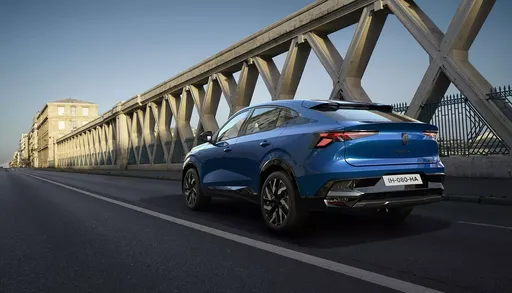
Rafale @ Renault Group Media

The New Era of Renault: Rafale vs. Scénic - A Head-to-Head Comparison

Renault, a brand synonymous with innovation and cutting-edge technology, introduces two exemplary models that redefine the meaning of performance and sustainability in the SUV segment. Meet the Renault Rafale and the Renault Scénic, both 2024 models that promise not only to elevate your driving experience but also maintain a sharp focus on eco-friendliness.
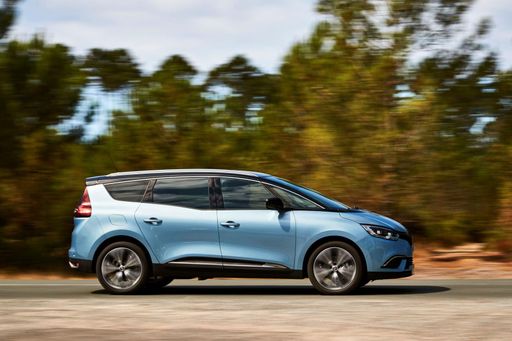
Scénic @ Renault Group Media

Engine and Performance

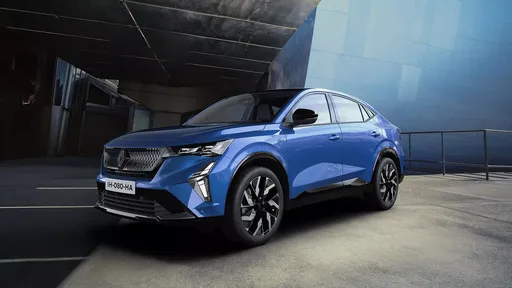
The Renault Rafale offers a choice between full hybrid and plugin hybrid powertrains, with power outputs of 200 HP and 300 HP, ensuring drivers experience a robust and flexible performance. Designed for those with a taste for speed, the Rafale zips from 0-100 km/h in as little as 6.4 seconds, depending on the engine option, and reaches a top speed of 180 km/h. Furthermore, its fuel consumption is impressively low at just 4.7 L/100km for the hybrid and a mere 0.6 L/100km for the plugin hybrid variant.

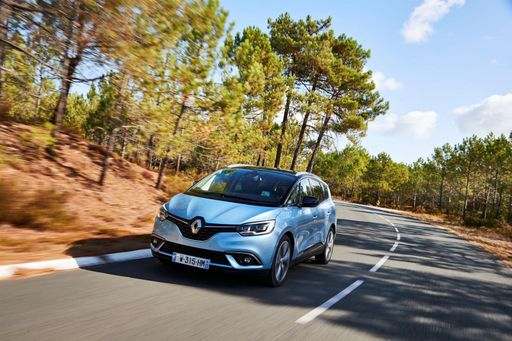
In contrast, the Renault Scénic is a pure electric vehicle, offering a serene yet powerful drive with power outputs of 170 HP and 220 HP. This SUV silently soars from 0-100 km/h in 7.9 seconds and comfortably cruises at top speeds of up to 170 km/h. With an electric range between 420 and 598 km, the Scénic minimizes its carbon footprint with zero CO2 emissions.

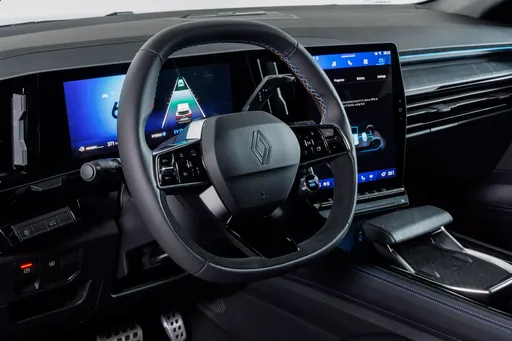
Rafale @ Renault Group Media

Technological Innovations and Efficiency

The technological prowess of the Rafale is evident in its advanced automatic gearbox that ensures smooth transitions and efficient energy usage. It also boasts an electric range of 97 km in its plugin hybrid model, allowing for short trips without fuel consumption. The CO2 emissions stand at a respectable 106 g/km for the hybrid version and an extraordinary 14 g/km for the plugin hybrid, classifying them within the C and B efficiency classes, respectively.

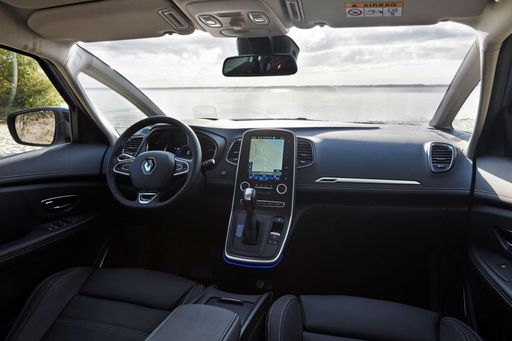
The all-electric Scénic, with its reduction gearbox, delivers an engaging drive that’s both seamless and environmentally conscious. Despite its prowess, it achieves a remarkable consumption rate of just 16.7 to 17.6 kWh/100km, firmly placing it in the A efficiency class with zero grams of CO2 emitted.

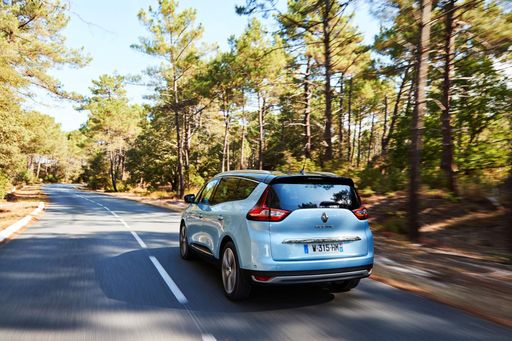
Scénic @ Renault Group Media

Interior and Dimensions

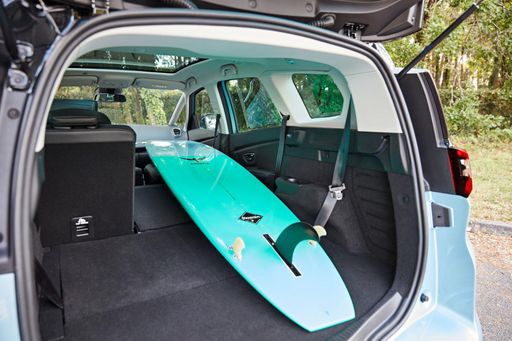
While both SUVs offer a comfortable seating arrangement for five passengers, their differing dimensions provide a unique driving experience. The Rafale, measuring 4710 mm in length, provides a spacious trunk capacity of 627 liters, making it perfect for long journeys and family adventures. Its larger stance, with a width of 1886 mm and height of 1613 mm, ensures an imposing presence on the road.

The Scénic takes a more compact approach at 4470 mm in length, making it ideal for urban navigation while still offering a generous trunk capacity of 545 liters. Its dimensions, with a width of 1864 mm and height of 1571 mm, offer a sleek and agile driving experience.

Rafale @ Renault Group Media

Weight and Payload

The Renault Rafale varies in curb weight between 1728 kg and 2025 kg, depending on the chosen engine and specification. It offers a payload capacity between 415 kg and 447 kg, catering to various loads and passenger needs.

Renault’s Scénic weighs in slightly heavier, ranging from 1822 kg to 1927 kg, ultimately allowing a payload capacity between 514 kg and 518 kg. This balance of weight ensures stability and a strong road presence.

Scénic @ Renault Group Media

Conclusion: Choice Between Hybrid and Electric Excellence

The Renault Rafale and Renault Scénic illustrate the brand’s commitment to innovation, diverse powertrain options, and sustainable mobility. Whether you are drawn to the versatile hybrid capabilities of the Rafale or the fully-electric, zero-emission concept of the Scénic, both models promise luxury, efficiency, and an elevated driving experience. As environmental consciousness meets power and versatility, each vehicle caters to distinct needs yet upholds Renault’s high standards of performance and innovation.

Here’s where it gets real: The technical differences in detail

Costs and Efficiency:

Price and efficiency are key factors when choosing a car – and this is often where the real differences emerge.

Renault Scénic has a minimal advantage in terms of price – it starts at 34600 £, while the Renault Rafale costs 37500 £. That’s a price difference of around 2914 £.

As for range, the Renault Scénic performs decisively better – achieving up to 598 km, about 501 km more than the Renault Rafale.

Engine and Performance:

Power, torque and acceleration say a lot about how a car feels on the road. This is where you see which model delivers more driving dynamics.

When it comes to engine power, the Renault Rafale has a evident edge – offering 300 HP compared to 218 HP. That’s roughly 82 HP more horsepower.

In acceleration from 0 to 100 km/h, the Renault Rafale is clearly perceptible quicker – completing the sprint in 6.40 s, while the Renault Scénic takes 7.90 s. That’s about 1.50 s faster.

In terms of top speed, the Renault Rafale performs minimal better – reaching 180 km/h, while the Renault Scénic tops out at 170 km/h. The difference is around 10 km/h.

Space and Everyday Use:

Cabin size, boot volume and payload all play a role in everyday practicality. Here, comfort and flexibility make the difference.

Both vehicles offer seating for 5 people.

In curb weight, Renault Rafale is barely noticeable lighter – 1734 kg compared to 1822 kg. The difference is around 88 kg.

In terms of boot space, the Renault Rafale offers to a small extent more room – 627 L compared to 545 L. That’s a difference of about 82 L.

In maximum load capacity, the Renault Rafale performs to a small extent better – up to 1910 L, which is about 240 L more than the Renault Scénic.

When it comes to payload, Renault Scénic a bit takes the win – 518 kg compared to 444 kg. That’s a difference of about 74 kg.

Who wins the race?

The Renault Rafale proves to be only a minor advantage and therefore becomes our DriveDuel Champion!
Renault Rafale is the better all-rounder in this comparison.

from about £37,500
Rafale @ Renault Group Media

Renault Rafale

  • Engine Type : Plugin Hybrid, Full Hybrid
  • Transmission : Automatic
  • Drive Type : All-Wheel Drive, Front-Wheel Drive
  • Power HP : 200 - 300 HP
  • Consumption L/100km : 0.6 - 5 L
  • Electric Range : 97 km

Renault Rafale

5 (3)
rate

The Renault Rafale dresses bold coupé-inspired lines around a practical crossover body, turning heads without trying too hard. Inside it serves up a comfortable, well-equipped cabin and engaging driving manners, making it a clever choice for buyers who want a bit of panache with their daily commute.

details

Renault Scénic

5 (1)
rate

The Renault Scénic is a quietly clever family MPV that balances everyday practicality with unexpected flair, offering a roomy, flexible cabin that makes school runs and weekend escapes less of a chore. It won't dazzle like a sports car, but its composed ride, sensible tech and thoughtful storage solutions make it a superbly pragmatic choice for buyers who prefer substance with a wink.

details
Renault Rafale
Renault Scénic
Rafale @ Renault Group Media
Scénic @ Renault Group Media

Costs and Consumption

Price
37500 - 49500 £
Price
34600 - 44000 £
Consumption L/100km
0.6 - 5 L
Consumption L/100km
-
Consumption kWh/100km
-
Consumption kWh/100km
16.6 - 17.5 kWh
Electric Range
97 km
Electric Range
420 - 598 km
Battery Capacity
-
Battery Capacity
-
co2
14 - 109 g/km
co2
0 g/km
Fuel tank capacity
55 L
Fuel tank capacity
-

Dimensions and Body

Body Type
SUV
Body Type
SUV
Seats
5
Seats
5
Doors
5
Doors
5
Curb weight
1734 - 2025 kg
Curb weight
1822 - 1927 kg
Trunk capacity
539 - 627 L
Trunk capacity
545 L
Length
4710 mm
Length
4470 mm
Width
1886 mm
Width
1864 mm
Height
1613 mm
Height
1571 mm
Max trunk capacity
1826 - 1910 L
Max trunk capacity
1670 L
Payload
415 - 444 kg
Payload
514 - 518 kg

Engine and Performance

Engine Type
Plugin Hybrid, Full Hybrid
Engine Type
Electric
Transmission
Automatic
Transmission
Automatic
Transmission Detail
Automatic Gearbox
Transmission Detail
Reduction Gearbox
Drive Type
All-Wheel Drive, Front-Wheel Drive
Drive Type
Front-Wheel Drive
Power HP
200 - 300 HP
Power HP
170 - 218 HP
Acceleration 0-100km/h
6.4 - 8.9 s
Acceleration 0-100km/h
7.9 - 8.6 s
Max Speed
180 km/h
Max Speed
150 - 170 km/h
Torque
-
Torque
280 - 300 Nm
Number of Cylinders
3
Number of Cylinders
-
Power kW
147 - 221 kW
Power kW
125 - 160 kW
Engine capacity
1199 cm3
Engine capacity
-

General

Model Year
2024 - 2025
Model Year
2025
CO2 Efficiency Class
B, C
CO2 Efficiency Class
A
Brand
Renault
Brand
Renault
What drive types are available for the Renault Rafale?

The Renault Rafale is offered with All-Wheel Drive or Front-Wheel Drive.

The prices and data displayed are estimates based on German list prices and may vary by country. This information is not legally binding.