VS

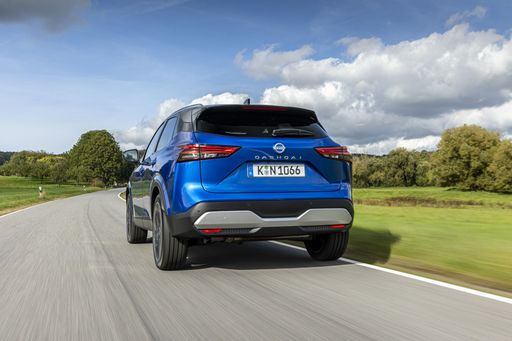
Skoda Kodiaq vs Nissan Qashqai comparison

Compare performance (265 HP vs 205 HP), boot space and price (37,900 £ vs 29,600 £ ) at a glance. Find out which car is the better choice for you – Skoda Kodiaq or Nissan Qashqai?

Skoda Kodiaq vs Nissan Qashqai: Key differences

Skoda Kodiaq

5 (4 Reviews)
rate
  • visibly more power
  • significantly more efficient
  • clearly quicker 0–100 km/h
  • considerably more trunk space

Nissan Qashqai

4.9 (3 Reviews)
rate
  • markedly cheaper
  • somewhat lighter

All details on performance, efficiency, range and trunk space can be found in the technical comparison below – including user reviews for both models.

Kodiaq

Nissan Qashqai vs Skoda Kodiaq: Battle of the SUVs

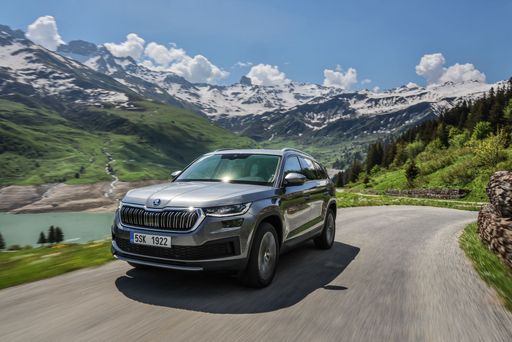
In the ever-competitive SUV market, two contenders have consistently attracted attention with their promise of performance, innovation, and versatility. The Nissan Qashqai and the Skoda Kodiaq, both 2024 models, offer compelling cases for those in search of a reliable, modern SUV. Let's delve into the technical specs and innovations of these vehicles to see which might be the better fit for your driving needs.
Qashqai

Design and Dimensions

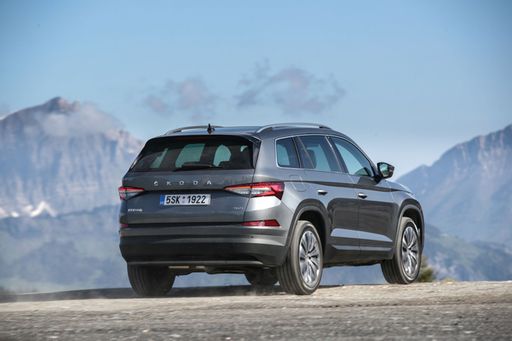
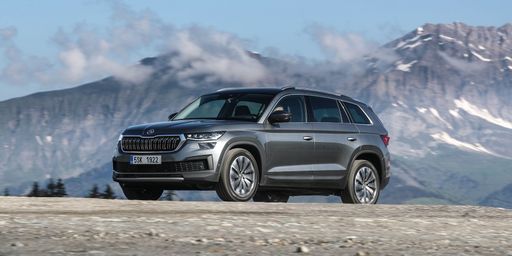
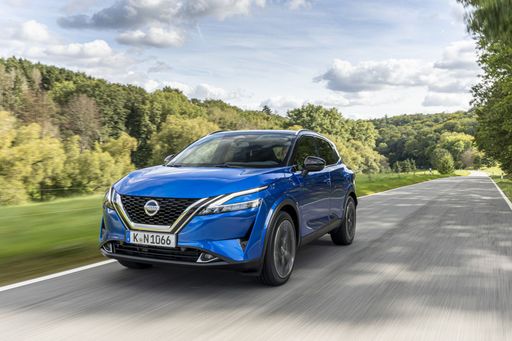
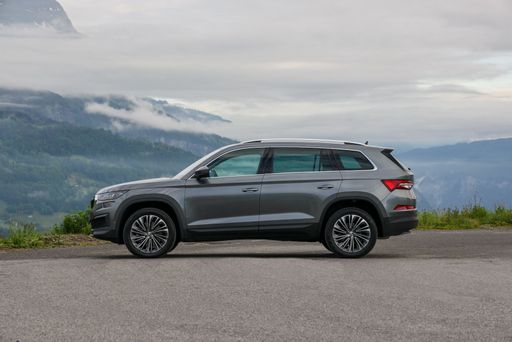
The Nissan Qashqai sports dimensions that reflect its agility and urban suitability. With a length of 4425 mm, width of 1835 mm, and height of 1625 mm, it offers a compact SUV experience that's well-suited for bustling city life. The Skoda Kodiaq, on the other hand, boasts a more substantial presence. It stretches out to 4758-4761 mm in length, with a width of 1864 mm and a height of 1663-1683 mm, providing ample space for both passengers and cargo.

Kodiaq

Power and Performance

The Qashqai comes with multiple engine configurations, including petrol MHEV and full hybrid options, delivering power outputs ranging from 140 to 190 HP. It offers a choice between manual and automatic (CVT) transmissions. The Qashqai promises a smooth ride with acceleration from 0-100 km/h in 7.9 to 10.2 seconds and a fuel consumption of between 5.1 to 6.8 L/100km, making it a balanced choice for efficiency and power.

In the Kodiaq, Skoda offers a varied engine selection, including plugin hybrid, petrol MHEV, diesel, and petrol. Its power spans from 150 to a robust 265 HP, with all versions sporting an automatic dual-clutch transmission. Notably, the plugin hybrid model delivers an impressive electric range of up to 123 km and a consumption of just 0.4 to 0.5 L/100km, appealing to environmentally conscious drivers. The Kodiaq accelerates from 0-100 km/h in 6.3 to 9.7 seconds.

Qashqai

Innovations and Features

Nissan embraces cutting-edge technology in the Qashqai, providing features like advanced driver-assistance systems and a state-of-the-art infotainment setup, making every journey both safe and enjoyable. Additionally, the hybrid model offers reduced emissions, important for eco-conscious drivers.

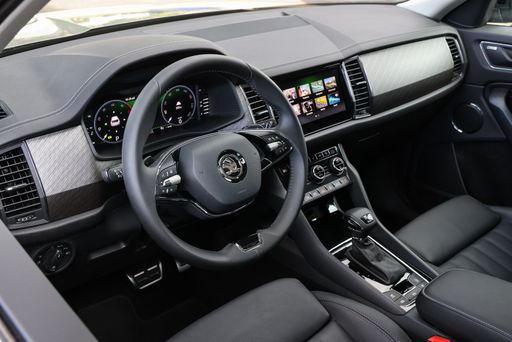
The Kodiaq shines with its advanced tech offerings as well, featuring an impressive lineup of driver aids and connectivity options. A plugin hybrid variant highlights Skoda's commitment to sustainability, offering not only reduced emissions but also practical electric-only modes for shorter trips.

Kodiaq

Efficiency and Environmental Impact

When it comes to emissions, the Qashqai's CO2 output ranges from 116 to 154 g/km, categorized in classes D and E. Its hybrid technology helps reduce the overall environmental footprint. The Kodiaq, particularly in its plugin hybrid form, achieves some of the lowest CO2 emissions in the segment at 9 to 186 g/km, classified from B to G efficiency classes. This variant is a step forward in eco-friendly driving.

Qashqai

Practicality and Capacity

The Qashqai offers a trunk capacity of 479 to 504 liters, sufficient for standard family needs or recreational gear. On the flip side, the Kodiaq impresses with its vast cargo space ranging from 745 to 910 liters, satisfying even the most demanding packing requirements for long journeys or bulky equipment.

Kodiaq

The Verdict

In conclusion, both the Nissan Qashqai and Skoda Kodiaq bring a unique set of attributes appealing to different types of drivers. The Qashqai stands out for its maneuverability and hybrid efficiencies, while the Kodiaq shines with its spaciousness, robust power range, and especially its eco-friendly plugin hybrid option. Your choice between these two may well come down to priorities like environmental consciousness versus space requirements and the daily demands of your driving lifestyle.

Here’s where it gets real: The technical differences in detail

Kodiaq

Costs and Efficiency:

Price and efficiency are key factors when choosing a car – and this is often where the real differences emerge.

Nissan Qashqai is markedly cheaper – starting at 29,600 £ , while the Skoda Kodiaq costs 37,900 £ . That’s a price difference of around 8,272 £.

Fuel consumption also shows a difference: the Skoda Kodiaq uses 1.5 L/100km and is significantly more efficient than the Nissan Qashqai with 4.5 L/100km. The difference is about 3 L/100km.

Qashqai

Engine and Performance:

Power, torque and acceleration say a lot about how a car feels on the road. This is where you see which model delivers more driving dynamics.

When it comes to engine power, the Skoda Kodiaq offers visibly more power – delivering 265 HP compared to 205 HP. That’s roughly 60 HP more horsepower.

When accelerating from 0 to 100 km/h, the Skoda Kodiaq is clearly quicker – completing the sprint in 6.3 s, while the Nissan Qashqai takes 7.6 s. That’s about 1.3 s quicker.

Looking at top speed, the Skoda Kodiaq is barely faster – reaching 226 km/h, while the Nissan Qashqai tops out at 206 km/h. The difference is around 20 km/h.

There’s also a difference in torque: the Skoda Kodiaq delivers somewhat more torque with 400 Nm compared to 330 Nm. That’s about 70 Nm more.

Kodiaq

Space and Everyday Use:

Cabin size, boot volume and payload all play a role in everyday practicality. Here, comfort and flexibility make the difference.

Both vehicles offer seating for 5 people.

In terms of curb weight, Nissan Qashqai is somewhat lighter – 1,420 kg compared to 1,684 kg. The difference is around 264 kg.

Looking at boot space, the Skoda Kodiaq offers considerably more boot space – 910 L compared to 504 L. That’s a difference of about 406 L.

For maximum load capacity, the Skoda Kodiaq offers visibly more capacity – up to 2,105 L, about 658 L more than the Nissan Qashqai.

When it comes to payload, the Skoda Kodiaq carries barely more – 563 kg compared to 520 kg. That’s a difference of about 43 kg.

Who wins the race in the data check?

The Skoda Kodiaq is clearly superior overall in the objective data comparison.
This result only shows which model scores more points on paper – not which of the two cars feels right for you.

from £37,900
Kodiaq

Skoda Kodiaq

  • Engine Type : Petrol, Petrol MHEV, Diesel, Plugin Hybrid
  • Transmission : Automatic
  • Drive Type : All-Wheel Drive, Front-Wheel Drive
  • Power HP : 150 - 265 HP
  • Consumption L/100km : 1.5 - 8.2 L/100km
  • Electric Range : 119 - 122 km
Skoda Kodiaq
Nissan Qashqai

Costs and Consumption

View detailed analysis

Engine and Performance

View detailed analysis

Dimensions and Body

View detailed analysis

Skoda Kodiaq

The Skoda Kodiaq blends sensible practicality with surprising style, so families and weekend adventurers get roomy comfort without looking like a moving van. It feels calm and composed on the road, packs clever storage and user-friendly tech, and manages to deliver a near-premium vibe without the pretension.

details

Nissan Qashqai

The Nissan Qashqai blends practical, family-friendly packaging with SUV styling that refuses to shout, making it a sensible and dependable choice for everyday life. It’s comfortable to live with, economical on the road, and neatly equipped enough to feel modern without ever feeling precious — perfect if you want crossover versatility without the drama.

details
Skoda Kodiaq
Nissan Qashqai

Costs and Consumption

Price
37,900 - 50,600 £
Price
29,600 - 39,900 £
Consumption L/100km
1.5 - 8.2 L/100km
Consumption L/100km
4.5 - 6.8 L/100km
Consumption kWh/100km
-
Consumption kWh/100km
-
Electric Range
119 - 122 km
Electric Range
-
Battery Capacity
-
Battery Capacity
-
co2
35 - 186 g/km
co2
102 - 154 g/km
Fuel tank capacity
58 L
Fuel tank capacity
55 L

Dimensions and Body

Body Type
SUV
Body Type
SUV
Seats
5
Seats
5
Doors
5
Doors
5
Curb weight
1,684 - 1,970 kg
Curb weight
1,420 - 1,665 kg
Trunk capacity
745 - 910 L
Trunk capacity
479 - 504 L
Length
4,758 mm
Length
4,425 mm
Width
1,864 mm
Width
1,835 mm
Height
1,679 - 1,683 mm
Height
1,625 mm
Max trunk capacity
2,105 L
Max trunk capacity
1,422 - 1,447 L
Payload
460 - 563 kg
Payload
466 - 520 kg

Engine and Performance

Engine Type
Petrol, Petrol MHEV, Diesel, Plugin Hybrid
Engine Type
Petrol MHEV, Full Hybrid
Transmission
Automatic
Transmission
Manuel, Automatic
Transmission Detail
Dual-Clutch Automatic
Transmission Detail
Manual Gearbox, CVT, Reduction Gearbox
Drive Type
All-Wheel Drive, Front-Wheel Drive
Drive Type
Front-Wheel Drive, All-Wheel Drive
Power HP
150 - 265 HP
Power HP
140 - 205 HP
Acceleration 0-100km/h
6.3 - 9.7 s
Acceleration 0-100km/h
7.6 - 10.2 s
Max Speed
226 km/h
Max Speed
170 - 206 km/h
Torque
250 - 400 Nm
Torque
240 - 330 Nm
Number of Cylinders
4
Number of Cylinders
3 - 4
Power kW
110 - 195 kW
Power kW
103 - 151 kW
Engine capacity
1,498 - 1,984 cm3
Engine capacity
1,332 - 1,498 cm3

General

Model Year
2,024 - 2,025
Model Year
2,025 - 2,026
CO2 Efficiency Class
F, G, E, B
CO2 Efficiency Class
E, C
Brand
Skoda
Brand
Nissan
DriveDuel uses data analysis and artificial intelligence to evaluate vehicle data and create content. Content is regularly reviewed and improved. The displayed prices are estimates based on German list prices, adjusted to the respective country’s VAT. Country-specific registration taxes are not included. This information is not legally binding.