VS

Skoda Octavia Combi vs VW Passat - Differences and prices compared

Compare performance (265 HP vs 272 HP), boot space and price (24400 £ vs 36500 £ ) at a glance. Find out which car is the better choice for you – Skoda Octavia Combi or VW Passat?

Skoda Octavia Combi

VW Passat

5 (3 Reviews)
rate

Here’s where it gets real: The technical differences in detail

Octavia Combi

Costs and Efficiency:

When it comes to price and running costs, the biggest differences usually appear. This is often where you see which car fits your budget better in the long run.

Skoda Octavia Combi has a significantly advantage in terms of price – it starts at 24400 £ , while the VW Passat costs 36500 £ . That’s a price difference of around 12042 £.

Fuel consumption also shows a difference: VW Passat manages with 1.20 L and is therefore convincingly more efficient than the Skoda Octavia Combi with 4.40 L. The difference is about 3.20 L per 100 km.

Passat

Engine and Performance:

Power, torque and acceleration are the classic benchmarks for car enthusiasts – and here, some clear differences start to show.

When it comes to engine power, the VW Passat has a slight edge – offering 272 HP compared to 265 HP. That’s roughly 7 HP more horsepower.

In acceleration from 0 to 100 km/h, the VW Passat is a bit quicker – completing the sprint in 5.80 s, while the Skoda Octavia Combi takes 6.50 s. That’s about 0.70 s faster.

There’s no difference in top speed – both reach 250 km/h.

There’s also a difference in torque: VW Passat pulls hardly perceptible stronger with 400 Nm compared to 370 Nm. That’s about 30 Nm difference.

Octavia Combi

Space and Everyday Use:

Cabin size, boot volume and payload all play a role in everyday practicality. Here, comfort and flexibility make the difference.

Both vehicles offer seating for 5 people.

In curb weight, Skoda Octavia Combi is a bit lighter – 1366 kg compared to 1573 kg. The difference is around 207 kg.

In terms of boot space, the VW Passat offers barely noticeable more room – 690 L compared to 640 L. That’s a difference of about 50 L.

In maximum load capacity, the VW Passat performs a bit better – up to 1920 L, which is about 220 L more than the Skoda Octavia Combi.

When it comes to payload, VW Passat minimal takes the win – 577 kg compared to 534 kg. That’s a difference of about 43 kg.

Who comes out on top?

Overall, the VW Passat shows itself to be leaves the rival little chance and secures the title of DriveDuel Champion.
It convinces with the more balanced overall package and proves to be the more versatile choice for everyday use.

from about £36,500
Passat

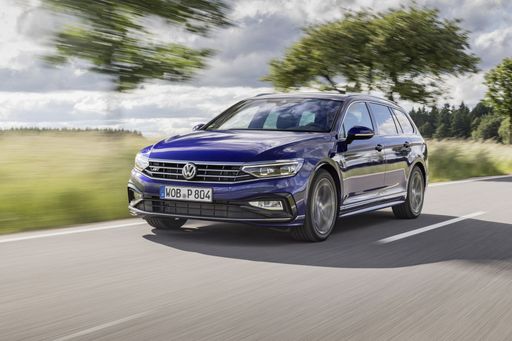
VW Passat

  • Engine Type : Petrol, Petrol MHEV, Diesel, Plugin Hybrid
  • Transmission : Automatic
  • Drive Type : All-Wheel Drive, Front-Wheel Drive
  • Power HP : 122 - 272 HP
  • Consumption L/100km : 1.2 - 8 L
  • Electric Range : 124 - 135 km
Skoda Octavia Combi
VW Passat

Costs and Consumption

View detailed analysis

Engine and Performance

View detailed analysis

Dimensions and Body

View detailed analysis

Skoda Octavia Combi

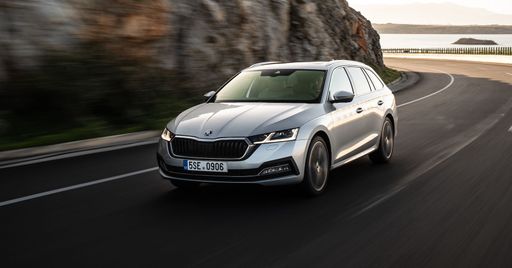
The Skoda Octavia Combi is the sensible family wagon that somehow turns grocery runs and long trips into a pleasant, unshowy experience — spacious, practical and built like it prefers reliability over flash. With smart touches, clever storage and a cabin that feels grown-up rather than frugal, it’s an easy recommendation for buyers who want maximum utility without sacrificing comfort or style.

details

VW Passat

5 (3 Reviews)
rate

The VW Passat is the grown-up family car that gets the basics absolutely right — roomy, comfortable and built to handle weekday commutes and weekend getaways without fuss. It won't set your pulse racing, but its calm composure and sensible packaging make it boring in the best possible way: a dependable, no‑drama choice for buyers who value practicality over flash.

details
Skoda Octavia Combi
VW Passat

Costs and Consumption

Price
24400 - 42300 £
Price
36500 - 58500 £
Consumption L/100km
4.4 - 6.9 L
Consumption L/100km
1.2 - 8 L
Consumption kWh/100km
-
Consumption kWh/100km
-
Electric Range
-
Electric Range
124 - 135 km
Battery Capacity
-
Battery Capacity
19.70 kWh
co2
113 - 157 g/km
co2
28 - 181 g/km
Fuel tank capacity
45 - 55 L
Fuel tank capacity
45 - 66 L

Dimensions and Body

Body Type
Estate
Body Type
Estate
Seats
5
Seats
5
Doors
5
Doors
5
Curb weight
1366 - 1553 kg
Curb weight
1573 - 1858 kg
Trunk capacity
640 L
Trunk capacity
510 - 690 L
Length
4698 - 4709 mm
Length
4917 mm
Width
1829 mm
Width
1849 mm
Height
1455 - 1468 mm
Height
1521 mm
Max trunk capacity
1700 L
Max trunk capacity
1770 - 1920 L
Payload
471 - 534 kg
Payload
501 - 577 kg

Engine and Performance

Engine Type
Petrol, Petrol MHEV, Diesel
Engine Type
Petrol, Petrol MHEV, Diesel, Plugin Hybrid
Transmission
Automatic, Manuel
Transmission
Automatic
Transmission Detail
Dual-Clutch Automatic, Manual Gearbox
Transmission Detail
Dual-Clutch Automatic
Drive Type
Front-Wheel Drive, All-Wheel Drive
Drive Type
All-Wheel Drive, Front-Wheel Drive
Power HP
116 - 265 HP
Power HP
122 - 272 HP
Acceleration 0-100km/h
6.5 - 10.7 s
Acceleration 0-100km/h
5.8 - 10.7 s
Max Speed
203 - 250 km/h
Max Speed
212 - 250 km/h
Torque
220 - 370 Nm
Torque
250 - 400 Nm
Number of Cylinders
4
Number of Cylinders
4
Power kW
85 - 195 kW
Power kW
90 - 200 kW
Engine capacity
1498 - 1984 cm3
Engine capacity
1498 - 1984 cm3

General

Model Year
2024 - 2025
Model Year
2024 - 2025
CO2 Efficiency Class
E, F, D, C
CO2 Efficiency Class
G, D, E, B
Brand
Skoda
Brand
VW
Is the Skoda Octavia Combi offered with different drivetrains?

The Skoda Octavia Combi is available as Front-Wheel Drive or All-Wheel Drive.

The prices shown are estimates based on German list prices, adjusted for local VAT. Local registration taxes (e.g. NoVA, BPM or CO2 malus) are not included. This information is not legally binding.