
 Deutschland
 France
 Nederland
 Great Britain
 Sverige
 Danmark
 Suomi
Suomi Italia
 Polska
 España
VS
BMW i5 Touring vs Toyota C-HR+ - Differences and prices compared
Compare performance (601 HP vs 343 HP), boot space and price (61900 £ vs 36000 £ ) at a glance. Find out which car is the better choice for you – BMW i5 Touring or Toyota C-HR+?
i5 Touring
Costs and Efficiency:
When it comes to price and running costs, the biggest differences usually appear. This is often where you see which car fits your budget better in the long run.
Toyota C-HR+ has a significantly advantage in terms of price – it starts at 36000 £ , while the BMW i5 Touring costs 61900 £ . That’s a price difference of around 25894 £.
In terms of energy consumption, the advantage goes to the Toyota C-HR+: with 13.40 kWh per 100 km, it’s slightly more efficient than the BMW i5 Touring with 15.40 kWh. That’s a difference of about 2 kWh.
As for electric range, the Toyota C-HR+ performs barely noticeable better – achieving up to 607 km, about 5 km more than the BMW i5 Touring.
i5 Touring
Engine and Performance:
Power, torque and acceleration say a lot about how a car feels on the road. This is where you see which model delivers more driving dynamics.
When it comes to engine power, the BMW i5 Touring has a convincingly edge – offering 601 HP compared to 343 HP. That’s roughly 258 HP more horsepower.
In acceleration from 0 to 100 km/h, the BMW i5 Touring is distinct quicker – completing the sprint in 3.90 s, while the Toyota C-HR+ takes 5.20 s. That’s about 1.30 s faster.
There’s also a difference in torque: BMW i5 Touring pulls significantly stronger with 820 Nm compared to 338 Nm. That’s about 482 Nm difference.
Space and Everyday Use:
Cabin size, boot volume and payload all play a role in everyday practicality. Here, comfort and flexibility make the difference.
Both vehicles offer seating for 5 people.
In curb weight, Toyota C-HR+ is noticeable lighter – 1810 kg compared to 2255 kg. The difference is around 445 kg.
In terms of boot space, the BMW i5 Touring offers noticeable more room – 570 L compared to 416 L. That’s a difference of about 154 L.
When it comes to payload, Toyota C-HR+ to a small extent takes the win – 655 kg compared to 560 kg. That’s a difference of about 95 kg.
Who wins the race in the data check?
The BMW i5 Touring holds a decisive overall lead in the objective data comparison.
This result only shows which model scores more points on paper – not which of the two cars feels right for you.
BMW i5 Touring
Toyota C-HR+
Costs and Consumption
View detailed analysis
View detailed analysis
Engine and Performance
View detailed analysis
View detailed analysis
Dimensions and Body
View detailed analysis
View detailed analysis
from about £61,900
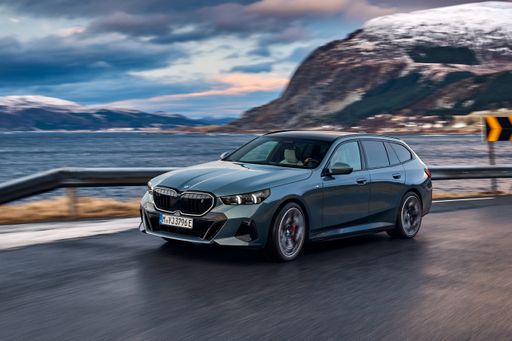
BMW i5 Touring
BMW i5 Touring
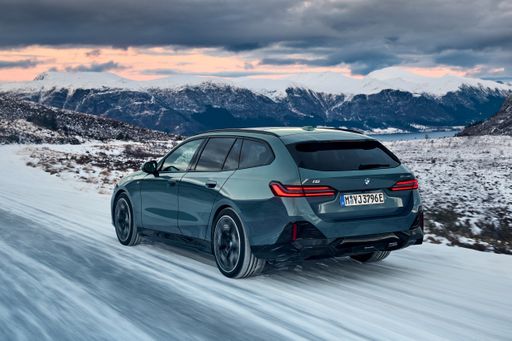
The BMW i5 Touring marries the everyday usefulness of a roomy estate with the hushed, premium feel of a modern electric BMW. It’s an appealing choice for buyers who want confident, relaxed driving and executive poise without sacrificing weekend practicality — and it even makes loading skis feel slightly glamorous.
details
Toyota C-HR+
The Toyota C-HR+ mixes sharp, coupe-like styling with comfortable, surprisingly practical packaging, making a bold statement around town and on the weekend run. It’s aimed at drivers who value standout looks and fuss-free ownership over sports-car thrills, so if you want personality and reliability in one tidy package, book a test drive.
details
BMW i5 Touring
Toyota C-HR+
Costs and Consumption |
|
|---|---|
|
Price
61900 - 87000 £
|
Price
36000 - 46300 £
|
|
Consumption L/100km
-
|
Consumption L/100km
-
|
|
Consumption kWh/100km
15.4 - 17.7 kWh
|
Consumption kWh/100km
13.4 - 15.5 kWh
|
|
Electric Range
522 - 602 km
|
Electric Range
458 - 607 km
|
|
Battery Capacity
81.20 kWh
|
Battery Capacity
-
|
|
co2
0 g/km
|
co2
0 g/km
|
|
Fuel tank capacity
-
|
Fuel tank capacity
-
|
Dimensions and Body |
|
|---|---|
|
Body Type
Estate
|
Body Type
SUV
|
|
Seats
5
|
Seats
5
|
|
Doors
4
|
Doors
-
|
|
Curb weight
2255 - 2425 kg
|
Curb weight
1810 - 2010 kg
|
|
Trunk capacity
570 L
|
Trunk capacity
416 L
|
|
Length
5060 mm
|
Length
-
|
|
Width
1900 mm
|
Width
1870 mm
|
|
Height
1505 - 1515 mm
|
Height
-
|
|
Max trunk capacity
1700 L
|
Max trunk capacity
-
|
|
Payload
535 - 560 kg
|
Payload
550 - 655 kg
|
Engine and Performance |
|
|---|---|
|
Engine Type
Electric
|
Engine Type
Electric
|
|
Transmission
Automatic
|
Transmission
Automatic
|
|
Transmission Detail
Reduction Gearbox
|
Transmission Detail
Reduction Gearbox
|
|
Drive Type
All-Wheel Drive, Rear-Wheel Drive
|
Drive Type
Front-Wheel Drive, All-Wheel Drive
|
|
Power HP
340 - 601 HP
|
Power HP
167 - 343 HP
|
|
Acceleration 0-100km/h
3.9 - 6.1 s
|
Acceleration 0-100km/h
5.2 - 8.4 s
|
|
Max Speed
193 - 230 km/h
|
Max Speed
-
|
|
Torque
430 - 820 Nm
|
Torque
268 - 338 Nm
|
|
Number of Cylinders
-
|
Number of Cylinders
-
|
|
Power kW
250 - 442 kW
|
Power kW
123 - 252 kW
|
|
Engine capacity
-
|
Engine capacity
-
|
General |
|
|---|---|
|
Model Year
2024
|
Model Year
2026
|
|
CO2 Efficiency Class
A
|
CO2 Efficiency Class
A
|
|
Brand
BMW
|
Brand
Toyota
|
Is the BMW i5 Touring offered with different drivetrains?
The BMW i5 Touring is offered with All-Wheel Drive or Rear-Wheel Drive.
The prices shown are estimates based on German list prices, adjusted for local VAT. Local registration taxes (e.g. NoVA, BPM or CO2 malus) are not included. This information is not legally binding.