VS

Dacia Spring vs Renault Twingo comparison

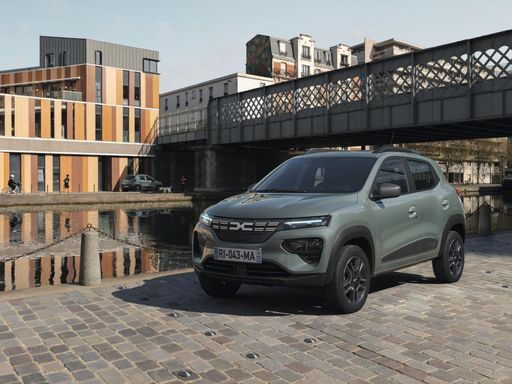
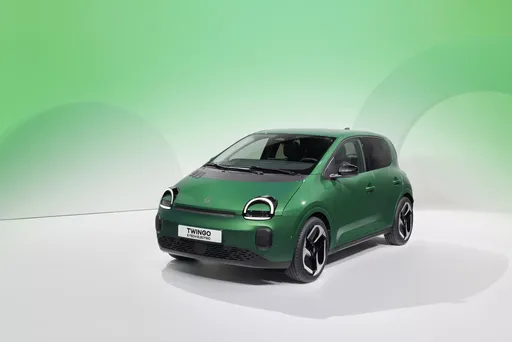
Compare performance (100 HP vs 82 HP), boot space and price (14500 £ vs 17100 £ ) at a glance. Find out which car is the better choice for you – Dacia Spring or Renault Twingo?

Dacia Spring vs Renault Twingo: Key differences

Dacia Spring

4.8 (3 Reviews)
rate
  • somewhat cheaper
  • somewhat more power
  • minimal more efficient
  • evident quicker from 0–100 km/h
  • slightly lighter
  • slight more trunk space

Renault Twingo

  • a bit more electric range

All details on performance, efficiency, range and trunk space can be found in the technical comparison below – including user reviews for both models.

Here’s where it gets real: The technical differences in detail

Spring

Costs and Efficiency:

Price and efficiency are key factors when choosing a car – and this is often where the real differences emerge.

Dacia Spring has a somewhat advantage in terms of price – it starts at 14500 £ , while the Renault Twingo costs 17100 £ . That’s a price difference of around 2572 £.

In terms of energy consumption, the advantage goes to the Dacia Spring: with 12.40 kWh per 100 km, it’s minimal more efficient than the Renault Twingo with 13.10 kWh. That’s a difference of about 0.70 kWh.

As for electric range, the Renault Twingo performs a bit better – achieving up to 262 km, about 37 km more than the Dacia Spring.

Twingo

Engine and Performance:

Under the bonnet, it becomes clear which model is tuned for sportiness and which one takes the lead when you hit the accelerator.

When it comes to engine power, the Dacia Spring has a somewhat edge – offering 100 HP compared to 82 HP. That’s roughly 18 HP more horsepower.

In acceleration from 0 to 100 km/h, the Dacia Spring is evident quicker – completing the sprint in 9.60 s, while the Renault Twingo takes 12.10 s. That’s about 2.50 s faster.

There’s also a difference in torque: Renault Twingo pulls noticeable stronger with 175 Nm compared to 137 Nm. That’s about 38 Nm difference.

Spring

Space and Everyday Use:

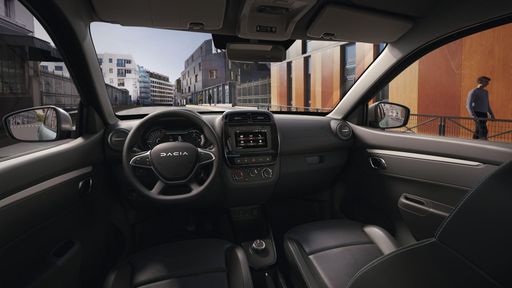
Beyond pure performance, interior space and usability matter most in daily life. This is where you see which car is more practical and versatile.

Both vehicles offer seating for 4 people.

In curb weight, Dacia Spring is slightly lighter – 1070 kg compared to 1275 kg. The difference is around 205 kg.

In terms of boot space, the Dacia Spring offers slight more room – 308 L compared to 305 L. That’s a difference of about 3 L.

When it comes to payload, Renault Twingo somewhat takes the win – 320 kg compared to 274 kg. That’s a difference of about 46 kg.

Who wins the race in the data check?

The Dacia Spring comes out ahead with a more balanced overall result in the objective data comparison.
This result only shows which model scores more points on paper – not which of the two cars feels right for you.

Dacia Spring
Renault Twingo

Costs and Consumption

View detailed analysis

Engine and Performance

View detailed analysis

Dimensions and Body

View detailed analysis
from about £14,500
Spring

Dacia Spring

  • Engine Type : Electric
  • Transmission : Automatic
  • Drive Type : Front-Wheel Drive
  • Power HP : 70 - 100 HP
  • Consumption kWh/100km : 12.4 - 12.7 kWh
  • Electric Range : 221 - 225 km

Dacia Spring

4.8 (3 Reviews)
rate

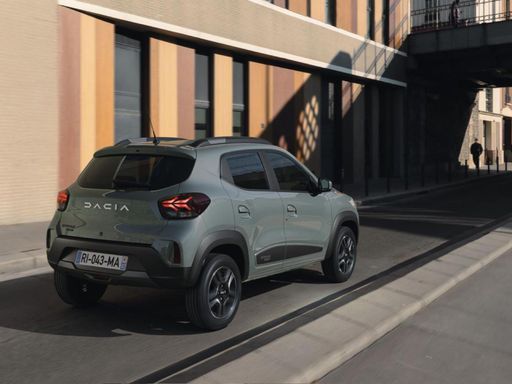
The Dacia Spring is an unpretentious city electric that strips EV ownership down to the essentials, offering clean, fuss-free transport for daily urban life. It won't impress luxury-seekers, but its cheerful practicality and rock-bottom running costs make it a clever, no-nonsense choice for anyone who wants electric mobility without the drama.

details

Renault Twingo

The Renault Twingo is a cheeky city car that turns tight streets and impossible parking spaces into an urban playground with its agile handling and compact footprint. It’s perfect for zipping around town thanks to clever interior packaging and a playful character, though buyers chasing long-distance comfort or huge luggage space should consider other options.

details
Dacia Spring
Renault Twingo

Costs and Consumption

Price
14500 - 16900 £
Price
17100 - 18500 £
Consumption L/100km
-
Consumption L/100km
-
Consumption kWh/100km
12.4 - 12.7 kWh
Consumption kWh/100km
13.10 kWh
Electric Range
221 - 225 km
Electric Range
260 - 262 km
Battery Capacity
-
Battery Capacity
-
co2
0 g/km
co2
0 g/km
Fuel tank capacity
-
Fuel tank capacity
-

Dimensions and Body

Body Type
SUV
Body Type
Hatchback
Seats
4
Seats
4
Doors
-
Doors
-
Curb weight
1070 kg
Curb weight
1275 - 1294 kg
Trunk capacity
308 L
Trunk capacity
305 L
Length
-
Length
-
Width
1583 mm
Width
1720 mm
Height
-
Height
-
Max trunk capacity
-
Max trunk capacity
-
Payload
274 kg
Payload
301 - 320 kg

Engine and Performance

Engine Type
Electric
Engine Type
Electric
Transmission
Automatic
Transmission
Automatic
Transmission Detail
Reduction Gearbox
Transmission Detail
Reduction Gearbox
Drive Type
Front-Wheel Drive
Drive Type
Front-Wheel Drive
Power HP
70 - 100 HP
Power HP
82 HP
Acceleration 0-100km/h
9.6 - 12.3 s
Acceleration 0-100km/h
12.10 s
Max Speed
-
Max Speed
-
Torque
137 Nm
Torque
175 Nm
Number of Cylinders
-
Number of Cylinders
-
Power kW
52 - 75 kW
Power kW
60 kW
Engine capacity
-
Engine capacity
-

General

Model Year
2025
Model Year
2026
CO2 Efficiency Class
A
CO2 Efficiency Class
A
Brand
Dacia
Brand
Renault
What drive types are available for the Dacia Spring?

The Dacia Spring is available as Front-Wheel Drive.

The prices shown are estimates based on German list prices, adjusted for local VAT. Local registration taxes (e.g. NoVA, BPM or CO2 malus) are not included. This information is not legally binding.