VS

Hyundai Santa Fe vs Nissan Qashqai comparison

Compare performance (288 HP vs 205 HP), boot space and price (51,700 £ vs 29,600 £ ) at a glance. Find out which car is the better choice for you – Hyundai Santa Fe or Nissan Qashqai?

Hyundai Santa Fe vs Nissan Qashqai: Key differences

Hyundai Santa Fe

4.7 (1 Reviews)
rate
  • clearly more power
  • moderately more efficient
  • visibly more trunk space
details

Nissan Qashqai

4.9 (3 Reviews)
rate
  • substantially cheaper
  • barely quicker 0–100 km/h
  • clearly lighter
details

By Achim Sedelmaier

Santa Fe

A Modern Rivalry: Hyundai Santa Fe vs. Nissan Qashqai

In the vast ocean of SUVs, choosing the perfect masterpiece that seamlessly fuses performance, design, and practicality can be a daunting task. Standing out in this genre, the Hyundai Santa Fe and the Nissan Qashqai represent some of the finest selections for SUV enthusiasts. Let's delve into a comparison of these two models with an eye on innovation, technical prowess, and the overall driving experience.
Qashqai

Power and Performance: A Tale of Two Engines

The 2024 Hyundai Santa Fe radiates power with options of a full hybrid and a plug-in hybrid engine, delivering an impressive maximum output of up to 253 HP. Coupled with an automatic gearbox and options for both front-wheel and all-wheel drives, the Santa Fe also boasts a remarkable torque of 367 Nm.

On the contrary, the 2024 Nissan Qashqai brings a versatile mix of petrol MHEV and full hybrid engines. While its highest-performing model presents 190 HP with a torque of 330 Nm, its tactical engine configuration paired with an option of CVT or a manual gearbox guarantees a respectable yet slightly less intimidating driving experience compared to the Santa Fe.

Santa Fe

Economy and Efficiency: Where Innovation Shines

When examining fuel consumption, the Nissan Qashqai edges slightly ahead with an average of 5.1 to 6.8 L/100km, as opposed to the Hyundai Santa Fe's uptake of 6.4 to 6.9 L/100km, and a remarkably low 1.7 L/100km in plug-in hybrid mode. The Santa Fe dazzles with an electric range of 54 km for eco-conscious urban planners.

Both vehicles score decently in CO2 efficiency, although the Santa Fe's hybrid variants take a greener approach compared to the Qashqai's CO2 output ranging from 116 to 154 g/km.

Qashqai

Space for More: Size and Capacity

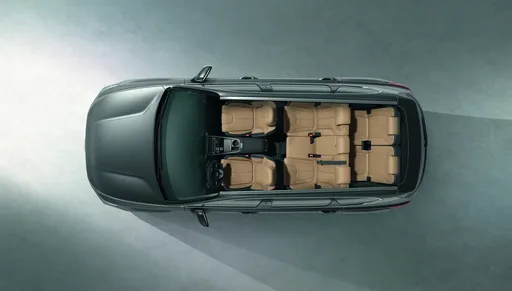
The Hyundai Santa Fe is not only grander in its dimensions but also more accommodating with seating options for up to seven passengers and an impressive trunk capacity starting at 621 liters. Measuring 4830 mm in length, it promises a spacious journey for families and adventurers alike.

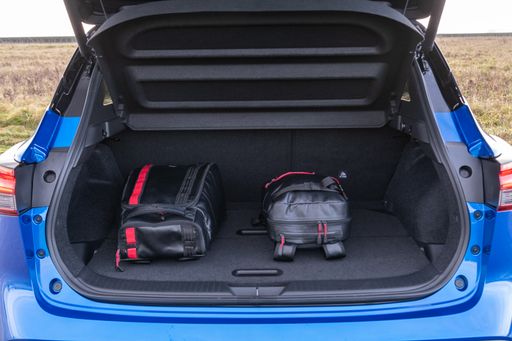
The Nissan Qashqai, while compact at 4425 mm in length, maximizes its available space with intelligent design choices offering a trunk capacity ranging up to 504 liters. Its smaller stature makes it a favorite in urban dwellings where maneuverability is prized.

Santa Fe

Design and Craftsmanship: Aesthetic Appeal

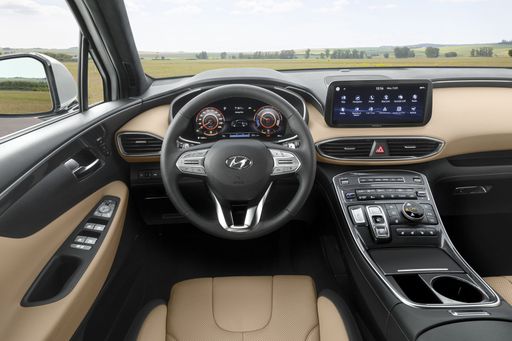
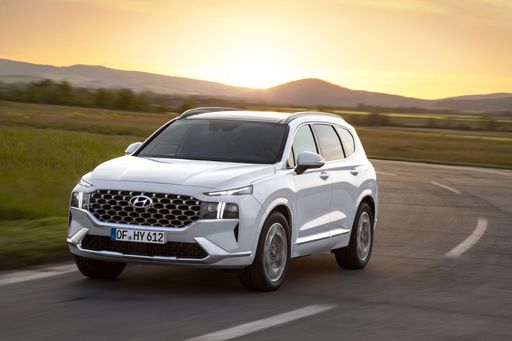
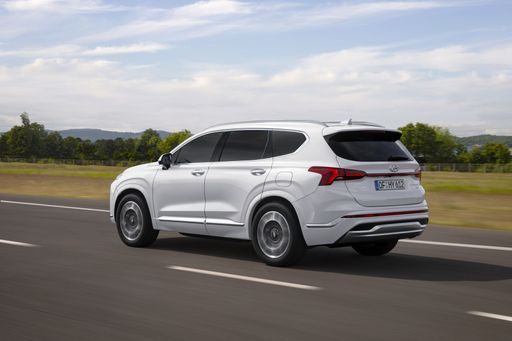
In design, the Hyundai Santa Fe stands tall with its bold and commanding presence, reflecting Hyundai's commitment to luxury with a modern twist. Its width of 1900 mm and height of 1720 mm emphasize its robust nature.

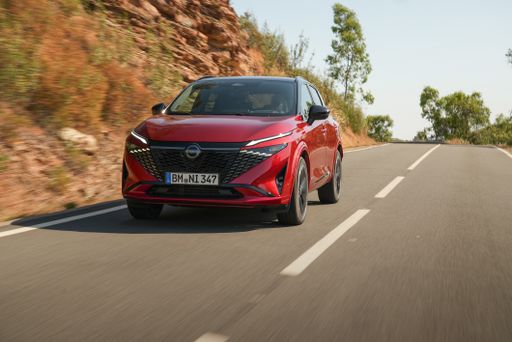
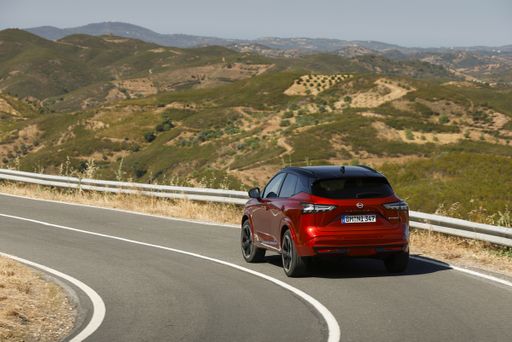
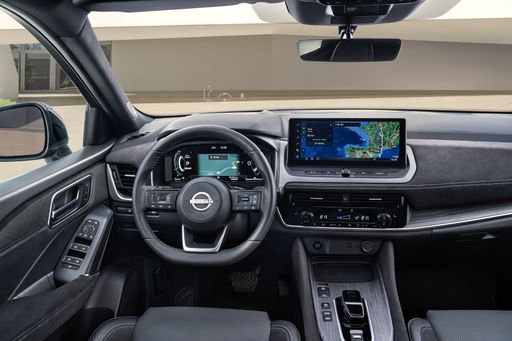
The Nissan Qashqai prefers a sleeker, agile entry, maintaining a youthful flair with its width of 1835 mm and height of 1625 mm, featuring contemporary lines and aerodynamics that exude confidence and modernity.

Qashqai

Final Thoughts

Choosing between the Hyundai Santa Fe and the Nissan Qashqai ultimately cascades down to personal preference. For those seeking a spacious, hybrid-powered SUV with advanced fuel-efficient technology, the Santa Fe presents a robust solution. Conversely, the Qashqai appeals to urban dwellers who desire a compact, agile vehicle without sacrificing modern innovations and design.

Both models represent the epitome of modern automotive engineering, ensuring that whichever choice you make, the road ahead will be one paved with innovation and enjoyment.

Here’s where it gets real: The technical differences in detail

Santa Fe

Costs and Efficiency:

Looking at overall running costs, both models reveal some interesting differences in everyday economy.

Nissan Qashqai is substantially cheaper – starting at 29,600 £ , while the Hyundai Santa Fe costs 51,700 £ . That’s a price difference of around 22,123 £.

Fuel consumption also shows a difference: the Hyundai Santa Fe uses 3.8 L/100km and is moderately more efficient than the Nissan Qashqai with 4.5 L/100km. The difference is about 0.7 L/100km.

Qashqai

Engine and Performance:

Power, torque and acceleration say a lot about how a car feels on the road. This is where you see which model delivers more driving dynamics.

When it comes to engine power, the Hyundai Santa Fe offers clearly more power – delivering 288 HP compared to 205 HP. That’s roughly 83 HP more horsepower.

When accelerating from 0 to 100 km/h, the Nissan Qashqai is barely quicker – completing the sprint in 7.6 s, while the Hyundai Santa Fe takes 8 s. That’s about 0.4 s quicker.

There’s also a difference in torque: the Hyundai Santa Fe delivers somewhat more torque with 380 Nm compared to 330 Nm. That’s about 50 Nm more.

Santa Fe

Space and Everyday Use:

Cabin size, boot volume and payload all play a role in everyday practicality. Here, comfort and flexibility make the difference.

Seats: Hyundai Santa Fe offers more seats – 7 vs 5.

In terms of curb weight, Nissan Qashqai is clearly lighter – 1,420 kg compared to 1,920 kg. The difference is around 500 kg.

Looking at boot space, the Hyundai Santa Fe offers visibly more boot space – 704 L compared to 504 L. That’s a difference of about 200 L.

When it comes to payload, the Hyundai Santa Fe carries visibly more – 665 kg compared to 520 kg. That’s a difference of about 145 kg.

Who wins the race in the data check?

The Hyundai Santa Fe is decisively ahead in the objective data comparison.
This result only shows which model scores more points on paper – not which of the two cars feels right for you.

from £51,700
Santa Fe

Hyundai Santa Fe

  • Engine Type : Full Hybrid, Plugin Hybrid
  • Transmission : Automatic
  • Drive Type : Front-Wheel Drive, All-Wheel Drive
  • Power HP : 239 - 288 HP
  • Consumption L/100km : 3.8 - 7.2 L/100km
  • Electric Range : 54 km
Hyundai Santa Fe
Nissan Qashqai

Costs and Consumption

View detailed analysis

Engine and Performance

View detailed analysis

Dimensions and Body

View detailed analysis

Hyundai Santa Fe

The Hyundai Santa Fe blends practical family friendliness with a hint of premium style, offering roomy, sensible packaging wrapped in modern, confident design. Inside it serves up comfortable seats, straightforward tech and a calm, composed ride that makes daily drives feel a little more grown up — a solid all‑rounder that doesn’t try to be flashy.

details

Nissan Qashqai

The Nissan Qashqai blends practical, family-friendly packaging with SUV styling that refuses to shout, making it a sensible and dependable choice for everyday life. It’s comfortable to live with, economical on the road, and neatly equipped enough to feel modern without ever feeling precious — perfect if you want crossover versatility without the drama.

details
Hyundai Santa Fe
Nissan Qashqai

Costs and Consumption

Price
51,700 - 58,600 £
Price
29,600 - 39,900 £
Consumption L/100km
3.8 - 7.2 L/100km
Consumption L/100km
4.5 - 6.8 L/100km
Consumption kWh/100km
-
Consumption kWh/100km
-
Electric Range
54 km
Electric Range
-
Battery Capacity
-
Battery Capacity
-
co2
90 - 162 g/km
co2
102 - 154 g/km
Fuel tank capacity
-
Fuel tank capacity
55 L

Dimensions and Body

Body Type
SUV
Body Type
SUV
Seats
5 - 7
Seats
5
Doors
-
Doors
5
Curb weight
1,920 - 2,165 kg
Curb weight
1,420 - 1,665 kg
Trunk capacity
621 - 704 L
Trunk capacity
479 - 504 L
Length
-
Length
4,425 mm
Width
1,900 mm
Width
1,835 mm
Height
-
Height
1,625 mm
Max trunk capacity
-
Max trunk capacity
1,422 - 1,447 L
Payload
560 - 665 kg
Payload
466 - 520 kg

Engine and Performance

Engine Type
Full Hybrid, Plugin Hybrid
Engine Type
Petrol MHEV, Full Hybrid
Transmission
Automatic
Transmission
Manuel, Automatic
Transmission Detail
Automatic Gearbox
Transmission Detail
Manual Gearbox, CVT, Reduction Gearbox
Drive Type
Front-Wheel Drive, All-Wheel Drive
Drive Type
Front-Wheel Drive, All-Wheel Drive
Power HP
239 - 288 HP
Power HP
140 - 205 HP
Acceleration 0-100km/h
8 - 9.2 s
Acceleration 0-100km/h
7.6 - 10.2 s
Max Speed
-
Max Speed
170 - 206 km/h
Torque
380 Nm
Torque
240 - 330 Nm
Number of Cylinders
4
Number of Cylinders
3 - 4
Power kW
176 - 212 kW
Power kW
103 - 151 kW
Engine capacity
1,598 cm3
Engine capacity
1,332 - 1,498 cm3

General

Model Year
2025
Model Year
2,025 - 2,026
CO2 Efficiency Class
E, F, B
CO2 Efficiency Class
E, C
Brand
Hyundai
Brand
Nissan
DriveDuel uses data analysis and artificial intelligence to evaluate vehicle data and create content. Content is regularly reviewed and improved. The displayed prices are estimates based on German list prices, adjusted to the respective country’s VAT. Country-specific registration taxes are not included. This information is not legally binding.