VS

Hyundai Tucson vs Skoda Karoq - Differences and prices compared

Compare performance (288 HP vs 190 HP), boot space and price (20900 £ vs 29100 £ ) at a glance. Find out which car is the better choice for you – Hyundai Tucson or Skoda Karoq?

Hyundai Tucson

5 (2 Reviews)
rate

Skoda Karoq

4.6 (2 Reviews)
rate

Here’s where it gets real: The technical differences in detail

Tucson

Costs and Efficiency:

Price and efficiency are often the first things buyers look at. Here it becomes clear which model has the long-term edge – whether at the pump, the plug, or in purchase price.

Hyundai Tucson has a distinct advantage in terms of price – it starts at 20900 £ , while the Skoda Karoq costs 29100 £ . That’s a price difference of around 8185 £.

Fuel consumption also shows a difference: Hyundai Tucson manages with 2.70 L and is therefore convincingly more efficient than the Skoda Karoq with 4.90 L. The difference is about 2.20 L per 100 km.

Karoq

Engine and Performance:

Power, torque and acceleration say a lot about how a car feels on the road. This is where you see which model delivers more driving dynamics.

When it comes to engine power, the Hyundai Tucson has a clearly perceptible edge – offering 288 HP compared to 190 HP. That’s roughly 98 HP more horsepower.

In acceleration from 0 to 100 km/h, the Skoda Karoq is minimal quicker – completing the sprint in 7 s, while the Hyundai Tucson takes 7.50 s. That’s about 0.50 s faster.

In terms of top speed, the Skoda Karoq performs slight better – reaching 221 km/h, while the Hyundai Tucson tops out at 204 km/h. The difference is around 17 km/h.

There’s also a difference in torque: Hyundai Tucson pulls minimal stronger with 379 Nm compared to 360 Nm. That’s about 19 Nm difference.

Tucson

Space and Everyday Use:

Beyond pure performance, interior space and usability matter most in daily life. This is where you see which car is more practical and versatile.

Both vehicles offer seating for 5 people.

In curb weight, Skoda Karoq is somewhat lighter – 1380 kg compared to 1542 kg. The difference is around 162 kg.

In terms of boot space, the Hyundai Tucson offers slightly more room – 620 L compared to 521 L. That’s a difference of about 99 L.

In maximum load capacity, the Hyundai Tucson performs hardly perceptible better – up to 1799 L, which is about 169 L more than the Skoda Karoq.

When it comes to payload, Skoda Karoq slight takes the win – 549 kg compared to 545 kg. That’s a difference of about 4 kg.

Who wins the race?

The Hyundai Tucson proves to be is largely superior and therefore becomes our DriveDuel Champion!
Hyundai Tucson is the better all-rounder in this comparison.

from about £20,900
Tucson

Hyundai Tucson

  • Engine Type : Petrol, Full Hybrid, Plugin Hybrid, Diesel MHEV
  • Transmission : Manuel, Automatic
  • Drive Type : Front-Wheel Drive, All-Wheel Drive
  • Power HP : 136 - 288 HP
  • Consumption L/100km : 2.7 - 7.6 L
  • Electric Range : 63 - 70 km
Hyundai Tucson
Skoda Karoq

Costs and Consumption

View detailed analysis

Engine and Performance

View detailed analysis

Dimensions and Body

View detailed analysis

Hyundai Tucson

5 (2 Reviews)
rate

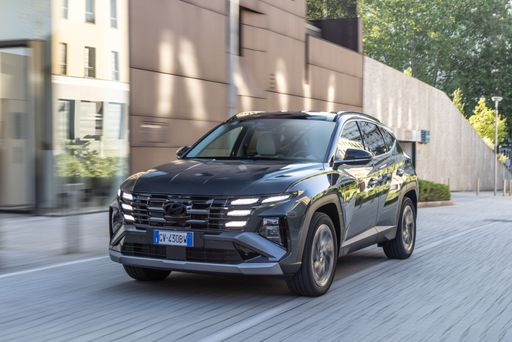
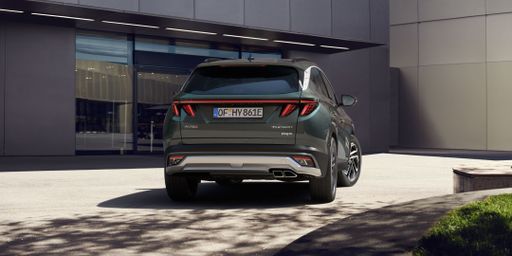
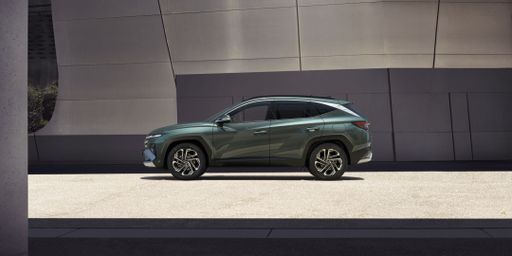
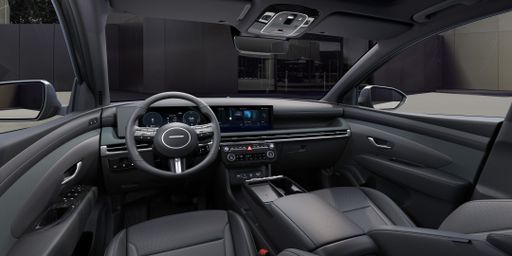
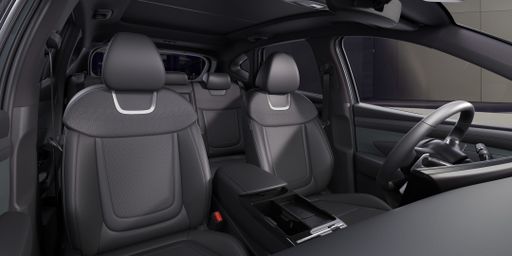
Hyundai Tucson marries bold, sculpted looks with a clever, roomy cabin that feels smarter than its price tag suggests. It's composed on the road, easy to live with day-to-day, and a sensible choice for buyers who want SUV style without the showroom theatrics.

details

Skoda Karoq

4.6 (2 Reviews)
rate

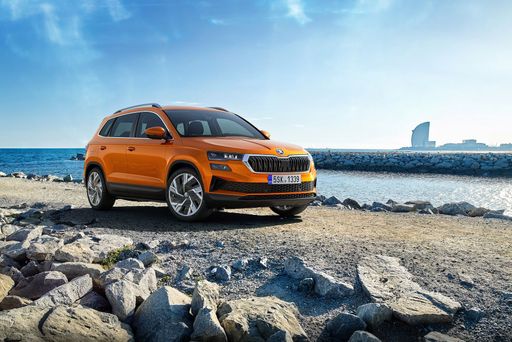
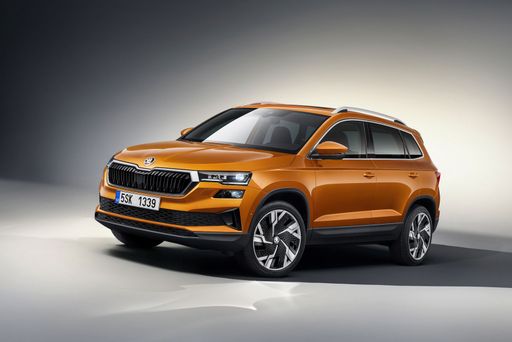
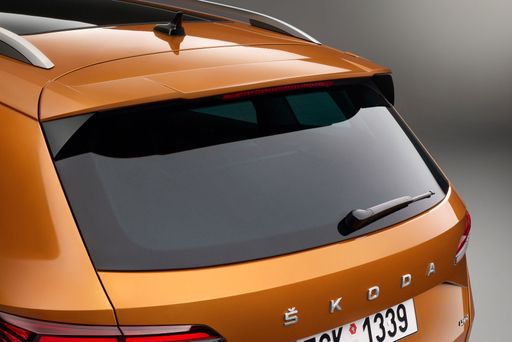
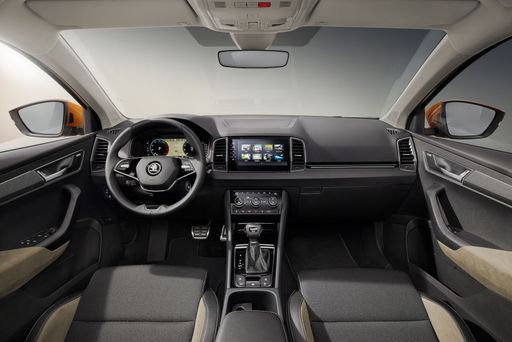
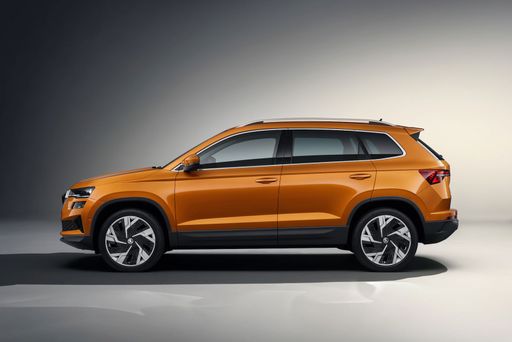
The Skoda Karoq is a smart, unfussy compact SUV that blends roomy practicality with a pleasantly composed driving character. It won’t turn heads at a car meet, but it will make daily life easier with clever storage, sensible ergonomics and a reassuringly grown-up ride.

details
Hyundai Tucson
Skoda Karoq

Costs and Consumption

Price
20900 - 47900 £
Price
29100 - 41700 £
Consumption L/100km
2.7 - 7.6 L
Consumption L/100km
4.9 - 7.6 L
Consumption kWh/100km
-
Consumption kWh/100km
-
Electric Range
63 - 70 km
Electric Range
-
Battery Capacity
-
Battery Capacity
-
co2
62 - 172 g/km
co2
128 - 173 g/km
Fuel tank capacity
52 - 54 L
Fuel tank capacity
50 - 55 L

Dimensions and Body

Body Type
SUV
Body Type
SUV
Seats
5
Seats
5
Doors
5
Doors
5
Curb weight
1542 - 1893 kg
Curb weight
1380 - 1655 kg
Trunk capacity
546 - 620 L
Trunk capacity
521 L
Length
4525 - 4535 mm
Length
4384 - 4390 mm
Width
1865 mm
Width
1841 mm
Height
1650 mm
Height
1624 - 1629 mm
Max trunk capacity
1795 - 1799 L
Max trunk capacity
1630 L
Payload
518 - 545 kg
Payload
456 - 549 kg

Engine and Performance

Engine Type
Petrol, Full Hybrid, Plugin Hybrid, Diesel MHEV
Engine Type
Petrol, Diesel
Transmission
Manuel, Automatic
Transmission
Manuel, Automatic
Transmission Detail
Manual Gearbox, Dual-Clutch Automatic, Automatic Gearbox
Transmission Detail
Manual Gearbox, Dual-Clutch Automatic
Drive Type
Front-Wheel Drive, All-Wheel Drive
Drive Type
Front-Wheel Drive, All-Wheel Drive
Power HP
136 - 288 HP
Power HP
115 - 190 HP
Acceleration 0-100km/h
7.5 - 11.6 s
Acceleration 0-100km/h
7 - 11.2 s
Max Speed
196 - 204 km/h
Max Speed
192 - 221 km/h
Torque
250 - 379 Nm
Torque
200 - 360 Nm
Number of Cylinders
4
Number of Cylinders
3 - 4
Power kW
100 - 212 kW
Power kW
85 - 140 kW
Engine capacity
1598 cm3
Engine capacity
999 - 1984 cm3

General

Model Year
2025
Model Year
2025
CO2 Efficiency Class
F, D, E, B
CO2 Efficiency Class
D, E, F
Brand
Hyundai
Brand
Skoda
What drive types are available for the Hyundai Tucson?

Available configurations include Front-Wheel Drive or All-Wheel Drive.

The prices shown are estimates based on German list prices, adjusted for local VAT. Local registration taxes (e.g. NoVA, BPM or CO2 malus) are not included. This information is not legally binding.