VS

Mercedes Vito Bus vs Hyundai Staria comparison

Compare performance (237 HP vs 225 HP), boot space and price (36,300 £ vs 42,400 £ ) at a glance. Find out which car is the better choice for you – Mercedes Vito Bus or Hyundai Staria?

Mercedes Vito Bus vs Hyundai Staria: Key differences

Mercedes Vito Bus

5 (1 Reviews)
rate
  • a bit cheaper
  • only slightly more power
  • somewhat more efficient
  • a bit lighter
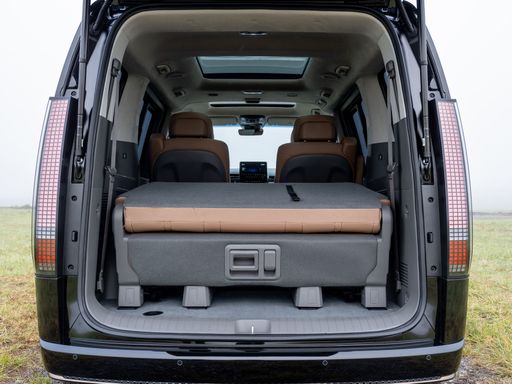
  • considerably more trunk space
details

Hyundai Staria

details

All details on performance, efficiency, range and trunk space can be found in the technical comparison below – including user reviews for both models.

By Achim Sedelmaier

Vito Bus

The Ultimate People Mover Showdown: Hyundai Staria vs. Mercedes Vito Bus

When it comes to transporting larger groups of people comfortably and efficiently, the Hyundai Staria and the Mercedes Vito Bus emerge as two prominent contenders. While both vehicles cater to the bus segment, their respective technical features and innovations set them apart in unique ways. Let’s delve into how these models stack up against each other in terms of performance, design, and technological advancements.
Staria

Performance and Power

The Hyundai Staria offers a range of diesel and full hybrid engines, reflecting its versatility in catering to different driving needs. The power output ranges from 177 to 225 horsepower, allowing the Staria to balance power with efficiency. With an automatic gearbox available for both front-wheel and all-wheel drive systems, the Staria boasts a fuel consumption range of 7.6 to 8.9 liters per 100 kilometers. The acceleration from 0 to 100 km/h takes between 10.2 to 13.5 seconds, depending on the variant, with a max speed reaching up to 185 km/h.

The Mercedes Vito Bus, on the other hand, expands its offering with diesel and electric powertrains. Power varies substantially from 136 to a robust 237 horsepower. It features a manual, automatic, and even a unique reduction gearbox, catering to diverse driver preferences. Despite the Vito’s max speed being lower at 140 km/h, its efficiency with a consumption range starting from 6.7 liters per 100 kilometers and an electric range of up to 371 km for electric versions speaks volumes about its eco-minded approach.

Design and Capacity

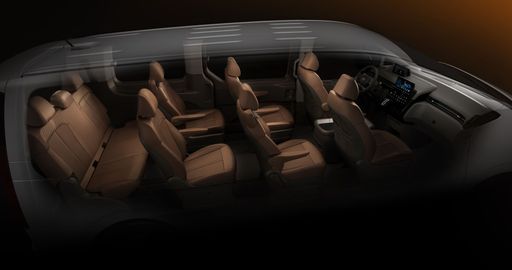
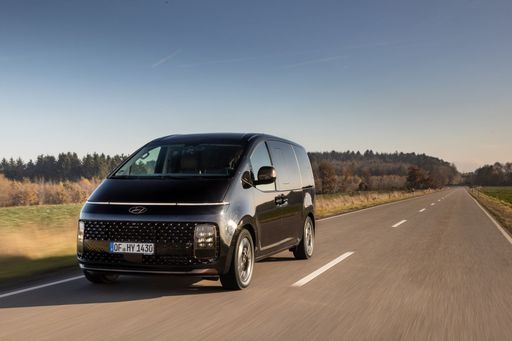
In terms of size, the Staria stands prominently with a length of 5253 mm, a width of 1997 mm, and a height of 1990 mm. It can accommodate up to nine passengers, making it ideal for larger groups or families. The trunk capacity varies from 117 to 831 liters, allowing for significant storage flexibility. The Hyundai's curb weight ranges from 2275 to 2443 kg, depending on the variant.

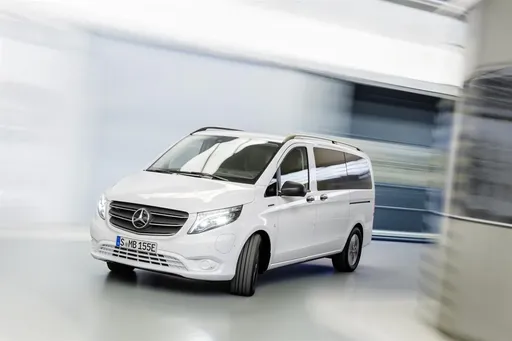
The Mercedes Vito Bus presents a slightly more compact design with a maximum length of 5370 mm and a width of 1928 mm. It seats eight passengers comfortably. The trunk space is diverse, with capacities ranging from 580 to 1390 liters, accommodating varied storage needs. Weighing in between 2483 to 2630 kg, the Vito prioritizes a robust build.

Innovation and Features

The Hyundai Staria impresses with its futuristic design and intelligent features, making it visually and technologically forward-thinking. Its lineup of engines embraces innovation with the integration of hybrid technology, contributing to a greener driving experience.

The Mercedes Vito Bus stands out with its electric powertrain option, a significant step towards sustainable transport. Its advanced driving aids and connectivity features make for a modern driving experience, appealing to tech-savvy consumers.

Conclusion: The Superior Choice?

The Hyundai Staria and Mercedes Vito Bus each cater to specific needs within the bus segment. If a futuristic design and a mix of powerful hybrid options pique interest, the Hyundai Staria might be the better choice. However, for those leaning towards sustainability with an electric option and a luxurious driving experience, the Mercedes Vito Bus stands out. Ultimately, choosing between these two will depend on personal preferences, required capacity, and environmental considerations.

Here’s where it gets real: The technical differences in detail

Vito Bus

Costs and Efficiency:

Looking at overall running costs, both models reveal some interesting differences in everyday economy.

Mercedes Vito Bus is a bit cheaper – starting at 36,300 £ , while the Hyundai Staria costs 42,400 £ . That’s a price difference of around 6,098 £.

Fuel consumption also shows a difference: the Mercedes Vito Bus uses 6.7 L/100km and is somewhat more efficient than the Hyundai Staria with 7.6 L/100km. The difference is about 0.9 L/100km.

Staria

Engine and Performance:

Power, torque and acceleration are the classic benchmarks for car enthusiasts – and here, some clear differences start to show.

When it comes to engine power, the Mercedes Vito Bus offers only slightly more power – delivering 237 HP compared to 225 HP. That’s roughly 12 HP more horsepower.

There’s also a difference in torque: the Mercedes Vito Bus delivers clearly more torque with 500 Nm compared to 367 Nm. That’s about 133 Nm more.

Space and Everyday Use:

Whether family car or daily driver – which one offers more room, flexibility and comfort?

Seats: Hyundai Staria offers more seats – 9 vs 8.

In terms of curb weight, Mercedes Vito Bus is a bit lighter – 2,023 kg compared to 2,275 kg. The difference is around 252 kg.

Looking at boot space, the Mercedes Vito Bus offers considerably more boot space – 1,390 L compared to 831 L. That’s a difference of about 559 L.

When it comes to payload, the Mercedes Vito Bus carries visibly more – 1,077 kg compared to 775 kg. That’s a difference of about 302 kg.

Who wins the race in the data check?

The Mercedes Vito Bus is decisively ahead in the objective data comparison.
This result only shows which model scores more points on paper – not which of the two cars feels right for you.

from £36,300
Vito Bus

Mercedes Vito Bus

  • Engine Type : Diesel, Electric, Petrol
  • Transmission : Automatic
  • Drive Type : Rear-Wheel Drive, All-Wheel Drive, Front-Wheel Drive
  • Power HP : 136 - 237 HP
  • Consumption L/100km : 6.7 - 10 L/100km
  • Consumption kWh/100km : 26.7 - 26.9 kWh/100km
  • Electric Range : 248 - 370 km
Mercedes Vito Bus
Hyundai Staria

Costs and Consumption

View detailed analysis

Engine and Performance

View detailed analysis

Dimensions and Body

View detailed analysis

Mercedes Vito Bus

The Mercedes Vito is a sturdy, no-nonsense people carrier that blends commercial practicality with a surprisingly civilised cabin, making long shuttles feel less like a chore. If you need a dependable transporter that swallows luggage, forgives hard use and still looks a touch more premium than a plain van, the Vito is an easy, sensible pick.

details

Hyundai Staria

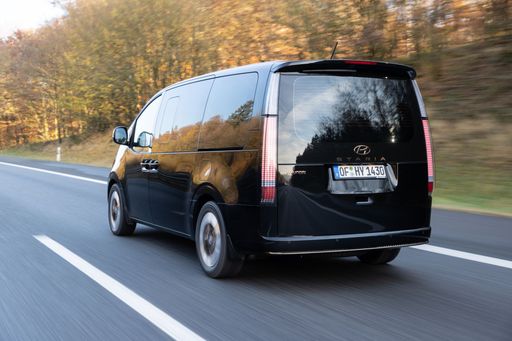
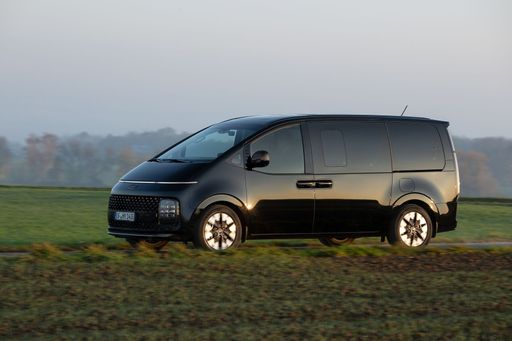
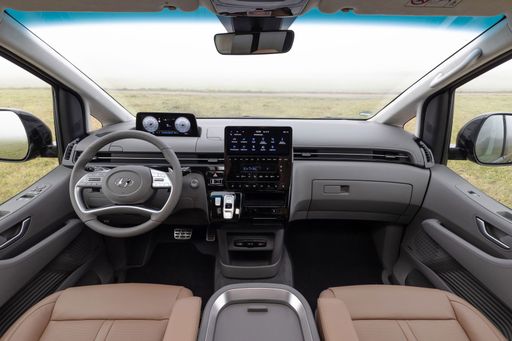
Hyundai Staria looks like a friendly spaceship, its sweeping glass and soft edges turning a people‑mover into a design statement that actually gets noticed. Inside it's airy and practical — perfect for families or anyone who likes travelling in comfort and style, with enough flexibility to swallow luggage and weekend plans without drama.

details
Mercedes Vito Bus
Hyundai Staria

Costs and Consumption

Price
36,300 - 55,900 £
Price
42,400 - 50,500 £
Consumption L/100km
6.7 - 10 L/100km
Consumption L/100km
7.6 L/100km
Consumption kWh/100km
26.7 - 26.9 kWh/100km
Consumption kWh/100km
-
Electric Range
248 - 370 km
Electric Range
-
Battery Capacity
60 - 90 kWh
Battery Capacity
-
co2
0 - 228 g/km
co2
172 g/km
Fuel tank capacity
57 - 70 L
Fuel tank capacity
-

Dimensions and Body

Body Type
Bus
Body Type
Bus
Seats
8
Seats
7 - 9
Doors
4
Doors
-
Curb weight
2,023 - 2,739 kg
Curb weight
2,275 - 2,345 kg
Trunk capacity
580 - 1,390 L
Trunk capacity
117 - 831 L
Length
4,895 - 5,370 mm
Length
-
Width
1,928 mm
Width
1,997 mm
Height
1,890 mm
Height
-
Max trunk capacity
4,190 - 4,990 L
Max trunk capacity
-
Payload
726 - 1,077 kg
Payload
605 - 775 kg

Engine and Performance

Engine Type
Diesel, Electric, Petrol
Engine Type
Full Hybrid
Transmission
Automatic
Transmission
Automatic
Transmission Detail
Automatic Gearbox, Reduction Gearbox
Transmission Detail
Automatic Gearbox
Drive Type
Rear-Wheel Drive, All-Wheel Drive, Front-Wheel Drive
Drive Type
Front-Wheel Drive
Power HP
136 - 237 HP
Power HP
225 HP
Acceleration 0-100km/h
-
Acceleration 0-100km/h
10.2 s
Max Speed
140 km/h
Max Speed
-
Torque
330 - 500 Nm
Torque
367 Nm
Number of Cylinders
4
Number of Cylinders
4
Power kW
100 - 174 kW
Power kW
165 kW
Engine capacity
1,950 - 1,999 cm3
Engine capacity
1,598 cm3

General

Model Year
2024
Model Year
2024
CO2 Efficiency Class
G, A
CO2 Efficiency Class
F
Brand
Mercedes-Benz
Brand
Hyundai
DriveDuel uses data analysis and artificial intelligence to evaluate vehicle data and create content. Content is regularly reviewed and improved. The displayed prices are estimates based on German list prices, adjusted to the respective country’s VAT. Country-specific registration taxes are not included. This information is not legally binding.