VS

Renault Arkana vs Ford Kuga comparison

Compare performance (143 HP vs 243 HP), boot space and price (28,500 £ vs 34,200 £ ) at a glance. Find out which car is the better choice for you – Renault Arkana or Ford Kuga?

Renault Arkana vs Ford Kuga: Key differences

Renault Arkana

3.8 (6 Reviews)
rate
  • clearly cheaper
  • marginally lighter
Customer feedback generally presents the Arkana as an economical, stylish and practical family crossover that suits everyday needs. Owners often praise its fuel economy, space and safety, while noting it isn’t a sporty coupe; a few reports of serious mechanical issues and costly repairs also appear. Opinions are mixed enough that broader reliability trends aren’t fully clear from the available comments.

Ford Kuga

4.3 (5 Reviews)
rate
  • considerably more power
  • significantly more efficient
  • clearly quicker 0–100 km/h

All details on performance, efficiency, range and trunk space can be found in the technical comparison below – including user reviews for both models.

Arkana

Ford Kuga vs. Renault Arkana: A Compelling SUV Showdown

In the ever-evolving world of SUVs, two contenders have emerged that marry style, practicality, and technology: the 2024 Ford Kuga and the 2023-2024 Renault Arkana. While both vehicles fall under the SUV category, they bring unique characteristics and innovations to the table, especially in terms of engine variety, drivetrain options, and performance metrics. This comparison delves deeper into what makes each of these models a compelling choice for prospective buyers.
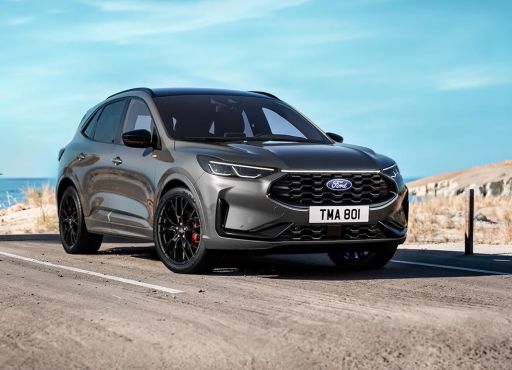
Kuga

Engine Options and Performance Capabilities

The Ford Kuga offers a versatile engine lineup, including petrol, full hybrid, and plug-in hybrid variants. Whether you're interested in a manual gearbox or the smooth transitions of a CVT, the Kuga covers both bases. The power output ranges from 150 to an impressive 243 HP, with a top speed stretching up to 200 km/h and acceleration times from 9.5 to a nimble 7.3 seconds for 0-100 km/h. Additionally, the Kuga's plug-in hybrid model boasts an electric range of up to 69 km, highlighting its emphasis on efficiency.

On the other hand, the Renault Arkana emphasizes a hybrid approach too, offering full hybrid and mild hybrid electric vehicle (MHEV) gasoline engines. Producing between 140 and 158 HP, and reaching top speeds of up to 174 km/h, the Arkana provides a dynamic drive. Accelerating from 0-100 km/h between 10.8 to 9.1 seconds, it might not match the rapid acceleration of some Kuga models but offers a balanced performance suitable for city and highway driving.

Arkana

Fuel Efficiency and Environmental Considerations

Efficiency is where both vehicles strive to impress. The Ford Kuga shines with a consumption rate as low as 0.9 L/100km in its plug-in hybrid form, backed by a CO2 efficiency class from E to B depending on the model configuration. This makes it an attractive option for environmentally-conscious consumers looking to minimize their carbon footprint.

The Arkana does not trail far behind, with an impressive 4.7 L/100km consumption in its full hybrid variant and CO2 outputs ranging from 106 to 135 g/km. Positioned with CO2 efficiency classes from C to D, the Arkana showcases Renault's commitment to sustainable yet functional vehicles.

Kuga

Design and Practicality

Design plays a crucial role in the buying decision, and both the Kuga and Arkana have an edge in aesthetics with their sleek lines and robust presence. The Ford Kuga spans a length between 4604 to 4645 mm, with a roomy width of 1882 mm and height up to 1681 mm. Its trunk capacity of 412 liters may appear limiting, yet its payload capacity compensates for various transport needs.

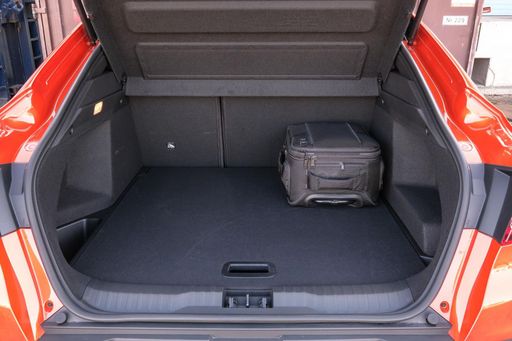
The Renault Arkana stands slightly shorter in both length (4568 mm) and height (1576 mm) but boasts a larger trunk volume of up to 513 liters, appealing to those requiring greater cargo space. Its more slender body width of 1821 mm offers a streamlined appearance, making it agile in urban settings.

Arkana

Choosing Between the Two: A Matter of Preference

Deciding between the Ford Kuga and Renault Arkana ultimately depends on personal preferences and driving needs. The Kuga is versatile with a broad engine range and superior hybrid efficiency, ideal for those valuing electric range and power. Meanwhile, the Arkana provides a compelling crossover experience with its efficient design and ample trunk space — appealing to practical yet style-conscious buyers.

Both SUVs embody the advancements in automotive engineering and offer considerable benefits. The choice depends largely on whether hybrid efficiency or a stylish, practical design ranks highest on your new car checklist.

Here’s where it gets real: The technical differences in detail

Arkana

Costs and Efficiency:

Price and efficiency are often the first things buyers look at. Here it becomes clear which model has the long-term edge – whether at the pump, the plug, or in purchase price.

Renault Arkana is clearly cheaper – starting at 28,500 £ , while the Ford Kuga costs 34,200 £ . That’s a price difference of around 5,785 £.

Fuel consumption also shows a difference: the Ford Kuga uses 2.8 L/100km and is significantly more efficient than the Renault Arkana with 4.7 L/100km. The difference is about 1.9 L/100km.

Kuga

Engine and Performance:

Under the bonnet, it becomes clear which model is tuned for sportiness and which one takes the lead when you hit the accelerator.

When it comes to engine power, the Ford Kuga offers considerably more power – delivering 243 HP compared to 143 HP. That’s roughly 100 HP more horsepower.

When accelerating from 0 to 100 km/h, the Ford Kuga is clearly quicker – completing the sprint in 7.3 s, while the Renault Arkana takes 10.8 s. That’s about 3.5 s quicker.

There’s also a difference in torque: the Ford Kuga delivers a bit more torque with 240 Nm compared to 205 Nm. That’s about 35 Nm more.

Arkana

Space and Everyday Use:

Beyond pure performance, interior space and usability matter most in daily life. This is where you see which car is more practical and versatile.

Both vehicles offer seating for 5 people.

In terms of curb weight, Renault Arkana is marginally lighter – 1,510 kg compared to 1,526 kg. The difference is around 16 kg.

When it comes to payload, the Ford Kuga carries moderately more – 550 kg compared to 451 kg. That’s a difference of about 99 kg.

Who wins the race in the data check?

The Ford Kuga is far ahead overall in the objective data comparison.
This result only shows which model scores more points on paper – not which of the two cars feels right for you.

from £34,200
Kuga

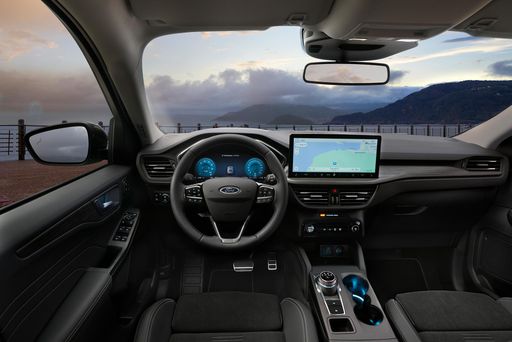
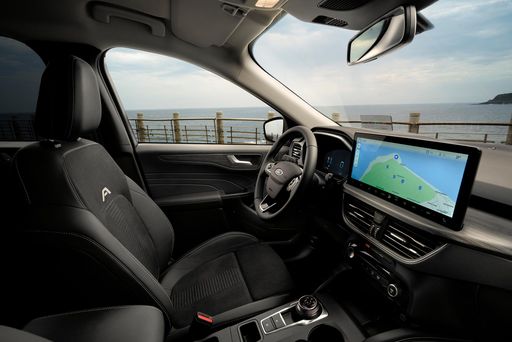
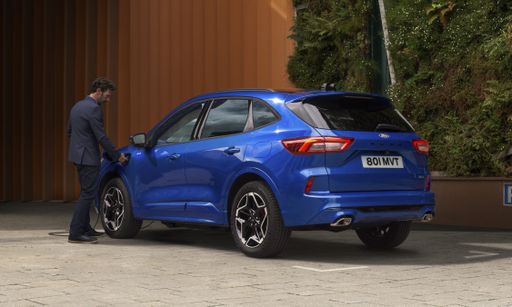
Ford Kuga

  • Engine Type : Petrol, Full Hybrid, Plugin Hybrid
  • Transmission : Manuel, Automatic
  • Drive Type : Front-Wheel Drive, All-Wheel Drive
  • Power HP : 150 - 243 HP
  • Consumption L/100km : 2.8 - 6.8 L/100km
  • Electric Range : 68 km
Renault Arkana
Ford Kuga

Costs and Consumption

View detailed analysis

Engine and Performance

View detailed analysis

Dimensions and Body

View detailed analysis

Renault Arkana

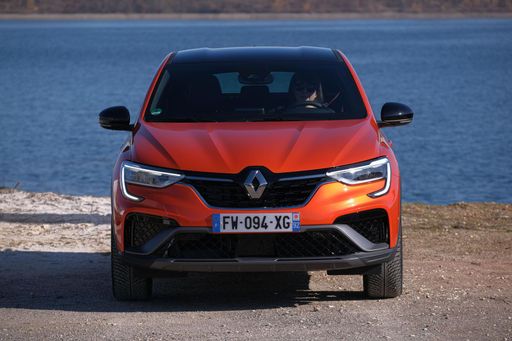
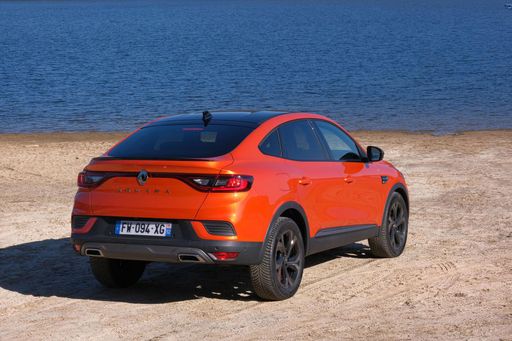
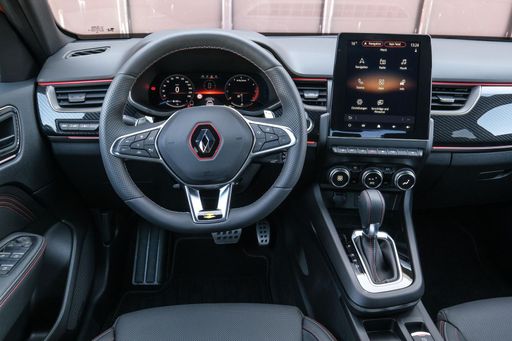
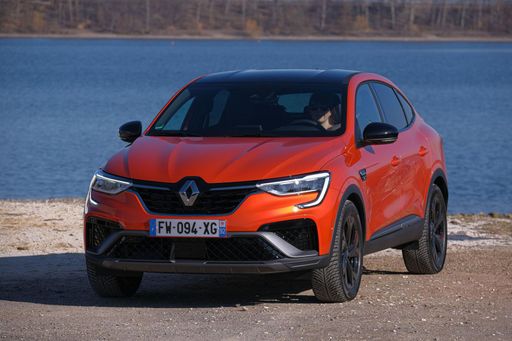
The Arkana stands out with its striking coupe-SUV design, blending sporty aesthetics with practicality. Its bold silhouette and high ride height offer a unique presence on the road, attracting attention wherever it goes. Inside, the Arkana combines modern technology with comfort, making it a versatile choice for both city driving and weekend getaways.

details

Ford Kuga

The Kuga is Ford’s adaptable family SUV that blends usable space with a surprisingly lively driving character, making daily commutes and weekend escapes equally enjoyable. With smart interior packaging, an easy-to-use infotainment setup and composed road manners, it’s a sensible choice for buyers who want a bit of fun without the fuss.

details
Renault Arkana
Ford Kuga

Costs and Consumption

Price
28,500 - 31,900 £
Price
34,200 - 46,300 £
Consumption L/100km
4.7 L/100km
Consumption L/100km
2.8 - 6.8 L/100km
Consumption kWh/100km
-
Consumption kWh/100km
-
Electric Range
-
Electric Range
68 km
Battery Capacity
-
Battery Capacity
-
co2
106 g/km
co2
55 - 154 g/km
Fuel tank capacity
-
Fuel tank capacity
-

Dimensions and Body

Body Type
SUV
Body Type
SUV
Seats
5
Seats
5
Doors
-
Doors
-
Curb weight
1,510 kg
Curb weight
1,526 - 1,859 kg
Trunk capacity
-
Trunk capacity
-
Length
-
Length
-
Width
1,821 mm
Width
1,882 mm
Height
-
Height
-
Max trunk capacity
-
Max trunk capacity
-
Payload
451 kg
Payload
541 - 550 kg

Engine and Performance

Engine Type
Full Hybrid
Engine Type
Petrol, Full Hybrid, Plugin Hybrid
Transmission
Automatic
Transmission
Manuel, Automatic
Transmission Detail
Automatic Gearbox
Transmission Detail
Manual Gearbox, CVT, Automatic Gearbox
Drive Type
Front-Wheel Drive
Drive Type
Front-Wheel Drive, All-Wheel Drive
Power HP
143 HP
Power HP
150 - 243 HP
Acceleration 0-100km/h
10.8 s
Acceleration 0-100km/h
7.3 - 9.9 s
Max Speed
-
Max Speed
-
Torque
205 Nm
Torque
240 Nm
Number of Cylinders
4
Number of Cylinders
3 - 4
Power kW
105 kW
Power kW
111 - 178 kW
Engine capacity
1,598 cm3
Engine capacity
1,496 - 2,488 cm3

General

Model Year
2,025
Model Year
2,025
CO2 Efficiency Class
C
CO2 Efficiency Class
E, D, B
Brand
Renault
Brand
Ford
DriveDuel uses data analysis and artificial intelligence to evaluate vehicle data and create content. Content is regularly reviewed and improved. The displayed prices are estimates based on German list prices, adjusted to the respective country’s VAT. Country-specific registration taxes are not included. This information is not legally binding.