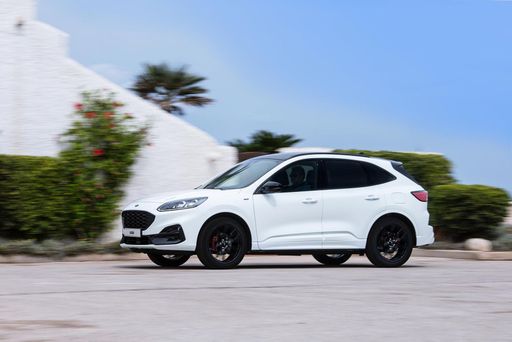
VS

Ford Kuga vs Ford Capri comparison

Compare performance (243 HP vs 340 HP), boot space and price (34,200 £ vs 36,300 £ ) at a glance. Find out which car is the better choice for you – Ford Kuga or Ford Capri?

Ford Kuga vs Ford Capri: Key differences

Ford Kuga

4.2 (6 Reviews)
rate
  • very slightly cheaper
  • clearly lighter

Ford Capri

5 (2 Reviews)
rate
  • noticeably more power
  • considerably more electric range
  • markedly quicker 0–100 km/h

All details on performance, efficiency, range and trunk space can be found in the technical comparison below – including user reviews for both models.

Kuga

Head-to-head: Ford Kuga VS Ford Capri — SUV practicality meets coupe flair

The showdown between the Ford Kuga and the Ford Capri is exactly the kind of clash buyers enjoy weighing before signing on the dotted line. On one side you've got the compact-SUV attitude of the Ford Kuga, and on the other a sleeker, more expressive silhouette in the Ford Capri that leans toward grand-tourer ambitions. This page is your quick read to understand the real-world differences, not buried spec tables — think character, comfort, and how each car behaves day-to-day. If you searched for "Ford Kuga VS Ford Capri" to decide which fits your life, you’re in the right place.
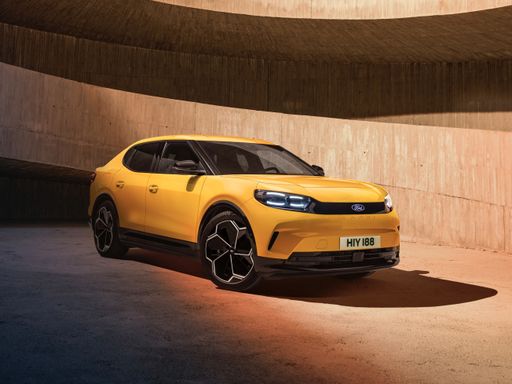
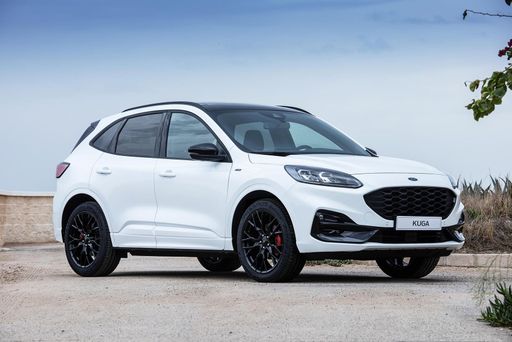
Capri

Two very different personalities under one brand

The Ford Kuga plays the sensible, unruffled family member: practical, unpretentious and built to handle groceries, school runs and occasional adventures without drama. The Ford Capri is the one who turns up in a brighter outfit and expects to be noticed — more attitude, more presence, and a driving posture that rewards engagement. Where the Ford Kuga signals reassurance and utility, the Ford Capri trades that for charisma and a touch of theater. Choosing between them is as much about temperament as it is about top-level features.

Kuga

How they behave in everyday life

If daily routine is the yardstick, the Ford Kuga is built for living: easy ingress, straightforward layouts, and a cabin that makes practical tasks feel less fiddly. The Ford Capri tilts the experience toward long drives and moments when driver engagement matters — it prefers a committed hand on the wheel and rewards you when you oblige. City dwellers and tight-park commuters will appreciate the Kuga’s familiar, no-nonsense usability, while those who log motorway miles and enjoy a more theatrical experience will find the Capri more satisfying. In short, one is about efficient living; the other is about enjoying the journey a little more theatrically.

Capri

Why you'll tell yourself you need one or the other

Buy the Ford Kuga if you want a defensible, everyday machine that makes family life and work commutes less of a gamble — it’s the car that earns its keep without fuss. Choose the Ford Capri if you want a car that justifies itself on feeling and image: it’s a statement on the driveway and a companion on longer trips when you want more connection. Some buyers will rationalize the Kuga as the “responsible” choice, while others will see the Capri as a justified indulgence — both explanations are perfectly valid. Which story fits you will often decide the sale as much as any spec sheet.

Kuga

Who should seriously be test-driving the Ford Kuga

If you prize practicality and low-stress ownership, the Ford Kuga is aimed squarely at you: commuters who want something friendly, families that value flexibility, and buyers who prefer predictability over flash. The Kuga’s comfort-focused setup and user-friendly ergonomics suit those who favour calm daily driving and sensible packaging over headline-grabbing performance. It’s a sensible pick for anyone who wants a car that works hard with minimal fuss, and it squeezes into a lot of lifestyles without asking permission. For buyers who care about utility first, this is the sensible meeting point.

Who the Ford Capri will seduce — and where the Kuga still makes sense

The Ford Capri will attract those who care about presence: style-conscious drivers, brand-minded buyers and anyone who wants a car that earns compliments on the road. It’s for people who enjoy driving as an experience and want their car to reflect personality as much as purpose, which puts it in the realm of design/status-focused buyers. That said, mention the Ford Kuga to the same shopper and you’ll trigger thoughts of practicality and everyday comfort — a reminder that the Kuga is the conservative alternative when the Capri’s theatrics aren’t needed. Read on into the technical section below to match these impressions with the numbers that matter to your decision.

Here’s where it gets real: The technical differences in detail

Kuga

Costs and Efficiency:

Price and efficiency are often the first things buyers look at. Here it becomes clear which model has the long-term edge – whether at the pump, the plug, or in purchase price.

Ford Kuga is very slightly cheaper – starting at 34,200 £ , while the Ford Capri costs 36,300 £ . That’s a price difference of around 2,100 £.

As for electric range, the Ford Capri offers considerably more range – reaching up to 627 km, about 559 km more than the Ford Kuga.

Capri

Engine and Performance:

Power, torque and acceleration are the classic benchmarks for car enthusiasts – and here, some clear differences start to show.

When it comes to engine power, the Ford Capri offers noticeably more power – delivering 340 HP compared to 243 HP. That’s roughly 97 HP more horsepower.

When accelerating from 0 to 100 km/h, the Ford Capri is markedly quicker – completing the sprint in 5.3 s, while the Ford Kuga takes 7.3 s. That’s about 2 s quicker.

There’s also a difference in torque: the Ford Capri delivers clearly more torque with 679 Nm compared to 240 Nm. That’s about 439 Nm more.

Kuga

Space and Everyday Use:

Whether family car or daily driver – which one offers more room, flexibility and comfort?

Both vehicles offer seating for 5 people.

In terms of curb weight, Ford Kuga is clearly lighter – 1,526 kg compared to 2,001 kg. The difference is around 475 kg.

When it comes to payload, the Ford Capri carries marginally more – 587 kg compared to 550 kg. That’s a difference of about 37 kg.

Who wins the race in the data check?

The Ford Capri is decisively ahead in the objective data comparison.
This result only shows which model scores more points on paper – not which of the two cars feels right for you.

from £36,300
Capri

Ford Capri

  • Engine Type : Electric
  • Transmission : Automatic
  • Drive Type : Rear-Wheel Drive, All-Wheel Drive
  • Power HP : 190 - 340 HP
  • Consumption kWh/100km : 13.8 - 16.5 kWh/100km
  • Electric Range : 439 - 627 km
Ford Kuga
Ford Capri

Costs and Consumption

View detailed analysis

Engine and Performance

View detailed analysis

Dimensions and Body

View detailed analysis

Ford Kuga

The Kuga is Ford’s adaptable family SUV that blends usable space with a surprisingly lively driving character, making daily commutes and weekend escapes equally enjoyable. With smart interior packaging, an easy-to-use infotainment setup and composed road manners, it’s a sensible choice for buyers who want a bit of fun without the fuss.

details

Ford Capri

The Ford Capri turned the family car into something cheekily sporty, with a long, rakish profile that still promises fun at a glance. Today it lives on as a lovable classic — easy to tinker with, enjoyable to drive and guaranteed to raise smiles at any meet.

details
Ford Kuga
Ford Capri

Costs and Consumption

Price
34,200 - 46,300 £
Price
36,300 - 50,900 £
Consumption L/100km
2.8 - 6.8 L/100km
Consumption L/100km
-
Consumption kWh/100km
-
Consumption kWh/100km
13.8 - 16.5 kWh/100km
Electric Range
68 km
Electric Range
439 - 627 km
Battery Capacity
-
Battery Capacity
-
co2
55 - 154 g/km
co2
0 g/km
Fuel tank capacity
-
Fuel tank capacity
-

Dimensions and Body

Body Type
SUV
Body Type
SUV
Seats
5
Seats
5
Doors
-
Doors
-
Curb weight
1,526 - 1,859 kg
Curb weight
2,001 - 2,175 kg
Trunk capacity
-
Trunk capacity
572 L
Length
-
Length
-
Width
1,882 mm
Width
1,872 mm
Height
-
Height
-
Max trunk capacity
-
Max trunk capacity
-
Payload
541 - 550 kg
Payload
559 - 587 kg

Engine and Performance

Engine Type
Petrol, Full Hybrid, Plugin Hybrid
Engine Type
Electric
Transmission
Manuel, Automatic
Transmission
Automatic
Transmission Detail
Manual Gearbox, CVT, Automatic Gearbox
Transmission Detail
Reduction Gearbox
Drive Type
Front-Wheel Drive, All-Wheel Drive
Drive Type
Rear-Wheel Drive, All-Wheel Drive
Power HP
150 - 243 HP
Power HP
190 - 340 HP
Acceleration 0-100km/h
7.3 - 9.9 s
Acceleration 0-100km/h
5.3 - 8 s
Max Speed
-
Max Speed
-
Torque
240 Nm
Torque
350 - 679 Nm
Number of Cylinders
3 - 4
Number of Cylinders
-
Power kW
111 - 178 kW
Power kW
140 - 250 kW
Engine capacity
1,496 - 2,488 cm3
Engine capacity
-

General

Model Year
2,025
Model Year
2,026
CO2 Efficiency Class
E, D, B
CO2 Efficiency Class
A
Brand
Ford
Brand
Ford
DriveDuel uses data analysis and artificial intelligence to evaluate vehicle data and create content. Content is regularly reviewed and improved. The displayed prices are estimates based on German list prices, adjusted to the respective country’s VAT. Country-specific registration taxes are not included. This information is not legally binding.