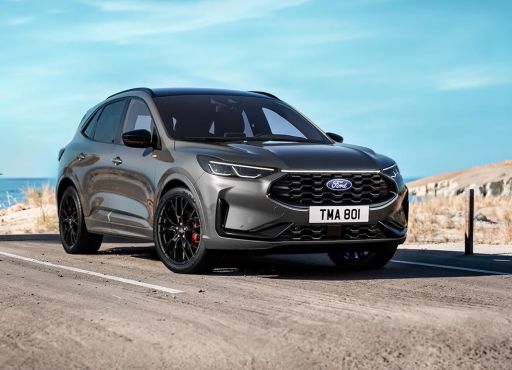
@ Ford Motor Company / Ford Media Center
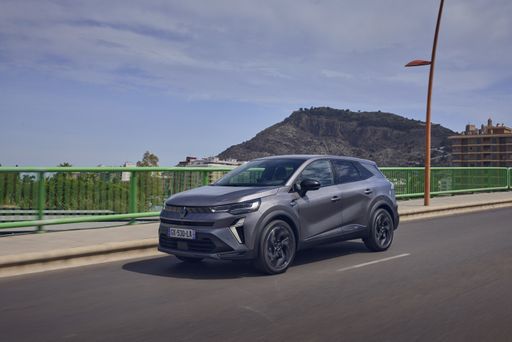
@ Renault Group Media
VS

Ford Kuga vs Renault Symbioz – Differences & prices compared

Everyday use, family trips or long-distance drives – here’s where the differences show.
Discover whether Ford Kuga or Renault Symbioz fits your lifestyle better.

Kuga @ Ford Motor Company / Ford Media Center

Ford Kuga vs. Renault Symbioz: A Comprehensive Comparison

In the ever-evolving world of SUVs, the Ford Kuga and Renault Symbioz stand out as two intriguing options for consumers in search of innovation, performance, and practicality. Both vehicles represent their respective brands' approach to the future of automotive technology, but which model takes the lead? This article delves into their specifications, innovations, and overall performance to help you make an informed decision.

Symbioz @ Renault Group Media

Powertrain and Performance

The Ford Kuga offers a versatile lineup of engines, including petrol, full hybrid, and plug-in hybrid variants. The range of power outputs goes from a modest 150 HP to a robust 243 HP, providing options for varying driving styles. Additionally, the Kuga boasts an impressive torque range, with a maximum value of 240 Nm.

In contrast, the Renault Symbioz is powered exclusively by a full hybrid engine producing 143 HP and 250 Nm of torque. While its performance is commendable, particularly with a focus on efficiency, it cannot quite match the range and variety of engine choices available with the Kuga.

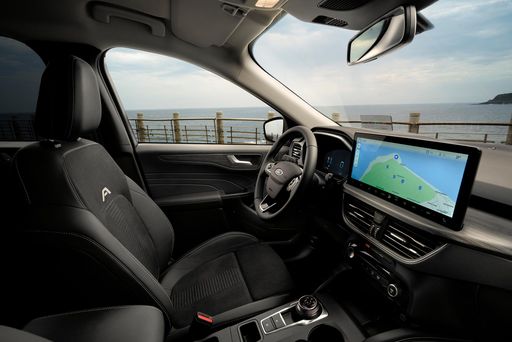
Kuga @ Ford Motor Company / Ford Media Center

Efficiency and Environmental Impact

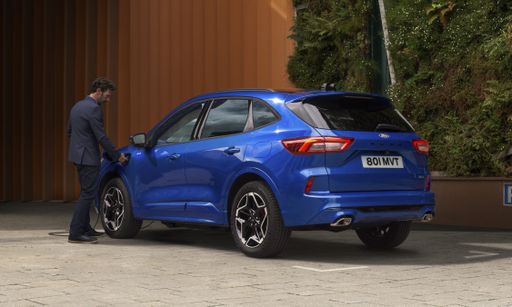
In terms of fuel efficiency, the Kuga shows a range of consumption figures from 5.3 to 6.4 L/100km, depending on the engine choice. Its plug-in hybrid variant stands out with a remarkable CO2 emission figure as low as 20 g/km. The Kuga also features an electric range of up to 69 km, catering to eco-conscious consumers who are looking for greener alternatives.

The Renault Symbioz, while less powerful, excels in fuel economy with a consumption figure of just 4.8 L/100km and a CO2 emission level of 109 g/km. Though it does not offer the same electric range as the Kuga, its eco-friendliness and slightly smaller carbon footprint make it a compelling choice for environmentally-focused drivers.

Symbioz @ Renault Group Media

Dimensions and Interior Space

Dimensionally, the Ford Kuga measures 4604 mm in length, 1882 mm in width, and has a height ranging from 1673 mm to 1681 mm across variants. Its trunk capacity of 412 liters provides ample room for cargo, making it a practical choice for families and adventurers alike.

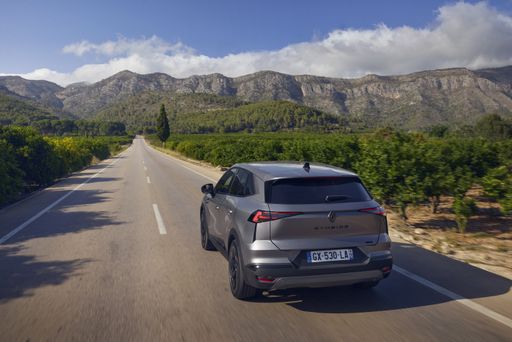
The Renault Symbioz, slightly smaller at 4413 mm in length and 1797 mm in width, offers a height of 1575 mm. However, it impresses with a larger trunk capacity of 492 liters. Despite its smaller exterior dimensions, the Symbioz manages to provide usable interior space, making it a standout for those prioritizing cargo capacity.

Kuga @ Ford Motor Company / Ford Media Center

Technology and Innovations

The Ford Kuga is packed with innovative technologies, including a comprehensive infotainment system, advanced safety features, and driver assistance technologies. The Kuga also includes connectivity options that are crucial in today’s tech-savvy automotive landscape, enabling seamless integration with smartphones and smart devices.

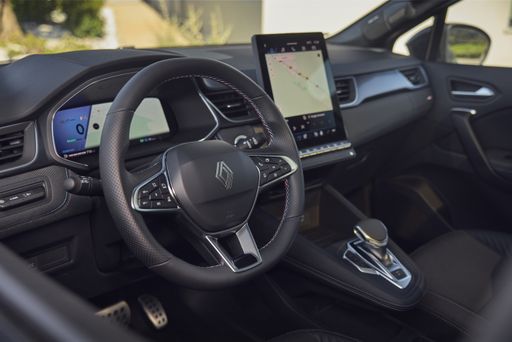
On the other hand, the Renault Symbioz focuses heavily on the convergence of mobility and technology, presenting features that aim for a more connected driving experience. Its design often reflects a vision towards autonomous driving and smart connectivity, appealing to those who are enthusiastic about the future of personal transportation.

Symbioz @ Renault Group Media

Final Verdict

Choosing between the Ford Kuga and Renault Symbioz ultimately depends on the buyer's priorities. If performance versatility, engine options, and robust driving dynamics are primary concerns, the Kuga emerges as the stronger contender. However, for those who prioritize eco-friendliness, innovative technology, and practicality with a spacious interior, the Symbioz represents an appealing modern alternative.

As both models enter the market in 2024, prospective SUV buyers would do well to consider their specific needs in this competitive segment, but regardless of choice, both vehicles bring exciting advancements to the automotive landscape.

Here’s where it gets real: The technical differences in detail

Costs and Efficiency:

Price and efficiency are often the first things buyers look at. Here it becomes clear which model has the long-term edge – whether at the pump, the plug, or in purchase price.

Renault Symbioz has a clearly advantage in terms of price – it starts at 24400 £, while the Ford Kuga costs 34200 £. That’s a price difference of around 9814 £.

Fuel consumption also shows a difference: Ford Kuga manages with 2.80 L and is therefore significantly more efficient than the Renault Symbioz with 4.50 L. The difference is about 1.70 L per 100 km.

Engine and Performance:

Power, torque and acceleration say a lot about how a car feels on the road. This is where you see which model delivers more driving dynamics.

When it comes to engine power, the Ford Kuga has a clearly perceptible edge – offering 243 HP compared to 158 HP. That’s roughly 85 HP more horsepower.

In acceleration from 0 to 100 km/h, the Ford Kuga is evident quicker – completing the sprint in 7.30 s, while the Renault Symbioz takes 9.10 s. That’s about 1.80 s faster.

In terms of top speed, the Ford Kuga performs barely noticeable better – reaching 200 km/h, while the Renault Symbioz tops out at 180 km/h. The difference is around 20 km/h.

There’s also a difference in torque: Renault Symbioz pulls hardly perceptible stronger with 265 Nm compared to 240 Nm. That’s about 25 Nm difference.

Space and Everyday Use:

Beyond pure performance, interior space and usability matter most in daily life. This is where you see which car is more practical and versatile.

Both vehicles offer seating for 5 people.

In curb weight, Renault Symbioz is somewhat lighter – 1359 kg compared to 1526 kg. The difference is around 167 kg.

In terms of boot space, the Renault Symbioz offers evident more room – 576 L compared to 412 L. That’s a difference of about 164 L.

In maximum load capacity, the Renault Symbioz performs slight better – up to 1682 L, which is about 148 L more than the Ford Kuga.

When it comes to payload, Ford Kuga a bit takes the win – 550 kg compared to 459 kg. That’s a difference of about 91 kg.

Who wins the race?

The Ford Kuga proves to be is largely superior and therefore becomes our DriveDuel Champion!
Ford Kuga is the better all-rounder in this comparison.

from about £34,200
Kuga @ Ford Motor Company / Ford Media Center

Ford Kuga

  • Engine Type : Petrol, Full Hybrid, Plugin Hybrid
  • Transmission : Manuel, Automatic
  • Drive Type : Front-Wheel Drive, All-Wheel Drive
  • Power HP : 150 - 243 HP
  • Consumption L/100km : 2.8 - 6.8 L
  • Electric Range : 68 km

Ford Kuga

3.5 (2)
rate

The Kuga is Ford’s adaptable family SUV that blends usable space with a surprisingly lively driving character, making daily commutes and weekend escapes equally enjoyable. With smart interior packaging, an easy-to-use infotainment setup and composed road manners, it’s a sensible choice for buyers who want a bit of fun without the fuss.

details

Renault Symbioz

The Renault Symbioz feels less like a traditional car and more like a rolling living room that's been told it's allowed to drive — its flowing lines and minimalist cabin are pure concept-car theatre that teases the future of everyday transport. For buyers with an eye for design and a taste for tech-forward ideas, the Symbioz is an alluring vision of what Renault could offer tomorrow, even if it's not yet a model you can park in your driveway.

details
Ford Kuga
Renault Symbioz
Kuga @ Ford Motor Company / Ford Media Center
Symbioz @ Renault Group Media

Costs and Consumption

Price
34200 - 46300 £
Price
24400 - 30700 £
Consumption L/100km
2.8 - 6.8 L
Consumption L/100km
4.5 - 6 L
Consumption kWh/100km
-
Consumption kWh/100km
-
Electric Range
68 km
Electric Range
-
Battery Capacity
1.1 - 14.4 kWh
Battery Capacity
-
co2
55 - 154 g/km
co2
102 - 136 g/km
Fuel tank capacity
42 - 54 L
Fuel tank capacity
48 L

Dimensions and Body

Body Type
SUV
Body Type
SUV
Seats
5
Seats
5
Doors
5
Doors
5
Curb weight
1526 - 1859 kg
Curb weight
1359 - 1544 kg
Trunk capacity
412 L
Trunk capacity
492 - 576 L
Length
4604 - 4645 mm
Length
4413 mm
Width
1882 mm
Width
1797 mm
Height
1673 - 1681 mm
Height
1575 mm
Max trunk capacity
1534 L
Max trunk capacity
1582 - 1682 L
Payload
541 - 550 kg
Payload
376 - 459 kg

Engine and Performance

Engine Type
Petrol, Full Hybrid, Plugin Hybrid
Engine Type
Full Hybrid, Petrol MHEV
Transmission
Manuel, Automatic
Transmission
Automatic, Manuel
Transmission Detail
Manual Gearbox, CVT, Automatic Gearbox
Transmission Detail
Automatic Gearbox, Manual Gearbox, Dual-Clutch Automatic
Drive Type
Front-Wheel Drive, All-Wheel Drive
Drive Type
Front-Wheel Drive
Power HP
150 - 243 HP
Power HP
140 - 158 HP
Acceleration 0-100km/h
7.3 - 9.9 s
Acceleration 0-100km/h
9.1 - 11 s
Max Speed
195 - 200 km/h
Max Speed
180 km/h
Torque
240 Nm
Torque
250 - 265 Nm
Number of Cylinders
3 - 4
Number of Cylinders
4
Power kW
111 - 178 kW
Power kW
103 - 116 kW
Engine capacity
1496 - 2488 cm3
Engine capacity
1332 - 1789 cm3

General

Model Year
2025
Model Year
2025
CO2 Efficiency Class
E, D, B
CO2 Efficiency Class
C, D, E
Brand
Ford
Brand
Renault
What drivetrain options does the Ford Kuga have?

The Ford Kuga is available as Front-Wheel Drive or All-Wheel Drive.

The prices and data displayed are estimates based on German list prices and may vary by country. This information is not legally binding.