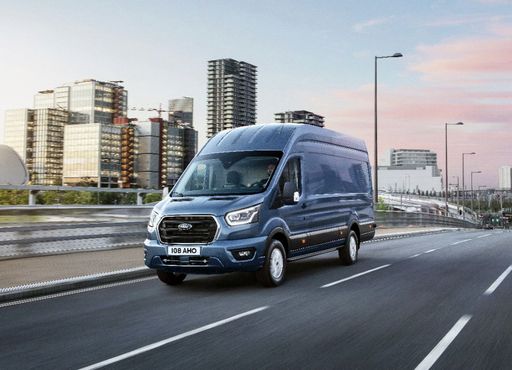
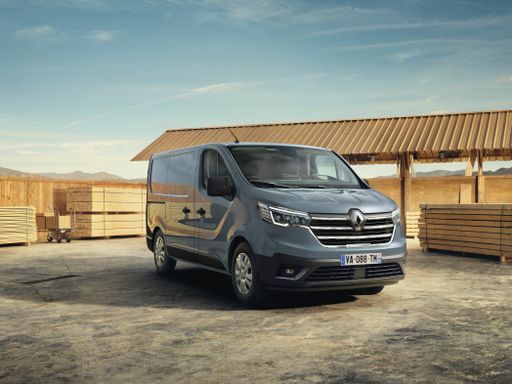
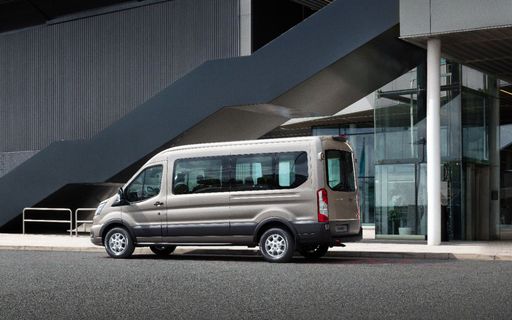
Price and efficiency are often the first things buyers look at. Here it becomes clear which model has the long-term edge – whether at the pump, the plug, or in purchase price.
Renault Trafic Transporter has a hardly perceptible advantage in terms of price – it starts at 33200 £, while the Ford Transit Custom Transporter costs 36300 £. That’s a price difference of around 3060 £.
In terms of energy consumption, the advantage goes to the Renault Trafic Transporter: with 21.20 kWh per 100 km, it’s barely noticeable more efficient than the Ford Transit Custom Transporter with 22.40 kWh. That’s a difference of about 1.20 kWh.
As for range, the Ford Transit Custom Transporter performs barely noticeable better – achieving up to 327 km, about 9 km more than the Renault Trafic Transporter.
Under the bonnet, it becomes clear which model is tuned for sportiness and which one takes the lead when you hit the accelerator.
When it comes to engine power, the Ford Transit Custom Transporter has a decisively edge – offering 286 HP compared to 170 HP. That’s roughly 116 HP more horsepower.
In acceleration from 0 to 100 km/h, the Renault Trafic Transporter is clearly perceptible quicker – completing the sprint in 10.80 s, while the Ford Transit Custom Transporter takes 13.40 s. That’s about 2.60 s faster.
In terms of top speed, the Renault Trafic Transporter performs to a small extent better – reaching 180 km/h, while the Ford Transit Custom Transporter tops out at 150 km/h. The difference is around 30 km/h.
There’s also a difference in torque: Ford Transit Custom Transporter pulls barely noticeable stronger with 415 Nm compared to 380 Nm. That’s about 35 Nm difference.
Beyond pure performance, interior space and usability matter most in daily life. This is where you see which car is more practical and versatile.
Seats: offers more seating capacity – vs .
In curb weight, Renault Trafic Transporter is hardly perceptible lighter – 1848 kg compared to 1893 kg. The difference is around 45 kg.
In maximum load capacity, the Renault Trafic Transporter performs distinct better – up to 8900 L, which is about 2100 L more than the Ford Transit Custom Transporter.
When it comes to payload, Ford Transit Custom Transporter hardly perceptible takes the win – 1332 kg compared to 1222 kg. That’s a difference of about 110 kg.
Overall, the Ford Transit Custom Transporter shows itself to be won narrowly and secures the title of DriveDuel Champion.
It convinces with the more balanced overall package and proves to be the more versatile choice for everyday use.
The Renault Trafic is a practical, workhorse transporter that hides thoughtful cabin comfort behind a tough, utilitarian exterior, so you can tackle a busy week without sacrificing sanity. It’s a sensible choice for buyers who want reliability and clever flexibility rather than flash, with just enough character to make daily hauling feel less like a chore.
detailsThe Transit Custom is a clever, no-nonsense workhorse that blends roomy practicality with surprisingly car-like driving manners, so your workday feels less like a chore and more like efficient transport. With a sensible interior, smart storage and tidy handling, it’s the kind of van that makes owners smile while they get on with the job — reliable, unfussy and built to keep moving.
details|
|
|
|
|
|
Costs and Consumption |
|
|---|---|
|
Price
33200 - 43500 £
|
Price
36300 - 71100 £
|
|
Consumption L/100km
6.6 - 7.8 L
|
Consumption L/100km
-
|
|
Consumption kWh/100km
21.2 - 22.2 kWh
|
Consumption kWh/100km
22.4 - 24.1 kWh
|
|
Electric Range
240 - 318 km
|
Electric Range
315 - 327 km
|
|
Battery Capacity
-
|
Battery Capacity
11.8 - 64 kWh
|
|
co2
0 - 206 g/km
|
co2
0 g/km
|
|
Fuel tank capacity
80 L
|
Fuel tank capacity
55 - 63 L
|
Dimensions and Body |
|
|---|---|
|
Body Type
Cargo Van
|
Body Type
Cargo Van
|
|
Seats
3 - 6
|
Seats
3 - 6
|
|
Doors
4
|
Doors
4
|
|
Curb weight
1848 - 2075 kg
|
Curb weight
1893 - 2122 kg
|
|
Trunk capacity
-
|
Trunk capacity
-
|
|
Length
5080 - 5480 mm
|
Length
5050 - 5450 mm
|
|
Width
1956 mm
|
Width
2032 mm
|
|
Height
1967 - 2509 mm
|
Height
1958 - 1959 mm
|
|
Max trunk capacity
3300 - 8900 L
|
Max trunk capacity
5800 - 6800 L
|
|
Payload
848 - 1222 kg
|
Payload
802 - 1332 kg
|
Engine and Performance |
|
|---|---|
|
Engine Type
Diesel, Electric
|
Engine Type
Electric, Diesel, Plugin Hybrid
|
|
Transmission
Manuel, Automatic
|
Transmission
Automatic, Manuel
|
|
Transmission Detail
Manual Gearbox, Reduction Gearbox, Automatic Gearbox
|
Transmission Detail
Reduction Gearbox, Manual Gearbox, Automatic Gearbox, CVT
|
|
Drive Type
Front-Wheel Drive
|
Drive Type
Rear-Wheel Drive, Front-Wheel Drive, All-Wheel Drive
|
|
Power HP
110 - 170 HP
|
Power HP
110 - 286 HP
|
|
Acceleration 0-100km/h
10.8 - 15.1 s
|
Acceleration 0-100km/h
13.4 - 16.9 s
|
|
Max Speed
110 - 180 km/h
|
Max Speed
110 - 150 km/h
|
|
Torque
245 - 380 Nm
|
Torque
310 - 415 Nm
|
|
Number of Cylinders
4
|
Number of Cylinders
4
|
|
Power kW
81 - 125 kW
|
Power kW
81 - 210 kW
|
|
Engine capacity
1997 cm3
|
Engine capacity
1996 - 2488 cm3
|
General |
|
|---|---|
|
Model Year
2022 - 2025
|
Model Year
2023 - 2024
|
|
CO2 Efficiency Class
F, G, A
|
CO2 Efficiency Class
A
|
|
Brand
Renault
|
Brand
Ford
|
The Renault Trafic Transporter is available as Front-Wheel Drive.
The prices and data displayed are estimates based on German list prices and may vary by country. This information is not legally binding.