VS

VW Tayron vs VW Touareg comparison

Compare performance (272 HP vs 462 HP), boot space and price (40,200 £ vs 64,300 £ ) at a glance. Find out which car is the better choice for you – VW Tayron or VW Touareg?

VW Tayron vs VW Touareg: Key differences

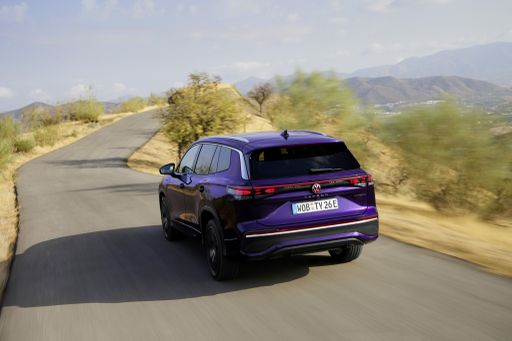
VW Tayron

4.5 (5 Reviews)
rate
  • substantially cheaper
  • substantially more efficient
  • considerably more electric range
  • clearly lighter
  • only slightly more trunk space
details

VW Touareg

4.9 (4 Reviews)
rate
  • clearly more power
  • slightly quicker 0–100 km/h
details

All details on performance, efficiency, range and trunk space can be found in the technical comparison below – including user reviews for both models.

By Achim Sedelmaier

Tayron

VW Touareg vs VW Tayron: choosing the right Volkswagen SUV for your life

The VW Touareg and VW Tayron aim at similar families but deliver very different experiences. In a straight VW Touareg VS VW Tayron matchup, the Touareg plays the serene, upper-class cruiser while the Tayron leans into family versatility and value. Both are quiet and easy-going, yet the way they cover ground, use space, and manage tech feels distinctly different. This comparison makes those real-world differences clear so you can pick the one that suits your roads, routines, and priorities.
Touareg

Ride, refinement and long-distance character

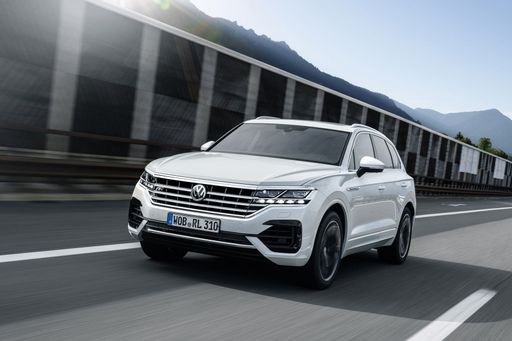
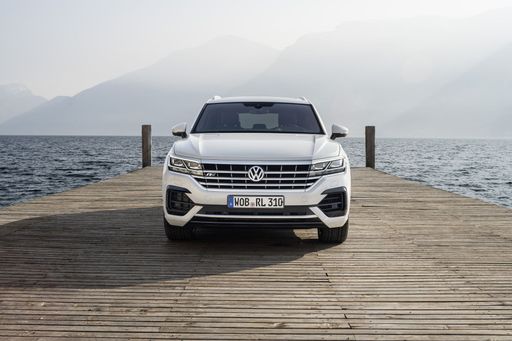
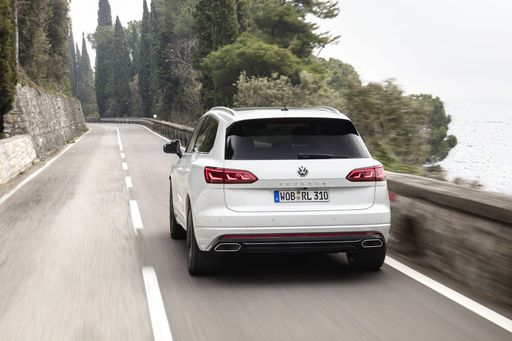
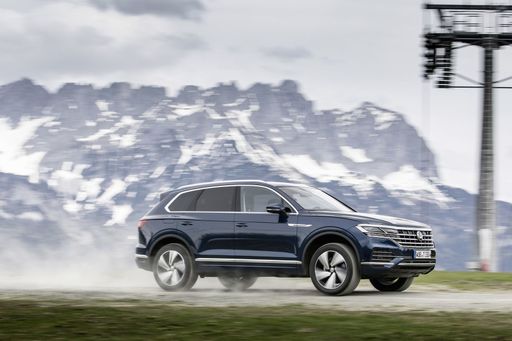
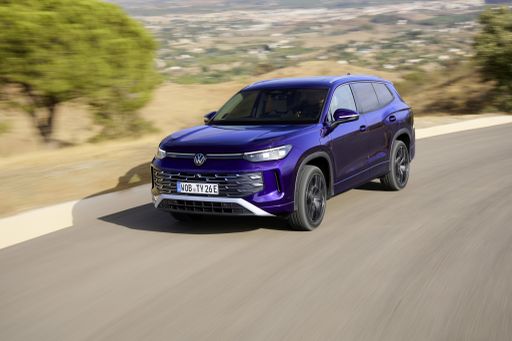
The Touareg is built for the motorway: calm, planted and impressively hushed, especially with air suspension, it turns long trips into short stories. Steering feel is measured rather than playful, but stability and confidence are where the Touareg shines, with strong, effortless shove when you need to overtake or tow. The Tayron is also a relaxed cruiser, yet its comfort tuning and lighter feel give it a more everyday friendliness, even if it can roll a touch more in quick direction changes. If your driving skews to big miles and high speeds, the Touareg’s extra serenity is tangible; if it’s a mix of school runs, A-roads and holidays, the Tayron’s mellow setup lands right in the sweet spot.

Tayron

Cabin vibe and controls

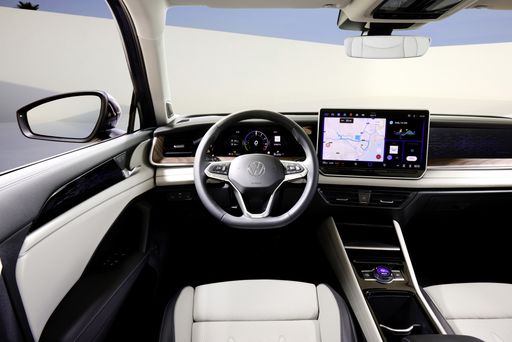
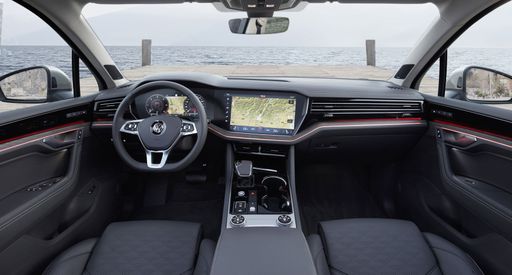
Inside the Touareg you get an executive-car atmosphere: broad surfaces, tight fit-and-finish and a huge central screen that looks the part, even if the touch-first climate and steering controls demand acclimatisation. Road and wind noise are impressively suppressed, so conversations remain low-voice easy at a cruise. The Tayron feels modern and well-assembled too, with cleaner menus, illuminated sliders and a handy rotary controller that reduce day-to-day faff. It’s not quite as plush in the details as the Touareg, and some camera and graphics elements feel basic, but the Tayron’s overall ergonomics are more straightforward in everyday use.

Touareg

Space, seats and family logistics

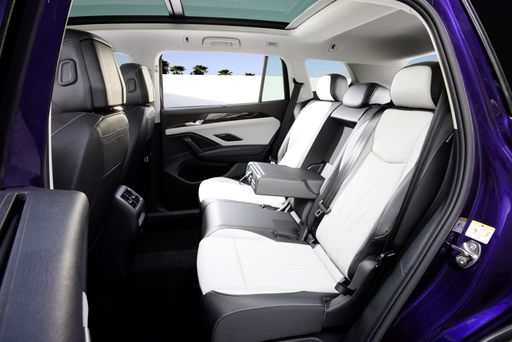
The Touareg’s rear bench is generous and the cargo area is square and easy to load; with air suspension you can even lower the rear for heavy items. It’s strictly a five-seater though, so if you occasionally need a third row you’ll have to look elsewhere. The Tayron’s second row is downright expansive, and depending on configuration it can add a small, kid-friendly third row for those last‑minute carpool emergencies. As a family tool the Tayron is the more flexible choice, while the Touareg counters with simpler, calmer packaging and an especially refined back-seat experience on long journeys.

Tayron

Efficiency, running costs and towing

The Tayron stacks the deck on efficiency and day-to-day costs, particularly as a plug-in hybrid with meaningful electric range and the convenience of DC top-ups on busy weeks. Its diesel option also sips gently on long drives, making it a savvy pick for commuters who value predictable fuel bills. The Touareg brings stronger engines and more effortless performance, but it asks more at the pump unless you choose the long-legged diesel and let it settle into its stride. For heavy-duty holiday gear or boats, the Touareg’s higher towing ceiling and calmer high-speed composure are reassuring, while the Tayron still offers a healthy, family-appropriate towing margin.

Touareg

City manners, ease of ownership and buyer fit

In tight streets the Tayron feels lighter to guide, but its larger turning circle and modest camera clarity take some shine off parking; it’s otherwise an easy companion. The Touareg is a big car to place, yet available rear-wheel steering shrinks it noticeably in multi-storeys and its refinement means you arrive less frazzled after cross-town slogs. If you prioritise upper-class calm, frequent motorway trips, and serious towing, the VW Touareg fits like a tailored suit. If you want maximum family flexibility, lower ownership costs, and real electric commuting, the VW Tayron nails the brief—now dive into the technical comparison to see how their powertrains and practicalities back up those everyday impressions.

Here’s where it gets real: The technical differences in detail

Tayron

Costs and Efficiency:

Price and efficiency are key factors when choosing a car – and this is often where the real differences emerge.

VW Tayron is substantially cheaper – starting at 40,200 £ , while the VW Touareg costs 64,300 £ . That’s a price difference of around 24,086 £.

Fuel consumption also shows a difference: the VW Tayron uses 1.5 L/100km and is substantially more efficient than the VW Touareg with 5.2 L/100km. The difference is about 3.7 L/100km.

As for electric range, the VW Tayron offers considerably more range – reaching up to 123 km, about 74 km more than the VW Touareg.

Touareg

Engine and Performance:

Under the bonnet, it becomes clear which model is tuned for sportiness and which one takes the lead when you hit the accelerator.

When it comes to engine power, the VW Touareg offers clearly more power – delivering 462 HP compared to 272 HP. That’s roughly 190 HP more horsepower.

When accelerating from 0 to 100 km/h, the VW Touareg is slightly quicker – completing the sprint in 5.1 s, while the VW Tayron takes 6.1 s. That’s about 1 s quicker.

There’s also a difference in torque: the VW Touareg delivers substantially more torque with 700 Nm compared to 400 Nm. That’s about 300 Nm more.

Tayron

Space and Everyday Use:

Cabin size, boot volume and payload all play a role in everyday practicality. Here, comfort and flexibility make the difference.

Both vehicles offer seating for 5 people.

In terms of curb weight, VW Tayron is clearly lighter – 1,682 kg compared to 2,059 kg. The difference is around 377 kg.

Looking at boot space, the VW Tayron offers only slightly more boot space – 885 L compared to 810 L. That’s a difference of about 75 L.

When it comes to payload, the VW Touareg carries noticeably more – 751 kg compared to 573 kg. That’s a difference of about 178 kg.

Who wins the race in the data check?

The VW Tayron is clearly superior overall in the objective data comparison.
This result only shows which model scores more points on paper – not which of the two cars feels right for you.

from £40,200
Tayron

VW Tayron

  • Engine Type : Petrol MHEV, Diesel, Petrol, Plugin Hybrid
  • Transmission : Automatic
  • Drive Type : Front-Wheel Drive, All-Wheel Drive
  • Power HP : 150 - 272 HP
  • Consumption L/100km : 1.5 - 8.5 L/100km
  • Electric Range : 116 - 123 km
VW Tayron
VW Touareg

Costs and Consumption

View detailed analysis

Engine and Performance

View detailed analysis

Dimensions and Body

View detailed analysis

VW Tayron

The VW Tayron combines a roomy, practical interior with a composed, comfortable ride that suits both daily commuting and longer journeys. With a restrained, modern design and a focus on straightforward tech and safety, it’s a sensible choice for buyers who want Volkswagen refinement without unnecessary flash.

details

VW Touareg

Volkswagen Touareg wraps a grown-up presence in a classy, well-appointed cabin that feels more like a premium saloon than an SUV. It glides with quiet composure, devours long journeys and tucks away clever tech that makes life easier whether you’re stuck in town or nipping off the beaten track.

details
VW Tayron
VW Touareg

Costs and Consumption

Price
40,200 - 56,000 £
Price
64,300 - 88,300 £
Consumption L/100km
1.5 - 8.5 L/100km
Consumption L/100km
5.2 - 10.5 L/100km
Consumption kWh/100km
-
Consumption kWh/100km
-
Electric Range
116 - 123 km
Electric Range
47 - 49 km
Battery Capacity
-
Battery Capacity
-
co2
33 - 192 g/km
co2
119 - 239 g/km
Fuel tank capacity
-
Fuel tank capacity
-

Dimensions and Body

Body Type
SUV
Body Type
SUV
Seats
5
Seats
5
Doors
-
Doors
-
Curb weight
1,682 - 1,948 kg
Curb weight
2,059 - 2,470 kg
Trunk capacity
705 - 885 L
Trunk capacity
665 - 810 L
Length
-
Length
-
Width
1,853 - 1,866 mm
Width
1,984 mm
Height
-
Height
-
Max trunk capacity
-
Max trunk capacity
-
Payload
489 - 573 kg
Payload
550 - 751 kg

Engine and Performance

Engine Type
Petrol MHEV, Diesel, Petrol, Plugin Hybrid
Engine Type
Petrol, Plugin Hybrid, Diesel
Transmission
Automatic
Transmission
Automatic
Transmission Detail
Dual-Clutch Automatic
Transmission Detail
Automatic Gearbox
Drive Type
Front-Wheel Drive, All-Wheel Drive
Drive Type
All-Wheel Drive
Power HP
150 - 272 HP
Power HP
231 - 462 HP
Acceleration 0-100km/h
6.1 - 9.7 s
Acceleration 0-100km/h
5.1 - 7.7 s
Max Speed
-
Max Speed
-
Torque
250 - 400 Nm
Torque
450 - 700 Nm
Number of Cylinders
4
Number of Cylinders
6
Power kW
110 - 200 kW
Power kW
170 - 340 kW
Engine capacity
1,498 - 1,984 cm3
Engine capacity
2,967 - 2,995 cm3

General

Model Year
2,025 - 2,026
Model Year
2025
CO2 Efficiency Class
E, F, G, B
CO2 Efficiency Class
G, D
Brand
VW
Brand
VW
DriveDuel uses data analysis and artificial intelligence to evaluate vehicle data and create content. Content is regularly reviewed and improved. The displayed prices are estimates based on German list prices, adjusted to the respective country’s VAT. Country-specific registration taxes are not included. This information is not legally binding.