VS

VW Tiguan vs Hyundai Santa Fe comparison

Compare performance (272 HP vs 288 HP), boot space and price (33,600 £ vs 51,700 £ ) at a glance. Find out which car is the better choice for you – VW Tiguan or Hyundai Santa Fe?

VW Tiguan vs Hyundai Santa Fe: Key differences

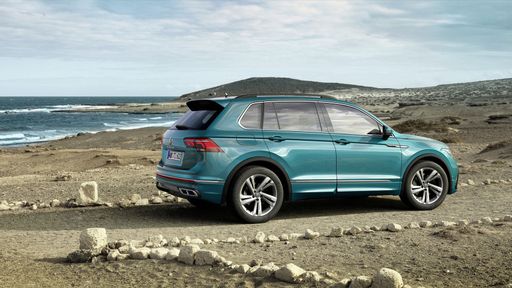
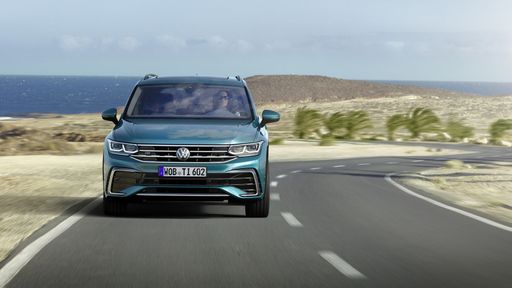
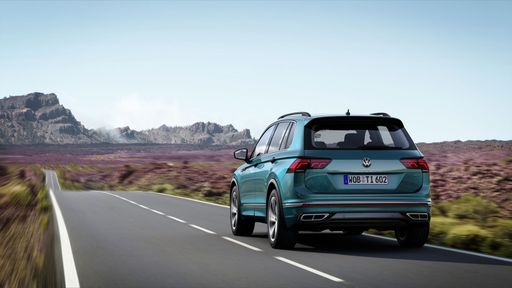
VW Tiguan

4.1 (8 Reviews)
rate
  • clearly cheaper
  • clearly more efficient
  • substantially more electric range
  • visibly quicker 0–100 km/h
  • markedly lighter

Hyundai Santa Fe

4.7 (1 Reviews)
rate
  • only slightly more power
  • marginally more trunk space

All details on performance, efficiency, range and trunk space can be found in the technical comparison below – including user reviews for both models.

Tiguan

Hyundai Santa Fe vs VW Tiguan: A Battle of the SUVs

The SUV market is bustling with innovations and diverse offerings, and two standout contenders are the Hyundai Santa Fe and the VW Tiguan. Each caters to different preferences and needs, making them worthwhile options for those in the market for a versatile SUV. This matchup explores their technical features, innovations, and what makes each unique in the growing SUV landscape.
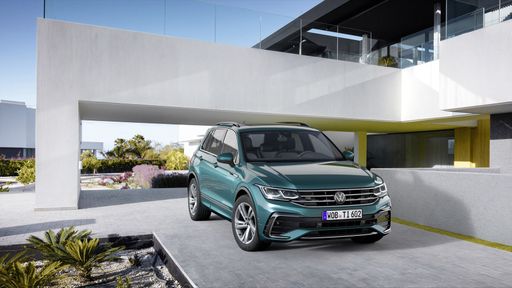
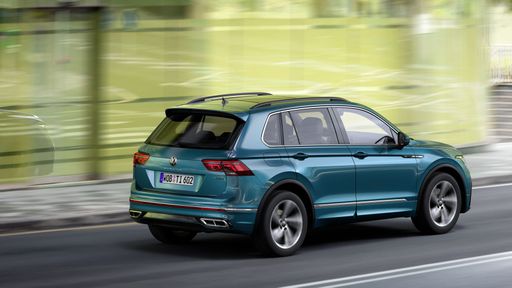
Santa Fe

Engine and Power Dynamics

Both the Hyundai Santa Fe and the VW Tiguan offer a variety of engine choices, but they cater to different driving experiences. The Santa Fe is available in full hybrid and plugin hybrid configurations, producing between 215 HP to 253 HP. The Tiguan, on the other hand, showcases a broader spectrum of powertrains, including petrol MHEV, plugin hybrid, diesel, and petrol, with power output ranging from 130 HP to a robust 272 HP.

For eco-conscious drivers, the Tiguan's plugin hybrid variant stands out with exceptional efficiency, offering an electric range of up to 113 km. The Tiguan also boasts a range of torque from 220 Nm to 400 Nm, showcasing its versatility. Meanwhile, the Santa Fe provides a balanced driving experience with its all-wheel and front-wheel drive options, generating a consistent torque of 367 Nm.

Tiguan

Performance and Efficiency

Performance enthusiasts will appreciate that the VW Tiguan can reach a maximum speed of up to 242 km/h, outpacing the Hyundai Santa Fe's top speed of 180 km/h. When it comes to acceleration, Tiguan showcases a faster sprint with times as low as 5.9 seconds in its most powerful configurations, while the Santa Fe ranges from 9.3 to 9.8 seconds.

Efficiency is another critical area of comparison. The Santa Fe offers a decent consumption range from 1.7 to 6.9 L/100km, depending on the version. Meanwhile, the Tiguan promises an efficient ride with consumption between 0.4 to 8.5 L/100km, showcasing the notable efficiency of its hybrid variants.

Santa Fe

Space and Practicality

When considering cargo space, the Hyundai Santa Fe provides a trunk capacity ranging from 621 to 711 liters, making it a solid option for families or those requiring additional luggage space. The VW Tiguan, while slightly less spacious with trunk capacities between 490 to 652 liters, offers practical solutions for daily usage.

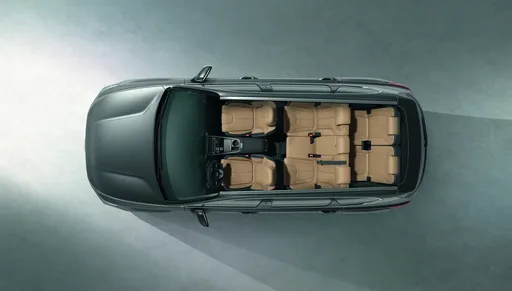
Passenger space and configuration also play a role in choosing an SUV. The Santa Fe offers flexibility with seating options for 5, 6, or 7 passengers, catering to larger families or groups. The Tiguan sticks to a 5-seat configuration, focusing on comfort and space for fewer passengers.

Tiguan

Dimensions and Design

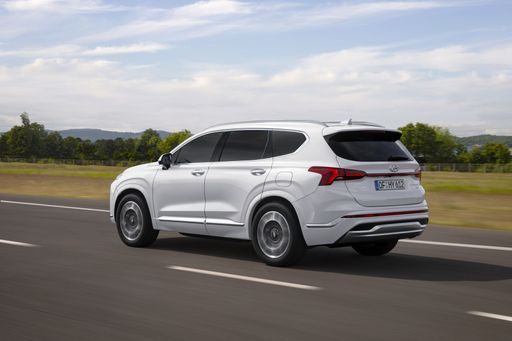
In terms of size, the Hyundai Santa Fe is the larger vehicle, measuring 4830 mm in length, 1900 mm in width, and 1720 mm in height. The Tiguan is more compact at 4539 mm in length, 1842 mm in width, and 1658 mm in height. The Santa Fe's size translates to a more commanding road presence, while the Tiguan's compactness offers easier maneuverability in urban settings.

Santa Fe

Final Thoughts

Both the Hyundai Santa Fe and the VW Tiguan bring unique strengths to the table. The Santa Fe's versatility, larger space, and hybrid options make it a great fit for families requiring flexibility and environmental consciousness. The Tiguan, with its vast engine choices, sporty performance, and impressive technology, appeals to those looking for an engaging driving experience and innovative features. Ultimately, the decision between these two comes down to individual priorities and lifestyle needs in the thriving SUV market.

Here’s where it gets real: The technical differences in detail

Tiguan

Costs and Efficiency:

Looking at overall running costs, both models reveal some interesting differences in everyday economy.

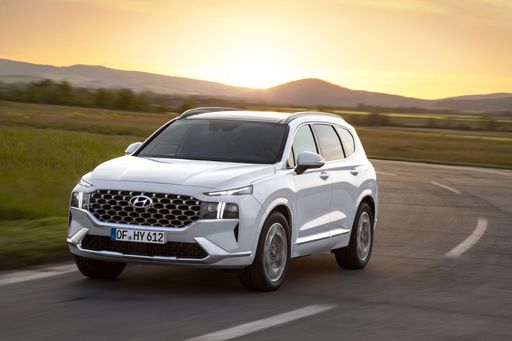
VW Tiguan is clearly cheaper – starting at 33,600 £ , while the Hyundai Santa Fe costs 51,700 £ . That’s a price difference of around 18,150 £.

Fuel consumption also shows a difference: the VW Tiguan uses 1.4 L/100km and is clearly more efficient than the Hyundai Santa Fe with 3.8 L/100km. The difference is about 2.4 L/100km.

As for electric range, the VW Tiguan offers substantially more range – reaching up to 126 km, about 72 km more than the Hyundai Santa Fe.

Santa Fe

Engine and Performance:

Power, torque and acceleration say a lot about how a car feels on the road. This is where you see which model delivers more driving dynamics.

When it comes to engine power, the Hyundai Santa Fe offers only slightly more power – delivering 288 HP compared to 272 HP. That’s roughly 16 HP more horsepower.

When accelerating from 0 to 100 km/h, the VW Tiguan is visibly quicker – completing the sprint in 5.9 s, while the Hyundai Santa Fe takes 8 s. That’s about 2.1 s quicker.

There’s also a difference in torque: the VW Tiguan delivers barely more torque with 400 Nm compared to 380 Nm. That’s about 20 Nm more.

Tiguan

Space and Everyday Use:

Whether family car or daily driver – which one offers more room, flexibility and comfort?

Seats: Hyundai Santa Fe offers more seats – 7 vs 5.

In terms of curb weight, VW Tiguan is markedly lighter – 1,599 kg compared to 1,920 kg. The difference is around 321 kg.

Looking at boot space, the Hyundai Santa Fe offers marginally more boot space – 704 L compared to 652 L. That’s a difference of about 52 L.

When it comes to payload, the Hyundai Santa Fe carries somewhat more – 665 kg compared to 533 kg. That’s a difference of about 132 kg.

Who wins the race in the data check?

The VW Tiguan stands well ahead of its rival in the objective data comparison.
This result only shows which model scores more points on paper – not which of the two cars feels right for you.

from £33,600
Tiguan

VW Tiguan

  • Engine Type : Petrol MHEV, Petrol, Diesel, Plugin Hybrid
  • Transmission : Automatic
  • Drive Type : Front-Wheel Drive, All-Wheel Drive
  • Power HP : 130 - 272 HP
  • Consumption L/100km : 1.4 - 8.4 L/100km
  • Electric Range : 118 - 126 km
VW Tiguan
Hyundai Santa Fe

Costs and Consumption

View detailed analysis

Engine and Performance

View detailed analysis

Dimensions and Body

View detailed analysis

VW Tiguan

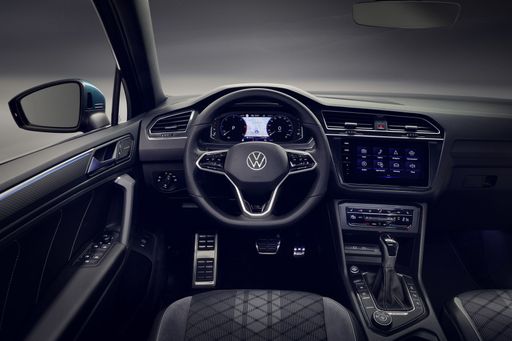
The VW Tiguan blends sensible family practicality with a dash of German polish, delivering a calm, reassuring ride and a cabin that never feels like an afterthought. For buyers who want an SUV that’s easy to live with yet still nicely dressed, the Tiguan is the grown‑up choice that keeps a cheeky wink in reserve.

details

Hyundai Santa Fe

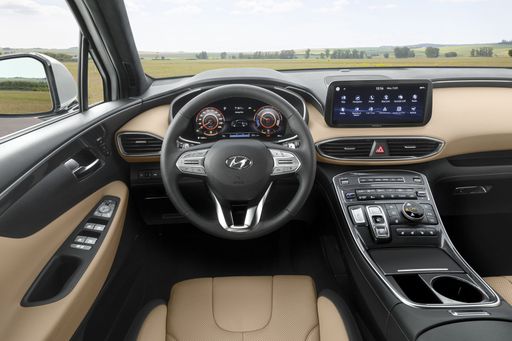
The Hyundai Santa Fe blends practical family friendliness with a hint of premium style, offering roomy, sensible packaging wrapped in modern, confident design. Inside it serves up comfortable seats, straightforward tech and a calm, composed ride that makes daily drives feel a little more grown up — a solid all‑rounder that doesn’t try to be flashy.

details
VW Tiguan
Hyundai Santa Fe

Costs and Consumption

Price
33,600 - 54,600 £
Price
51,700 - 58,600 £
Consumption L/100km
1.4 - 8.4 L/100km
Consumption L/100km
3.8 - 7.2 L/100km
Consumption kWh/100km
-
Consumption kWh/100km
-
Electric Range
118 - 126 km
Electric Range
54 km
Battery Capacity
19.7 kWh
Battery Capacity
-
co2
32 - 190 g/km
co2
90 - 162 g/km
Fuel tank capacity
45 L
Fuel tank capacity
-

Dimensions and Body

Body Type
SUV
Body Type
SUV
Seats
5
Seats
5 - 7
Doors
5
Doors
-
Curb weight
1,599 - 1,879 kg
Curb weight
1,920 - 2,165 kg
Trunk capacity
490 - 652 L
Trunk capacity
621 - 704 L
Length
4,539 mm
Length
-
Width
1,842 - 1,859 mm
Width
1,900 mm
Height
1,658 mm
Height
-
Max trunk capacity
1,486 L
Max trunk capacity
-
Payload
460 - 533 kg
Payload
560 - 665 kg

Engine and Performance

Engine Type
Petrol MHEV, Petrol, Diesel, Plugin Hybrid
Engine Type
Full Hybrid, Plugin Hybrid
Transmission
Automatic
Transmission
Automatic
Transmission Detail
Dual-Clutch Automatic
Transmission Detail
Automatic Gearbox
Drive Type
Front-Wheel Drive, All-Wheel Drive
Drive Type
Front-Wheel Drive, All-Wheel Drive
Power HP
130 - 272 HP
Power HP
239 - 288 HP
Acceleration 0-100km/h
5.9 - 10.6 s
Acceleration 0-100km/h
8 - 9.2 s
Max Speed
210 - 215 km/h
Max Speed
-
Torque
220 - 400 Nm
Torque
380 Nm
Number of Cylinders
4
Number of Cylinders
4
Power kW
96 - 200 kW
Power kW
176 - 212 kW
Engine capacity
1,498 - 1,984 cm3
Engine capacity
1,598 cm3

General

Model Year
2,024 - 2,026
Model Year
2,025
CO2 Efficiency Class
D, E, F, B, G
CO2 Efficiency Class
E, F, B
Brand
VW
Brand
Hyundai
DriveDuel uses data analysis and artificial intelligence to evaluate vehicle data and create content. Content is regularly reviewed and improved. The displayed prices are estimates based on German list prices, adjusted to the respective country’s VAT. Country-specific registration taxes are not included. This information is not legally binding.