VS

Ford Kuga vs Nissan Qashqai comparison

Compare performance (243 HP vs 205 HP), boot space and price (34,200 £ vs 29,600 £ ) at a glance. Find out which car is the better choice for you – Ford Kuga or Nissan Qashqai?

Ford Kuga vs Nissan Qashqai: Key differences

Ford Kuga

4.2 (6 Reviews)
rate
  • somewhat more power
  • significantly more efficient
  • barely quicker 0–100 km/h

Nissan Qashqai

4.9 (3 Reviews)
rate
  • a bit cheaper
  • barely lighter

All details on performance, efficiency, range and trunk space can be found in the technical comparison below – including user reviews for both models.

By Achim Sedelmaier

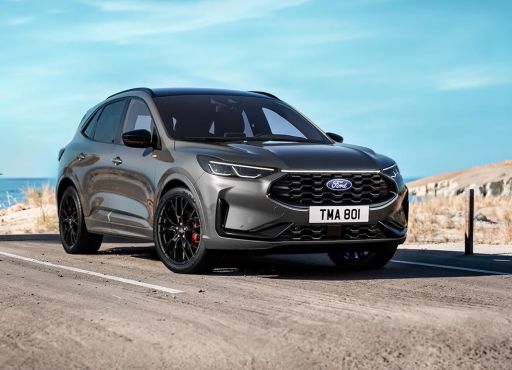
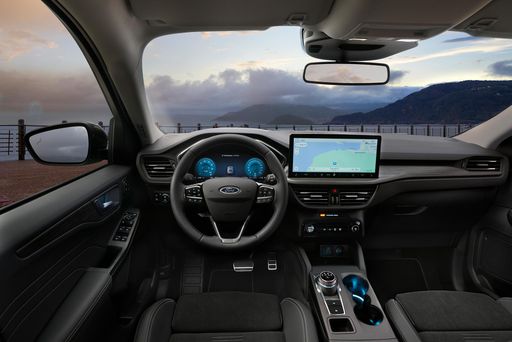
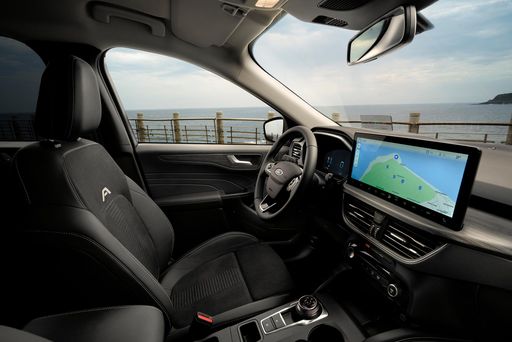
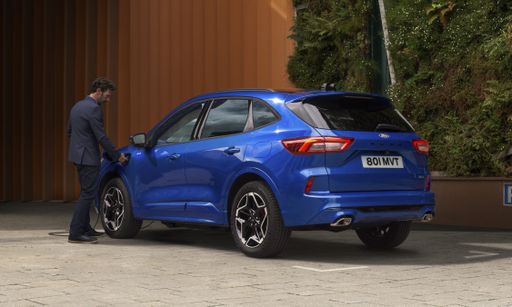
Kuga

Comparing the Ford Kuga and Nissan Qashqai: Which SUV Reigns Supreme?

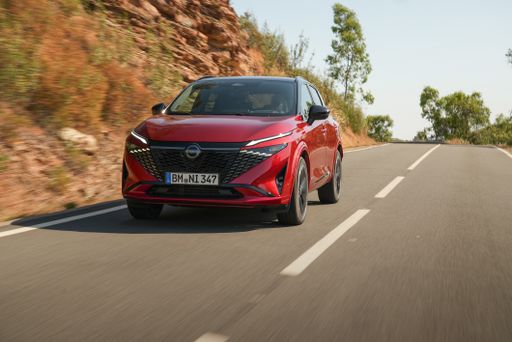
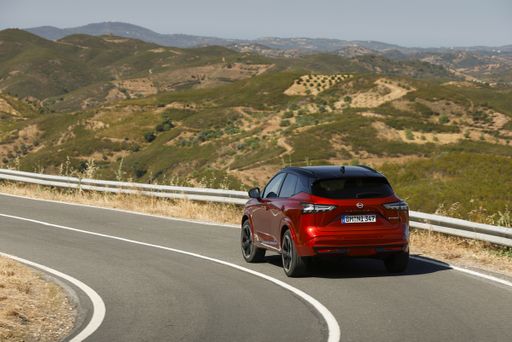
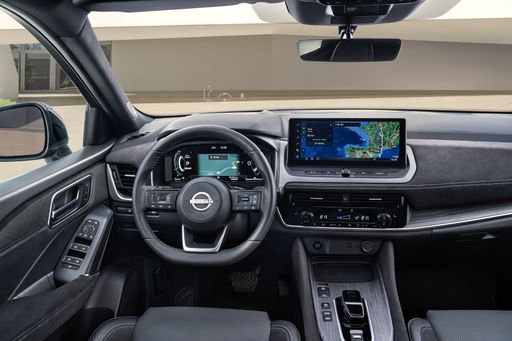
In the ever-evolving landscape of compact SUVs, the Ford Kuga and the Nissan Qashqai stand out as two prominent contenders. Both vehicles have undergone significant updates in the 2024 model year, featuring advanced technologies, various powertrains, and sleek designs. Let's dive into the technical specifications and innovative features of these two SUVs to determine which one best matches your needs.

Qashqai

Powertrain and Performance

The Ford Kuga offers a diverse array of engine types, including petrol, full hybrid, and plug-in hybrid options. With power outputs ranging from 150 to 243 HP and a 0-100 km/h acceleration time as brisk as 7.3 seconds, the Kuga promises robust performance for its class. Notably, the plug-in hybrid variant delivers an impressive electric range of 69 km, courtesy of a 14.4 kWh battery.

On the other hand, the Nissan Qashqai provides petrol mild hybrid and full hybrid options. With power outputs ranging from 140 to 190 HP, the Qashqai achieves a decent acceleration, with the best 0-100 km/h timing at 7.9 seconds. Its peak torque of 330 Nm, however, lends the Qashqai a responsive and energetic driving experience, ideal for every urban setting.

Kuga

Efficiency and Environment

In terms of efficiency, the Ford Kuga's plug-in hybrid version stands out with a consumption rate as low as 0.9 L/100km and a mere 20 g/km of CO2 emissions. This makes it an attractive choice for eco-conscious drivers. Other Kuga variants maintain competitive efficiency levels, with consumption ranging between 5.3 and 6.4 L/100km, depending on the powertrain.

The Nissan Qashqai exhibits commendable efficiency with a consumption rate between 5.1 and 6.8 L/100km, and CO2 emissions from 116 to 154 g/km. Despite this, the Qashqai's CO2 efficiency classes mainly stay in the 'E' and 'D' categories, slightly lagging behind the Kuga's best-in-class figures.

Qashqai

Interior and Cargo Space

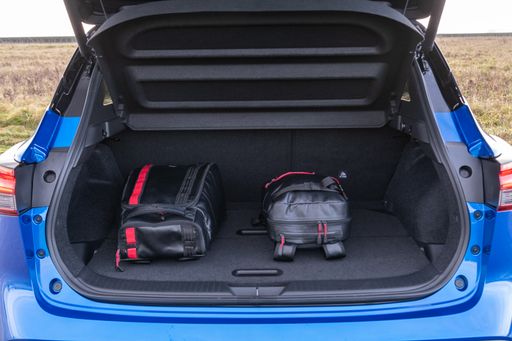
Both vehicles offer ample space for five passengers, but when it comes to cargo, the Nissan Qashqai takes the lead with a trunk capacity of up to 504 liters, compared to the Ford Kuga's 412 liters. This makes the Qashqai particularly appealing for those who frequently need to transport larger items or luggage.

Kuga

Dimensions and Design

Ford's Kuga exhibits a more substantial presence with its length extending up to 4,645 mm. It stands slightly taller with a height reaching up to 1,681 mm and offers wider spacing at 1,882 mm. In contrast, the Nissan Qashqai measures a little more compact with a length of 4,425 mm, a more modest height of 1,625 mm, and a width of 1,835 mm. These dimensions indicate that the Kuga might provide more comfort for larger passengers, while the Qashqai's more compact design enhances its maneuverability in tight spaces.

Qashqai

Final Thoughts

Choosing between the Ford Kuga and Nissan Qashqai hinges on your personal preferences and priorities. For those prioritizing environmental considerations and electric range, the Kuga's plug-in hybrid version is an excellent choice. However, if practicality, cargo space, and torque are at the top of your wishlist, then the Nissan Qashqai emerges as a strong contender.

The decision ultimately comes down to balancing your need for performance, efficiency, and utility. Both SUVs encapsulate what modern drivers seek, making either a worthy addition to the family driveway.

Here’s where it gets real: The technical differences in detail

Kuga

Costs and Efficiency:

When it comes to price and running costs, the biggest differences usually appear. This is often where you see which car fits your budget better in the long run.

Nissan Qashqai is a bit cheaper – starting at 29,600 £ , while the Ford Kuga costs 34,200 £ . That’s a price difference of around 4,637 £.

Fuel consumption also shows a difference: the Ford Kuga uses 2.8 L/100km and is significantly more efficient than the Nissan Qashqai with 4.5 L/100km. The difference is about 1.7 L/100km.

Qashqai

Engine and Performance:

Power, torque and acceleration say a lot about how a car feels on the road. This is where you see which model delivers more driving dynamics.

When it comes to engine power, the Ford Kuga offers somewhat more power – delivering 243 HP compared to 205 HP. That’s roughly 38 HP more horsepower.

When accelerating from 0 to 100 km/h, the Ford Kuga is barely quicker – completing the sprint in 7.3 s, while the Nissan Qashqai takes 7.6 s. That’s about 0.3 s quicker.

There’s also a difference in torque: the Nissan Qashqai delivers markedly more torque with 330 Nm compared to 240 Nm. That’s about 90 Nm more.

Kuga

Space and Everyday Use:

Beyond pure performance, interior space and usability matter most in daily life. This is where you see which car is more practical and versatile.

Both vehicles offer seating for 5 people.

In terms of curb weight, Nissan Qashqai is barely lighter – 1,420 kg compared to 1,526 kg. The difference is around 106 kg.

When it comes to payload, the Ford Kuga carries very slightly more – 550 kg compared to 520 kg. That’s a difference of about 30 kg.

Who wins the race in the data check?

The Ford Kuga is far ahead overall in the objective data comparison.
This result only shows which model scores more points on paper – not which of the two cars feels right for you.

from £34,200
Kuga

Ford Kuga

  • Engine Type : Petrol, Full Hybrid, Plugin Hybrid
  • Transmission : Manuel, Automatic
  • Drive Type : Front-Wheel Drive, All-Wheel Drive
  • Power HP : 150 - 243 HP
  • Consumption L/100km : 2.8 - 6.8 L/100km
  • Electric Range : 68 km
Ford Kuga
Nissan Qashqai

Costs and Consumption

View detailed analysis

Engine and Performance

View detailed analysis

Dimensions and Body

View detailed analysis

Ford Kuga

The Kuga is Ford’s adaptable family SUV that blends usable space with a surprisingly lively driving character, making daily commutes and weekend escapes equally enjoyable. With smart interior packaging, an easy-to-use infotainment setup and composed road manners, it’s a sensible choice for buyers who want a bit of fun without the fuss.

details

Nissan Qashqai

The Nissan Qashqai blends practical, family-friendly packaging with SUV styling that refuses to shout, making it a sensible and dependable choice for everyday life. It’s comfortable to live with, economical on the road, and neatly equipped enough to feel modern without ever feeling precious — perfect if you want crossover versatility without the drama.

details
Ford Kuga
Nissan Qashqai

Costs and Consumption

Price
34,200 - 46,300 £
Price
29,600 - 39,900 £
Consumption L/100km
2.8 - 6.8 L/100km
Consumption L/100km
4.5 - 6.8 L/100km
Consumption kWh/100km
-
Consumption kWh/100km
-
Electric Range
68 km
Electric Range
-
Battery Capacity
-
Battery Capacity
-
co2
55 - 154 g/km
co2
102 - 154 g/km
Fuel tank capacity
-
Fuel tank capacity
55 L

Dimensions and Body

Body Type
SUV
Body Type
SUV
Seats
5
Seats
5
Doors
-
Doors
5
Curb weight
1,526 - 1,859 kg
Curb weight
1,420 - 1,665 kg
Trunk capacity
-
Trunk capacity
479 - 504 L
Length
-
Length
4,425 mm
Width
1,882 mm
Width
1,835 mm
Height
-
Height
1,625 mm
Max trunk capacity
-
Max trunk capacity
1,422 - 1,447 L
Payload
541 - 550 kg
Payload
466 - 520 kg

Engine and Performance

Engine Type
Petrol, Full Hybrid, Plugin Hybrid
Engine Type
Petrol MHEV, Full Hybrid
Transmission
Manuel, Automatic
Transmission
Manuel, Automatic
Transmission Detail
Manual Gearbox, CVT, Automatic Gearbox
Transmission Detail
Manual Gearbox, CVT, Reduction Gearbox
Drive Type
Front-Wheel Drive, All-Wheel Drive
Drive Type
Front-Wheel Drive, All-Wheel Drive
Power HP
150 - 243 HP
Power HP
140 - 205 HP
Acceleration 0-100km/h
7.3 - 9.9 s
Acceleration 0-100km/h
7.6 - 10.2 s
Max Speed
-
Max Speed
170 - 206 km/h
Torque
240 Nm
Torque
240 - 330 Nm
Number of Cylinders
3 - 4
Number of Cylinders
3 - 4
Power kW
111 - 178 kW
Power kW
103 - 151 kW
Engine capacity
1,496 - 2,488 cm3
Engine capacity
1,332 - 1,498 cm3

General

Model Year
2,025
Model Year
2,025 - 2,026
CO2 Efficiency Class
E, D, B
CO2 Efficiency Class
E, C
Brand
Ford
Brand
Nissan
DriveDuel uses data analysis and artificial intelligence to evaluate vehicle data and create content. Content is regularly reviewed and improved. The displayed prices are estimates based on German list prices, adjusted to the respective country’s VAT. Country-specific registration taxes are not included. This information is not legally binding.