VS

Jeep Avenger vs Volvo XC60 comparison

Compare performance (156 HP vs 406 HP), boot space and price (22,500 £ vs 58,300 £ ) at a glance. Find out which car is the better choice for you – Jeep Avenger or Volvo XC60?

Jeep Avenger vs Volvo XC60: Key differences

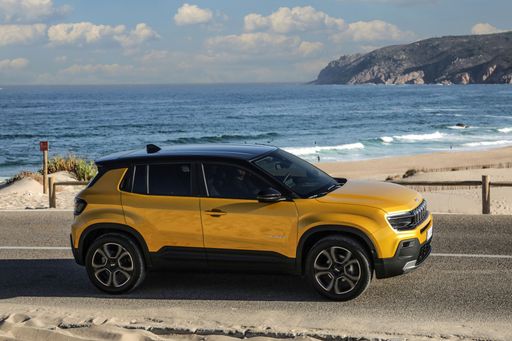
Jeep Avenger

4.1 (9 Reviews)
rate
  • substantially cheaper
  • clearly more electric range
  • clearly lighter
details

Volvo XC60

4.7 (7 Reviews)
rate
  • substantially more power
  • clearly more efficient
  • clearly quicker 0–100 km/h
details

All details on performance, efficiency, range and trunk space can be found in the technical comparison below – including user reviews for both models.

By Achim Sedelmaier

Avenger

The All-New Contenders: Jeep Avenger vs. Volvo XC60

In the ever-evolving world of SUVs, two powerful contenders have made their mark on the 2023 and 2024 models scene: the Jeep Avenger and Volvo XC60. Both brands have established themselves with a rich legacy of performance, strength, and utility, yet they bring distinctive innovations that cater to diverse audience preferences. With the Jeep Avenger bringing electrification to the forefront and the Volvo XC60 continuing its quest for luxury performance, this comparison offers exciting insights into what these models have in store for consumers.
XC60

Design & Dimensions

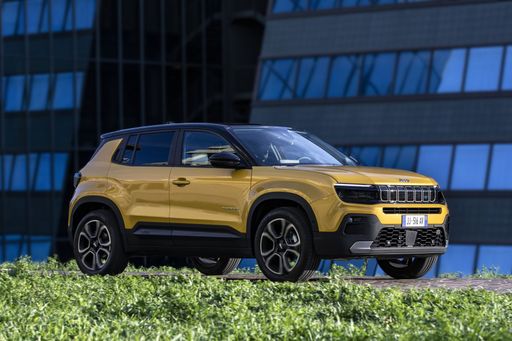
The Jeep Avenger stands as a compact SUV with a length of 4084 mm, a width of 1776 mm, and a height ranging from 1528 to 1536 mm, making it a robust choice that balances city agility with rugged versatility. Its trunk capacity ranges from 325 to 380 liters, offering practicality for urban adventures.

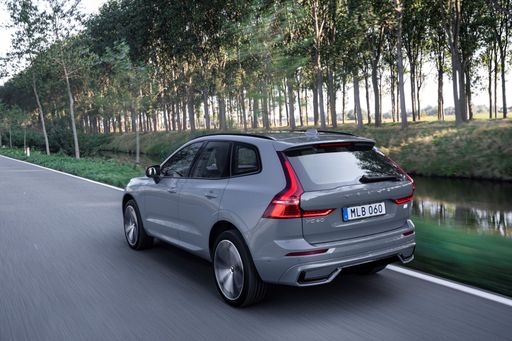
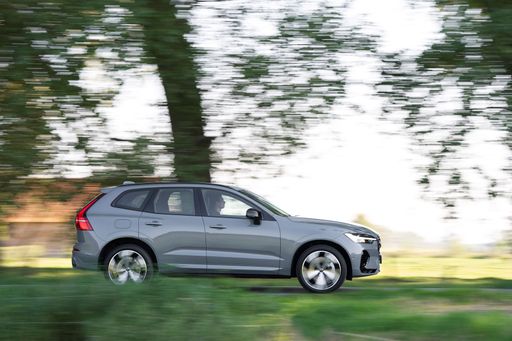
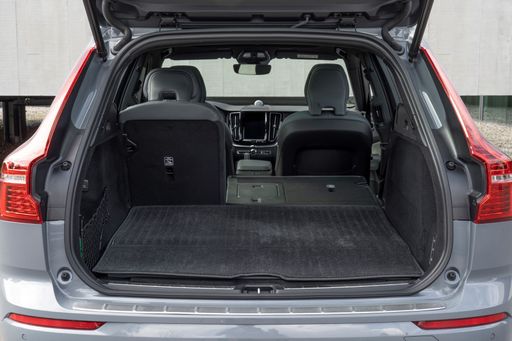
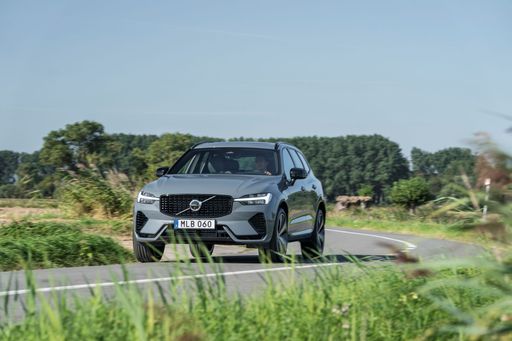
In contrast, the Volvo XC60 exudes grandeur with a length of 4688 mm, a width of 1902 mm, and a height of 1658 mm. Its more sizeable dimensions translate into a larger trunk capacity, ranging from 468 to 483 liters, catering to those who demand more space without compromising on style and luxury.

Avenger

Powertrain & Performance

The Jeep Avenger offers a variety of engine types, including electric, petrol Mild Hybrid Electric Vehicle (MHEV), and traditional petrol engines. It provides options between front-wheel drive and all-wheel drive, with power outputs ranging from 100 HP to 156 HP and torques from 205 Nm to 260 Nm. The electric variant boasts an impressive 400 km range and a consumption of 15.4 kWh/100km, ideal for eco-friendly city driving. The Avenger's petrol models present a fuel consumption between 5.4 and 5.7 liters per 100 km.

On the other hand, the Volvo XC60 offers sophisticated powertrain choices in petrol MHEV and plug-in hybrid options, all with automatic transmission. With a compelling power range, the XC60 delivers between 250 HP and an enthralling 455 HP with torque reaching a staggering 709 Nm in its hybrid form. The plug-in hybrid variant shines with a fuel consumption as low as 0.9 liters per 100 km and an electric range near 80 km, ideal for those who prioritize efficiency along with power.

XC60

Acceleration & Top Speed

The Jeep Avenger offers respectable acceleration capabilities, achieving 0-100 km/h in times ranging from 9 to 10.9 seconds, with a maximum speed between 150 km/h and 194 km/h. This ensures a dynamic drive suited to varied road conditions.

Volvo's XC60, renowned for its performance edge, accelerates more rapidly, with its top variant reaching 0-100 km/h in an astonishing 4.9 seconds. The XC60 also maximizes safety-sealed top speeds at 180 km/h, maintaining Volvo's commitment to robust yet responsibly monitored performance.

Avenger

Innovations & Efficiency

Both vehicles showcase impressive innovation. The Jeep Avenger’s electric variant marks a step towards sustainable driving, offering drivers an eco-friendly vehicle with convenience in mind. Meanwhile, the modern MHEV technology extends fuel efficiency to their internal combustion engine options, merging pragmatism with progress.

The Volvo XC60, a beacon of Scandinavian automotive excellence, augments its offering with plug-in hybrid technology to dramatically reduce emissions and enhance fuel economy. This aligns with Volvo's strategic vision for sustainability without compromising the exhilarating driving experience the brand is known for.

XC60

Conclusion

In this head-to-head, the Jeep Avenger caters to the urban warrior seeking a compact, versatile vehicle for both traditional and electric mobility options. In contrast, the Volvo XC60 appeals to those desiring a luxurious, powerful ride equipped with pioneering hybrid technologies. Both models enhance their segments, appealing to a diverse range of drivers and setting significant benchmarks in efficiency, innovation, and design.

Ultimately, whether you opt for the adventurous compactness of the Avenger or the plush, powerful drive of the XC60, both vehicles promise a unique driving experience quintessentially tailored to the demands of the modern SUV enthusiast.

Here’s where it gets real: The technical differences in detail

Avenger

Costs and Efficiency:

Price and efficiency are often the first things buyers look at. Here it becomes clear which model has the long-term edge – whether at the pump, the plug, or in purchase price.

Jeep Avenger is substantially cheaper – starting at 22,500 £ , while the Volvo XC60 costs 58,300 £ . That’s a price difference of around 35,735 £.

Fuel consumption also shows a difference: the Volvo XC60 uses 1.6 L/100km and is clearly more efficient than the Jeep Avenger with 4.9 L/100km. The difference is about 3.3 L/100km.

As for electric range, the Jeep Avenger offers clearly more range – reaching up to 400 km, about 321 km more than the Volvo XC60.

XC60

Engine and Performance:

Under the bonnet, it becomes clear which model is tuned for sportiness and which one takes the lead when you hit the accelerator.

When it comes to engine power, the Volvo XC60 offers substantially more power – delivering 406 HP compared to 156 HP. That’s roughly 250 HP more horsepower.

When accelerating from 0 to 100 km/h, the Volvo XC60 is clearly quicker – completing the sprint in 4.9 s, while the Jeep Avenger takes 9 s. That’s about 4.1 s quicker.

There’s also a difference in torque: the Volvo XC60 delivers substantially more torque with 669 Nm compared to 260 Nm. That’s about 409 Nm more.

Avenger

Space and Everyday Use:

Cabin size, boot volume and payload all play a role in everyday practicality. Here, comfort and flexibility make the difference.

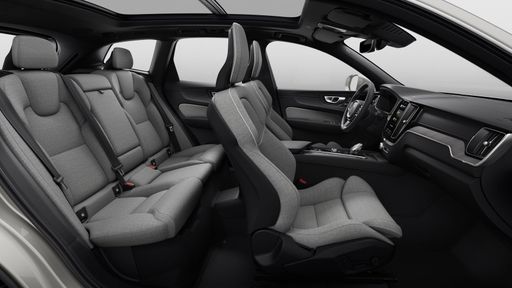
Both vehicles offer seating for 5 people.

In terms of curb weight, Jeep Avenger is clearly lighter – 1,180 kg compared to 2,150 kg. The difference is around 970 kg.

When it comes to payload, the Volvo XC60 carries marginally more – 510 kg compared to 502 kg. That’s a difference of about 8 kg.

Who wins the race in the data check?

The Volvo XC60 is clearly superior overall in the objective data comparison.
This result only shows which model scores more points on paper – not which of the two cars feels right for you.

from £58,300
XC60

Volvo XC60

  • Engine Type Plugin Hybrid
  • Transmission Automatic
  • Drive Type All-Wheel Drive
  • Power HP 335 - 406 HP
  • Consumption L/100km 1.6 L/100km
  • Electric Range 79 km
Jeep Avenger
Volvo XC60

Costs and Consumption

View detailed analysis

Engine and Performance

View detailed analysis

Dimensions and Body

View detailed analysis

Jeep Avenger

The Jeep Avenger mixes rugged styling with a compact, city‑friendly footprint that makes it easy to maneuver while keeping Jeep’s adventurous character. Inside it offers a practical, modern cabin with sensible tech and comfort aimed at everyday driving and light weekend getaways.

details

Volvo XC60

The Volvo XC60 blends Scandinavian elegance with a strong focus on occupant safety, delivering a calm, composed ride and a well-crafted, user-friendly cabin. It’s a practical yet premium compact SUV that balances comfort with confident road manners, ideal for buyers who value refinement and everyday usability.

details
Jeep Avenger
Volvo XC60

Costs and Consumption

Price
22,500 - 36,800 £
Price
58,300 - 71,400 £
Consumption L/100km
4.9 - 5.7 L/100km
Consumption L/100km
1.6 L/100km
Consumption kWh/100km
15.5 kWh/100km
Consumption kWh/100km
-
Electric Range
400 km
Electric Range
79 km
Battery Capacity
-
Battery Capacity
-
co2
0 - 129 g/km
co2
59 g/km
Fuel tank capacity
-
Fuel tank capacity
-

Dimensions and Body

Body Type
SUV
Body Type
SUV
Seats
5
Seats
5
Doors
-
Doors
-
Curb weight
1,180 - 1,520 kg
Curb weight
2,150 kg
Trunk capacity
325 - 380 L
Trunk capacity
-
Length
-
Length
-
Width
1,776 mm
Width
1,902 mm
Height
-
Height
-
Max trunk capacity
-
Max trunk capacity
-
Payload
490 - 502 kg
Payload
510 kg

Engine and Performance

Engine Type
Petrol MHEV, Electric, Petrol
Engine Type
Plugin Hybrid
Transmission
Automatic, Manuel
Transmission
Automatic
Transmission Detail
Dual-Clutch Automatic, Reduction Gearbox, Manual Gearbox
Transmission Detail
Automatic Gearbox
Drive Type
Front-Wheel Drive, All-Wheel Drive
Drive Type
All-Wheel Drive
Power HP
100 - 156 HP
Power HP
335 - 406 HP
Acceleration 0-100km/h
9 - 10.6 s
Acceleration 0-100km/h
4.9 - 5.7 s
Max Speed
-
Max Speed
-
Torque
205 - 260 Nm
Torque
589 - 669 Nm
Number of Cylinders
3
Number of Cylinders
4
Power kW
74 - 115 kW
Power kW
247 - 299 kW
Engine capacity
1,199 cm3
Engine capacity
1,969 cm3

General

Model Year
2026
Model Year
2026
CO2 Efficiency Class
C, A, D
CO2 Efficiency Class
B
Brand
Jeep
Brand
Volvo
DriveDuel uses data analysis and artificial intelligence to evaluate vehicle data and create content. Content is regularly reviewed and improved. The displayed prices are estimates based on German list prices, adjusted to the respective country’s VAT. Country-specific registration taxes are not included. This information is not legally binding.