VS

Mazda CX-30 vs Toyota Corolla Touring Sports comparison

Compare performance (186 HP vs 178 HP), boot space and price (25200 £ vs 29600 £ ) at a glance. Find out which car is the better choice for you – Mazda CX-30 or Toyota Corolla Touring Sports?

CX-30

The Battle of Versatility: Mazda CX-30 vs. Toyota Corolla Touring Sports

In a world where consumers demand practicality, efficiency, and performance all wrapped in one package, two vehicles stand out: the Mazda CX-30 and the Toyota Corolla Touring Sports. Each brings a unique blend of innovation and tradition, aiming to capture the diverse needs of modern drivers. This comparison delves into their technical prowess and innovative features, helping you decide which might be the better choice for your lifestyle.
Corolla Touring Sports

Body Type and Design

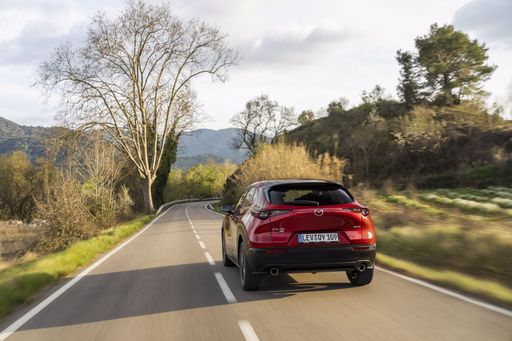
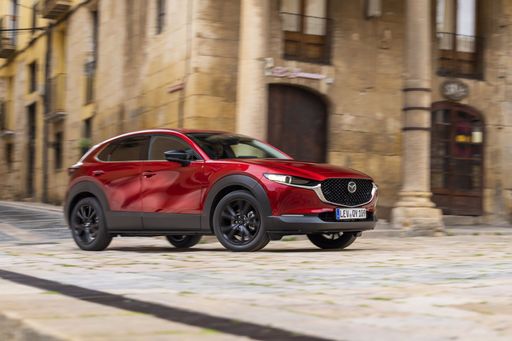
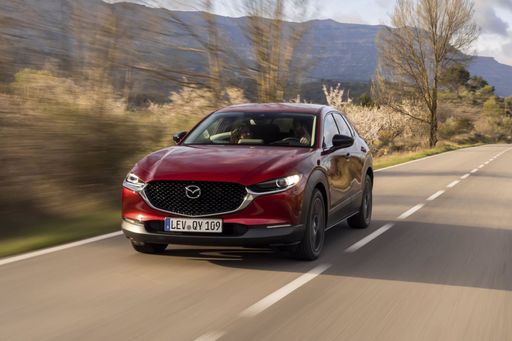
The Mazda CX-30 presents itself as a sporty SUV with dimensions of 4395 mm in length, 1795 mm in width, and 1540 mm in height. It stands out with its distinctive curves and upscale design, fitting perfectly into urban and rugged environments alike.

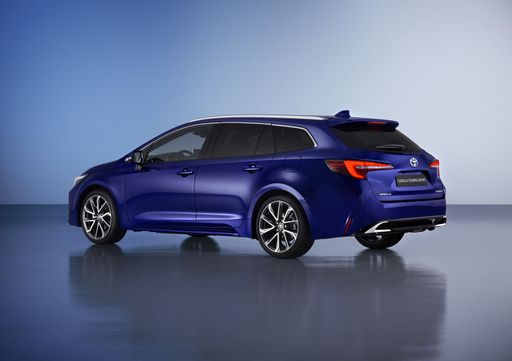
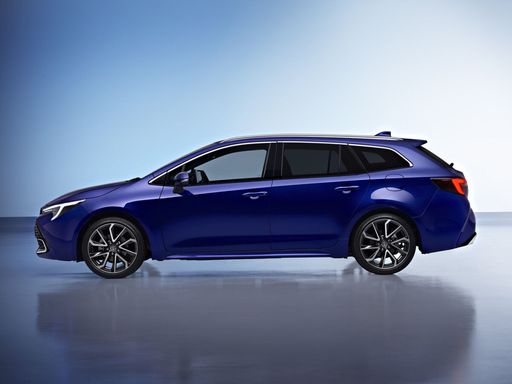
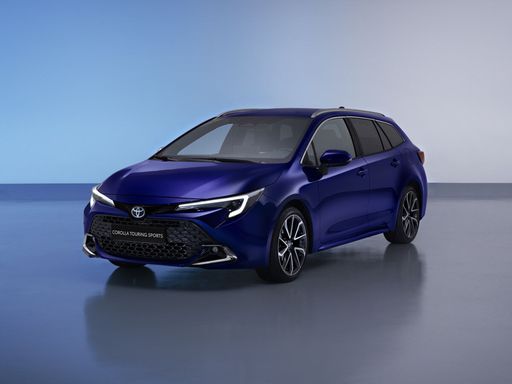
In contrast, the Toyota Corolla Touring Sports adopts a wagon body style, measured at 4650 mm in length, 1790 mm in width, and 1435 mm in height. Known for its practical design, the Corolla Touring Sports offers more generous trunk space, making it ideal for families or those needing extra cargo capacity.

CX-30

Performance and Powertrain

The Mazda CX-30 offers a choice between a manual and automatic gearbox, powered by a petrol MHEV engine with power outputs ranging from 140 HP to 186 HP. For those who crave performance, the option of all-wheel drive ensures superior traction and handling. With acceleration from 0-100 km/h as quick as 8.3 seconds and a top speed of up to 204 km/h, it manages to infuse excitement into everyday driving.

The Toyota Corolla Touring Sports is powered by a full hybrid engine with automatic CVT transmission. It is available in 140 HP and 196 HP variants. Known for its efficiency, it accelerates from 0-100 km/h in as little as 7.5 seconds. Despite a maximum speed of 180 km/h, it offers a compelling balance of economy and agility with fuel consumption as low as 4.4 L/100km.

Corolla Touring Sports

Efficiency and Environmental Impact

When considering fuel efficiency, the Corolla Touring Sports takes the lead with consumption figures between 4.4 and 4.6 L/100km and a CO2 output of just 100 g/km, earning it a CO2 efficiency class of C. This makes it a strong contender for eco-conscious drivers.

Meanwhile, the Mazda CX-30, with its consumption range between 5.7 and 6.6 L/100km and CO2 emissions from 129 g/km to 148 g/km, offers a slightly higher environmental footprint. However, it balances this with a performance-oriented drive.

CX-30

Interior and Comfort

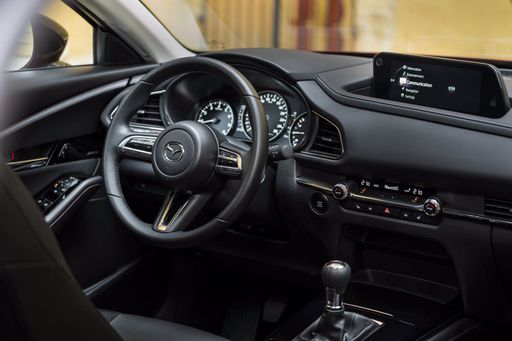
Both cars cater to five passengers, offering comfort and advanced features. The CX-30's upscale interior materials and modern design provide a feeling of luxury, while its seating ensures comfort on all journeys. Its trunk capacity of up to 430 liters, though smaller than its competitor, is ample for average daily needs.

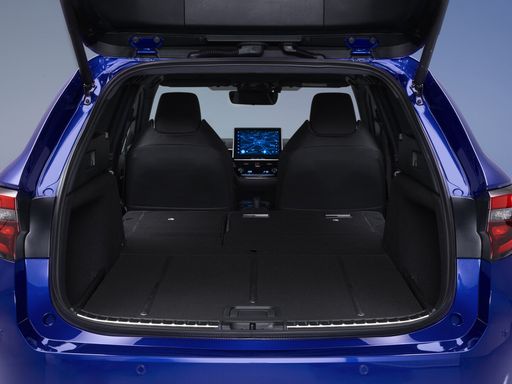
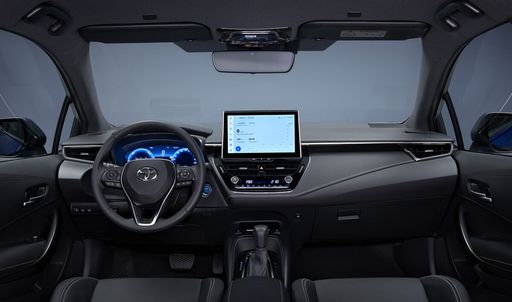
In comparison, the Corolla Touring Sports provides a more spacious trunk capacity of up to 596 liters, making it exceptionally practical for greater cargo needs. Its interior is thoughtfully designed to maximize space and comfort, with advanced technology options for an enhanced driving experience.

Corolla Touring Sports

Innovation and Features

Both vehicles are equipped with modern technological features aimed at enhancing the driving experience. The Mazda CX-30 prides itself on its innovative vehicle dynamics and safety technologies, promoting a harmonious drive no matter the road conditions.

The Toyota Corolla Touring Sports features an updated hybrid system for optimal efficiency, accompanied by Toyota’s renowned safety technologies ensuring a secure and smooth ride.

In conclusion, the decision between the Mazda CX-30 and Toyota Corolla Touring Sports hinges on individual requirements. The CX-30 appeals to those prioritizing dynamic performance and SUV capability, whereas the Corolla Touring Sports stands out for fuel efficiency and practical space. Both vehicles embody their brand's dedication to innovation and reliability, catering to varied tastes and lifestyles.

Mazda CX-30 vs Toyota Corolla Touring Sports: Key differences

Mazda CX-30

4.4 (2 Reviews)
rate
  • to a small extent cheaper
  • slight more power
  • slight lighter

Toyota Corolla Touring Sports

4.7 (1 Reviews)
rate
  • distinct more efficient
  • to a small extent quicker from 0–100 km/h
  • noticeable more trunk space

All details on performance, efficiency, range and trunk space can be found in the technical comparison below – including user reviews for both models.

Here’s where it gets real: The technical differences in detail

CX-30

Costs and Efficiency:

Looking at overall running costs, both models reveal some interesting differences in everyday economy.

Mazda CX-30 has a to a small extent advantage in terms of price – it starts at 25200 £ , while the Toyota Corolla Touring Sports costs 29600 £ . That’s a price difference of around 4371 £.

Fuel consumption also shows a difference: Toyota Corolla Touring Sports manages with 4.40 L and is therefore distinct more efficient than the Mazda CX-30 with 5.70 L. The difference is about 1.30 L per 100 km.

Corolla Touring Sports

Engine and Performance:

Under the bonnet, it becomes clear which model is tuned for sportiness and which one takes the lead when you hit the accelerator.

When it comes to engine power, the Mazda CX-30 has a slight edge – offering 186 HP compared to 178 HP. That’s roughly 8 HP more horsepower.

In acceleration from 0 to 100 km/h, the Toyota Corolla Touring Sports is to a small extent quicker – completing the sprint in 7.50 s, while the Mazda CX-30 takes 8.30 s. That’s about 0.80 s faster.

Space and Everyday Use:

Cabin size, boot volume and payload all play a role in everyday practicality. Here, comfort and flexibility make the difference.

Both vehicles offer seating for 5 people.

In curb weight, Mazda CX-30 is slight lighter – 1455 kg compared to 1485 kg. The difference is around 30 kg.

In terms of boot space, the Toyota Corolla Touring Sports offers noticeable more room – 596 L compared to 430 L. That’s a difference of about 166 L.

When it comes to payload, Mazda CX-30 to a small extent takes the win – 496 kg compared to 440 kg. That’s a difference of about 56 kg.

Who wins the race in the data check?

The Toyota Corolla Touring Sports comes out modestly ahead in the objective data comparison.
This result only shows which model scores more points on paper – not which of the two cars feels right for you.

Mazda CX-30
Toyota Corolla Touring Sports

Costs and Consumption

View detailed analysis

Engine and Performance

View detailed analysis

Dimensions and Body

View detailed analysis
from about £29,600
Corolla Touring Sports

Toyota Corolla Touring Sports

  • Engine Type : Full Hybrid
  • Transmission : Automatic
  • Drive Type : Front-Wheel Drive
  • Power HP : 140 - 178 HP
  • Consumption L/100km : 4.40 L

Mazda CX-30

4.4 (2 Reviews)
rate

The Mazda CX-30 blends sleek coupe-like lines with the practicality of a compact crossover, feeling more premium than its price tag suggests. It’s a joy to drive for anyone who likes a taut chassis and an interior that treats daily commutes like a small luxury escape.

details

Toyota Corolla Touring Sports

4.7 (1 Reviews)
rate

The Toyota Corolla Touring Sports is a sensible yet stylish estate that blends everyday practicality with Toyota's trademark reliability, making it the kind of car that quietly gets on with family life without drama. Inside it's cleverly packaged for luggage and kids' gear and feels calm and comfortable on the road — sensible rather than flashy, but with enough character to make daily drives more enjoyable.

details
Mazda CX-30
Toyota Corolla Touring Sports

Costs and Consumption

Price
25200 - 36800 £
Price
29600 - 36400 £
Consumption L/100km
5.7 - 6.6 L
Consumption L/100km
4.40 L
Consumption kWh/100km
-
Consumption kWh/100km
-
Electric Range
-
Electric Range
-
Battery Capacity
-
Battery Capacity
-
co2
129 - 148 g/km
co2
100 g/km
Fuel tank capacity
-
Fuel tank capacity
43 L

Dimensions and Body

Body Type
SUV
Body Type
Estate
Seats
5
Seats
5
Doors
-
Doors
5
Curb weight
1455 - 1587 kg
Curb weight
1485 - 1515 kg
Trunk capacity
422 - 430 L
Trunk capacity
581 - 596 L
Length
-
Length
4650 mm
Width
1795 mm
Width
1790 mm
Height
-
Height
1435 mm
Max trunk capacity
-
Max trunk capacity
1591 - 1606 L
Payload
458 - 496 kg
Payload
400 - 440 kg

Engine and Performance

Engine Type
Petrol MHEV
Engine Type
Full Hybrid
Transmission
Manuel, Automatic
Transmission
Automatic
Transmission Detail
Manual Gearbox, Automatic Gearbox
Transmission Detail
CVT
Drive Type
Front-Wheel Drive, All-Wheel Drive
Drive Type
Front-Wheel Drive
Power HP
140 - 186 HP
Power HP
140 - 178 HP
Acceleration 0-100km/h
8.3 - 10.3 s
Acceleration 0-100km/h
7.5 - 9.2 s
Max Speed
-
Max Speed
180 km/h
Torque
238 - 240 Nm
Torque
-
Number of Cylinders
4
Number of Cylinders
4
Power kW
103 - 137 kW
Power kW
103 - 131 kW
Engine capacity
1998 - 2488 cm3
Engine capacity
1798 - 1987 cm3

General

Model Year
2025
Model Year
2025
CO2 Efficiency Class
D, E
CO2 Efficiency Class
C
Brand
Mazda
Brand
Toyota
What drive types are available for the Mazda CX-30?

The Mazda CX-30 is offered with Front-Wheel Drive or All-Wheel Drive.

The prices shown are estimates based on German list prices, adjusted for local VAT. Local registration taxes (e.g. NoVA, BPM or CO2 malus) are not included. This information is not legally binding.