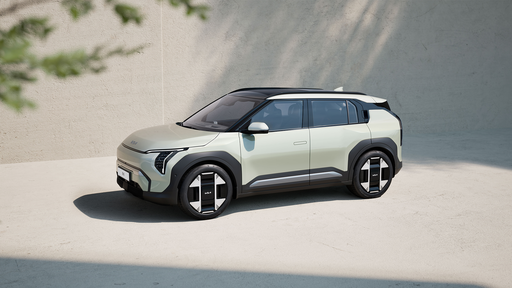
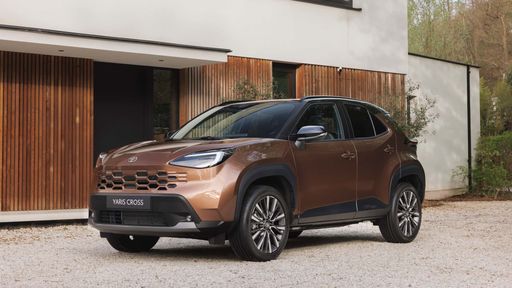
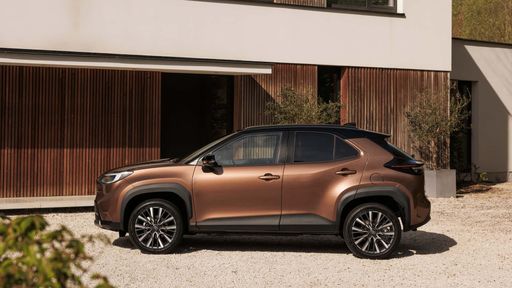
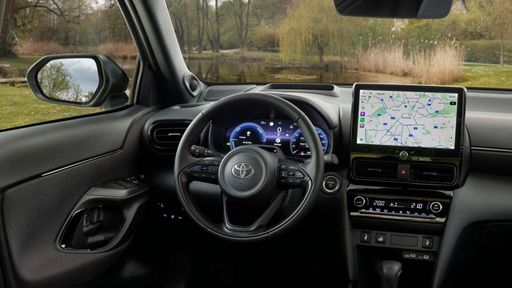
Compare performance (130 HP vs 147 HP), boot space and price (23,700 £ vs 22,800 £ ) at a glance. Find out which car is the better choice for you – Toyota Yaris Cross or Kia EV2?
All details on performance, efficiency, range and trunk space can be found in the technical comparison below – including user reviews for both models.
Looking at overall running costs, both models reveal some interesting differences in everyday economy.
Kia EV2 is barely cheaper – starting at 22,800 £ , while the Toyota Yaris Cross costs 23,700 £ . That’s a price difference of around 891 £.
Power, torque and acceleration say a lot about how a car feels on the road. This is where you see which model delivers more driving dynamics.
When it comes to engine power, the Kia EV2 offers somewhat more power – delivering 147 HP compared to 130 HP. That’s roughly 17 HP more horsepower.
When accelerating from 0 to 100 km/h, the Kia EV2 is markedly quicker – completing the sprint in 8.7 s, while the Toyota Yaris Cross takes 10.7 s. That’s about 2 s quicker.
Whether family car or daily driver – which one offers more room, flexibility and comfort?
Both vehicles offer seating for 5 people.
In terms of curb weight, Toyota Yaris Cross is visibly lighter – 1,180 kg compared to 1,620 kg. The difference is around 440 kg.
When it comes to payload, the Toyota Yaris Cross carries only slightly more – 510 kg compared to 475 kg. That’s a difference of about 35 kg.
The Kia EV2 is clearly superior overall in the objective data comparison.
This result only shows which model scores more points on paper – not which of the two cars feels right for you.
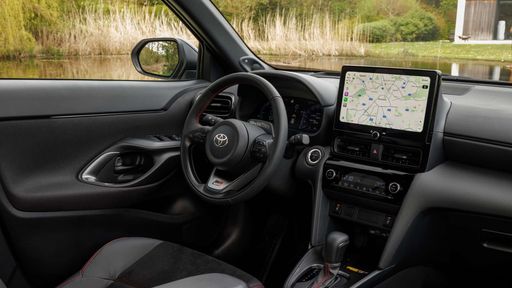
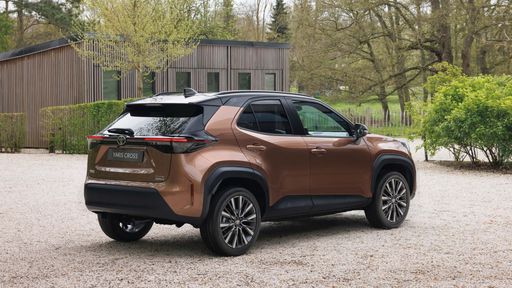
The Toyota Yaris Cross takes the jaunty personality of the Yaris and gives it a taller stance and a bit more practicality, so you get city-friendly agility with added SUV presence. It’s easy to live with, economical on the daily grind, and smartly packaged — a sensible pick for buyers who want fuss-free transport with a touch of character.
details
The Kia EV2 is a compact electric crossover aimed at buyers who want a practical, affordable EV with a modern, well-appointed cabin. It combines comfortable, predictable handling with straightforward tech and efficient everyday usability, making it a sensible choice for daily driving.
detailsCosts and Consumption |
|
|---|---|
|
Price
23,700 - 34,300 £
|
Price
22,800 - 31,600 £
|
|
Consumption L/100km
4.5 - 4.8 L/100km
|
Consumption L/100km
-
|
|
Consumption kWh/100km
-
|
Consumption kWh/100km
15.1 - 16.3 kWh/100km
|
|
Electric Range
-
|
Electric Range
317 - 453 km
|
|
Battery Capacity
-
|
Battery Capacity
-
|
|
co2
101 - 108 g/km
|
co2
0 g/km
|
|
Fuel tank capacity
-
|
Fuel tank capacity
-
|
Dimensions and Body |
|
|---|---|
|
Body Type
SUV
|
Body Type
SUV
|
|
Seats
5
|
Seats
4 - 5
|
|
Doors
-
|
Doors
-
|
|
Curb weight
1,180 - 1,290 kg
|
Curb weight
1,620 - 1,625 kg
|
|
Trunk capacity
320 - 397 L
|
Trunk capacity
-
|
|
Length
-
|
Length
-
|
|
Width
1,765 mm
|
Width
1,800 mm
|
|
Height
-
|
Height
-
|
|
Max trunk capacity
-
|
Max trunk capacity
-
|
|
Payload
485 - 510 kg
|
Payload
400 - 475 kg
|
Engine and Performance |
|
|---|---|
|
Engine Type
Full Hybrid
|
Engine Type
Electric
|
|
Transmission
Automatic
|
Transmission
Automatic
|
|
Transmission Detail
CVT
|
Transmission Detail
Reduction Gearbox
|
|
Drive Type
Front-Wheel Drive, All-Wheel Drive
|
Drive Type
Front-Wheel Drive
|
|
Power HP
116 - 130 HP
|
Power HP
135 - 147 HP
|
|
Acceleration 0-100km/h
10.7 - 11.3 s
|
Acceleration 0-100km/h
8.7 - 9.7 s
|
|
Max Speed
-
|
Max Speed
-
|
|
Torque
-
|
Torque
250 Nm
|
|
Number of Cylinders
3
|
Number of Cylinders
-
|
|
Power kW
85 - 96 kW
|
Power kW
100 - 108 kW
|
|
Engine capacity
1,490 cm3
|
Engine capacity
-
|
General |
|
|---|---|
|
Model Year
2026
|
Model Year
2026
|
|
CO2 Efficiency Class
C
|
CO2 Efficiency Class
A
|
|
Brand
Toyota
|
Brand
Kia
|