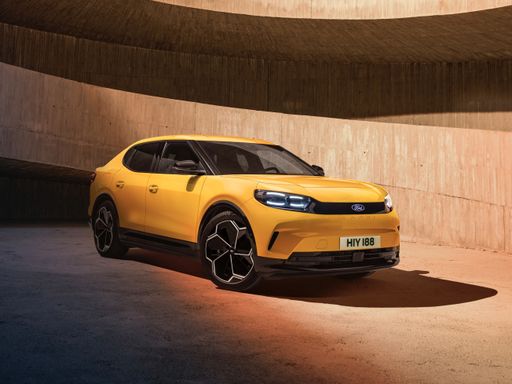
@ Ford Motor Company / Ford Media Center
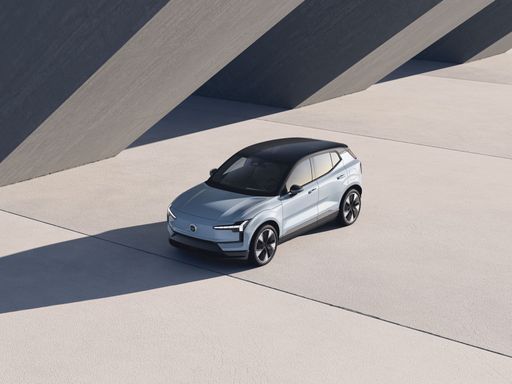
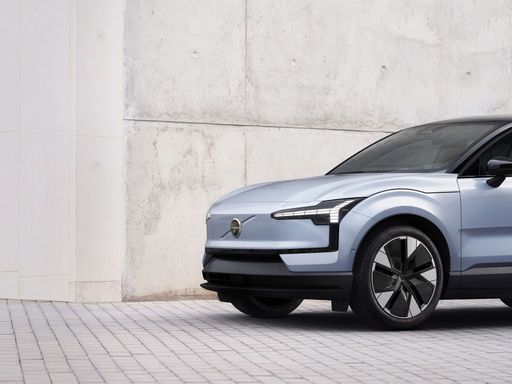
@ Volvo Cars
VS

Ford Capri vs Volvo EX30 – Performance, range & efficiency compared

Compare performance, boot capacity, efficiency and price at a glance.
Find out which car is the better choice for you – Ford Capri or Volvo EX30?

Capri @ Ford Motor Company / Ford Media Center

An Electrifying Showdown: Ford Capri vs. Volvo EX30

The automotive world has seen a seismic shift toward electrification, and two significant contenders in this green revolution are the Ford Capri and the Volvo EX30. Both vehicles promise to deliver heart-pounding performance, exceptional efficiency, and a comfortable ride, all while being environmentally responsible. Let’s dive into the features and innovations that make each of these SUVs stand out.

EX30 @ Volvo Cars

Performance and Powertrain

The Ford Capri offers a robust lineup of powertrains. With horsepower options ranging from 170 to 340 HP, the Capri brings excitement to the pavement. The 0-100 km/h sprint is achievable in just 5.3 to 6.4 seconds, thanks to its rear-wheel and all-wheel drive capabilities. It’s powered by a selection of battery sizes—52 kWh to 79 kWh—which facilitates a superior electric range of up to 627 km. All models feature an automatic transmission with a reduction gearbox, ensuring smooth power delivery.

In contrast, the Volvo EX30 pushes the boundaries with a top-end power output of 428 HP and a mesmerizing acceleration time of 3.6 seconds from 0-100 km/h. Its batteries, ranging from 49 kWh to 65 kWh, give it a maximum range of 476 km. It, too, employs a reduction gearbox to manage its automatic transmission, available in both rear-wheel and all-wheel drive options. Despite its slightly lower range, its performance figures are unparalleled in its category.

Capri @ Ford Motor Company / Ford Media Center

Efficiency and Environmental Edge

Both the Ford Capri and Volvo EX30 shine in the area of efficiency. The Ford Capri is an exemplar of optimization, achieving between 13.3 and 15.8 kWh/100 km. Moreover, their CO2 efficiency class stands proudly at A, with a CO2 output of 0 g/km.

Volvo doesn’t lag far behind, with consumption figures between 17 and 18.7 kWh/100 km. Its environmental credentials are further bolstered by a CO2 figure of 0 g/km and the same A efficiency class rating. These SUVs prove that going green doesn’t mean compromising on performance or style.

EX30 @ Volvo Cars

Interior and Practicality

The Capri is not just powerful; it’s practical too. With a generous trunk capacity of up to 572 liters, it caters to families and adventurers alike. The vehicle’s 4634 mm length and 1872 mm width promise plenty of interior space without sacrificing sleek lines.

The EX30, on the other hand, positions itself as a compact city cruiser with 318 liters of trunk space. It’s notably shorter at 4233 mm and a tad narrower at 1837 mm, making it exceptionally well-suited to urban environments where parking space is at a premium.

Conclusion

Both the Ford Capri and Volvo EX30 embody the spirit of modern electric SUVs: innovative, efficient, and designed for the future. While the Ford Capri serves those who prioritize range and utility, the Volvo EX30 appeals to speed enthusiasts with tighter urban driving needs. Either way, both are excellent choices for conscientious drivers looking to make a difference on the road.

Here’s where it gets real: The technical differences in detail

Costs and Efficiency:

Looking at overall running costs, both models reveal some interesting differences in everyday economy.

Volvo EX30 has a a bit advantage in terms of price – it starts at 33000 £, while the Ford Capri costs 36300 £. That’s a price difference of around 3351 £.

In terms of energy consumption, the advantage goes to the Ford Capri: with 13.80 kWh per 100 km, it’s evident more efficient than the Volvo EX30 with 17 kWh. That’s a difference of about 3.20 kWh.

As for range, the Ford Capri performs evident better – achieving up to 627 km, about 151 km more than the Volvo EX30.

Engine and Performance:

Under the bonnet, it becomes clear which model is tuned for sportiness and which one takes the lead when you hit the accelerator.

When it comes to engine power, the Volvo EX30 has a evident edge – offering 428 HP compared to 340 HP. That’s roughly 88 HP more horsepower.

In acceleration from 0 to 100 km/h, the Volvo EX30 is decisively quicker – completing the sprint in 3.60 s, while the Ford Capri takes 5.30 s. That’s about 1.70 s faster.

There’s no difference in top speed – both reach 180 km/h.

There’s also a difference in torque: Ford Capri pulls distinct stronger with 679 Nm compared to 543 Nm. That’s about 136 Nm difference.

Space and Everyday Use:

Cabin size, boot volume and payload all play a role in everyday practicality. Here, comfort and flexibility make the difference.

Both vehicles offer seating for 5 people.

In curb weight, Volvo EX30 is minimal lighter – 1840 kg compared to 1914 kg. The difference is around 74 kg.

In terms of boot space, the Ford Capri offers convincingly more room – 572 L compared to 318 L. That’s a difference of about 254 L.

In maximum load capacity, the Ford Capri performs noticeable better – up to 1510 L, which is about 510 L more than the Volvo EX30.

When it comes to payload, Ford Capri evident takes the win – 587 kg compared to 390 kg. That’s a difference of about 197 kg.

Who wins the race?

The Ford Capri proves to be dominates this comparison and therefore becomes our DriveDuel Champion!
Ford Capri is the better all-rounder in this comparison.

from about £36,300
Capri @ Ford Motor Company / Ford Media Center

Ford Capri

  • Engine Type : Electric
  • Transmission : Automatic
  • Drive Type : Rear-Wheel Drive, All-Wheel Drive
  • Power HP : 170 - 340 HP
  • Consumption kWh/100km : 13.8 - 16.4 kWh
  • Electric Range : 374 - 627 km

Ford Capri

5 (1)
rate

The Ford Capri turned the family car into something cheekily sporty, with a long, rakish profile that still promises fun at a glance. Today it lives on as a lovable classic — easy to tinker with, enjoyable to drive and guaranteed to raise smiles at any meet.

details

Volvo EX30

The Volvo EX30 arrives as a compact electric with crisp Scandinavian design and a cheeky personality, proving you can be serious about safety and still enjoy a grin on your commute. Its cabin is cleverly packaged and delightfully easy to live with, offering smart tech and practical touches that make it feel like a grown-up's city car with a sense of fun.

details
Ford Capri
Volvo EX30
Capri @ Ford Motor Company / Ford Media Center
EX30 @ Volvo Cars

Costs and Consumption

Price
36300 - 50900 £
Price
33000 - 49100 £
Consumption L/100km
-
Consumption L/100km
-
Consumption kWh/100km
13.8 - 16.4 kWh
Consumption kWh/100km
17 - 18.7 kWh
Electric Range
374 - 627 km
Electric Range
339 - 476 km
Battery Capacity
52 - 79 kWh
Battery Capacity
49 - 65 kWh
co2
0 g/km
co2
0 g/km
Fuel tank capacity
-
Fuel tank capacity
-

Dimensions and Body

Body Type
SUV
Body Type
SUV
Seats
5
Seats
5
Doors
5
Doors
5
Curb weight
1914 - 2174 kg
Curb weight
1840 - 1960 kg
Trunk capacity
567 - 572 L
Trunk capacity
318 L
Length
4634 mm
Length
4233 mm
Width
1872 mm
Width
1838 mm
Height
1626 mm
Height
1550 - 1567 mm
Max trunk capacity
1505 - 1510 L
Max trunk capacity
1000 L
Payload
570 - 587 kg
Payload
370 - 390 kg

Engine and Performance

Engine Type
Electric
Engine Type
Electric
Transmission
Automatic
Transmission
Automatic
Transmission Detail
Reduction Gearbox
Transmission Detail
Reduction Gearbox
Drive Type
Rear-Wheel Drive, All-Wheel Drive
Drive Type
Rear-Wheel Drive, All-Wheel Drive
Power HP
170 - 340 HP
Power HP
272 - 428 HP
Acceleration 0-100km/h
5.3 - 8.7 s
Acceleration 0-100km/h
3.6 - 5.7 s
Max Speed
160 - 180 km/h
Max Speed
180 km/h
Torque
310 - 679 Nm
Torque
343 - 543 Nm
Number of Cylinders
-
Number of Cylinders
-
Power kW
125 - 250 kW
Power kW
200 - 315 kW
Engine capacity
-
Engine capacity
-

General

Model Year
2024 - 2025
Model Year
2024 - 2025
CO2 Efficiency Class
A
CO2 Efficiency Class
A
Brand
Ford
Brand
Volvo
Is the Ford Capri offered with different drivetrains?

The Ford Capri is offered with Rear-Wheel Drive or All-Wheel Drive.

The prices and data displayed are estimates based on German list prices and may vary by country. This information is not legally binding.