@ Ford Motor Company / Ford Media Center
@ Jaguar Land Rover Media
VS

Ford Ranger vs Land Rover Defender – Which model is better for everyday use?

Both models have their strengths – but which one suits you more?
Compare performance, efficiency, price and space directly: Ford Ranger or Land Rover Defender?

Ford Ranger

Land Rover Defender

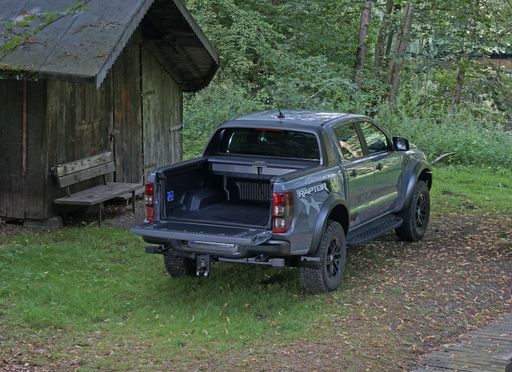
Ranger @ Ford Motor Company / Ford Media Center

The Ultimate Comparison: Ford Ranger vs Land Rover Defender

When it comes to rugged vehicles that promise both adventure and utility, few names command as much respect as the Ford Ranger and the Land Rover Defender. Both vehicles, deeply rooted in off-road heritage, offer robust engineering and innovative features aimed at explorers and work enthusiasts alike. This article pits the 2023 Ford Ranger against the 2024 Land Rover Defender, highlighting their technical aspects and innovations to help you decide the ultimate off-road champion.
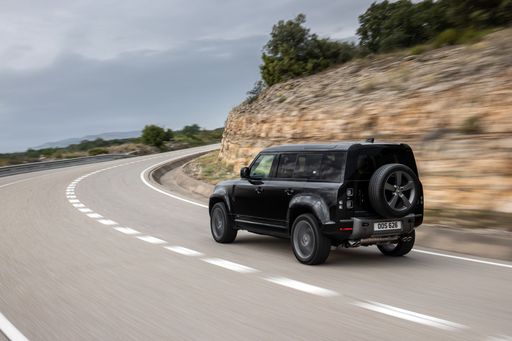
Defender @ Jaguar Land Rover Media

Powertrain and Performance

The Ford Ranger presents a versatile array of engine choices, including diesel and petrol options, accompanied by both manual and automatic transmissions. Notable figures include power outputs ranging from 170 to 292 horsepower, ensuring an agile response across varied terrains with a top speed breaching the 180km/h mark.

In contrast, the Land Rover Defender offers a broader spectrum with options such as Diesel MHEV, Plugin Hybrid, Petrol MHEV, and pure Petrol engines, all paired with an automatic gearbox. With power outputs soaring up to 525 HP, the Defender provides an electrifying driving experience complemented by robust torque figures as high as 650 Nm. For those environmentally conscious, the plugin hybrid offers an electric range of 45 km, showcasing Land Rover's commitment to modern eco-friendly advancements.

Ranger @ Ford Motor Company / Ford Media Center

Consumption and Efficiency

Fuel economy remains a pivotal factor for adventurers venturing far from civilization. The Ranger's fuel consumption fluctuates between a respectable 8.4 to 13.8 L/100km dependent on the powertrain configuration. Its CO2 emissions hover around 220 g/km, reflecting a sturdy yet slightly less eco-conscious ride.

The Defender puts forth a competitive consumption range from an efficient 2.6 L/100km with the plugin hybrid to a more substantial 14.2 L/100km for the range-topping models. This remarkable breadth in fuel efficiency is paired with a hybrid option, aligning well with modern emission standards.

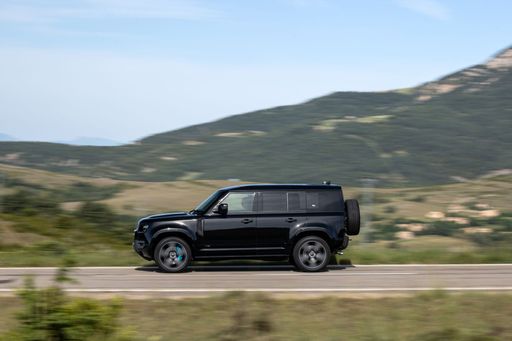
Defender @ Jaguar Land Rover Media

Dimensions and Practicality

Practicality plays a crucial role, especially when loading gear for off-the-grid escapes. The Ford Ranger stands tall with a length of up to 5420 mm, boasting a payload capacity that stretches to 1108 kg, catering well to those demanding substantial haul potential.

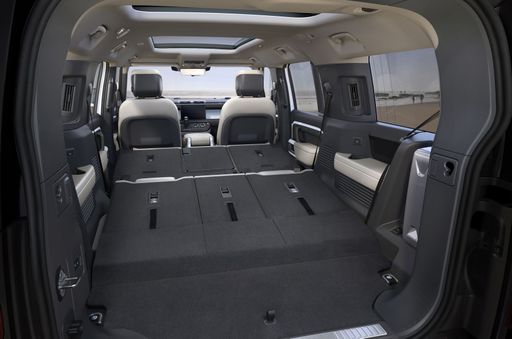
Meanwhile, the Defender, with its off-roader archetype, delivers multiple body configurations ranging from compact to roomy. Its apex version stretches to 5358 mm in length and presents considerable trunk capacity, ranging up to 786 liters, ensuring no adventure gear is left behind.

Innovation and Features

Both models assert their presence with cutting-edge innovations in driving technology. The Ranger integrates advanced suspension dynamics that promise enhanced comfort across bumpy trails. Simultaneously, it offers driver-assist features that elevate safety and control in unpredictable environments.

The Defender, however, excels with its Terrain Response system – a hallmark of Land Rover's technological prowess. This system adapts the vehicle’s characteristics to suit different terrains, resulting in a seamless drive across diverse topographies. The compatibility of its systems with various electronics further elevates the driving experience.

End Note: Which Suits You Better?

In summation, the choice between the Ford Ranger and Land Rover Defender boils down to your specific needs and preferences. If sheer power and diversity in fuel options intrigue you, the Defender is a formidable contender, especially with its hybrid technology and adaptive terrain systems. Meanwhile, the Ranger appeals through its utilitarian ethos with a robust build quality, suitable for both labor and leisure. Choose your adventure – cityscapes or wild terrains await.

Here’s where it gets real: The technical differences in detail

Costs and Efficiency:

Looking at overall running costs, both models reveal some interesting differences in everyday economy.

Ford Ranger has a convincingly advantage in terms of price – it starts at 37500 £, while the Land Rover Defender costs 57900 £. That’s a price difference of around 20332 £.

Fuel consumption also shows a difference: Ford Ranger manages with 3.10 L and is therefore clearly more efficient than the Land Rover Defender with 6 L. The difference is about 2.90 L per 100 km.

As for range, the Land Rover Defender performs to a small extent better – achieving up to 48 km, about 6 km more than the Ford Ranger.

Engine and Performance:

Power, torque and acceleration are the classic benchmarks for car enthusiasts – and here, some clear differences start to show.

When it comes to engine power, the Land Rover Defender has a convincingly edge – offering 635 HP compared to 292 HP. That’s roughly 343 HP more horsepower.

In acceleration from 0 to 100 km/h, the Land Rover Defender is convincingly quicker – completing the sprint in 4 s, while the Ford Ranger takes 7.90 s. That’s about 3.90 s faster.

In terms of top speed, the Land Rover Defender performs evident better – reaching 250 km/h, while the Ford Ranger tops out at 190 km/h. The difference is around 60 km/h.

There’s also a difference in torque: Land Rover Defender pulls hardly perceptible stronger with 750 Nm compared to 697 Nm. That’s about 53 Nm difference.

Space and Everyday Use:

Beyond pure performance, interior space and usability matter most in daily life. This is where you see which car is more practical and versatile.

Seats: Land Rover Defender offers noticeable more seating capacity – 8 vs 5.

In curb weight, Ford Ranger is to a small extent lighter – 2082 kg compared to 2300 kg. The difference is around 218 kg.

When it comes to payload, Ford Ranger clearly perceptible takes the win – 1108 kg compared to 819 kg. That’s a difference of about 289 kg.

Who comes out on top?

Overall, the Land Rover Defender shows itself to be outperforms in nearly all aspects and secures the title of DriveDuel Champion.
It convinces with the more balanced overall package and proves to be the more versatile choice for everyday use.

Ford Ranger
Land Rover Defender

Costs and Consumption

View detailed analysis

Engine and Performance

View detailed analysis

Dimensions and Body

View detailed analysis
from about £57,900
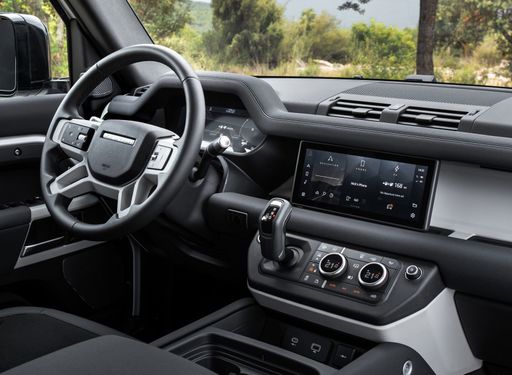
Defender @ Jaguar Land Rover Media

Land Rover Defender

  • Engine Type : Petrol, Diesel MHEV, Plugin Hybrid, Petrol MHEV
  • Transmission : Automatic
  • Drive Type : All-Wheel Drive
  • Power HP : 200 - 635 HP
  • Consumption L/100km : 6 - 14.4 L
  • Electric Range : 48 km

Ford Ranger

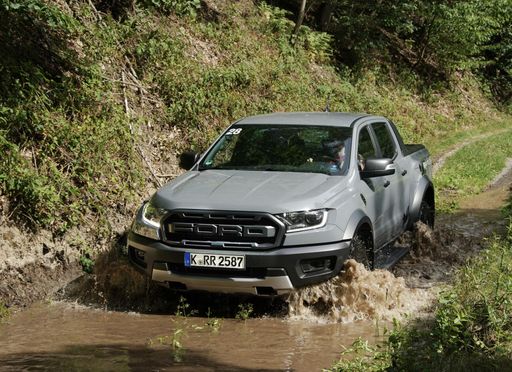
The Ford Ranger is a workhorse with the manners of a grown-up pickup—practical, tough, and surprisingly civilized on the road. It’s the sort of truck that laughs at mud on the weekend and performs like a sensible daily driver during the week, making it an easy sell for buyers who want capability without theatrics.

details

Land Rover Defender

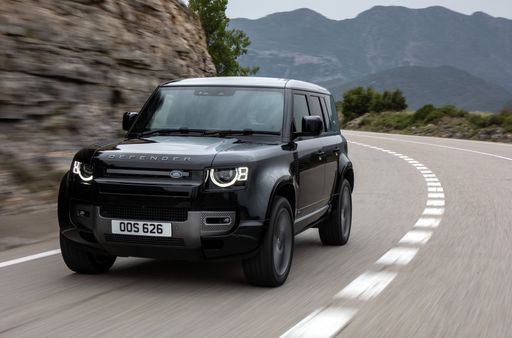
The Land Rover Defender looks like it could shrug off a weekend of serious off-road abuse while still turning heads on the high street. Inside it balances practical, no-nonsense utility with enough creature comforts to make daily driving feel less like an expedition and more like a stylish commute—rugged charm with civilized manners.

details
Ford Ranger
Land Rover Defender
Ranger @ Ford Motor Company / Ford Media Center
Defender @ Jaguar Land Rover Media

Costs and Consumption

Price
37500 - 71900 £
Price
57900 - 172000 £
Consumption L/100km
3.1 - 13.8 L
Consumption L/100km
6 - 14.4 L
Consumption kWh/100km
-
Consumption kWh/100km
-
Electric Range
42 km
Electric Range
48 km
Battery Capacity
11.80 kWh
Battery Capacity
15.40 kWh
co2
70 - 315 g/km
co2
135 - 324 g/km
Fuel tank capacity
80 L
Fuel tank capacity
89 - 91 L

Dimensions and Body

Body Type
Pickup
Body Type
Off-Roader
Seats
2 - 5
Seats
2 - 8
Doors
2 - 4
Doors
3 - 5
Curb weight
2082 - 2511 kg
Curb weight
2300 - 2745 kg
Trunk capacity
-
Trunk capacity
293 - 786 L
Length
5370 - 5420 mm
Length
4323 - 5358 mm
Width
1918 - 1968 mm
Width
2008 mm
Height
1868 - 1922 mm
Height
1967 - 1995 mm
Max trunk capacity
-
Max trunk capacity
1263 - 2078 L
Payload
676 - 1108 kg
Payload
494 - 819 kg

Engine and Performance

Engine Type
Diesel, Petrol, Plugin Hybrid
Engine Type
Petrol, Diesel MHEV, Plugin Hybrid, Petrol MHEV
Transmission
Manuel, Automatic
Transmission
Automatic
Transmission Detail
Manual Gearbox, Automatic Gearbox
Transmission Detail
Automatic Gearbox
Drive Type
All-Wheel Drive
Drive Type
All-Wheel Drive
Power HP
170 - 292 HP
Power HP
200 - 635 HP
Acceleration 0-100km/h
7.9 - 12.1 s
Acceleration 0-100km/h
4 - 10.2 s
Max Speed
180 - 190 km/h
Max Speed
175 - 250 km/h
Torque
405 - 697 Nm
Torque
500 - 750 Nm
Number of Cylinders
4 - 6
Number of Cylinders
4 - 8
Power kW
125 - 215 kW
Power kW
147 - 467 kW
Engine capacity
1996 - 2993 cm3
Engine capacity
1997 - 5000 cm3

General

Model Year
2022 - 2025
Model Year
2025
CO2 Efficiency Class
G, B
CO2 Efficiency Class
G, D
Brand
Ford
Brand
Land Rover
What drive types are available for the Ford Ranger?

The Ford Ranger is offered with All-Wheel Drive.

The prices and data displayed are estimates based on German list prices and may vary by country. This information is not legally binding.

do not click