@ Mercedes-Benz Group Media
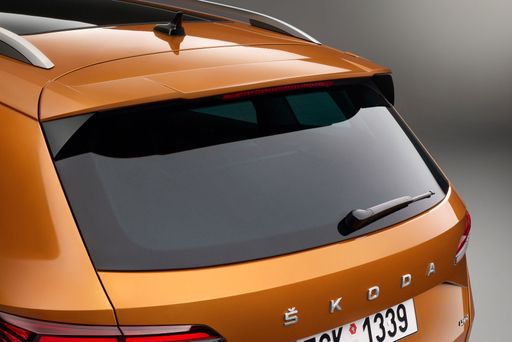
@ Škoda Auto a.s. / Škoda Storyboard
VS

Mercedes GLC vs Skoda Karoq – Performance, range & efficiency compared

Compare performance, boot capacity, efficiency and price at a glance.
Find out which car is the better choice for you – Mercedes GLC or Skoda Karoq?

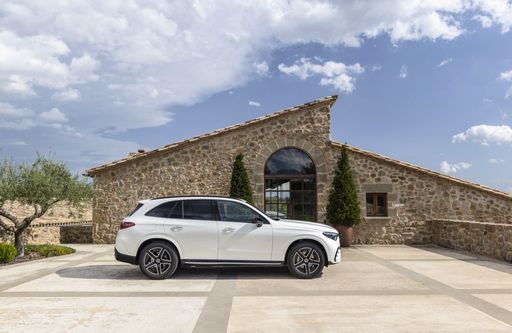
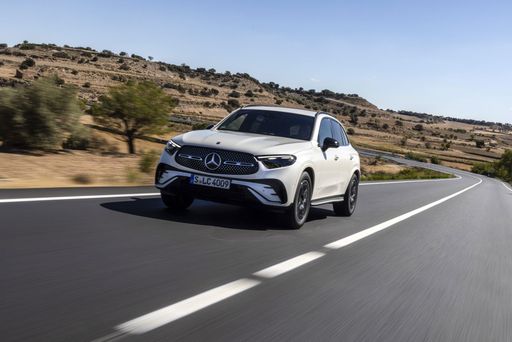
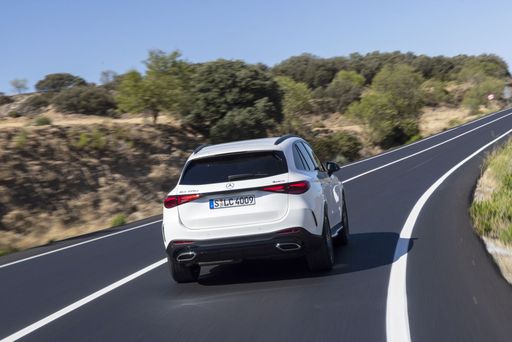
GLC @ Mercedes-Benz Group Media

Introduction

When it comes to compact SUVs, the Mercedes GLC and Skoda Karoq have proven themselves as formidable players in an increasingly competitive segment. Both vehicles cater to different audiences while promising performance, practicality, and a host of modern features. In this article, we’ll delve into their technical specifications, innovations, and how they stack up against one another.
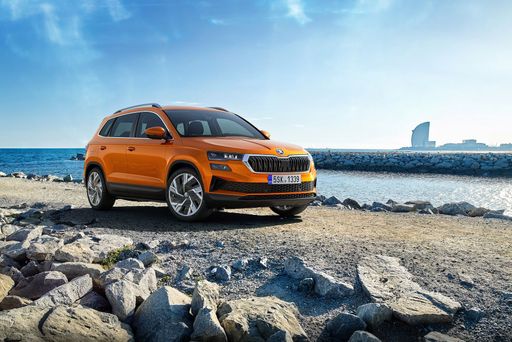
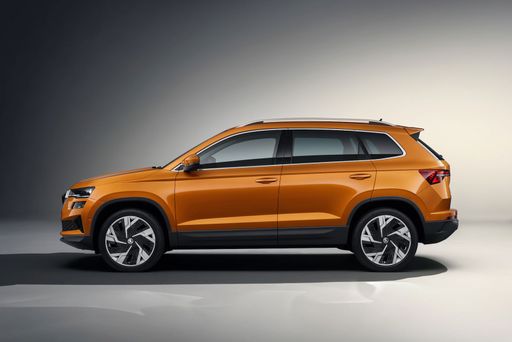
Karoq @ Škoda Auto a.s. / Škoda Storyboard

Design and Dimensions

Starting with aesthetics, the Mercedes GLC offers a sleek and sophisticated design that reflects the luxury brand's signature styling. With lengths ranging from 4716mm to 4792mm and a width of 1890mm, it commands presence on the road. Meanwhile, the Skoda Karoq takes a more utilitarian approach with a compact length of 4384mm and width of 1841mm, making it easier to maneuver in tight spaces.

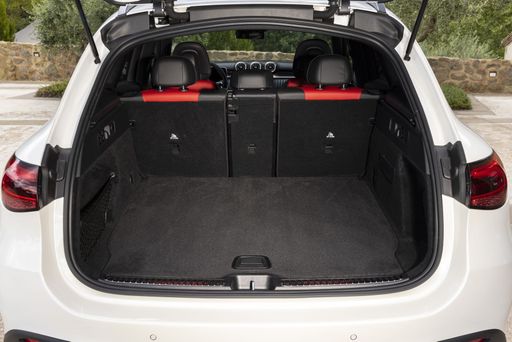
In terms of height, the Karoq stands at 1603 to 1624 mm compared to the GLC's height of 1605 to 1647 mm. Both models come with five doors and provide ample space for passengers, but GLC’s trunk capacity ranges from 390L to 620L, offering a superior cargo versatility compared to Karoq's 521L.

GLC @ Mercedes-Benz Group Media

Engine Performance and Efficiency

Under the hood, the Mercedes GLC provides a wider range of powertrains, including petrol and diesel Mild Hybrid Electric Vehicles (MHEVs) and plugin hybrids. The power outputs vary significantly, ranging from 186 HP to an exhilarating 680 HP for the hybrid variant, paired with an automatic gearbox and all-wheel-drive capabilities. Fuel consumption ranges from 5.1 to 10.3 L/100km, showcasing its efficiency during everyday driving.

On the other hand, the Skoda Karoq offers a more modest lineup with petrol and diesel engines delivering between 115 HP and 190 HP. While the Karoq's efficiency is commendable at 4.9 to 7.6 L/100km, it cannot quite match the range and performance options provided by the GLC. Karoq's top speed reaches up to 221 km/h, comparable to certain GLC variants.

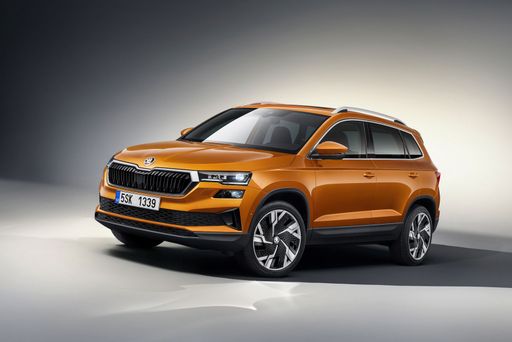
Karoq @ Škoda Auto a.s. / Škoda Storyboard

Acceleration and Driving Experience

The acceleration figures reveal a stark difference in performance. The GLC impressively accelerates from 0-100km/h in as low as 3.5 seconds for its sportier variants, while the Karoq lags behind, maxing out at approximately 7 seconds for the more powerful models. This discrepancy highlights the distinct target markets for each vehicle, with the GLC aimed at performance enthusiasts and the Karoq appealing to those prioritizing practicality.

GLC @ Mercedes-Benz Group Media

Innovative Features and Technology

Both SUVs are equipped with cutting-edge technology, but they approach it in different ways. The GLC integrates the latest in infotainment with the Mercedes-Benz User Experience (MBUX) system, which includes voice control, AI, and an immense touchscreen interface for seamless connectivity. Moreover, advanced driver-assistance systems enhance safety and driver convenience.

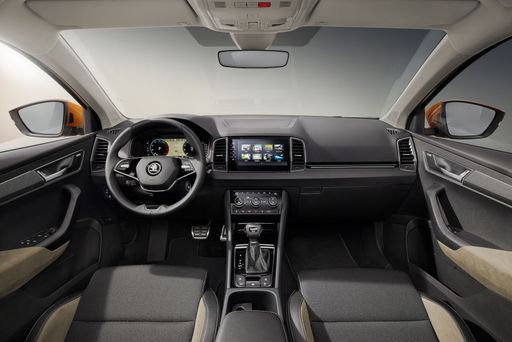
In contrast, the Skoda Karoq emphasizes functional innovations such as the Modular Infotainment Matrix and SmartLink compatibility. It features user-friendly interfaces and practical storage solutions within the cabin, appealing to families and everyday drivers.

Karoq @ Škoda Auto a.s. / Škoda Storyboard

Conclusion

The Mercedes GLC and Skoda Karoq are excellent representatives of the compact SUV market, each targeting distinct audiences. The GLC excels in luxury, performance, and innovative technology, making it ideal for those seeking a premium driving experience. Conversely, the Skoda Karoq offers practicality and efficiency, catering to budget-conscious buyers without sacrificing essential features.

Your choice ultimately hinges on your preferences: whether you prioritize the lavish allure and performance of the GLC or the pragmatic and efficient attributes of the Karoq. No matter your decision, both vehicles promise to deliver satisfaction on the road.

Here’s where it gets real: The technical differences in detail

GLC @ Mercedes-Benz Group Media

Costs and Efficiency:

Looking at overall running costs, both models reveal some interesting differences in everyday economy.

Skoda Karoq has a convincingly advantage in terms of price – it starts at 29100 £, while the Mercedes GLC costs 50300 £. That’s a price difference of around 21245 £.

Fuel consumption also shows a difference: Mercedes GLC manages with 1.60 L and is therefore clearly more efficient than the Skoda Karoq with 4.90 L. The difference is about 3.30 L per 100 km.

Karoq @ Škoda Auto a.s. / Škoda Storyboard

Engine and Performance:

Power, torque and acceleration are the classic benchmarks for car enthusiasts – and here, some clear differences start to show.

When it comes to engine power, the Mercedes GLC has a decisively edge – offering 680 HP compared to 190 HP. That’s roughly 490 HP more horsepower.

In acceleration from 0 to 100 km/h, the Mercedes GLC is decisively quicker – completing the sprint in 3.50 s, while the Skoda Karoq takes 7 s. That’s about 3.50 s faster.

In terms of top speed, the Mercedes GLC performs to a small extent better – reaching 275 km/h, while the Skoda Karoq tops out at 221 km/h. The difference is around 54 km/h.

There’s also a difference in torque: Mercedes GLC pulls convincingly stronger with 1020 Nm compared to 360 Nm. That’s about 660 Nm difference.

GLC @ Mercedes-Benz Group Media

Space and Everyday Use:

Beyond pure performance, interior space and usability matter most in daily life. This is where you see which car is more practical and versatile.

Both vehicles offer seating for 5 people.

In curb weight, Skoda Karoq is evident lighter – 1380 kg compared to 1910 kg. The difference is around 530 kg.

In terms of boot space, the Mercedes GLC offers slightly more room – 620 L compared to 521 L. That’s a difference of about 99 L.

In maximum load capacity, the Mercedes GLC performs minimal better – up to 1740 L, which is about 110 L more than the Skoda Karoq.

When it comes to payload, Mercedes GLC barely noticeable takes the win – 600 kg compared to 549 kg. That’s a difference of about 51 kg.

Who wins the race?

The Mercedes GLC proves to be leaves the rival little chance and therefore becomes our DriveDuel Champion!
Mercedes GLC is the better all-rounder in this comparison.

from about £50,300
GLC @ Mercedes-Benz Group Media

Mercedes GLC

  • Engine Type : Petrol MHEV, Plugin Hybrid, Diesel MHEV, Electric
  • Transmission : Automatic
  • Drive Type : All-Wheel Drive
  • Power HP : 186 - 680 HP
  • Consumption L/100km : 1.6 - 9.9 L
  • Consumption kWh/100km : 14.9 - 16.6 kWh
  • Electric Range : 12 - 714 km

Mercedes GLC

4 (2)
rate

The Mercedes GLC blends plush cabin comfort and composed road manners into an SUV that feels more grown-up than it looks. It won’t shout for attention, but will quietly please buyers who want refinement, usable space and a touch of luxury without the drama.

details

Skoda Karoq

5 (1)
rate

The Skoda Karoq is a smart, unfussy compact SUV that blends roomy practicality with a pleasantly composed driving character. It won’t turn heads at a car meet, but it will make daily life easier with clever storage, sensible ergonomics and a reassuringly grown-up ride.

details
Mercedes GLC
Skoda Karoq
GLC @ Mercedes-Benz Group Media
Karoq @ Škoda Auto a.s. / Škoda Storyboard

Costs and Consumption

Price
50300 - 126600 £
Price
29100 - 41700 £
Consumption L/100km
1.6 - 9.9 L
Consumption L/100km
4.9 - 7.6 L
Consumption kWh/100km
14.9 - 16.6 kWh
Consumption kWh/100km
-
Electric Range
12 - 714 km
Electric Range
-
Battery Capacity
94 kWh
Battery Capacity
-
co2
0 - 225 g/km
co2
128 - 173 g/km
Fuel tank capacity
49 - 65 L
Fuel tank capacity
50 - 55 L

Dimensions and Body

Body Type
SUV
Body Type
SUV
Seats
5
Seats
5
Doors
5
Doors
5
Curb weight
1910 - 2535 kg
Curb weight
1380 - 1655 kg
Trunk capacity
390 - 620 L
Trunk capacity
521 L
Length
4716 - 4845 mm
Length
4384 - 4390 mm
Width
1890 - 1913 mm
Width
1841 mm
Height
1603 - 1647 mm
Height
1624 - 1629 mm
Max trunk capacity
1335 - 1740 L
Max trunk capacity
1630 L
Payload
475 - 600 kg
Payload
456 - 549 kg

Engine and Performance

Engine Type
Petrol MHEV, Plugin Hybrid, Diesel MHEV, Electric
Engine Type
Petrol, Diesel
Transmission
Automatic
Transmission
Manuel, Automatic
Transmission Detail
Automatic Gearbox, Reduction Gearbox
Transmission Detail
Manual Gearbox, Dual-Clutch Automatic
Drive Type
All-Wheel Drive
Drive Type
Front-Wheel Drive, All-Wheel Drive
Power HP
186 - 680 HP
Power HP
115 - 190 HP
Acceleration 0-100km/h
3.5 - 9 s
Acceleration 0-100km/h
7 - 11.2 s
Max Speed
208 - 275 km/h
Max Speed
192 - 221 km/h
Torque
320 - 1020 Nm
Torque
200 - 360 Nm
Number of Cylinders
4 - 6
Number of Cylinders
3 - 4
Power kW
137 - 500 kW
Power kW
85 - 140 kW
Engine capacity
1991 - 2989 cm3
Engine capacity
999 - 1984 cm3

General

Model Year
2025 - 2026
Model Year
2025
CO2 Efficiency Class
F, G, B, A
CO2 Efficiency Class
D, E, F
Brand
Mercedes-Benz
Brand
Skoda
What drive types are available for the Mercedes GLC?

The Mercedes GLC is offered with All-Wheel Drive.

The prices and data displayed are estimates based on German list prices and may vary by country. This information is not legally binding.