VS

Nissan Juke vs Mazda CX-30 comparison

Compare performance (143 HP vs 186 HP), boot space and price (21,400 £ vs 25,200 £ ) at a glance. Find out which car is the better choice for you – Nissan Juke or Mazda CX-30?

Nissan Juke vs Mazda CX-30: Key differences

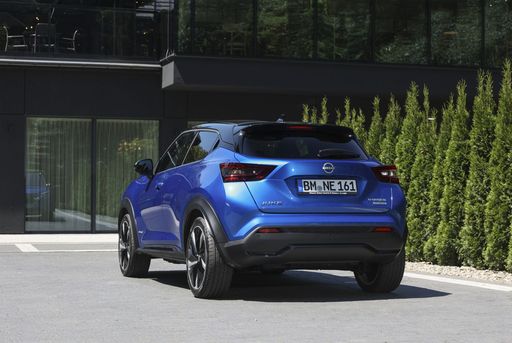
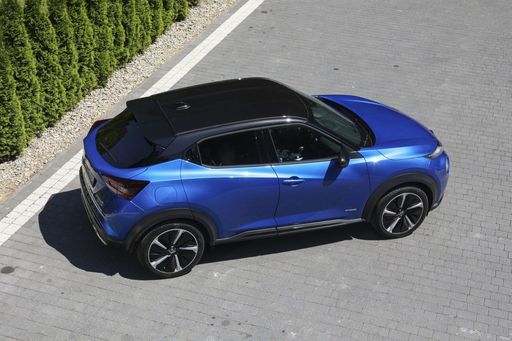
Nissan Juke

5 (1 Reviews)
rate
  • a bit cheaper
  • visibly more efficient
  • moderately lighter

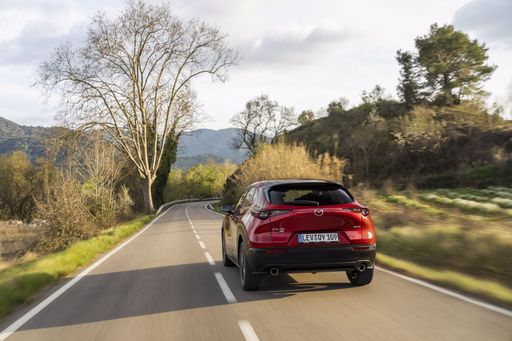
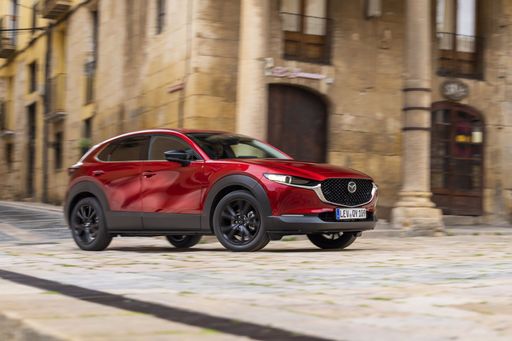
Mazda CX-30

4.6 (3 Reviews)
rate
  • clearly more power
  • noticeably quicker 0–100 km/h
  • only slightly more trunk space

All details on performance, efficiency, range and trunk space can be found in the technical comparison below – including user reviews for both models.

Juke

Mazda CX-30 vs. Nissan Juke: Clash of the Compact SUVs

In the highly competitive world of compact SUVs, two vehicles have managed to stand out for their unique blend of performance, comfort, and design innovation: the Mazda CX-30 and the Nissan Juke. Both are fresh contenders in the 2024 lineup, bringing something distinct to the table for SUV enthusiasts. In this article, we'll delve into their technical specifics and compare their key innovations to see how they stack up against each other.
CX-30

Performance and Power

The Mazda CX-30 offers a robust performance with its petrol MHEV engine available in both manual and automatic transmissions. The engine delivers a substantial power range of up to 186 HP with torque reaching 240 Nm, promising a spirited driving experience. The CX-30 boasts superior acceleration, reaching 0-100 km/h in about 8.3 seconds with a maximum speed of up to 204 km/h, making it a strong contender in its category.

On the other side, the Nissan Juke provides a more modest power output range, with its petrol and full hybrid options delivering up to 143 HP and 200 Nm of torque. Despite having a slower acceleration of up to 10.1 seconds for 0-100 km/h, it’s designed for efficiency and urban utility rather than pure speed, with a maximum speed of 180 km/h.

Juke

Fuel Efficiency and Environmental Impact

Efficiency is a critical factor for many SUV buyers today. The Mazda CX-30 offers a respectable fuel consumption range of 5.7 to 6.6 L/100km and CO2 emissions ranging from 129 to 148 g/km, classifying it in the D to E CO2 efficiency classes.

The Nissan Juke scores slightly better in terms of carbon footprint, especially with its full hybrid variant, achieving a low consumption of 4.7 L/100km and CO2 emissions down to 107 g/km, earning it a C efficiency classification. This makes the Juke a compelling option for environmentally conscious drivers.

CX-30

Design and Space

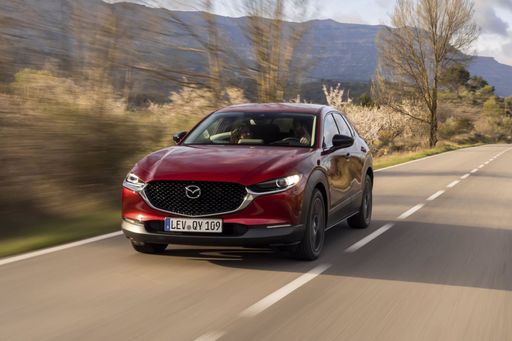
Both SUVs share a sleek five-door design, although they differ in dimensions. The Mazda CX-30 is larger overall, with measurements of 4395 mm in length, 1795 mm in width, and 1540 mm in height. This space allows for a trunk capacity of up to 430 liters, slightly more than the Juke's offering, and is ideal for those needing extra cargo space.

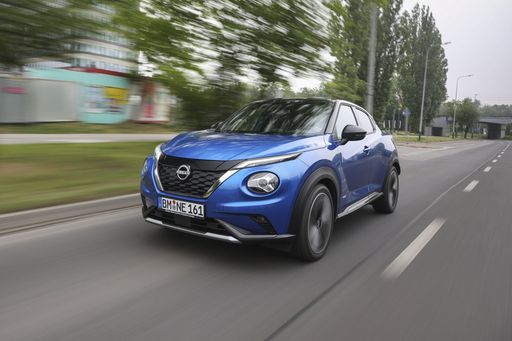
The Nissan Juke is slightly more compact, with a length of 4210 mm and a greater height of 1593 mm, providing a quirkier, more dynamic design that favors tight city navigation. Its trunk varies between 354 to 422 liters, balancing urban agility with utility.

Juke

Drivetrain and Handling

Drive preferences are crucial when selecting an SUV. The Mazda CX-30 offers flexibility with both front-wheel and all-wheel drive options, catering to those who enjoy off-road excursions as much as city driving. The all-wheel-drive system provides enhanced stability and control across diverse terrains.

The Nissan Juke, focusing primarily on front-wheel drive, gears more towards city performance and efficiency, providing nimble handling suited for urban lifestyles. Its dual-clutch automatic gearbox in automatic variants ensures smooth transitions and a more engaging drive.

CX-30

Final Verdict

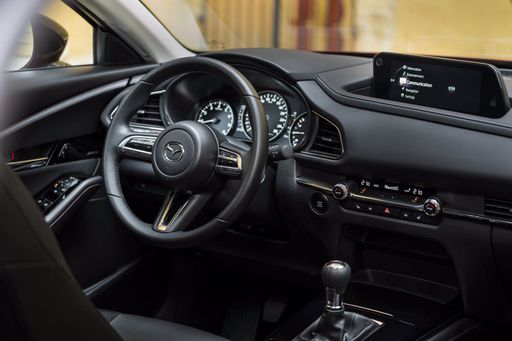
The choice between the Mazda CX-30 and Nissan Juke ultimately comes down to personal preference and intended use. If you seek power, versatility, and a spacious interior, the Mazda CX-30 is an excellent choice, capable of delivering more in terms of performance and off-road capabilities.

However, if your priorities lie in urban efficiency, cutting-edge hybrid technology, and a distinctive design, the Nissan Juke may be your ideal match. Its excellent fuel economy and innovative features make it particularly well-suited for city dwellers looking for style and sustainability.

Both models have made notable strides in technology and design, ensuring they are worthy choices in their segment. Your decision might just rely on whether you prioritize the thrill of driving or the practicality of everyday use.

Here’s where it gets real: The technical differences in detail

Juke

Costs and Efficiency:

Looking at overall running costs, both models reveal some interesting differences in everyday economy.

Nissan Juke is a bit cheaper – starting at 21,400 £ , while the Mazda CX-30 costs 25,200 £ . That’s a price difference of around 3,849 £.

Fuel consumption also shows a difference: the Nissan Juke uses 4.7 L/100km and is visibly more efficient than the Mazda CX-30 with 5.7 L/100km. The difference is about 1 L/100km.

CX-30

Engine and Performance:

Power, torque and acceleration say a lot about how a car feels on the road. This is where you see which model delivers more driving dynamics.

When it comes to engine power, the Mazda CX-30 offers clearly more power – delivering 186 HP compared to 143 HP. That’s roughly 43 HP more horsepower.

When accelerating from 0 to 100 km/h, the Mazda CX-30 is noticeably quicker – completing the sprint in 8.3 s, while the Nissan Juke takes 10.1 s. That’s about 1.8 s quicker.

There’s also a difference in torque: the Mazda CX-30 delivers somewhat more torque with 240 Nm compared to 200 Nm. That’s about 40 Nm more.

Juke

Space and Everyday Use:

Cabin size, boot volume and payload all play a role in everyday practicality. Here, comfort and flexibility make the difference.

Both vehicles offer seating for 5 people.

In terms of curb weight, Nissan Juke is moderately lighter – 1,274 kg compared to 1,455 kg. The difference is around 181 kg.

Looking at boot space, the Mazda CX-30 offers only slightly more boot space – 430 L compared to 422 L. That’s a difference of about 8 L.

When it comes to payload, the Mazda CX-30 carries moderately more – 496 kg compared to 427 kg. That’s a difference of about 69 kg.

Who wins the race in the data check?

The Mazda CX-30 is decisively ahead in the objective data comparison.
This result only shows which model scores more points on paper – not which of the two cars feels right for you.

from £25,200
CX-30

Mazda CX-30

  • Engine Type : Petrol MHEV
  • Transmission : Manuel, Automatic
  • Drive Type : Front-Wheel Drive, All-Wheel Drive
  • Power HP : 140 - 186 HP
  • Consumption L/100km : 5.7 - 6.6 L/100km
Nissan Juke
Mazda CX-30

Costs and Consumption

View detailed analysis

Engine and Performance

View detailed analysis

Dimensions and Body

View detailed analysis

Nissan Juke

The Nissan Juke is a pocket-sized crossover that refuses to blend in, with quirky styling and a cheeky stance that turns heads at every traffic light. It’s ideal for shoppers who value personality and nimble urban driving over maximum practicality, delivering surprising pep and a well-equipped feel for everyday fun.

details

Mazda CX-30

The Mazda CX-30 blends sleek coupe-like lines with the practicality of a compact crossover, feeling more premium than its price tag suggests. It’s a joy to drive for anyone who likes a taut chassis and an interior that treats daily commutes like a small luxury escape.

details
Nissan Juke
Mazda CX-30

Costs and Consumption

Price
21,400 - 31,800 £
Price
25,200 - 36,800 £
Consumption L/100km
4.7 - 6 L/100km
Consumption L/100km
5.7 - 6.6 L/100km
Consumption kWh/100km
-
Consumption kWh/100km
-
Electric Range
-
Electric Range
-
Battery Capacity
-
Battery Capacity
-
co2
105 - 136 g/km
co2
129 - 148 g/km
Fuel tank capacity
-
Fuel tank capacity
-

Dimensions and Body

Body Type
SUV
Body Type
SUV
Seats
5
Seats
5
Doors
-
Doors
-
Curb weight
1,274 - 1,405 kg
Curb weight
1,455 - 1,587 kg
Trunk capacity
354 - 422 L
Trunk capacity
422 - 430 L
Length
-
Length
-
Width
1,800 mm
Width
1,795 mm
Height
-
Height
-
Max trunk capacity
-
Max trunk capacity
-
Payload
405 - 427 kg
Payload
458 - 496 kg

Engine and Performance

Engine Type
Petrol, Full Hybrid
Engine Type
Petrol MHEV
Transmission
Manuel, Automatic
Transmission
Manuel, Automatic
Transmission Detail
Manual Gearbox, Dual-Clutch Automatic, Automatic Gearbox
Transmission Detail
Manual Gearbox, Automatic Gearbox
Drive Type
Front-Wheel Drive
Drive Type
Front-Wheel Drive, All-Wheel Drive
Power HP
114 - 143 HP
Power HP
140 - 186 HP
Acceleration 0-100km/h
10.1 - 11.8 s
Acceleration 0-100km/h
8.3 - 10.3 s
Max Speed
-
Max Speed
-
Torque
200 Nm
Torque
238 - 240 Nm
Number of Cylinders
3 - 4
Number of Cylinders
4
Power kW
84 - 105 kW
Power kW
103 - 137 kW
Engine capacity
999 - 1,598 cm3
Engine capacity
1,998 - 2,488 cm3

General

Model Year
2,025
Model Year
2,025
CO2 Efficiency Class
D, E, C
CO2 Efficiency Class
D, E
Brand
Nissan
Brand
Mazda
DriveDuel uses data analysis and artificial intelligence to evaluate vehicle data and create content. Content is regularly reviewed and improved. The displayed prices are estimates based on German list prices, adjusted to the respective country’s VAT. Country-specific registration taxes are not included. This information is not legally binding.