VS

Renault Symbioz vs Honda HR-V comparison

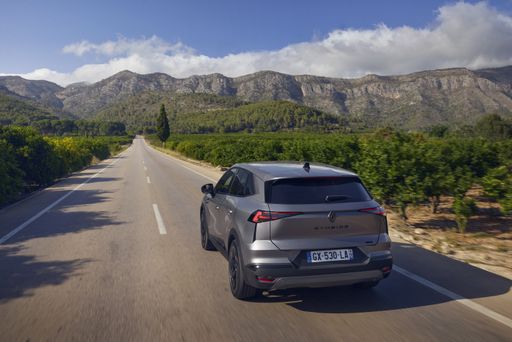
Compare performance (158 HP vs 131 HP), boot space and price (24,400 £ vs 29,700 £ ) at a glance. Find out which car is the better choice for you – Renault Symbioz or Honda HR-V?

Renault Symbioz vs Honda HR-V: Key differences

Renault Symbioz

5 (3 Reviews)
rate
  • markedly cheaper
  • slightly more power
  • markedly more efficient
  • somewhat quicker 0–100 km/h
  • marginally lighter
  • significantly more trunk space

Honda HR-V

4 (9 Reviews)
rate
Overall, owners tend to find the Honda HR‑V a practical, reliable and economical compact SUV that’s easy to live with in town and for family duties, offering predictable handling and a comfortable ride. Common positives include good fuel economy, roomy/intuive packaging and reassuring manners; common negatives some owners mention are noticeable noise under brisk acceleration or low‑speed maneuvers and a tendency to feel underpowered on sustained highway runs. So while feedback is broadly favorable for city and everyday use, opinions are more mixed on long‑distance refinement — worth a motorway run during your test drive if that’s your regular terrain.

All details on performance, efficiency, range and trunk space can be found in the technical comparison below – including user reviews for both models.

Symbioz

Honda HR-V vs Renault Symbioz: A Clash of SUVs

Both the Honda HR-V and Renault Symbioz represent the next generation of hybrid SUVs, designed to offer efficiency and performance without compromising the standard comforts of an SUV. While they share common attributes, each brings unique elements to the table, making the choice between them an intriguing decision for potential buyers.

Design and Dimensions

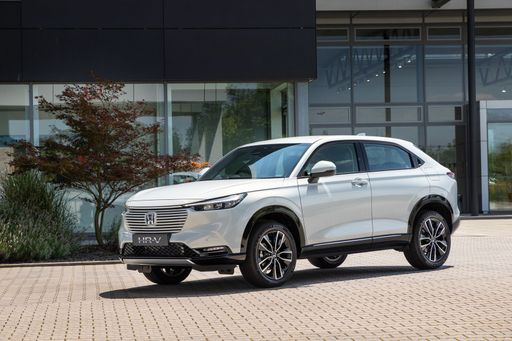
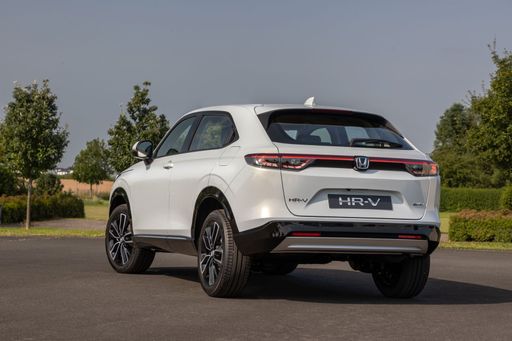
The Honda HR-V, launched in 2022, features an exterior length of 4340 mm and a height of 1582 mm, encapsulating a compact yet spacious design typical of an urban SUV. It's practical for those who require maneuverability and interior space simultaneously.

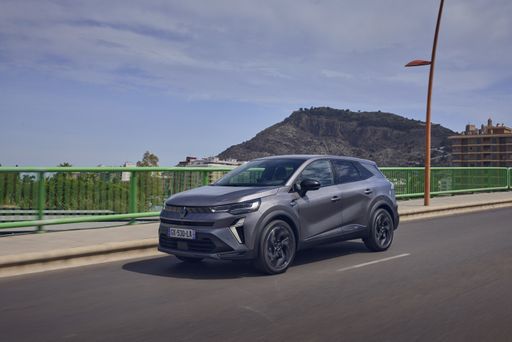
The Renault Symbioz, on the other hand, with its model year marked at 2024, stretches to 4413 mm in length and offers a slightly lower height of 1575 mm. Its additional width at 1797 mm gives it a broader stance, promising more interior space, especially in terms of carrying capacity with a larger trunk offering of 492 liters compared to HR-V's 335 liters.

Engine and Efficiency

Both SUVs come equipped with full hybrid engines; however, they differ in capacity and efficiency. The HR-V boasts a 1498 cm3 engine with a respectable 130 HP output and a CO2 efficiency class of D. With a combined consumption of 5.4 L/100km, it merges decent performance with environmental concern.

The Symbioz takes a step forward with a more robust 1598 cm3 engine, offering 143 HP and a better CO2 efficiency class of C, owing to its lower emissions of 109 g/km. What's more, its hybrid system proves to be more efficient, achieving a consumption rate of 4.8 L/100km, making it a more environmentally friendly option.

Performance Details

When it comes to performance, the Honda HR-V accelerates from 0-100 km/h in approximately 10.7 seconds, providing a smoother yet slightly slower drive compared to the Symbioz, which edges out slightly at 10.6 seconds. Both vehicles share a maximum speed of 170 km/h, aligning them equally in terms of speed capabilities.

In terms of power delivery, both cars are neck and neck with the HR-V pushing 96 kW and the Symbioz harnessing an output of 105 kW. For torque, the HR-V claims 253 Nm while the Symbioz registers a close 250 Nm. These subtle differences suggest marginal variances in how power is managed and delivered on-road.

Practicality and Capacity

The HR-V offers a curb weight of 1452 kg with a payload of 418 kg, underlining its capacity for both passenger comfort and baggage. It comes fitted with a fuel tank capacity of 40 liters, ideal for a balanced urban and highway drive.

Conversely, the Symbioz's slightly higher curb weight of 1498 kg and its expanded fuel tank of 48 liters allows for longer drives without frequent refueling stops, complemented by its higher payload, providing greater utility.

Conclusion

Choosing between the Honda HR-V and the Renault Symbioz primarily rests on priorities—whether it’s the HR-V with its compact practicality and well-rounded performance or the Symbioz with its superior efficiency, slightly larger dimensions, and enhanced environmental profile. Both have their own distinct charms, making them worthy considerations for anyone in the market for a hybrid SUV.
Here’s where it gets real: The technical differences in detail

Symbioz

Costs and Efficiency:

Price and efficiency are key factors when choosing a car – and this is often where the real differences emerge.

Renault Symbioz is markedly cheaper – starting at 24,400 £ , while the Honda HR-V costs 29,700 £ . That’s a price difference of around 5,314 £.

Fuel consumption also shows a difference: the Renault Symbioz uses 4.5 L/100km and is markedly more efficient than the Honda HR-V with 5.4 L/100km. The difference is about 0.9 L/100km.

HR-V

Engine and Performance:

Power, torque and acceleration are the classic benchmarks for car enthusiasts – and here, some clear differences start to show.

When it comes to engine power, the Renault Symbioz offers slightly more power – delivering 158 HP compared to 131 HP. That’s roughly 27 HP more horsepower.

When accelerating from 0 to 100 km/h, the Renault Symbioz is somewhat quicker – completing the sprint in 9.1 s, while the Honda HR-V takes 10.6 s. That’s about 1.5 s quicker.

There’s also a difference in torque: the Renault Symbioz delivers barely more torque with 265 Nm compared to 253 Nm. That’s about 12 Nm more.

Symbioz

Space and Everyday Use:

Cabin size, boot volume and payload all play a role in everyday practicality. Here, comfort and flexibility make the difference.

Both vehicles offer seating for 5 people.

In terms of curb weight, Renault Symbioz is marginally lighter – 1,359 kg compared to 1,452 kg. The difference is around 93 kg.

Looking at boot space, the Renault Symbioz offers significantly more boot space – 576 L compared to 319 L. That’s a difference of about 257 L.

When it comes to payload, the Renault Symbioz carries barely more – 459 kg compared to 418 kg. That’s a difference of about 41 kg.

Who wins the race in the data check?

The Renault Symbioz is decisively ahead in the objective data comparison.
This result only shows which model scores more points on paper – not which of the two cars feels right for you.

from £24,400
Symbioz

Renault Symbioz

  • Engine Type : Full Hybrid, Petrol MHEV
  • Transmission : Automatic, Manuel
  • Drive Type : Front-Wheel Drive
  • Power HP : 140 - 158 HP
  • Consumption L/100km : 4.5 - 6 L/100km
Renault Symbioz
Honda HR-V

Costs and Consumption

View detailed analysis

Engine and Performance

View detailed analysis

Dimensions and Body

View detailed analysis

Renault Symbioz

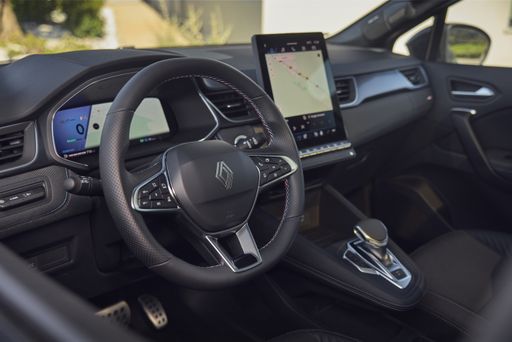
The Renault Symbioz feels less like a traditional car and more like a rolling living room that's been told it's allowed to drive — its flowing lines and minimalist cabin are pure concept-car theatre that teases the future of everyday transport. For buyers with an eye for design and a taste for tech-forward ideas, the Symbioz is an alluring vision of what Renault could offer tomorrow, even if it's not yet a model you can park in your driveway.

details

Honda HR-V

The Honda HR-V is the sensible compact crossover that blends roomy practicality with a composed, friendly drive, making it an easy pick for buyers who want everyday usability without fuss. It won’t thrill hardcore enthusiasts, but its clever packaging, comfortable cabin and low-key styling make life simpler — and that’s exactly the point.

details
Renault Symbioz
Honda HR-V

Costs and Consumption

Price
24,400 - 30,700 £
Price
29,700 - 35,400 £
Consumption L/100km
4.5 - 6 L/100km
Consumption L/100km
5.4 L/100km
Consumption kWh/100km
-
Consumption kWh/100km
-
Electric Range
-
Electric Range
-
Battery Capacity
-
Battery Capacity
-
co2
102 - 136 g/km
co2
122 g/km
Fuel tank capacity
48 L
Fuel tank capacity
-

Dimensions and Body

Body Type
SUV
Body Type
SUV
Seats
5
Seats
5
Doors
5
Doors
-
Curb weight
1,359 - 1,465 kg
Curb weight
1,452 kg
Trunk capacity
492 - 576 L
Trunk capacity
319 L
Length
4,413 mm
Length
-
Width
1,797 mm
Width
-
Height
1,575 mm
Height
-
Max trunk capacity
1,682 L
Max trunk capacity
-
Payload
455 - 459 kg
Payload
418 kg

Engine and Performance

Engine Type
Full Hybrid, Petrol MHEV
Engine Type
Full Hybrid
Transmission
Automatic, Manuel
Transmission
Automatic
Transmission Detail
Automatic Gearbox, Manual Gearbox, Dual-Clutch Automatic
Transmission Detail
CVT
Drive Type
Front-Wheel Drive
Drive Type
Front-Wheel Drive
Power HP
140 - 158 HP
Power HP
131 HP
Acceleration 0-100km/h
9.1 - 11 s
Acceleration 0-100km/h
10.6 - 10.8 s
Max Speed
180 km/h
Max Speed
-
Torque
250 - 265 Nm
Torque
253 Nm
Number of Cylinders
4
Number of Cylinders
4
Power kW
103 - 116 kW
Power kW
96 kW
Engine capacity
1,332 - 1,789 cm3
Engine capacity
1,498 cm3

General

Model Year
2,025
Model Year
2,025
CO2 Efficiency Class
C, D, E
CO2 Efficiency Class
D
Brand
Renault
Brand
Honda
DriveDuel uses data analysis and artificial intelligence to evaluate vehicle data and create content. Content is regularly reviewed and improved. The displayed prices are estimates based on German list prices, adjusted to the respective country’s VAT. Country-specific registration taxes are not included. This information is not legally binding.